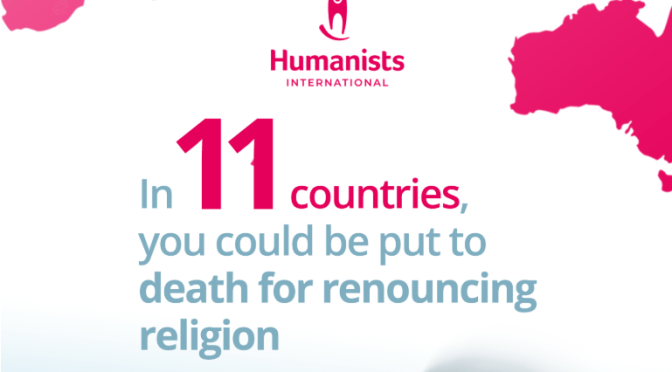
At an event hosted by the American Humanist Association, Humanists International launched the 2024 Key Countries Edition of the Freedom of Thought Report. Introducing the event, Executive Director of the American Humanist Association, Fish Stark, stated:
“For much of human history despots and tyrants have used belief as a weapon to consolidate power and compel conformity, to narrow minds and silence critics, to rob people of the dignity and empowerment of choosing for themselves the sources from which they draw their meaning and their inspiration. […] Attacks on freedom of thought are attacks on universal human rights, attacks on civil liberties, and attacks on the human spirit. It’s our job not to just to be aware of them, not just to investigate them, but to protect our fellow humans from them.”
The 2024 report is the 13th annual report. Humanist Heritage Canada has kept an eye on the HI’s Freedom of Thought report for much of that period, with posts about our observations in 2020 and 2022:
- https://humanistfreedoms.com/2020/12/18/humanist-internationals-2020-freedom-of-thought-report/
- https://humanistfreedoms.com/2022/12/10/humanist-internationals-2022-freedom-of-thought-report/
2025’s Key Countries Edition features 10 country entries – including Afghanistan, Italy, Nigeria and Qatar, among others – as well as a powerful piece by Indian filmmaker and poet Leena Manimekalai that gives us insights into her personal battle against ‘blasphemy’ allegations.
Senior Policy Director at Hindus for Human Rights, Ria Chakrabarty, shared the organization’s work to promote democracy, pluralism, and human rights, and challenge caste and supremacy. Reflecting on the impact of Hindu nationalism in India today and the case of Leena Manimekalai, Ria stated:
“If you know anything about the way fundamentalist Hinduism works in India today, everything about Kali is antithetical to the way that they present Hinduism, which is vegetarian, puritanical, misogynistic. It has no place for me and hundreds of millions of Hindus who worship Kali. And that India also has no place for people like Leena who tap into a millennia-old tradition to reimagine Gods and Goddesses in a land where faith and belief are often moulded to people’s unique identities. […]
“Faith as it is practised should be multiple and syncretic. The weaponization of blasphemy (as seen in Leena’s case) seeks to take away all of the pluralism surrounding a faith tradition. […]
“Blasphemy laws are used to identify who is insufficiently religious, religious in the wrong way or not religious at all. And the rights of those that fall into this brackets are curtailed for the sake of purity and oppression.
“Blasphemy laws aren’t just about curtailing the freedom to worship as you see fit, or not worship at all, but are also about curtailing people’s broader freedom of expression. [….] This is one of the many tools used to attack people’s democratic rights.”
Nigerian humanist, Mubarak Bala, shared his reflections on their origins and impact of ‘blasphemy’ laws in Nigeria, sharing details of his case, and the challenges he has faced after coming out as non-religious some 15 years ago.
Speaking at the launch of the report, USCIRF Commissioner Mohamed Elsanousi, stated:
“Unfortunately, governments around the world continue to persecute people because of their religious beliefs or lack thereof. In recent years, USCIRF has been particularly troubled by the passage and enforcement of blasphemy laws, including a 2023 law in Denmark criminalizing ‘inappropriate treatment of a religious text’. Legal penalties around the world include fines, imprisonment as well as the death penalty on some occasions. Blasphemy laws affect people of all religious beliefs. However, members of atheist communities in many countries, especially vulnerable communities including women and LGBTQ+ communities, are at elevated risk given their fundamental disagreement with government-endorsed religious interpretations. […] For humanists, atheists and secular people in oppressive societies these [blasphemy] laws represent a severe restriction on their religious freedom.”
Introducing the Report, Humanists International’s Casework & Campaigns Manager, Emma Wadsworth-Jones, reminded guests that:
“We know from our work supporting humanists at risk across the globe that the fear of being accused of being ‘blasphemous’ or an ‘apostate’ – and the perils that are associated with it, be it ostracism, challenges securing employment, violence or legal prosecution – is one of the primary drivers of self-censorship among our community. For the non-religious, simply saying ‘I don’t believe in God’ can be taken as evidence of ‘blasphemy’. Their very belief system is ‘blasphemous’.”
Being concerned with humanism in Canada, we note that the Canadian entry in the FOTR was last updated in 2023.

Citations, References And Other Reading
- Featured Photo Courtesy of https://humanists.international/
- https://humanists.international/2025/02/american-humanist-association-hosts-international-launch-of-the-freedom-of-thought-report-2024/
- https://humanists.international/2020/06/growing-evidence-of-worsening-persecution-targeting-the-non-religious-around-the-world-new-report-reveals/
- https://humanistfreedoms.com/2020/12/18/humanist-internationals-2020-freedom-of-thought-report/
- https://www.msn.com/en-us/news/world/us-leaders-gather-to-discuss-rights-of-nonreligious-people-across-the-world/ar-AA156MlE
The views, opinions and analyses expressed in the articles on Humanist Freedoms are those of the contributor(s) and do not necessarily reflect the views or opinions of the publishers.
 Humanist Heritage Canada