
A few months ago, we mentioned an intention to acquire and read a copy of Elliot Hanowski’s 2023 book, “Towards A Godless Dominion: Unbelief in Interwar Canada”. While we were a little late in discovering the book, we’re very glad that we did…and we’re very pleased with following-through on our intentions.
Our copy is a soft-cover with about 330 pages and we read the book over the course of several weekend mornings in May and June. We can confirm that our earlier expectation that it is an obvious must-read for anyone wishing to examine Canada’s humanist heritage was correct.
There are eight chapters, several of which feature a regional focus. Depictions of events in Manitoba, Ontario and Quebec dominate the book, but there is also a brief chapter covering “Unbelief on the Coasts“, as well. The bibliography is about 22 pages long, giving credit and credibility to Hanowski for what must be un-counted hours of research.
According to McGill-Queen’s University Press, Elliot Hanowski is an academic librarian at the University of Manitoba. Hanowski is the author of Towards A Godless Dominion: Unbelief in Interwar Canada. Hanowski is also one of the founders of the International SocieWety for Historians of Atheism, Secularism and Humanism.
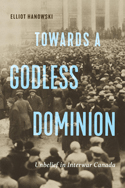
The book’s publicity materials state, Towards a Godless Dominion explores both anti-religious activism and the organized opposition unbelievers faced from Christian Canada during the interwar period. Despite Christianity’s prominence, anti-religious ideas were propagated by lectures in theatres, through newspapers, and out on the streets. Secularist groups in Montreal, Toronto, Winnipeg, and Vancouver actively tried to win people away from religious belief. In the first two cities, they were met with stiff repression by the state, which convicted unbelievers of blasphemous libel, broke up their meetings, and banned atheistic literature from circulating. In the latter two cities unbelievers met social disapproval rather than official persecution. Looking at interwar controversies around religion, such as arguments about faith healing and fundamentalist campaigns against teaching evolution, Elliot Hanowski shows how unbelievers were able to use these conflicts to get their skeptical message across to the public. Challenging the stereotype of Canada as a tolerant, secular nation, Towards a Godless Dominion returns to a time when intolerant forms of Christianity ruled a country that was considered more religious than the United States.
What we gained from having read the book is a renewed sense of connection to the humanist heritage that is an unjustly obscured part of our Canadian identity. The Canadian humanist community has not been particularly effective in recalling and telling its own story. Hanowski’s book is a an important and effective gift to the collection of “nones” that make up such a large part of Canadian society.
The final sentence of Hanowski’s book states, “Interwar unbelievers demonstrated considerable courage and determination in their struggle to create a godless yet more humane Canada.” and that may be the best place to conclude…along with our encouragement to everyone to go ahead and acquire a copy of this book, read it over a few weekend mornings and connect with the heritage that it contains.
Up For Discussion
If you’re interested in analyzing and discussing this issue, there are actions you can take. First, here at Humanist Heritage Canada (Humanist Freedoms), we are open to receiving your well-written articles.
Second, we encourage you to visit the New Enlightenment Project’s (NEP) Facebook page and discussion group.
Citations, References And Other Reading
- Featured Photo Courtesy of : https://umanitoba.academia.edu/ElliotHanowski
- https://www.mqup.ca/towards-a-godless-dominion-products-9780228018834.php#!prettyPhoto
By continuing to access, link to, or use this website and/or podcast, you accept the HumanistFreedoms.com and HumanistHeritageCanada.ca Terms of Service in full. If you disagree with the terms of service in whole or in part, you must not use the website, podcast or other material.
The views, opinions and analyses expressed in the articles on Humanist Freedoms are those of the contributor(s) and do not necessarily reflect the views or opinions of the publishers.
 Humanist Heritage Canada