All posts by humanistfreedoms

Humanist Children’s Book Released to Muslim-majority Countries

“Everyone has a right to think freely” – free children’s books about science and humanism released to Muslim-majority countries

Where do we come from? What are we? How can we all get along?

For many, answers to these questions are sought in houses of worship. But like almost half of their Gen Z peers, youth authors Elle (12) and Bailey Harris (16) draw their guiding principles and values from science and humanism, not religion. The sisters have written four beloved children’s books — Elle the Humanist and the three-book My Name is Stardust series — which explore secular topics including humanism, the solar system and evolution in language and pictures that young children can understand. 

Bailey, who was eight years old when she began writing her first book, explains, “I wanted kids of all ages to see that we humans are a part of something beautiful, natural and larger than ourselves.” Now, the impact of their books is larger than she or her sister ever imagined. With the help of the Translations ProjectLabel Free Publishing is thrilled to announce that all four books are now available in Arabic, Urdu, Farsi and Bahasa Indonesia for free as downloadable PDFs at www.translationsproject.org.

The Translations Project was created by the Center for Inquiry in response to a growing appetite for scientific literature in Muslim-majority countries, where accessing such literature in the local language can be difficult, and sometimes dangerous. The program began by offering free translations of evolutionary biologist Richard Dawkin’s many books and today records over 20,000 downloads a year. The translation of the Harris sisters’ books marks the first time the program has taken on children’s literature — and the response has been overwhelming. 

Wafa Bahri, Director of the Translations Project, explains, “We’ve gotten so many emails from the translators, many who must stay anonymous out of fear for their safety, about how much they appreciate working on these children’s books. They understand the importance of this work, and care deeply about bringing change to their own countries.”  

Greg Epstein, the Humanist Chaplain at Harvard and MIT adds, “Elle the Humanist is one of my favorite humanist books — period. There are countless millions of people all over the world who are essentially raising their children as humanists, but without the tools or understanding of what that identity really means. This little book could help spark a conversation that changes the world’s perspective on religious diversity.”

Label Free Publishing is based in Santa Barbara, California and aims to inspire a love of science and nature and a sense of wonder at the universe. The Translations Project is a program of the Richard Dawkins Foundation for Reason & Science, part of the Center for Inquiry.

Citations, References And Other Reading

  1. Feature Image Courtesy: https://www.kingsenglish.com/event/bailey-harris-and-douglas-harris-my-name-stardust
  2. https://stardustscience.com/pages/news
  3. https://religionnews.com/2022/06/09/humanist-childrens-books-translated-available-free-in-muslim-majority-countries/
  4. https://stardustscience.com/

The views, opinions and analyses expressed in the articles on Humanist Freedoms are those of the contributor(s) and do not necessarily reflect the views or opinions of the publishers.

AAT’s Atheist Refugees Assistance Program

In our search for interesting, challenging and critical perspectives on contemporary humanism, we occasionally find articles published via other venues that we think HumanistFreedoms.com readers may enjoy. The following article was located on Bianet.org on June 1, 2022.

By: Melin Durmaz

İstanbul – BIA News Desk – 26 May 2022

The Atheism Association in Turkey is running several projects, most notably the Atheist Refugees Assistance Program (ARAP).

As part of the ARAP project, 13 people were provided with housing, nine people were provided with jobs, 25 people were provided with legal assistance and reference letters were provided for 22 files in two years. Also, 20 people were provided with psychological, financial or educational counseling.

The ARAP project has three partners: The Atheist Alliance International, the Center for Inquiry and the Ex Muslims of North America.

Summarizing their work, Süleyman Karan, the chair of the association, said, “With the ARAP Project, the association carries out integration work for people who had to migrate due to religion. The association provides translation support in addition to legal support for refugees’ questions, such as ‘How to find a home? How to get a residence permit? How to access education?'”

“At least 3 percent of Turkey are atheists”According to the official data, at least 3 percent of the people in Turkey are atheists. Atheism is divided within itself and the association forms an umbrella, said Karan.”The reason for the existence of the Atheism Association is to show that different atheists exist in this country as a community of at least 3 percent [of the country]. Currently, deism has the highest share; it is followed by agnostics.”Deism and agnosticism have a manageable comfort in the public. For an atomized individual, to feel is super comfortable. Saying that a creator exists facilitates one’s existence in society. Agnostic atheism, however, says positioning ourselves on a thing that we can never know whether it exists or not is not right.”

Karan also talked about the stories of the people who applied to them:

“Atheists refugees are under threat”

“People are coming from Iran, Afghanistan. There are many refugees whose families are taken prisoner in Iran. We had atheist friends who lost one eye because of torture in their own countries. An activist in Afghanistan is currently trying to survive by changing hotels every day.

“In this region, there is a considerable number of secular, atheist and deist people. Refugee people are under double oppression. They are both displaced from their homeland and they are subjected to discrimination and threats within their communities because they are atheists. For example, a Syrian atheist is under serious threat in terms of mental health and life safety within their refugee community.”

The ARAP project is carried out with two employees who speak Persian and Arabic. The association is also looking for lawyers because their services in migration law are weak, said Karan.

“We are the pole star in the region”

Noting that they are the only atheism association in Turkey that is accredited by the European Union and the United Nations, Kata said, “Along with being the only atheist and humanist association in the region, we are in a transit location for migrants.”

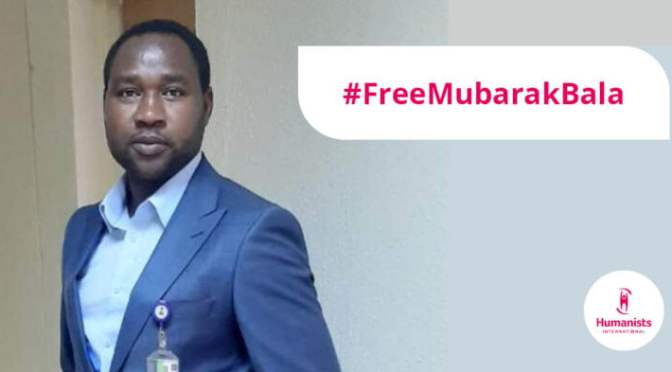
“Even though there is an association in Nigeria with the name of the Nigerian Humanism Association, its chairperson Mubarak Bala was sentenced to prison. Raif Badawi in Saudi Arabia was sentenced to 10 years in prison and 1000 lashes for writing blog posts criticizing religious regulations. In this context, we are a little pole star that the countries in the region can look at.”

Campaign against high azan volume

The Atheism Association is also running campaigns about the compulsory religion class, high volume of azan, the Muslim call for prayers, and removal of the “religion” section from ID cards.

“[Lawyer] Tuba Torun brought the compulsory religion class issue to the European Court of Human Rights (ECtHR) and won. We also provide legal support in this regard.

“Another issue is the campaign to remove religion from identity. The ‘Take five minutes to get rid of this’ campaign. This is also child abuse. Your family cannot assign you a religion before you can make up your mind. This is a successful campaign that we run, saying, ‘Show courage and give the right answer to one of the most fundamental problems of existence.’

“In Rize, someone told the civil registry directorate that they wanted to erase the religion section and the official told them that ‘They will kill you.’ The boy came to the Beşiktaş Civil Registry Directorate [İstanbul] and had it erased.

“Another campaign of ours is the high volume of azan, which we consider to be environmental and noise pollution. The [Presidency of] Religious Affairs is responsible for the volume not exceeding a certain level. But, while the azan would not be heard in Teşvkiye and Muradiye Mosques in the past, it is now very disturbing in Şişli. We provide legal support for this.”

Humanist perspective

The association puts the humanist perspective at the center of atheism. Karan is of the opinion that refugee policies in Turkey should also be addressed within this framework.

“Refugees come to Turkey from different countries and regions. Integration policies should be developed by protecting the freedoms and rights of refugees within the framework of human rights, starting from the Universal Declaration of Human Rights. We have to support refugees. This is the case from a humanist perspective.

“When I say humanist, I’m not talking about loving humans, I mean being human-centered. I mean the likes of Thomas More and David Hume.

Humanism is the basic proposition behind the universal declaration of human rights, the rule of law, and secularism. The main effort of humanism is to take the power from there and bring it here. Humanism is people putting themselves before God.” (MD/AÖ/VK)


Citations, References And Other Reading

  1. Feature Image Courtesy: https://www.atheistrefugeesturkey.com/post/jana-s-story
  2. https://bianet.org/english/migration/262402-turkey-s-atheism-association-is-helping-atheist-refugees-faced-with-double-oppression
  3. https://www.atheistrefugeesturkey.com/about-us#:~:text=WHAT%20IS%20ASSOCIATION%20OF%20ATHEISM%2C%20TURKEY%3F%20The%20Association,Republic%20of%20Turkey%2C%20European%20Union%20and%20United%20Nations.
  4. http://turkishatheist.net/
  5. https://www.atheistrepublic.com/news/turkish-atheism-association-shuts-down-due-pressure

The views, opinions and analyses expressed in the articles on Humanist Freedoms are those of the contributor(s) and do not necessarily reflect the views or opinions of the publishers.
HumanistFreedoms.com on Facebook

To celebrate World Humanism Day 2022, we’ve launched a new Facebook page where we invite thoughtful, respectful and dignified discussion of articles appearing on HumanistFreedoms.com and about topics related to contemporary applied humanism.

HumanistFreedoms.com readers may have noticed that most articles appearing on the site do not provide the option for reader commentary and feedback. While we celebrate freedom of thought and freedom of expression, the HumanistFreedoms.com website has never been intended to be a publication that required the ongoing active maintenance which a community’s commentary section would inevitably entail.

For those who may wish to undertake thoughtful, respectful and dignified discussion of HumanistFreedoms.com articles and content, we’ve developed a Facebook page and will soon be recommending discussion boards that you may find interesting. Watch for articles to appear on this topic in the coming weeks and months.

So if you have a few words to share – please visit us on Facebook. And please remember that we’re always accepting article proposals related to contemporary applied humanism, humanist principles & values and human rights.

We’ve also developed a new logo concept adapted from the familiar “Happy Human” logo familiar to humanist organizations throughout the world. We think the logo’s three happy human individuals, each moving in their own direction from a common launching point of “Humanist Freedoms”, is an apt depiction of the Humanist Freedoms perspective on contemporary applied humanism. The focus on a green font is intended to evoke a connection to ecological concerns.

World Humanist Day in 2022 is Tuesday, June 21. Falling on the (northern hemisphere’s) summer solstice, it is the day designated by humanist organizations around the world to celebrate the positive, world-improving values of humanism. Whether and how you may celebrate humanism in your life, these are just two new steps we’re taking to expand our celebration of humanists and contemporary applied humanism.

Thank you for visiting often!

Toppled Legacies: How the Renaming of Ryerson University Recommends the End of Public Funding of Ontario’s Catholic School Boards

In August of 2021, the Board of Directors of the former Ryerson University voted to change the name of the institution due to (as one CBC story phrases it) concerns about the man the institution is named for and his links to Canada’s residential schools.

RU/TMU: Is it a University or a Fortress?

According to www.ryerson.ca, “Names matter. They tell the world who we are and what we stand for. They communicate ideas, values and aspirations. They speak to the future even as they acknowledge the past.  A new name offers an invitation to be more inclusive, to imagine novel ways of thinking and creating —  to open ourselves to new possibilities.  This is a new chapter for our university, informed by the pages that come before but open to the opportunities that lie ahead. Now is a time to recommit to the values that define us, to invite our community to gather around our shared mission and to shape a future in which everyone belongs.” So Ryerson University is now the Toronto Metropolitan University where “It’s the many collisions between peoples and perspectives that take place in a metropolitan setting that drive innovation. As such, our name is as much a marker of location as it is a statement of identity, one that’s befitting of a thoroughly urban university.” Collisions? OK. We can take that as food for thought.

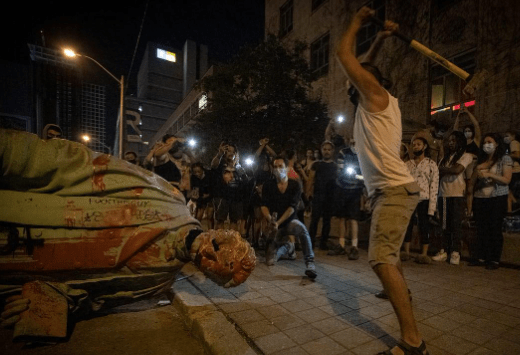
Since questions of a dead legislator’s legacy is not only fair game for consideration (Ryerson/TMU has a 131-page document examining the life and legacy of their former namesake), it is the inspiration for baseball bats and crowbars to be taken to statuary (per featured image), perhaps it is reasonable and even to-be-encouraged that all areas of that legislator’s legacy be examined.

Consider, for example the Common School Act of 1850. As spacing.ca explains it: “The Common School Act of 1850 set into law what was already being practised (sic) by local communities throughout Ontario. The act permitted any group of five Black families to ask local school trustees to establish a separate school. The law also permitted the creation of separate schools for Roman Catholic and Protestant families.”

Here in 2022, as ideas of how to implement contemporary values of diversity and inclusivity collide with the legacy institutions, it seems odd that those who are concerned with updating our systems to reflect the values of the present and our aspirations for the future haven’t decided that a certain elephant in the room needs to be addressed. The public funding of Catholic school boards in Ontario is the single largest and least supportable example of segregation and systemic faith-based discrimination (faithism) in Canada.

By all means, let us rename, rebrand, renew. A better, more diverse and inclusive future is waiting.

Citations, References And Other Reading

  1. Feature Image Courtesy: CBC Canada
  2. https://www.msn.com/en-ca/news/canada/ryerson-university-to-change-its-name/ar-AANMA8o#:~:text=Ryerson%20University%27s%20board%20of%20directors%20has%20voted%20to,for%20and%20his%20links%20to%20Canada%27s%20residential%20schools.
  3. https://www.ryerson.ca/next-chapter/
  4. http://spacing.ca/toronto/2021/02/19/how-racism-in-ontario-schools-today-is-connected-to-a-history-of-segregation/#:~:text=The%20Common%20School%20Act%20of%201850%20set%20into,separate%20schools%20for%20Roman%20Catholic%20and%20Protestant%20families.

The views, opinions and analyses expressed in the articles on Humanist Freedoms are those of the contributor(s) and do not necessarily reflect the views or opinions of the publishers.
Ellen S. Jaffe Humanist Award for Poetry

The Ontario Poetry Society has launched the Ellen S. Jaffe Humanist Award for Poetry. Open to everyone in Canada and the USA, the award accepts a suite of poems of no fewer than 12 pages and no greater than 15 pages on humanist themes of family, community, traditions and customs, social issues, peace and the effects of war, climate change, ecological issues and the healing power of poetry.

Ellen S. Jaffe was born in New York City, came to Canada in 1979, and became a Canadian citizen in 1993; she died in Toronto on March 16, 2022 at the age of 77.

Jaffe’s works include a young-adult novel, Feast of Lights (Sumach Press, 2006), a poetry  collection, Water Children (Mini Mocho Press, 2002), and Writing Your Way: Creating a Personal Journal (Sumach Press, 2001). Two of her books and one individual poem have received awards from Arts Hamilton (formerly the Hamilton & Region Arts Council). She has adapted Margaret Laurence’s novel, Jason’s Quest, into a play for young people, produced in 2001. She has also written another play “Promise You Won’t Marry Me”, produced in 2008 by the Black Box Fire’s Emerging Artist series.

A great deal more information about Jaffe and her writing at http://www.ellen-s-jaffe.com/. The website currently includes blog entries, the most recent of which is dated March 5, 2022 and says:

Sorry it’s been a while since I’ve written, but a lot has happened.Good news number 2: while he was here, The Ontario Poetry Society announced they are creating an award in my honour: the Ellen Sue Jaffe Humanitarian Poetry Award. This is a great honour and combines my two deep values in life. Thank you, Bunny Iskov and Elana Woolf, for arranging this. The award will be every other year, beginning with the deadline on March 15, 2023 (my birthday), with one winner and 5 runners-up. There will be a cash prize and a certificate, and my son Joe and I were able to drive to Willowdale to thank Bunny in person and give her some of my signed books to add to the prize.

Jaffe’s writing has been published in journals including Fireweed, Capilano Review, Kaleidoscope, CV 2, and Kairos, and in various anthologies; she was on the 2005 short-list for Lichen magazine’s “Tracking a Serial Poet” contest (the only person to have two entries short-listed!), and she was also on the short-list for the CBC Literary Competition in 1996. Recently two poems were published in Crossing Lines by Seraphim Press (2008), an anthology by poets who came to Canada during the Vietnam War era. She received the Orion prize for poetry in 2000, and has read at the Niagara International Festival of Chamber Music, as well as venues in Toronto and elsewhere in Ontario, Prince Edward Island, and British Columbia.

Ellen was a member of The Writers Union of Canada, the League of Canadian Poets, and CANSCAIP. She has received grants from the Ontario Arts Council for both writing and teaching. She currently works with Learning Through the Arts and Living through the Arts, programmes run by the Royal Conservatory of Music that enable artists to work jn schools and community organizations. She has also taught in many other school and community programs, and has been a judge for various writing contests for both young people and adults.


The Ontario Poetry Society Presents:

The $1000 Ellen S. Jaffe Humanist Award for Poetry

Contest held every second year

Open to Everyone in Canada and the U.S.A.

First Prize $500 & a Certificate
Plus 5 Honourable Mention Awards of $100 each with a Certificate
Signed copies of Ellen’s Book, Skinny-Dipping with the Muse, Guernica Editions
will be awarded to the top 6 winners.
Money prizes paid in Canadian Dollars.

Rules & Guidelines
Accepting a suite of poems of no fewer than 12 pages and no greater
than 15 pages on humanist themes of family, community, traditions
and customs, social issues, peace and the effects of war,
climate change, ecological issues and the healing power of poetry.
The suite of poems to be on one continuous theme.
No lewdness, no foul language & no heavy slant on religion.
Free verse poems preferred.
Each poem to be a maximum length of 60 lines
and the stanza spaces count as lines.
Line width should be up to 55 characters and word spaces.
Poems must be unpublished and not sent elsewhere.
Poems to be printed on one side of 81/2 x 11 plain white paper.
Arial 11 Font size.
Do not attach any pictures or artwork or biographical information.
Blind Judging: No author ID to be anywhere on the poem pages.
Include a cover page with Author name, mailing address, telephone #
& e-mail as well as a vertical list of poem titles (or first lines if no titles).

Entry fee: $20 for the first suite of poems
and $10 for each additional suite of poems.
There is no limit to the number of submissions per entrant.
Manuscripts are not returned unless a larger envelope
is enclosed with sufficient postage.

Entries to be postmarked on or before March 15, 2023.
Include a #10 s.a.s.e. for the winners list and $2 in coupons
to spend on another contest sponsored by The Ontario Poetry Society.
Contest entries to be submitted through Canada Post.
No electronic submissions accepted.

Send your entries to:
The Ontario Poetry Society
#710 – 65 Spring Garden Ave.
Toronto, Ont. M2N 6H9
Contest Judge is Elana Wolff


Citations, References And Other Reading

  1. Featured Image Courtesy: https://hamiltonjewishnews.com/arts-culture/on-being-a-jewish-writer
  2. https://www.thespec.com/news/hamilton-region/2022/05/02/obituary-prominent-poet-and-writer-ellen-jaffe-reached-a-lot-of-people-with-her-work.html
  3. http://www.theontariopoetrysociety.ca/contest_Ellen_S_Jaffe_Humanist_Award.html
  4. http://www.ellen-s-jaffe.com/

The views, opinions and analyses expressed in the articles on Humanist Freedoms are those of the contributor(s) and do not necessarily reflect the views or opinions of the publishers.

Wole Soyinka: The Concept of Blasphemy Should Not Even Exist in a Secular State

In our search for interesting, challenging and critical perspectives on contemporary humanism, we occasionally find articles published in other venues that we think humanistfreedoms.com readers may enjoy. The following article was published on April 19, 2021 on:

The Punch


By: Solomon Odeniyi

Nobel Laureate, Prof. Wole Soyinka, has lambasted Governor Abdullahi Ganduje of Kano State for his hypocrisy and promotion of religious intolerance in the state which allegedly contributed to the 24-year jail term handed down to atheist, Mubarak Bala.

In a telephone interview with The PUNCH, Soyinka said the sentence handed down to Bala must be appealed at once even as he argued that it was hypocritical of the Ganduje government and the Sharia authorities to be chasing blasphemers while the governor himself saw nothing wrong in stuffing his babariga outfit with dollars.

Ganduje was in 2018 caught on video stuffing his outfit with wads of dollars presumed to be kickbacks, a development which attracted criticisms from several pro-transparency groups.

The governor however denied receiving kickbacks.

Soyinka said he was shocked by Ganduje’s statement wherein he promised to sign the death warrant of musician, Yahaya Shariff, who was convicted for blasphemy in 2020.

“You can imagine a governor saying he would sign the death warrant of a musician for blasphemy! For me, it is nothing short of a crime against humanity. It reeks of hypocrisy. This was the same governor that was stuffing his outfit with dollars.

“I have deliberately not called for his arrest because he enjoys immunity. But these are the people who arrest blasphemers,” said the Nobel Laureate.

When asked if he would be seeking Ganduje’s prosecution after he leaves office, Soyinka responded, “Of course, the authorities know what to do once he leaves office.”

He added that it was hypocritical of the northern leaders to hound blasphemers while turning a blind eye to corruption.

The Nobel Laureate called on civil society groups to launch a campaign against the 24-year imprisonment of Bala even as he insisted that the moves should be made to immediately appeal the sentence.

“I am glad that the conviction will be appealed but I think it is imperative for rights groups to launch a campaign against these atrocities. Nigeria is a secular nation and has no state religion. The conviction is one of the fallouts of the so-called Sharia that was adopted by some of these states years ago.

“We are not in the dark ages or cavemen. No one should be imprisoned for their religious views. The concept of blasphemy should not even exist in a secular state,” he said.

Also in an interview with The PUNCH, Bala’s lawyer, James Ibor, said the matter would be appealed soon.

The lawyer said the 24-year sentence handed to his client was outrageous, adding that the court even lacked the jurisdiction to hear the matter in the first place.

Ibor lamented that despite a Federal High Court in Abuja ordering the release of his client, the authorities refused to obey the order.

“We will appeal the matter very soon. This is a travesty of justice. My client only pleaded guilty because he and his family had been receiving threats and just decided to end it all. And even after pleading guilty, the sentence should not have exceeded five years based on Kano sentencing guidelines and he has already been in detention for two years which means he shouldn’t have been given more than three years,” Ibor said.

Human rights lawyer, Mr. Femi Falana (SAN), also condemned the sentence, adding that he was sure the matter would be overturned once it is challenged at the Court of Appeal.

“The conviction will not stand the test of an appeal. He should also apply for bail. No doubt, the Court of Appeal will uphold his fundamental rights of freedom of conscience and freedom of expression,” Falana said.


Citations, References And Other Reading

  1. Featured Image Courtesy:
  2. https://www.msn.com/en-xl/africa/other/soyinka-accuses-ganduje-of-hypocrisy-over-atheist-s-imprisonment/ar-AAWneX2?ocid=BingNewsSearch
  3. https://www.theguardian.com/world/2021/apr/28/un-condemns-one-year-detention-of-nigerian-humanist-mubarak-bala?msclkid=6998673bc5b911ec882193d39ff8250c

The views, opinions and analyses expressed in the articles on Humanist Freedoms are those of the contributor(s) and do not necessarily reflect the views or opinions of the publishers.
Faith Under Fire -BBC Africa Eye Documentary

For hundreds of millions of Africans, Christianity is the cornerstone of their existence. But an explosion of rogue pastors exploiting the trust and belief of their followers for profit and power has led to a fight for the soul of Christianity in Africa.

Africa Eye reporter Peter Macjob travels to Uganda to meet the new religious movements rejecting Christian conventions, the traditional pastors working hard to maintain their flocks, the families who have suffered tragic losses at the hands of rogue pastors, and those who have abandoned religion altogether.

Over 80% of the population in Uganda are Christian. Churches offer blessings, life changing miracles and exorcisms’ of evil spirits.

In 2000 a cult in Kanungu, Western Uganda called the Movement for the Restoration of the Ten Commandments of God – believed the new millennium signalled the end of the world. Over 500 members of its members were put in a church. The doors and windows were nailed shut and the church was set alight. Everyone in the church died.

In Kagadi, Western Uganda thousands of followers belong to a religious sect known as ‘Faith of Unity’.  Their leader Omukama Bisaka perceived himself as God with supernatural powers. Despite passing away 1 year ago many of his followers believe that he will return. Faith of Unity is so popular that it has support from the government, including the President. Their teachings reject the bible as they are of the view that it has been introduced to distort the minds of Africans.  Instead, they use a version that was written by their former leader Bisaka. In theirs, Jesus does not exist and their leader is portrayed as a Deity.

Asiimwe George William was a senior leader in the Faith of Unity for over 20 years.  He tells Africa Eye: “When I read the characteristics of a cult I discovered that we actually belonged to a cult.” He admits things were made up; “Things we used to concoct, but they did not harm directly anyone. We wanted to sustain our faith. That’s why we concocted them.”

BBC Africa Eye put these claims to Faith of Unity but they declined to comment.

Pastor Rodgers Atwebembeire has spent years looking at new religious movements across East Africa. He breaks down how these leaders act. “Their word is as authoritative as the Bible. When they speak, God has spoken. Their followers are expected to obey them without question.”

Despite there being over 40,000 evangelical churches in Uganda. Many are struggling to maintain their memberships.

Peter met a family who opened up their home to a pastor and his wife. Their 4-year-old daughter was allegedly murdered by the couple for a human sacrifice. The mother says: “When you looked at him you would think he was a man of God. He used to praise, worship, and clap his hands. He would pretend to be spiritual, but it was all a lie.”

Due to the rise of rogue pastors many Ugandans are turning to other secular forms such as Humanism. Its core principles are based on accepting everyone regardless of religion, culture or sexual orientation. Pastor Rodgers Atwebembeire says: “I really do think that in the coming 10 years or 15 years we are going to see a very huge shift. We will see a lot of Humanism, not only taking over our institutions of education, but also even what used to be Christian churches and congregations.

With charlatans and conmen preying on the faith of millions, what is the future for believers in Uganda and across Africa?

Africa Eye brings you original, investigative journalism revealing secrets and rooting out injustice in the world’s most complex and exciting continent. Nothing stays hidden forever.

You can check out all #BBCAfricaEye investigations here: https://bit.ly/bbcafricaeye Credits: Reporter – Peter Macjob Filmed, Produced and Directed by Chris Alcock Archive – AP, NEXT MEDIA, IrabTV Composer – Yasmin Latkowski Film Editor – David Preston Online Editor – Chris Stott Dubbing Mixer – Jez Spencer Colour Grader – Boyd Nagle Reversioning Producer- Izzy Fleming Digital Producer – Ameer Ahmed Impact Producer – Courtney Bembridge Social Media Producer – Anusha Kumar Production Coordinator – Sarah Clarke, Charlotte Fraser Production Manager – Simon Frost Africa Eye Editor – Tom Watson


Citations, References And Other Reading

  1. Featured Image Courtesy:
  2. https://www.bukedde.co.ug/news/131061/bbc-africa-eye-investigation—faith-under-fi

The views, opinions and analyses expressed in the articles on Humanist Freedoms are those of the contributor(s) and do not necessarily reflect the views or opinions of the publishers.

SHARE THIS:

Read: Ontario’s Funding of Catholic School Systems – A Story of Systemic Faithism

The concept of systemic faithism may not be familiar to HumanistFreedoms.com readers, so as a kind of preamble to the focus of this article, consider this definition of systemic faithism as presented by the Government of Ontario’s own Ontario Human Rights Commission presented in its 2013 Human Rights and Creed Research and Consultation Report.:

Systemic faithism refers to the ways that cultural and societal norms, systems, structures and institutions directly or indirectly, consciously or unwittingly, promote, sustain or entrench differential (dis)advantage for individuals and groups based on their faith (understood broadly to include religious and non-religious belief systems). Systemic faithism can adversely affect both religious and non-religious persons, depending on the context, as discussed in the examples below. Some forms of systemic faithism can be actionable under the Code (e.g. those amounting to “systemic discrimination”), while others may not be (e.g. those taking broader cultural or societal forms). This section looks more closely at two dominant forms of systemic faithism in the current era, flowing from the “residually Christian” structuring of public culture and institutions, and from “closed secular” ideology and practice...Among the most obvious examples of residual Christianity in Ontario…public funding in Ontario of Roman Catholic separate schools, but not other religion-based schools.

How is it that a provincial government is able to simultaneously identify, define and detail a form of systemic discrimination and continuously defend and perpetuate the abuse? It’s a puzzler.

The authors of upsetting.ca have decided to do their best to explore and communicate the lengthy and, well as the website says – upsetting history of ongoing privileging of a particular community within the provinces of Ontario, Alberta and Saskatchewan (a bit of rough math reveals that roughly half of all Canadians live in a jurisdiction that continues to ensconce and fund a major form of systemic discrimination).

Upsetting’s authors make their position clear: On the practical side, the Ontario public has never sanctioned the public funding of separate school systems for Roman Catholic citizens, just politicians.  The RC school systems (French & English) were foisted upon Ontario through two dictatorial moves by politicians.  Skullduggery (trickery, dishonesty) in the highest places has maintained them.  Each post in this series will tell a different story in order to reveal all the events and the characters associated with them.  Posts will be every Sunday evening, Tuesday evening, and Thursday evening for several weeks.

You can subscribe to the series of fifteen articles/posts at: https://civilrightsinpubliceducationinc.forwardtomyfriend.com/r-hkftrjdkk-3AC2157C-tyyusdl-l-j.

A Second Thought…

Perhaps you’re interested to investigate systemic faithism from a distinctly different angle? Have a listen to a podcast from York University’s Critical Spirituality in Leadership who say that they recognize that “neutral” or “secular” views often privilege agnostic or atheist traditions and worldviews (Ontario Human Rights Commission, n.d.) and are “residually and normatively Christian” (Seljak et. al, 2008). This leads to systemic faithism.. we consider Seljak et. al’s (2008) analysis of the close connections between religion, ethnicity and race in the Ontario context and caution that Christian privilege can result in anti-religious sentiment, ethno-religious alienation, polarization, and alienation, rooted in the belief that religious practices and identities are incompatible with Canadian identity and citizenship (OHRC, n.d.). This encourages the creation of religious “ghettoes” that may lead to religious radicalization and disengagement from Canadian public life (OHRC, n.d.). We heed Butler’s (2000) warning that spirituality may be commodified in modern schooling, reducing it to individual approaches instead of situating it in larger contexts of social struggle. 

Citations, References And Other Reading

  1. https://www.ohrc.on.ca/en/human-rights-and-creed-research-and-consultation-report
  2. https://www.ohrc.on.ca/en/iii-background-and-context/4-systemic-faithism
  3. https://www.upsetting.ca/
  4. https://www.yorku.ca/edu/unleading/podcast-episodes/critical-spirituality/#:~:text=This%20leads%20to%20systemic%20faithism%2C%20which%20the%20Ontario,broadly%20to%20include%20religious%20and%20non-religious%20belief%20systems%29.

The views, opinions and analyses expressed in the articles on Humanist Freedoms are those of the contributor(s) and do not necessarily reflect the views or opinions of the publishers.

Listen: Centre For Inquiry Canada’s Podcast for Inquiry

One of Canada’s leading secular humanist organizations, Centre For Inquiry Canada (CFIC) has launched a new podcast titled The Podcast For Inquiry. The podcast appears to be available on the CFIC’s website as well as Spotify.

Leslie Rosenblood, the podcast’s host and a long-time member of the CFIC community in the Toronto area has walked through seven episodes (to date) of conversation about such topics as freedom of expression, the state of democracy in the world and Quebec’s Bill C-21.

In the most recent March 23, 2022) episode, Leslie speaks with James Turk, the Director of the Centre for Free Expression at Ryerson University about “the importance of free expression in a democratic society, the futility and counterproductive nature of censorship, and what limits on expression are reasonable and justified.”

We note that our friend and inspiration, Dr. Richard Thain’s experience of attempting to advertise in the City of Winnipeg, is featured during the conversation.

We hope CFIC continues to provide compelling and valuable insights into our most important humanist rights and freedoms.

Citations, References And Other Reading


The views, opinions and analyses expressed in the articles on Humanist Freedoms are those of the contributor(s) and do not necessarily reflect the views or opinions of the publishers.
War in Ukraine 2022: What are the Humanists Saying?

On February 24, 2022, the Russian military invaded Ukraine. Whether this conflict should be considered any more or less serious than other global conflicts may be a matter for historians to consider at some future date. Currently, however, this seems to be a very concerning situation as it is viewed by some as the largest military assault in Europe since the 1940’s. This attitude seems to ignore the Bosnian war of the early 1990’s, which was no small incident.

Setting aside comparisons, the conflict in Ukraine may well be a world-changing situation. So HumanistFreedoms.com is interested to know what humanists and humanist organizations have to say. Following is a sample of what we’ve found. Are you a humanist and have something to say? Do you know about a humanist position on this situation that we ought to cover? Let us know.


February 28, 2022: Humanists International Says “Human Rights Council must act in response to Russia’s invasion of Ukraine”

Ahead of an urgent debate at the UN Human Rights Council on the Human Rights situation in Ukraine following the unprovoked and illegal invasion by Russia, Humanists International is calling for the creation of a UN mechanism to monitor and report on the situation in Ukraine and for Russia to be suspended as a member of the Human Rights Council.

During the opening of the 49th session of the UN Human Rights Council – which began this morning – Ukraine called on the Council to approve the holding of an urgent debate following the Russian invasion on 24 February.

When requesting that the debate happen, the Ukrainian Ambassador, said, “The reason for this request is known to the whole world. Russia, a member of this Council, perpetrated an unprovoked and unified attack on Ukraine.” She noted that, “Russian aggression is accompanied by a massive flow of disinformation that aims to distort the truth and mislead the international community. Some of it we will hear today, as well as in other rooms of the [UN] Palais des Nations.”

Members of the Human Rights Council approved the request of an urgent debate to be held, with 29 out of 47 countries voted in favor. China, Cuba, Russia, Venezuela and Eritrea voted against having the debate. Armenia, Cameroon, Gabon, India, Kazakhstan, Mauritania, Namibia, Pakistan, Senegal, Somalia, Sudan, UAE, and Uzbekistan abstained.

The debate is scheduled to happen on Thursday 3 March and Friday 4 March.

Ahead of the debate, Humanists International is calling for the debate to lead to the adoption of a resolution unequivocally condemning Russia’s violations of international law, including international criminal law, international human rights law and the UN Charter. It should recognise that Russia’s actions against Ukraine constitute an unprovoked and illegal invasion, and one which has, and will, result in massive human rights violations.

It is also calling for the resolution to:

  • Call on the UN General Assembly to suspend Russia’s membership of the Human Rights Council (in line with GA Resolutions General Assembly Resolution 60/251);
  • Create a Commission of Inquiry, to monitor and report on the situation in Ukraine and to promote accountability for all human rights violations;
  • Mandate a Special Rapporteur on the human rights situation in Russia itself. The oppressive human rights climate in the Russian Federation itself (including the severe restrictions on free expression, the widespread propagation of disinformation, the repression of civil society, and the intimidation, censoring and criminalisation of journalists) all contribute to the Russian government being able to wage a war of aggression without accountability at home.


March 1, 2022 on Pressenza: A Guide for Peace in Ukraine: A Humanist and Nonviolent Proposal

The Centre for Humanist Studies “Exemplary Actions”, the Portuguese branch of the World Centre for Humanist Studies, an organism of the Humanist Movement, is disseminating a non-violent proposal for the restoration of peace in Ukraine, inviting citizens and non-governmental organisations who identify with it to sign it and send it to the Russian, Ukrainian and American embassies, as well as to the United Nations (UN), the European Commission and the Ministry of Foreign Affairs of their respective countries, to sign it and send it to the Russian, Ukrainian and American embassies, as well as to the United Nations (UN), the European Commission and the Ministry of Foreign Affairs of their respective countries, in order to produce a popular outcry capable of influencing the course of events.

For your information, we transcribe here the humanist proposal in its entirety:

Whereas,

  • A nation is defined by the mutual recognition established by people who identify themselves with similar values ​​and who aspire to a common future – and this does not necessarily have to do with race or ethnicity, or with language, or with History understood as a long process that begins in a mythical past;
  • This mutual recognition between people can lead to the formation of national or plurinational States, as well as the existence of nations spread over several States, without this implying the loss of the individual’s sense of belonging to their community or preventing the possibility of convergence in diversity;
  • States do not have the potentiality to constitute, by themselves, nations and can, therefore, be transformed throughout history, since they are, for all intents and purposes, changeable social and political constructions, as models of governance of peoples ;
  • National minorities have, in any case, the right to have their cultural specificity recognized, as well as the right to self-determination, within the framework of a democratic federative organization and respect for human rights.

And recognizing that,

  • Peaceful conflict resolution requires each party to put itself in the other’s shoes, opening itself to a process of cooperative negotiation and reciprocal treatment;
  • National interests must be reciprocally attended, as far as possible, but they do not justify everything, nor can they override the human being as a central value and concern;
  • The freedom of choice of individuals and peoples only exists if it can be exercised without external pressure and interference, imposed in a violent way;
  • Humanity’s progress is not made through the constitution of empires or supranational entities that alienate the power of the social base in favour of particular economic interests, but through the construction of a Universal Human Nation, diverse and inclusive, governed by freedom, equal rights and opportunities and non-violence;

We propose the following guide for peace, given the difficult situation currently experienced on Ukrainian territory, with a view to halting the unacceptable return to war on European soil, which has caused so much life and destruction in the recent past:

  1. Immediate ceasefire between the warring parties and opening of humanitarian corridors for assistance to civilian populations;
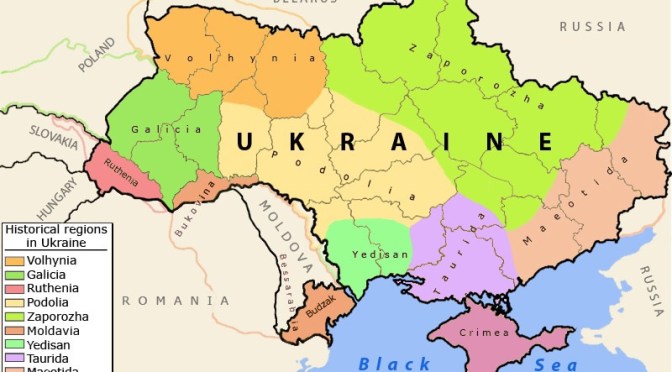
  2. Withdrawal of Russian troops from Ukrainian territory and creation of a multinational peacekeeping force, constituted under the aegis of the United Nations (UN), for the Dombass region;
  3. Temporary demilitarization of Dombass by the belligerent forces and the possibility of the return of refugee civilian populations;
  4. Organization of a fair and free referendum on the self-determination of Dombass territory, under UN supervision, with a commitment to the acceptance of the respective results by the interested parties;
  5. Organization of a fair and free referendum on the self-determination of the territory of Crimea, under UN supervision, with a commitment to the acceptance of the respective results by the interested parties;
  6. Adoption of a status of political-military neutrality by Ukraine and recognition of its sovereignty and territorial integrity, depending on the results of the aforementioned referendums, by Russia;
  7. Lifting of all economic sanctions between the parties and resumption of international political and economic cooperation.
  8. Conducting international talks on nuclear and conventional disarmament at regional and global levels.

March 4, 2022 : The Ontario Humanist Society Condemns Russia’s Invasion of Ukraine

OHS calls for Russia to cease its illegal and unprovoked actions, and to cease all challenges to Ukraine’s independence. Russia must terminate its violation of international law and of the UN Charter, and withdraw from Ukraine immediately. There is no justification for this aggression and the cost will be borne by innocent Ukrainians. As Humanists we can NOT turn away from this humanitarian crisis. We encourage OHS members to stand behind the Ukrainian people through the many opportunities available to us, some suggestions are listed below. Our Ethical Actions Committee will further examine steps we can take to continue to show our support for Ukraine.

If you would like to donate to support Ukraine, here are some charities that you might wish to consider:

Canada/Ukraine Foundation

Ukrainian Red Cross

Canadian Red Cross Ukraine Humanitarian Appeal The Canadian Government will match all donations by Canadians dollar-for-dollar, to a maximum of $10 million.

United Nations High Commission on Refugees Canada

If you would like to provide input into Canada’s response to the situation in Ukraine:

Write to our Prime Minister https://pm.gc.ca/en/connect/contact

Or seek out an on-line petition that supports your point of view. Thank you for joining the OHS board in condemning this travesty that is unfolding before us.

Sincerely,

Kerry J. Bowser President, OHS


March 14, 2022: The Gold Foundation’s Statement in Support of Ukraine and Humanism

These tumultuous and uncertain times demand of us the greatest possible expression of humanism. As Dr. George Thibault, Trustee of the Gold Foundation, has said in his defining essay on this topic,  “It will be hard to have humanism in medicine if there is no humanism in the world around us.

We are reminded of these words as the crisis continues to unfold in the Ukraine. Russia has attacked not only military targets and soldiers but civilians, schools, homes, and hospitals. More than 30 hospitals have been destroyed, including the horrific bombing of a children’s hospital in Mariupol.

These attacks are the essence of anti-humanism, sparing no human interests, values, and dignity. They are both direct attacks on humanism in healthcare, the sphere of our work, and on the wider humanism in our world, literally the foundation of freedom, compassion and science.

Still, through the scenes of rubble and destruction, we see humanity. Humanity in the healthcare heroes dodging artillery as they work tirelessly on the frontlines of the conflict. Humanity in those rising to defend their homes, their country, and democracy at large. Humanity in the charitable donations and mobilization here in the United States and around the globe. Humanity in a time where home can be everywhere and nowhere all at once, an unfortunate truth that tells the story of so many refugees from war and conflict throughout our world.

At the Gold Foundation, in thousands of ways, we’ve seen Gold community members apply compassion, collaboration, and scientific excellence in practical, real-life ways throughout their clinical work, teachings, talks, and relationships. The culture of humanism in healthcare is the bedrock of the Gold Foundation, influencing all of our work, creating the structure and draw of the Gold community and its Gold Humanism Honor Society, whose Advisory Council voted unanimously to publish a statement on the inhumanity of the tragedy in Ukraine. It is joined by the entirety of the Gold Foundation family in standing with the efforts of humanists around the world who rally together and further humanism in all its forms. The Ukrainian people and all people affected depend on the shared mission of humanism, in this crisis and in the years to come.


March 16, 2022: Humanists International says: Belgian Humanist convoy reaches Ukraine border with humanitarian aid

After a journey of 1,500km, employees from deMens.nu and Centre d’Action Laïque reached Medyka, a village on the Polish-Ukrainian border, on Monday night.

Four vans, packed with medical supplies and other necessities, were unloaded at the tent camp yesterday, then sorted and distributed to Ukrainian refugees .

“We are all very impressed by what we have seen. It is quiet in the car, words fail everyone . Despite the confrontation with a lot of human suffering, I am particularly proud of our humanist community, which has shown its full force,” says Yasmina El Boubkari.

deMens.nu is still collecting funds to help Ukrainian refugees. You can donate to BE 55 9734 2242 6344.

With this money, deMens.nu and CAL are buying bandages, syringes, infusions,, paracetamol, ibuprofen, isobetadine, styptic drugs, antibiotics, haemostatic agents, but also baby food, milk powder, wet wipes, sanitary towels, candles, diapers, thermal blankets, gloves, hats, stockings, backpacks, thermal clothing, ski clothes, sleeping bags, food preserves and ready meals.


Citations, References And Other Reading

  1. Featured Photo Courtesy of
  2. https://www.ontariohumanists.ca/post/the-ontario-humanist-condemns-russia-s-invasion-of-ukraine
  3. https://www.gold-foundation.org/newsroom/news/statement-in-support-of-ukraine-and-humanism/
  4. https://en.wikipedia.org/wiki/2022_Russian_invasion_of_Ukraine
  5. https://www.elephantjournal.com/2022/03/war-humanism-racism-in-ukraine-when-people-arent-just-people-anymore-james-ezimoha/
  6. https://www.pressenza.com/2022/03/a-guide-for-peace-in-ukraine-a-humanist-and-nonviolent-proposal/
  7. https://humanists.international/2022/02/humanists-international-human-rights-council-must-act-in-response-to-russias-invasion-of-ukraine/
  8. https://humanists.international/2022/03/belgian-humanist-convoy-reaches-ukraine-border-with-humanitarian-aid/

The views, opinions and analyses expressed in the articles on Humanist Freedoms are those of the contributor(s) and do not necessarily reflect the views or opinions of the publishers.