Humanist International defines itself as “the global representative body of the humanist movement, uniting a diverse community of non-religious organizations and individuals. Inspired by humanist values, we are optimistic for a world where everyone can have a dignified and fulfilling life. We build, support and represent the global humanist movement and work to champion human rights and secularism.”
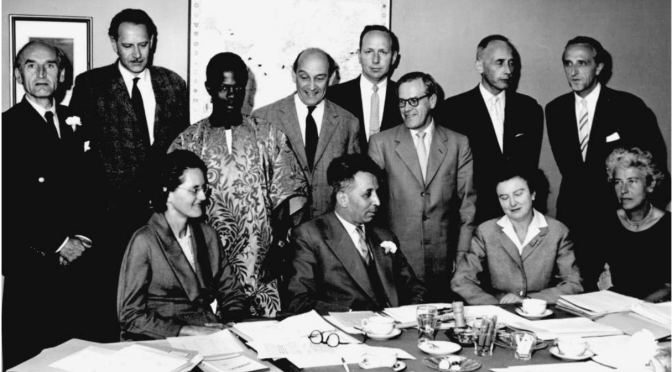
In other words, Humanist International strives to be the global voice for humanism. The organization held its annual General Assembly (i.e. governance and policy meetings) in Glasgow, Scotland (UK) from June 3-5 this year. The 2022 assembly represented a landmark as it marked the 70th anniversary of the first World Humanist Congress.
Back in 1952, the first World Humanist Congress launched The Amsterdam Declaration, a document which intended to articulate a set of agreed-upon fundamental principles of “modern humanism“.
Somewhat parenthetically, visitors to HumanistFreedoms.com may observe that we use the term “contemporary applied humanism” to describe our content rather than “modernapplied humanism”. This choice is a deliberate choice as there are philosophical and semantic implications of the term “modernism” which are, to say the least, problematic.
Qualms and quibbles over terminology, such as we’ve just touched-upon, can be a necessary thing. Which is, presumably, why Humanists International included in its celebration of 70 years of existence, an update and relaunch of the 1952 original (and its 2002 revision) which is currently being called The Amsterdam Declaration 2022. It seems a bit odd that the new document hasn’t been called The Glasgow Declaration or even The Glasgow Revision of the Noordwijkerhoutu Update of the Amsterdam Declaration – but such is the nature of geo-political sentimentalism, traditionalism and authorial pride. It weens its way into just about everything to the extent that a “global” declaration must necessarily be tied to a specific set of meetings and those who attended.
How about “Global Declaration of Humanism III” and let everyone own it in the time and place of their own? Just a thought.
Humanists International have published an educational video for those who may be interested in the history and details which includes recitations of the text.
On the Humanists International website, the organization explains that the original declaration was a “child of its time” . The implication is that the original needed revision to bring it into alignment with contemporary perspectives and issues – that is to say, the tastes and attitudes of organization-based humanists of 2022.
Here is what the organized and political Humanists have establishes as the fundamental principles of humanism in 2022:
“Humanist beliefs and values are as old as civilization and have a history in most societies around the world. Modern humanism is the culmination of these long traditions of reasoning about meaning and ethics, the source of inspiration for many of the world’s great thinkers, artists, and humanitarians, and is interwoven with the rise of modern science. As a global humanist movement, we seek to make all people aware of these essentials of the humanist worldview:“
1. Humanists strive to be ethical
We accept that morality is inherent to the human condition, grounded in the ability of living things to suffer and flourish, motivated by the benefits of helping and not harming, enabled by reason and compassion, and needing no source outside of humanity.
We affirm the worth and dignity of the individual and the right of every human to the greatest possible freedom and fullest possible development compatible with the rights of others. To these ends we support peace, democracy, the rule of law, and universal legal human rights.
We reject all forms of racism and prejudice and the injustices that arise from them. We seek instead to promote the flourishing and fellowship of humanity in all its diversity and individuality.
We hold that personal liberty must be combined with a responsibility to society. A free person has duties to others, and we feel a duty of care to all of humanity, including future generations, and beyond this to all sentient beings.
We recognise that we are part of nature and accept our responsibility for the impact we have on the rest of the natural world.
2. Humanists strive to be rational
We are convinced that the solutions to the world’s problems lie in human reason, and action. We advocate the application of science and free inquiry to these problems, remembering that while science provides the means, human values must define the ends. We seek to use science and technology to enhance human well-being, and never callously or destructively.
3. Humanists strive for fulfillment in their lives
We value all sources of individual joy and fulfillment that harm no other, and we believe that personal development through the cultivation of creative and ethical living is a lifelong undertaking.
We therefore treasure artistic creativity and imagination and recognise the transforming power of literature, music, and the visual and performing arts. We cherish the beauty of the natural world and its potential to bring wonder, awe, and tranquility. We appreciate individual and communal exertion in physical activity, and the scope it offers for comradeship and achievement. We esteem the quest for knowledge, and the humility, wisdom, and insight it bestows.
4. Humanism meets the widespread demand for a source of meaning and purpose to stand as an alternative to dogmatic religion, authoritarian nationalism, tribal sectarianism, and selfish nihilism
Though we believe that a commitment to human well-being is ageless, our particular opinions are not based on revelations fixed for all time. Humanists recognise that no one is infallible or omniscient, and that knowledge of the world and of humankind can be won only through a continuing process of observation, learning, and rethinking.
For these reasons, we seek neither to avoid scrutiny nor to impose our view on all humanity. On the contrary, we are committed to the unfettered expression and exchange of ideas, and seek to cooperate with people of different beliefs who share our values, all in the cause of building a better world.
We are confident that humanity has the potential to solve the problems that confront us, through free inquiry, science, sympathy, and imagination in the furtherance of peace and human flourishing.
We call upon all who share these convictions to join us in this inspiring endeavor.
Is this a perfectly-achieved declaration? Certainly not. There are plenty of quibbles and nuances that probably need to be given some attention. But it may well be more adequate to serve most contemporary humanists needs and preferences when it comes to something like this than its 1952 and 2002 predecessors. Or maybe not.
Setting qualms and quibbles aside – it is a good thing that Humanists International and the growing number of national and local organizations continue to update and revise their public positions. Any organization which believes that it has nailed these things down once-and-for-all begins to dance the dance of dogma. We wouldn’t want that.
Nor would we want a Global Declaration of Fundamental Principles that we fully agree-with and are satisfied-by. A document like that seems like it would probably find itself out of relevance pretty damn quick. So let’s embrace those qualms and quibbles for what they are – indicators of the kind of progress we’d like to see within contemporary and future applied humanism.
What do you think? Let us know in the comments.
Citations, References And Other Reading
Featured Photo Courtesy of: Humanists International
The views, opinions and analyses expressed in the articles on Humanist Freedoms are those of the contributor(s) and do not necessarily reflect the views or opinions of the publishers.
Admission is free to this CFI Canada Victoria branch monthly talk.
It is widely accepted by scientists that us humans are ‘superpredators’. We are indeed the source of the most terminal problems of our planet such as global warming and all sorts of pollution. While humanism is a democratic and ethical life stance which affirms that human beings have the right and responsibility to give meaning and shape to their own lives, there are also humanists who think that humanity actually sucks big time.
Some believe that overpopulation is by far the worst kind of pollution. Some argue that not having children derives not from dislike of children, but from love too great to bring them into this limited, vain, and cruel world. Some say parents have a child, and in doing so they bring into the world a monster that kills everything it comes in contact with.
This month, we’ll discuss the basics of antinatalism, and explore some of its different forms. Our hosts are two antinatalists from Centre for Inquiry Canada’s leadership team: Mark Maharaj (CFIC’s Office Manager and Volunteer Coordinator), and Onur Romano (CFIC Director and Human Rights Chair). Our subject matter expert is transhumanist author David Pearce.
The views, opinions and analyses expressed in the articles on Humanist Freedoms are those of the contributor(s) and do not necessarily reflect the views or opinions of the publishers.
HumanistFreedoms.com is proud to have reported the activism of a dedicated humanist in organizing the first Russell Township Pride Week flag-raising ceremony in 2021.
Russell Pride Week 2022
During this year’s celebration, Dr. Richard Thain, one of the event’s organizers said he was proud to take some time to “stop and reflect about things which are important to us: community, inclusion and renewal.“
Two of Russell Township’s Councillors (Cindy Saucier and Mike Tarnowski) were in attencance. As was the Township’s mayor, His Worship Pierre Leroux who delivered a welcoming speech.
Other speakers included a local mother of two gay sons, and a high-school student who explained how in some local schools, 2SLGBQTQ+ students do not feel that they receive acceptance and support from the school administration.
Key organizers of the bi-lingual event included the KIN Club of Russell as well as Geneviève and Réjeanne Thain. Kinship, care and the passing of compassionate values from one generation to the next was clearly a theme of the activity. Geneviève commented that “…selon Statistique Canada, en 2018, les Canadiens de minorité sexuelle étaient deux fois plus susceptibles de déclarer avoir été victimes de comportements inappropriés en public, en ligne ou au travail. N’oublions pas que l’article premier de la Déclaration universelle des droits de l’homme stipule que « tous les êtres humains naissent libres et égaux en dignité et en droits.“
Richard and Geneviève Thain
According to Statistics Canada, in 2018, sexual minority Canadians were twice as likely to report experiencing inappropriate behavior in public, online or at work. Let us not forget that article 1 of the Universal Declaration of Human Rights states that “all human beings are born free and equal in dignity and rights.
A highlight of the event was the performance of Lara Fabian’s La Différence by local singer, Lise Dazé and a brief presentation by Mme Denise Latulippe.
In 2022, human rights and the warm inclusion of all people in our community remains both one of our most fundamental of Canadian values – but also something that individual and collective Canadians should take time to reflect on and contribute to in a meaningful way. There are so many wonderful communities throughout the country and all of them can only be enriched when their members take time to care for one another.
Well done to all those who gathered on a warm August day to remember where we’ve been, where we are and where we wish to go with UNIVERSAL human rights.
The views, opinions and analyses expressed in the articles on Humanist Freedoms are those of the contributor(s) and do not necessarily reflect the views or opinions of the publishers.
On 12 August 2022, Salman Rushdie was brutally attacked and severely injured during a speaking event in Chautauqua, New York. As a publication devoted to humanism and human rights – including the right to freedom of expression which is so fundamentally linked to this situation – HumanistFreedoms.com condemns the attack and expresses hope for Sir Ahmed Salman Rushdie’s best possible recovery.
While there are many stories about the attack in mainstream media providing reports of the attempted murder, the attacker’s name and hints to his motivation, these particulars seem to be little more than incidental to the attack. There seems to be little point in re-sharing information that is so readily available . Indeed, there seems to be much more sense in focusing on who the attacker was in the bigger picture. This latest attacker was nothing other than the inevitable and violent hand of extremist ideology.
Some of us at HumanistFreedoms.com had the opportunity and privilege to attend Rushdie’s reading from one of his novels when he visited the Toronto Public Library in 2015. It was a lovely and engaging evening – exactly the way attending a reading ought to be. The way the event in Chautauqua ought to have been. A room full of mostly mild, curious and intelligent individuals; a brief and charming interview; an author sharing their own voice with those who wished to hear it. It was the kind of thing Rushdie had so clearly been doing for many previous years and clearly expected to do for many future years as well. After all, who goes to hear an author speak other than those who want to hear what he has written and may have to say about it?
It is not possible, however, to have attended a reading by Salman Rushdie without being aware that he had lived under the threat of attack and assassination since 1989 when a fanatical ideologue and politician issued a faith-based assassination order against him. His conversation never seems to be far from that simple fact nor from the implications that it carried: sometimes people attend these events to prevent others from hearing the things that may be said.
The fact that the fanatical politician/ideologue/religious leader who had ordered the assassination happened to be a high ranking Shia clergy member and the “supreme leader” of a nation ought to have been enough to keep fanaticism and the perpetual probability of violence on anybody’s mind. In 1989, someone tried to complete the assassination and blew himself (and some of a hotel) up. Apparently there is a shrine in Tehran describing the person
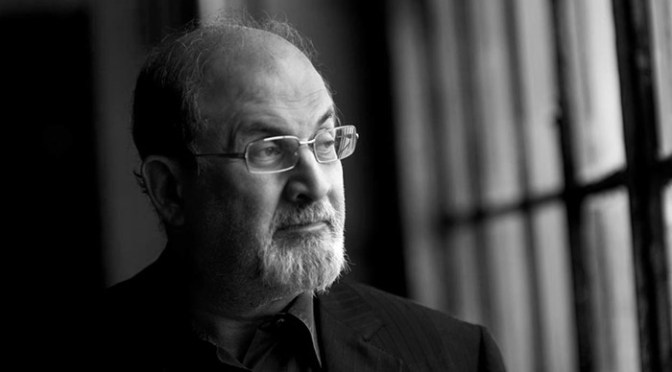
Salman Rushdie: Violently attacked due to a work of fiction written almost forty years go.
as a “martyr”. in other words, a religious hero.
Fanaticism is a state that must be developed, encouraged and maintained. It must be cultivated. The fanatic and their cultivator each bear a portion of the responsibility for any violence which they promote and enact. To claim anything else is cowardice, at best – but more probably an indicator of traits worse by far than mere cowardice.
In the Iranian government’s first public comment on this more recent attack, its foreign Ministry spokesperson Nasser Kanaani said “Regarding the attack on Salman Rushdie, we do not consider anyone other than [Rushdie] and his supporters worthy of blame and even condemnation.” The message is clear when it comes to ideologues. Cross them and you’ll get what they think you deserve.
But not everyone is like that. Not everyone flinches from truth.
The attacker’s mother had some different perspectives to offer, “As I said to the FBI I’m not going to bother talking to him again. He’s responsible for his actions. I have another two minors that I need to take care of. They are upset, they’re shocked. All we can do is try to move on from this, without him.“
Only a few things more need to be said in context of an initial reaction to this brutality. Violence is the inevitable conclusion when extremist ideology, and let us emphasize any extremist ideology, is left unchecked, when fanatics are allowed to persist in delusions that their opinions and preferences cannot be challenged, when destroying another human being is considered a morally-entitled response to being offended.
And what do the humanist organizations have to say so far? We might have wished for more…and more emphatic than what we have been able to locate so far (Frankly, Rex Murphy seems to have done a better job of it). But we searched several prominent English-language humanist organizations with Salman Rushdie’s name and here is what we found on 2022/08/16
Unrelated to the attempted slaughter of an author by the violent hand of ideologues, one of our humanist mentors had recently shared a quotation from Martin Luther King: “Our lives begin to end the day we become silent about the things that matter.”
The views, opinions and analyses expressed in the articles on Humanist Freedoms are those of the contributor(s) and do not necessarily reflect the views or opinions of the publishers.
Miriam Beerman: 1923–2022 NOTHING HAS CHANGED Opens Fall Season at Monmouth University
Exhibition shines a spotlight on the late Miriam Beerman, a New Jersey artist whose works are included in the permanent collections of over 60 museums worldwide and a female pioneer in the 20th-century art world
WEST LONG BRANCH, NJ—The Monmouth University Center for the Arts announces the launch of its fall 2022 season with Miriam Beerman: 1923–2022 NOTHING HAS CHANGED.
The exhibition showcases Beerman (1923–2022) as one of the 20th-century’s most provocative artists, whose humanist expressionist works highlight her talent as a colorist. A pioneer as one of the first female artists to be given a solo exhibition at the Brooklyn Museum of Art, Beerman is part of a canon of 20th-century women artists who were nearly lost to obscurity due to their gender in a male-dominated art world.
The show runs from September 6 to December 11 in the Rechnitz Hall DiMattio Gallery in the Monmouth University Center for the Arts. The opening reception is September 22 from 6 to 9 p.m.
Influenced by the social injustice seen around her, Beerman shines a spotlight on the horror and pathos of man’s inhumanity to man. The themes prove to be timeless, resonating today as much as when they were created in the 20th century. Her life and art were explored in the 2015 documentary Miriam Beerman: Expressing the Chaos.
Nearly 20 large-scale canvases by Beerman will be represented. The show is guest curated by gallerist James Yarosh and draws upon the recent exhibition Miriam Beerman – REDISCOVER, shown at James Yarosh & Associates Gallery in Holmdel, N.J., which opened in spring 2022. The exhibition, Miriam Beerman, 1923-2022 NOTHING HAS CHANGED marks the second guest curator role at the university for Yarosh who curated Sheba Sharrow: Balancing Act in 2017. A companion show of Beerman’s works on paper and collages is simultaneously on view at James Yarosh & Associates Gallery.
“Living with Miriam Beerman’s paintings at the gallery with the current exhibit REDISCOVER, one cannot help but be both moved and stirred to be in the presence of the colossal works, heavy with paint, laden with subject. When you see these humanist expressionist works existing silently, holding the weight of the world, you begin to understand the gallery’s presentation,” says Yarosh, a gallerist fueled by curatorial activism in recent years. “As I described Miriam’s art with clients, it occurred to me that those words also described the role of female artists of the 20th century whose voices were more stifled in favor of male artists—and of women’s roles in a patriarchal society.
“If our art history is male-dominant, and the artists before us our teachers, we are only getting half the lessons to be learned,” he continues. “We have an opportunity to do better. This presentation with Monmouth University allows the conversations to continue and include a younger generation.”
“NOTHING HAS CHANGED picks up the dialogue from the 2017 Sheba Sharrow: Balancing Act exhibition. Although their art is different, the mission is similar: A female artist who rails against social injustices in her art as a call to action to evoke change,” says Scott Knauer, Director of Galleries and Collections, Department of Art & Design, Monmouth University. “Much of the subject matter that Miriam Beerman delved into is still so relevant and threatened today: political, social, religious rights, women’s rights and threats against minorities.”
The show’s title piece, Beerman’s 1999 canvas Nothing Has Changed (shown above) is described by Yarosh as “a later work, a portrait of a monumental female face, whose eyes are closed in resignation of her role. She disappears behind the facade of joyous yellows and pink, and yet her hopes are painted on the right—an abstract dream vision of her imagined joy, to run away, to color outside the lines and create her own ideas of ‘happy ever after.’ The archetypal portrait is Beerman’s Mona Lisa, except here, the smile is upside-down.”
Gallerist Mitchell Algus and artist Heather L. Barone (a mentee and longtime assistant of Beerman) and Corey Dzenko and Theresa Grupico in the Monmouth University Department of Art & Design are contributing to the catalogue. A smartphone tour is also being planned with a potential online discussion with artist, author and former Asbury Park Press art columnist Tova Navarra. Other planned events include a series of salon evenings, a Q&A evening with the Expressing the Chaos filmmaker and an event closing show. For details on upcoming events, visit the “What’s New” page on the James Yarosh Associates Fine Art & Design Gallery website: jamesyarosh.com.
ABOUT MIRIAM BEERMAN: Miriam Beerman studied painting at the Rhode Island School for Design, where she earned a BFA. Afterward, she spent two years in France as a Fulbright Scholar, working in Atelier 17 and having her painting critiqued by Marcel Brion. In New York, she studied with Yasuo Kuniyoshi at the Art Students League and Adja Yunkers at the New School for Social Research. She has had over 30 solo shows, including at the Brooklyn Museum, Graham Gallery, the New Jersey State Museum and the Everson Museum.
Beerman’s work is included in many major collections, including Metropolitan Museum, Whitney Museum, LACMA, National Gallery of Art, Phillips Collection, National Museum of Women in the Arts, Victoria and Albert Museum, the Fitzwilliam Museum in England, the MEAM in Spain, the Israel Museum and the National Portrait Gallery in Washington, D.C., among others. Beerman’s painting “Scorpio” is also currently on display as part of The Vault Show exhibit at University of Arizona Museum of Art through fall 2022. She has won many awards, including awards from the Joan Mitchell Foundation, Pollock-Krasner Foundation, RSID and others.
ABOUT MONMOUTH UNIVERSITY: Monmouth University is the region’s premier private coastal university offering a comprehensive array of undergraduate, graduate, and doctoral degree programs in a dynamic and personalized learning environment. Located in West Long Branch, New Jersey, Monmouth University’s magnificent coastal campus is approximately one hour from both New York City and Philadelphia. Innovative academic programs, individual faculty attention, and nationally ranked Division I athletics make this private university a great place to find your future.
ABOUT JAMES YAROSH: Established in 1996, the James Yarosh Associates Gallery in Holmdel, New Jersey, was founded upon and remains loyal to its vision: to represent fine art for art’s sake and to curate gallery collections and thoughtfully present art and interior design specification with an artist’s eye and understanding. Yarosh, an artist and well- published interior designer, offers a full-scale gallery and design center where clients can associate with other like-minded individuals located just one hour outside Manhattan.
Yarosh advocates for what greatness looks like in the arts, showcasing at his destination gallery the works of both new and established museum-recognized artists of merit in a space designed to replicate the intimacy of an artist’s home. Current exhibitions such as Miriam Beerman – REDISCOVER (2022), The Humanist Show (2021), Sheba Sharrow: History Repeats (2020) and the NYC art fair Art on Paper (2021) help foster the idea of art as intellectual engagements that sit above decoration in design hierarchy, adding exponentially to the experience of living with art.
Citations, References And Other Reading
Featured Photo Courtesy of :
The views, opinions and analyses expressed in the articles on Humanist Freedoms are those of the contributor(s) and do not necessarily reflect the views or opinions of the publishers.
Over 20 human rights, pro-choice, and international aid groups, and the Norwegian and Danish Governments, have called on the UK Government to reverse its decision to arbitrarily strip ‘sexual and reproductive health and rights’ and ‘bodily autonomy’ from an international human rights statement it – and 22 other countries – signed only two weeks ago.
However, the agreed statement, published on the Foreign, Commonwealth and Development Office website, was inexplicably amended without consultation; removing any references to ‘sexual and reproductive health and rights’ and ‘bodily autonomy’.
Now the Norwegian and Danish Governments have criticised the move. The Norwegian Government has told the Guardian:
‘Norway and Denmark have approached the UK and the Netherlands, who are the chair and co-chair respectively of the International Religious Freedom or Belief Alliance (IRFBA), to enquire about and protest against the substantive changes to the statement and the way the changes were made. Norway has yet to make a decision on being a signatory to the amended version of the statement.’
Furthermore, an array of influential charities and rights groups have signed a joint letter asking the UK Government to explain its reasoning behind the shock move and to reverse its decision immediately. The letter was organised by Humanists UK, which first spotted the change. Signatories include Amnesty International UK, Human Rights Watch, ActionAid UK, BPAS, MSI Reproductive Choices, Liberty, Fawcett, Brook, the End Violence Against Women Coalition, Article 19, and Maternity Action.
They write to the Foreign Secretary, Liz Truss:
‘We are writing to you with serious concern about the deletion of references to ‘sexual and reproductive health and rights’ and ‘bodily autonomy’ from the UK-organised ‘Statement on freedom of religion or belief and gender equality’. We urge you to reverse this move, and hope you could explain why the change happened in the first place.
‘As Professor Ahmed Shaheed, the UN Special Rapporteur on Freedom of Religion or Belief, has said in response to the changes: “Claims that freedom of religion or belief can be invoked to deny women and girls the exercise and enjoyment of their sexual and reproductive health rights have no foundation in human rights. Rather, such claims must be rejected as representing intolerant and patriarchal attitudes that deny the equal rights of men and women to freedom of religion or belief. Such claims especially ignore that freedom of religion or belief also guarantees to women the right to bodily autonomy and conscientious choice.”
‘At a time when abortion provision around the world is under serious threat, due to the reversal of Roe v Wade, it has never been more important for the UK Government to stand up for sexual and reproductive health and rights and bodily autonomy. We note that the latest British Social Attitudes Survey to ask indicates that less than 5% of the UK population oppose access to abortion in all circumstances. In addition, 22 countries had signed up to the statement before revision – a similar number to those signing the other Ministerial statements – which is further indication that there is no sound reason for these amendments. We urge that they be reversed immediately.’
Andrew Copson, Chief Executive of Humanists UKsaid:
‘The Government must surely be aware that, given the recent events in the United States, abortion rights are under threat. To amend an agreed statement in such a manner, omitting these rights, is therefore particularly poorly timed, never mind about being regrettable anyway.
‘Unfortunately, this supplanting of individual freedom under the guise of “religious freedom” is an example of the right to freedom of religion or belief being abused in order to infringe the rights of others.
‘The Government should withdraw these amendments.’
Marie Juul Petersen, Senior Researcher at the Danish Institute for Human Rights, helped draft the original statement. She has told the Guardian that the revised text was ‘a big surprise’ and called the amendment process ‘flawed and unreasonable’. She added:
‘I saw the original statement as such a big step forward because this has been a very conflict-ridden area – the relationship between freedom of religion and belief and gender equality. For so many years, there have not been many attempts at finding synergies and overlaps or at demonstrating how these two sets of rights are actually compatible and in fact intertwined and inseparable. And I thought this statement was really a big step forward in that direction, showing that these two rights are not in opposition to one another but can actually reinforce one another. So I was really disappointed.’
A total of 22 countries signed the Statement before it was amended. The revised Statement has seen that number reduce to five of the original signatories, plus one new addition – anti-abortion Malta.
The stated intention of the London 2022 International Ministerial Conference on Freedom of Religion or Belief was bringing international governments, parliamentarians, faith and belief representatives, and civil society together to increase global action on freedom of religion or belief for all.
Speakers included Humanists UK’s Chief Executive Andrew Copson, in his capacity as President of Humanists International, who spoke at the opening session alongside the Foreign Secretary, Archbishop of Canterbury, Chief Rabbi, and global Muslim, Hindu, and Sikh leaders.
Notes:
Those signing the letter protesting the changes to the original statement are:
Andrew Copson, Chief Executive, Humanists UK
Clare Murphy, Chief Executive, British Pregnancy Advisory Service (BPAS)
Bethan Cobley, Director of Policy and Partnerships, MSI Reproductive Choices
Sacha Deshmukh, CEO, Amnesty International UK
Yasmine Ahmed, UK Director, Human Rights Watch
John Good, Acting CEO, ActionAid UK
Martha Spurrier, Director, Liberty
Jemima Olchawski, Chief Executive, Fawcett Society
Helen Marshall, Chief Executive, Brook, UK
Andrea Simon, Director, End Violence Against Women Coalition
Quinn McKew, Executive Director, Article 19
Ros Bragg, Director, Maternity Action
Mara Clarke, Founder, Abortion Support Network
Emma Campbell, Co-Convenor, Alliance for Choice
Jane Fisher, Director, Antenatal Results and Choices (ARC)
Dr Hayley Webb, Co-Chair, Doctors for Choice UK
Lesley Hoggart and Jayne Kavanagh, Co-Directors, Abortion Talk
Marge Berer, Retiring Coordinator, International Campaign for Women’s Right to Safe Abortion
Rachel Adamson and Laura Tomson, Co-Directors, Zero Tolerance
Jackie Longworth, Chair, Fair Play South West, the women’s equality network
Professor Claire de Than, Chair, Sexual Health and Disability Alliance
Jo Kinsey, President, Business & Professional Women UK
Dr Pam Lowe, Senior Lecturer, Aston University
Marie Fox, Professor of Law, Health Law & Regulation Unit, University of Liverpool
Grainne Maginnis
For further comment or information, media should contact Humanists UK Director of Public Affairs and Policy Richy Thompson at press@humanists.uk or phone 020 7324 3072 or 07534 248 596.
In terms of what has changed in the statement:
A part said ‘Discriminatory personal status laws, laws that allow harmful practices, or restrict women’s and girls’ full and equal enjoyment of all human rights, including sexual and reproductive health and rights, bodily autonomy, and other laws that justify, condone, or reinforce violence, discrimination, or inequalities on the grounds of religion, belief or gender should be repealed’.It now merely says ‘Challenge discriminatory laws that justify, condone, or reinforce violence, discrimination, or inequalities on the grounds of religion, belief or gender and that restrict women and girls’ full and equal enjoyment of human rights’.The significant change here appears to be the removal of ‘laws that restrict women’s and girls’ full and equal enjoyment of all human rights, including sexual and reproductive health and rights, bodily autonomy… should be repealed’.
A part said ‘We commit to protect and support individuals, organisations and institutions that work to promote gender-responsive religious interpretations and practices’.‘gender-responsive’ has been replaced with ‘human dignity through’.
A part said ‘support and build capacities of local religious and belief leaders to advocate for gender equality, denounce sexual and gender-based violence and harmful practices and ensure access to sexual and reproductive health and rights’.Everything after ‘religious and belief leaders’ has been deleted. So again, sexual and reproductive health and rights has been removed.
As already noted, 18 signatory countries of the statement have come off the list, while one – Malta – has signed since.
Humanists UK is the national charity working on behalf of non-religious people. Powered by 100,000 members and supporters, they advance free thinking and promote humanism to create a tolerant society where rational thinking and kindness prevail. Humanists UK provides ceremonies, pastoral care, education, and support services benefitting over a million people every year and its campaigns advance humanist thinking on ethical issues, human rights, and equal treatment for all.
The views, opinions and analyses expressed in the articles on Humanist Freedoms are those of the contributor(s) and do not necessarily reflect the views or opinions of the publishers.
In our search for interesting, challenging and critical perspectives on contemporary humanism, we occasionally find articles published via other venues that we think HumanistFreedoms.com readers may enjoy. The following articles and studies were located on the APA website and in several online publications.
Self-referencing affects perceptions of workplace discrimination against atheists.
Cantone, J. A., Walls, V., & Rutter, T. (2022). Self-referencing affects perceptions of workplace discrimination against atheists. Psychology of Religion and Spirituality. Advance online publication. https://doi.org/10.1037/rel0000466
The number of self-identified atheists and nonreligious individuals is increasing, yet research examining discrimination toward atheists in the workplace remains rare. The present study expands prior work on religious hostile work environment complaints to one involving an atheist employee alleging discrimination. In the present study, 234 students and community members (gender: 133 women, 93 men, 6 nonbinary/transgender, 2 unreported; religious status: 126 religiously affiliated; 75 “none”; 10 atheist; 6 agnostic; 17 unreported) were recruited to complete an online legal decision-making study. Participants read the complaint of an atheist employee alleging that an Evangelical Christian supervisor’s proselytizing constituted discrimination. Participants were randomly assigned to one of four conditions varying the complainant’s gender (male; female) and student status (student; worker) to examine the role of similarity. Participants completed legal measures from both the objective perspective required by the law and their own subjective perspective to examine the role of self-referencing. Participants’ subjective ratings of whether the conduct would constitute discrimination if it happened to them generally affected their objective ratings of whether the atheist employee had been discriminated against. Religious status similarity, as well as gender, affected participants’ legal ratings. In particular, nonreligious, atheist, and agnostic participants were more likely to see the conduct as discrimination, while Evangelical Christian participants were less likely. Results show that self-referencing and similarity affect how people perceive workplace discrimination faced by atheists. Recommendations for future research and workplace trainings are discussed. (PsycInfo Database Record (c) 2022 APA, all rights reserved)
Being agnostic, not atheist: Personality, cognitive, and ideological differences.
Karim, M., & Saroglou, V. (2022). Being agnostic, not atheist: Personality, cognitive, and ideological differences. Psychology of Religion and Spirituality. Advance online publication. https://doi.org/10.1037/rel0000461
Abstract
Thomas Henry Huxley coined the term agnostic in 1869.
Why do several nonreligious people self-identify as agnostic and not as atheist? Beside epistemological differences regarding what is knowledgeable, we hypothesized that such a preference reflects (a) personality dispositions, that is, prosocial orientation, open-mindedness, but also neuroticism, (b) cognitive preferences, that is, lower analytic thinking, and (c) ideological inclinations, that is, openness to spirituality. In a secularized European country (Belgium), we surveyed participants who self-identified as Christian, agnostic, or atheist (total N = 551). Compared to atheists, agnostics were more neurotic, but also more prosocially oriented and spiritual, and less dogmatic.Strong self-identification as atheist, but not as agnostic, was positively related to analytic thinking and emotional stability but also dogmatism. Nevertheless, spiritual inclinations among both agnostics and atheists reflected low dogmatism and high prosocial orientation, and, additionally, among agnostics, social and cognitive curiosity. From a personality perspective, agnostics compose a distinct psychological category and are not just closet atheists. (PsycInfo Database Record (c) 2022 APA, all rights reserved)
Explaining anti-atheist discrimination in the workplace: The role of intergroup threat.
Rios, K., Halper, L. R., & Scheitle, C. P. (2021). Explaining anti-atheist discrimination in the workplace: The role of intergroup threat. Psychology of Religion and Spirituality. Advance online publication. https://doi.org/10.1037/rel0000326
Abstract
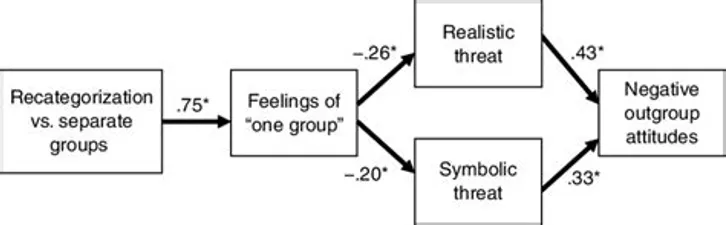
Based on the common ingroup identity model and Intergroup Threat Theory, as well as the fact that atheists are among the most stigmatized groups in the U.S., the present experiments tested whether and why people would be less willing to accommodate atheist (relative to Christian, Jewish, or Muslim) employees’ religion-related requests in the workplace. In three studies, participants responded to vignettes depicting an employee who requested to express his/her religious beliefs (or lack thereof) at work—for example, by displaying a quote at his/her cubicle or wearing a pin with a religious (or non-religious) symbol. As predicted, participants were especially unlikely to honor the atheist employees’ requests; this effect was driven by participants’ perceptions that the atheist employees posed a symbolic threat (i.e., were trying to impose their beliefs onto others; Studies 2–3) and, to a lesser extent, a realistic threat (i.e., jeopardized the organization’s economic status and resources; Study 3) in the workplace. Though the effects of participant religiosity were inconsistent across studies, the tendency for reluctance to accommodate the atheist employees’ requests was slightly stronger among religious than non-religious participants. Implications for how anti-atheist bias at work arises and can be mitigated are discussed. (PsycInfo Database Record (c) 2021 APA, all rights reserved)
The views, opinions and analyses expressed in the articles on Humanist Freedoms are those of the contributor(s) and do not necessarily reflect the views or opinions of the publishers.
Under legal pressure from a humanist parent, a school without a religious character in Worcestershire has radically altered its planned Key Stage 4 curriculum for 2022/23, in order to make sure that its religious education is fully inclusive of humanism.
Humanists UK, which supported the parent, said the decision marks a ‘significant win’ in making sure that schools do not force a narrow curriculum on children, and says the Department for Education and other schools must now make sure that such a broad curriculum is also offered everywhere else. In a timely coincidence an amendment to the Schools Bill, to replace RE with ‘religion and worldviews’ education in schools without a religious character, is due to be debated during Report Stage of the Bill on the afternoon of 12 July. The amendment is being proposed by crossbench peer Baroness Meacher.
Humanist parent James Hammond launched the case after learning that his child was being mandated to study an RE GCSE with a syllabus that was not inclusive of non-religious worldviews. No additional teaching was to be provided to make up for this exclusivity. All other schools in the academy trust apart from the one in question appeared to provide inclusive RE. Furthermore, since the school did not provide alternative GCSE options for those withdrawing from RE, if Mr Hammond withdrew his child, then they would have missed out on one GCSE qualification compared with their peers.
The academy has agreed to meet the parent’s request by providing, in addition to the GCSE course, two other units of RE, one for Year 10 and one for Year 11, focusing on non-religious worldviews and taught from a critical and objective perspective. Each unit will run for 6-7 weeks, and will meet the requirement to accord equal respect for non-religious worldviews in RE, as established in 2015 by the Fox case.
Parent James Hammond said:
‘I’m delighted that the school has conceded in this case, and by so doing accepted that its RE provision for years 10 and 11 was unlawful, due to not being inclusive of non-religious worldviews.
‘It was wholly wrong that a school of no religious character was imposing such a narrowly-focused RE curriculum on 15 and 16 years olds: at that age they are developing advanced powers of reason and thought, so to deny them the ability to learn about non-religious beliefs and values was both discriminatory and short-sighted, given the increasingly non-religious demographics in Britain.’
Humanists UK Education Campaigns Manager Robert Cann said:
‘This is a significant win. The Fox case in 2015, which was supported by Humanists UK, clearly set a legal precedent – this school should never have forced Mr Hammond into taking this action in the first place, and we are glad that it eventually conceded the case.
‘But the fact that the school was able to behave in this way in the first place was due to a failure of leadership by the UK Government. We’d much rather not be going through the courts – the Government must enable the Schools Bill to bring this case law onto the statute book, by accepting today’s amendment on religion and worldviews education.’
Dan Rosenberg of Simpson Millar said:
‘While my client is pleased that the case has been resolved in a way that enables his child to be taught RE in a more inclusive way, it should not have required the threat of legal action to resolve this. Mandating a GCSE course focused exclusively on religious worldviews for all pupils, at a school without a religious character, and as the entirety of their RE provision, was always going to run into legal trouble. The school has sensibly acknowledged the need for a significantly wider offering.
‘My client hopes that other schools will take a cooperative and responsible approach to providing non-discriminatory, inclusive education for all children, and no other parents will need to instruct solicitors to ensure that their concerns and beliefs are taken seriously.’
The views, opinions and analyses expressed in the articles on Humanist Freedoms are those of the contributor(s) and do not necessarily reflect the views or opinions of the publishers.
As a follow-on to his popular article “Is Wokism a Mind Virus?” article, Dr. Robertson has agreed to share his experience as a moderator of a popular humanist-themed social media discussion page.
In the early 1990s the Humanist Association of Canada (HAC) created an on-line open discussion forum for people who believed in the free and open exchange of ideas and were committed to respecting the dignity of each individual. This forum moved to Facebook shortly after 2005, and the discussion group’s membership grew to more than 1,500. Then, in 2015 a re-branded Humanist Canada unveiled its new professionally designed Facebook page. Only board members could initiate posts on this new platform (although this right was eventually taken away from them as well). The old HAC listserve was allowed to continue. Although it was basically self-monitoring, board secretary Michel Virard was named administrator and I was named as one of three moderators. This article is about how this discussion group came to be viewed “problematic,” and was terminated.
Dr. Lloyd Hawkeye Robertson
The major part of my time as a volunteer Humanist Canada board member at the time was to research the need for ceremony in the lives of humanists (Robertson, 2017b). As a consequence, I was invited to participate in a HAC thread initiated by the Humanists, Atheists and Agnostics of Manitoba on the need for humanist ceremonies. As expected, the discussion was cordial, informative and productive. I returned to the discussion group site in 2019, but this time the language was anything but cordial. Some members were calling on the moderators to ban others they called “racists,” “alt-right,” “white supremacists,” and “anti-humanists.” I read the offending posts. No one had advocated racism, white supremacy or even conservative politics. Earlier, white academic activists who used such language to support what some called “cancel culture” had appropriated the term “woke” from black culture to imply those that did not share their views were “not awake.” I told these Woke to keep the discussion civil. A couple of weeks later I found the former victims giving as good as they got, so I admonished them all. Over time non-Woke stopped participating. With no debate, the only new threads on the old site were pleas for donations from a humanist school in Uganda that was, at the time, partially funded through Humanist Canada. To stimulate discussion, I posted an article by a police officer (Wilson, 2020) arguing against the then current campaign to defund the police. I invited comments, but as a moderator offered no opinion. One commentator stated that articles published in Quillette Magazine should not appear in a humanist forum. I set up a separate thread to discuss whether we should censor articles based on their magazine of origin.
Image Courtesy of vectorstock.com
Several articles from Quillette were posted but none promoted an ideology of racism, sexism or hate, and I refused to impugn motives based on some subjectively held notion of “dog-whistling.” One participant repeatedly expressed insult over my refusal to share my own views on the RCMP officer’s article. I agreed to do so, but under my own name outside of the moderator role. The resultant exchange was reasoned and civil.
Steven Pinker
Two posts in a different discussion thread implied, without evidence, that humanist Steven Pinker was associated with pedophilia. I viewed this as promoting hatred against an individual, and in the role of moderator, I deleted the posts. During the subsequent discussion, I informed one of the posters that he could appeal my decision to the site administrator, but he replied that he would approach “Martin,” the Humanist Canada president, instead.
During the ensuing months the HAC site generated more comments than the official Humanist Canada page despite having one third the members, and discussions were mostly civil. Then, in early August 2020, another moderator who had only recently become involved, cancelled a participant’s right to post under circumstances I challenged. The moderator explained:
The reason I blocked Ullrich Fischer form (sic) the HAC site had nothing to do with the nature of the content he was posting, but for targeting another member for harassment by systematically going through her previous comments on previous posts and replying to each one. (Sassan Sanei, e-mail, Aug. 6/20)
Ullrich had posted “five or six” replies to separate posts mostly responding to comments the other member had posted to him. For example, she had advised “Please don’t post alt-right material to a Humanist Group” to which he had responded, “Please don’t define as alt-right everything which disagrees with you about anything.” I restored Ullrich’s privileges because due process had not been followed. I explained that we could create a rule limiting the number of posts a member could make, but in fairness we would need to communicate such a rule to everyone in advance, and no one should be cancelled after a first offense. I also pointed out that the alleged “victim” here had called yet another member a “terrible human being” and had sent that member a private message calling her a “condescending bitch,” so if anyone should be cancelled it should be this alleged victim. Sassan then apologized to Ullrich admitting:
It was wrong of me to do that without informing you why the action was taken, giving you an opportunity to respond, or discussing it with other moderators. I’m sorry, and I promise you it will not happen again.
Sassan took exception to my use of the term “Woke.” While the term had been appropriated from U.S. black culture, he explained the word was now used as a slur directed against the appropriators. I agreed to use an alternate term “Identitarian Left” instead.
In early September I deleted four posts that consisted of name calling, swearing or belittling of people. In keeping with our protocol, I notified the other moderators. Sassan re-instated two of the posts explaining in an email, “The idea of a safe space does not extend to non-victimized or non-marginalized persons.” One member whose post remained deleted after calling another “a racist piece of shit,” declared that I, the moderator, favoured “raping and torturing children.” When asked for evidence, he posted that I had deleted the incriminating posts.
Brand Management: Entity over Ideology? (Image Courtesy Marketplace Valet)
At a meeting that included the Humanist Canada president, Sassan and me, it was decided to remove all reference to Humanist Canada in the old discussion group as the discussions were “hurting our brand.” I thought it odd that the site administrator had not been invited to this meeting. Nonetheless, the Identitarian Left still insisted that anything stated on the site represented Humanist Canada policy. In keeping with the discussion at our meeting, I posted:
This is not the official webpage of Humanist Canada and the opinions expressed here do not conform to any official statement or position. This is an open discussion group for humanists with a wide variety of opinions and perspectives. We ask that participants to this forum talk to each other respectfully.
One poster became so offended by this statement that he called on the president, Martin Frith, “to do something with me.” In the meantime, Sassan suspended comments on a thread in support of ex-Muslims who had become humanists, and he suspended the person who started the thread for the next 30 days with the ominous warning “if another admin approves (his posts) I will remove them.” As it had become apparent that the two moderators were following different rules, I decided to bring it to the Humanist Canada board for resolution. I proposed that Sassan and I each resign to be replaced by a former Humanist Canada treasurer who could be seen as a neutral moderator using the following rules:
No racist, sexist or hate speech permitted;
Bullying including name-calling is not permitted;
Posts that contain racist, sexist or hate speech or otherwise exhibit bullying will be removed;
Participants who have posts removed will be advised of the reason for the removal;
Persistent abuse of the rules will result in an individual losing their posting privileges.
Sassan’s response at the board meeting was to demand an apology from me for using the term “Identitarian Leftist!” The board decided to refer the matter to its social media committee. I reverted to using the term “Woke.”
Four new discussion group members identified as transgender. When Sassan posted a “trans rights are human rights” banner in the forum, one trans person accused him of appropriating trans issues to advance his organization. He replied that his post was necessary because many humanists had been posting “transphobic” and “hateful” statements. I had not seen any such statements, and I asked Sassan to produce them. He said he had deleted them, but as moderator, I had access to all deletions, and found none. Sassan subsequently deleted as “transphobic hate speech” an article written by a transwoman, that was critical of J.K. Rowling. I did not consider her call for dialogue to be hate speech, so I reposted it under my name. The initial discussion on this article was civil, but it was interrupted by an individual who called me a transphobe and a bigot without any arguments supporting those assertions. Ze also contacted me on my private messenger service with threats to have me removed as moderator. Ze subsequently posted, on the personal Facebook of another member, “You are completely uneducated. Ignorant. Privileged and bigoted.” As this individual had six similar posts removed earlier, I cancelled the member’s posting privileges. Sassan reinstated the person without contacting me. I cancelled the person again. I then discovered I was cancelled as moderator. I appealed to the site administrator but he had been cancelled too! The president suggested we sort this problem out at the social committee meeting he would schedule.
The dam burst. Transactivists and their allies attacked non-Woke with the same derision that had prompted me to become an active moderator the year earlier. Three participants defended me saying that they had searched my postings and did not find any posted by me that were anti-trans. Woke replied that I had removed the offending posts. One of the Woke organized a letter writing campaign. Sassan defended this behaviour stating, “The member(s) in question was (were) not harassing anybody. They were standing up and speaking out against the endless stream of hateful, transphobic commentary and bullying that has dominated the group in recent weeks.” No examples of such hateful, transphobic or bullying comments were given.
The HAC discussion group was shut down with the rationale that social media necessarily degenerates into such divisive name calling. I believed this was likely true at the time, but the New Enlightenment Project (NEP) established its own Facebook discussion forum in 2021, and it has proven to be a safe place in which humanists can have respectful, informative and civil conversations about controversial topics.
Sassan had not been authorized to terminate a moderator or the discussion group administrator. President Frith was determined to ensure that this matter would not be discussed by the Humanist Canada board, and he invited me to attend a “discussion group post-mortem.” After waiting for Martin who failed to attend, Sassan apologized for his actions to the cancelled administrator and myself. I thought he should apologize to the board because he had broken a board protocol, but the former administrator suggested that we should move on to educate humanists about the threat of Wokism.
This was my first direct experience observing Wokism in action. The Woke accused those who disagreed with them of being anti-humanist. People who said Canada’s first prime minister should not be blamed for things that happened well after his death were accused of favoring the torturing and raping of children. Feminists who want to ensure biological females have safe spaces were accused of wanting to deny transsexuals right to exist. Those who defended their positions were accused of harassment or bullying. There were thus two types of humanists represented: the Woke who viewed freedom of speech, science, logic and reason as “white, male ways of knowing” in opposition to their “anti-racist” narratives; and, those grounded in the Enlightenment view that we can learn about objective reality through careful observation, science, reason and logic. To these Enlightenment humanists, freedom of speech acts as an antidote to dogma and is a means of checking our own subjectively held biases. Those who coined the term “The Enlightenment” implied that those who disagreed with their approach were unenlightened, but in my book, The Evolved Self (Robertson, 2020), I argue that these values flow from the individualism inherent in having a self,and that this self is both cross-cultural and ancient. The Enlightenment was not about educating unenlightened people so much as removing cultural constraints on the powers of mind. From this lens, Wokism is a reactionary movement seeking to re-impose such constraints.
I came to the conclusion that Wokism is not a coherent ideology but amalgam of partially assimilated and conflicting belief systems (Robertson, 2021). It replaces the economic ruling class of Marxism with the racial designation “white.” It uses anti-Marxist postmodernism to “deconstruct” all beliefs with no rationale given as to why its own dogma is exempt from such deconstruction. Its attack on science and reason is copied from Martin Heidegger (1962), but it claims to be anti-fascist. It claims allegiance to social justice but ignores the egalitarian basis of the civil rights movement upon which social justice is built. The Woke claim to be anti-racist but promote the racialization of society through identity politics. They claim to be anti-capitalist while being embraced by the largest corporations in the world. They are convinced of their moral superiority, but are prepared to act unethically to defeat their opponents. These contradictions help explain the psychology of the people I observed.
Sassan had been extremely deferential to the transperson who accused him of using trans-issues to further an agenda. Sometimes referred to as “victim culture” (Campbell & Manning, 2014, 2016; Gabay et al., 2020; Haufman, 2020), Wokism establishes a hierarchy of identity groups with members of some groups presumed to have suffered greater victimization thereby acquiring greater moral entitlement. One would think that white males would be at the bottom of this hierarchy, but they are given a special role. Several times white males in the discussion group would state that they were “giving voice” to those “without voice.” This gives them a leadership position in which they engage in aggressive attacks on others as evidence of overcoming their own “whiteness.” On numerous occasions I observed Woke amending their posts after the discussion so as to make themselves appear more effective.
Like a secret cult, Wokism may not be named and attempts to name it are deemed to be “slurs.” The Woke would prefer to be known as “Left” or “Progressives;” yet we know there are many people who identify with the Left who embrace science, reason and free speech. We also know that progressivism is an Enlightenment doctrine that peoples’ lives can be improved incrementally. By this measure a leading progressive is Steven Pinker (2012, 2018), a humanist whom the Woke have repeatedly denounced.
Every cult needs some means of identifying authentic members, and the Woke do this through the inventive use of language. For example, the word “Latinx” is not used by Hispanic people and it is not used by Woke talking to Hispanic people. It is used by Woke talking through Hispanic people to other Woke. The word “systemic” is thrown in before words like “racism,” “sexism,” and “oppression,” but it is not used as an adjective because the Woke never explain how systems work to establish these problems. The word “problematic,” is used in preference to the word “problem” so as to appear more “systemic.” Similarly words like micro-aggression, intersectionality, and cisgender are not needed for communication, but signify that the user is Woke.
“in the final analysis, wokism is abut power.”
In the final analysis, Wokism is about power. The Woke have taken over universities, school boards, media, non-government organizations and government agencies for the purpose of creating more Woke. Although they were successful in disabling and shutting down an open humanist discussion group, the Woke were not finished with Humanist Canada. Enlightenment humanists need to recognize the challenge to our movement and to update our understandings in light of modern conditions.
Campbell, B., & Manning, J. (2016). Campus Culture Wars and the Sociology of Morality. Comparative Sociology, 15(2), 147-178.
Gabay, R., Hameiri, B., Rubel-Lifschitz, T., & Nadler, A. (2020). The tendency for interpersonal victimhood: The personality construct and its consequences. Personality and Individual Differences, 165, 110134. https://doi.org/doi.org/10.1016/j.paid.2020.110134
Haufman, S. B. (2020, June 29). Unraveling the Mindset of Victimhood: Focusing on grievances can be debilitating; social science points to a better way. Scientific American.
Pinker, S. (2012). The better angels of our nature: Why violence has declined. Penguin.
Pinker, S. (2018). Enlightenment now: The case for reason, science, humanism, and progress. Penguin.
Robertson, L. H. (2017a). The infected self: Revisiting the metaphor of the mind virus. Theory & Psychology, 27(3), 354-368. https://doi.org/10.1177/0959354317696601
Robertson, L. H. (2017b). Secular weddings in Canada: An examination of a humanist response to the evolution of marriage. Journal of Secularism and Non-religion, 6, 1-10. https://doi.org/<http://doi.org/10.5334/snr.76>
Robertson, L. H. (2020). The Evolved Self: Mapping an understanding of who we are. University of Ottawa Press.
The views, opinions and analyses expressed in the articles on Humanist Freedoms are those of the contributor(s) and do not necessarily reflect the views or opinions of the publishers.
To all of Don’s many friends and family, HumanistFreedoms.com would like to express our most heartfelt condolences and sympathy. if you have memories or sentiments to share, please add them as comments or send an email and we’ll be proud to share them on this page.
Recollection by Eric Adriaans
A little over a week ago, I received an email message from an old friend that said simply, “Don died on Sunday. We’re all a bit shocked. I’ll let you know more soon.” Messages from old friends can be like that sometimes. There doesn’t really need to be more -every word carries its own freight of memory and significance. Old friends know how utterly, deeply felt and shared is the loss of a friend like Don Cullen.
I first met Don in the cramped and stuffy Toronto offices of Centre For Inquiry Canada (CFIC) at the corner of Yonge & College in the spring of 2014. I had recently joined the organization and wasn’t altogether certain whether I had gotten my myself and my career onto a pretty unusual path. Then Don popped-in for a visit, wearing what seemed to be a kind of trademark big-grin-avec-fishing-vest ensemble, and we chatted for quite a long time.
Don Cullen with a copy of the infamous Charlie Hebdo “Je Suis Charlie” edition.
We chatted about the forming of CFIC and some of the other humanist organizations in Toronto and Canada; also about Don’s interests, career and memories. He told me about the Bohemian Embassy, about his poetry and about his deeply-felt and long-considered ideas about humanism and atheism. Don’s warmth, humour and intelligence were a welcome indication that I probably was on an unusual path – but there was wonderful company to be had. It was Don’s first of many gifts and lessons to me about humanism. It’s a gift I try to carry and share that gift of welcome and community with others.
I wasn’t aware at our first meeting, but Don was one of the people who helped to create CFIC. Later, I was able to obtain some recollections from him about this history and I want to recall some of that here.
In the late 1990’s, a vibrant American import name, Terri Hope, became coordinator of the Humanist Association of Toronto (HAT). Membership was growing and George Baker became a life member. George was a non-academic intellectual. Because of the Great Depression, he had left school in grade seven. Tests for air crew in the Royal Canadian Air Force proved George to be above average intelligence. It got him interested in great ideas. He read, attended lectures.
At that time, HAT had no home base. There was a phone number and an answering machine, a fax number and a website. Many HAT members wanted a store-front, a gathering place….a home. Proposals were made. George Baker was more than interested. Hard work and good luck had brought serious financial rewards and he wished to do something for Humanism.
I had presided over four incarnations of the Bohemian Embassy coffee house where Margaret Atwood, Ian & Sylvia Tyson, Al Purdy, Gordie Lightfoot, Joni Mitchell, Bill Coshy and many more performed. I arranged a meeting with George. He and I had already become acquainted with the Centre For Inquiry in Amherst, New York. Paul Kurtz, the founder, Tom Flynn and Joe Nickell had spoken at HAT events. I had attended talks in Amherst and CFI presented a 2-day conference at the Ramada Inn on Jarvis Street. They indicated a desire for a Toronto location and sought cooperation from HAT. Nothing resulted. Some say it was apathy among HAT members, fear of American domination or was it that CFI Los Angeles had drained the exchequer!
HAT members Ron Burns and Jim Cranwell joined George and me. Using the CFI model, we envisioned an umbrella organization with HAT, HAC and the Toronto Skeptics sharing the same roof. We needed a location. Feeling a need for more youthful participation, we wanted to be close to the University of Toronto and consulted Neil Wright Real Estate. he found us a location on Harbord Street. It needed a lot of work. George hired an architect. Plans were drawn up. A strike at City Hall delayed approval month after month. George, in his 80s, couldn’t stand the delays. He sold Harbord Street and got out.
Robert Buckman, an internationally famous oncologist had come to Toronto. He had a lot of TV exposure in Great Britain, had partnered with Monty Python’s John Cleese in several projects. He did several programs on TV Ontario. He had a high profile and he replaced Henry Morgantaler as President of HAC. HAT and HAC presented some events under Rob’s direction. Membership at HAT soared well over 200.
Quite separately, things were happening at U of T. It was decided to create a multi-faith Centre. Two students objected. Independently, Jenny Fiddes and Justin Trottier felt that a university should be secular, supporting no religion. Religion might support colleges but not the university. Where did atheists fit !?
George Baker and I heard about it and gave them a couple of hundred bucks for stamps and envelopes. I was on the HAT Board of Directors and proposed for Jenny and Justin to make presentations on the U of T campus. They were successful with considerable interest in Humanism and Atheism. George and I arranged a lunch at Bumpkins Restaurant with Justin, Jenny and Rob Buckman. Rob imagined a Humanist Drop-in Centre near the university. A meeting with Henry Morgantaler, Rob, Ron Burns, Jim Cranwell and me occurred and we decided we would do it. I contacted Mr. Wright and he found 216 Beverly Street.
The umbrella organization idea began to unfold. The skeptics were skeptical and decided not to participate. The Humanist Association of Canada wanted their headquarters to stay in Ottawa. A vote of HAT members was 100% for moving in and the organization was set up. The student team at U of T was enthusiastic….(more on the CFIC website)
It is eminently fitting to re-share one of Don’s own stories. Whether it was the forming and re-forming of the Bohemian Embassy or helping to shape humanist communities – Don seemed always, when I was with him, to be sharing a story. But also creating a stage for those around him to sing just as purely, laugh just as joyfully, think and feel just as deeply and shine just as brightly as he did.
Don was a wonderful human and a wonderful humanist.
Reflections by Richard Thain
I first met Don at a Humanist Association of Canada (HAC) conference almost four decades ago, and it was a pleasure knowing and associating with Don through HAC (now Humanist Canada), Humanist Association of Toronto, Centre for Inquiry Canada, etc.
As most of us know, Don was a creative dynamo, entertainer, writer, and Canadian cultural luminary. In addition to his professional work, Don found the time to support numerous secular humanist organizations. He regularly attended and contributed to humanist conferences, was a founder of Humanist Association of Toronto (HAT), and Centre for Inquiry Canada (CFIC). Don was an articulate and staunch supporter of all our humanist causes. One of the last conversations he had, before he died, was about how extremely upset he was over the recent news from the USA, regarding the overturning of the Roe (v) Wade decision.
In recent years, while visiting Toronto, I occasionally was able to join Don, Jim Cranwell, and other humanist, atheist friends, at their Friday afternoon social and discussion sessions. The conversations were always fascinating and enlightening, to say the least. On one such visit, he passed me his brilliant Quotesanon pamphlet. The pamphlet included a poem which he had written:
A Found Poem by Don Cullen
An eye for an eye
Makes the whole world blind. *
Only human kindness
Will save humankind. **
* Accredited to M.K. Gandhi
** Accredited to Bertrand Russell
Don Cullen was a thoughtful, generous, creative, and compassionate man. Last week we lost a wonderful friend – a great Canadian humanist.
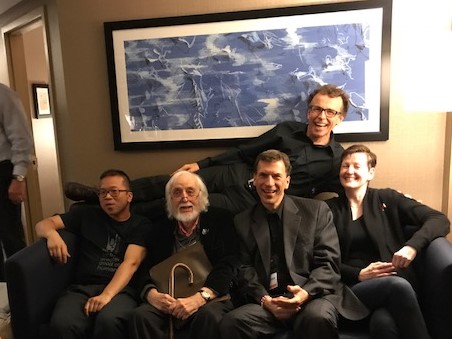
Don Cullen, seated, in centre. Jim Cranwell, second from right.
Citations, References And Other Reading
Feature Image Courtesy: Dr. Richard Thain
The views, opinions and analyses expressed in the articles on Humanist Freedoms are those of the contributor(s) and do not necessarily reflect the views or opinions of the publishers.





















 Humanist Heritage Canada