We present a timeline of Canada’s secular and humanist heritage.
1776
Fleury Mesplet published Enlightenment thought, skepticism and anti-clericalism for a Québec audience via his Gazette littéraire and Montreal Gazette.
1867
The Dominion of Canada was established through the unification of the provinces of Canada (Ontario & Québec), New Brunswick and Nova Scotia on July 1, 1867. The Civil Code of Lower Canada (Québec) was retained, thus ensuring Québec’s distinct legal and laïcité tradition. The other provinces joined confederation at a later time.
1873
The Toronto Free Thought Associate was formed in 1873 and renamed the Toronto Secular Society in 1881. Among other activities, the Society invited Robert Ingersoll (the “Great Agnostic”) to speak in Toronto, Ottawa, Montreal, Belleville and Napanee.
1892
Criminal Code Section 296, a blasphemy law was entered into Canada’s Criminal Code. The law stated, 296. (1) Every one who publishes a blasphemous libel is guilty of an indictable offence and liable to imprisonment for a term not exceeding two years (2) No person shall be convicted of an offence under this section for expressing in good faith and in decent language, or attempting to establish by argument used in good faith and conveyed in decent language, an opinion on a religious subject. (3) It is a question of fact whether or not any matter that is published is a blasphemous libel. This law remained in force for 125 years until it was repealed in 2018.
1901 – 1931
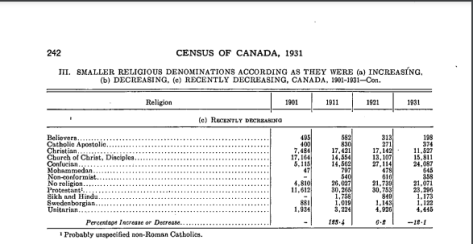
Census information shows that 4,810 Canadians declared “no religion” in 1901. That figure then jumped to more than 26,000 in 1911 and settled at approximately 21,000 by the early 1930s.
1916 -1960
Women’s suffrage (right to vote and be candidates for election) was achieved via a series of federal and provincial Acts.
1926
Marshall Jerome Gauvin moved to Winnipeg to found the Winnipeg Rationalist Society. Active until 1940, Gauvin was Canada’s first “professional atheist”.
1926
Ernest Victor Sterry became one of the founding members of the Rationalist Society of Canada, an
organization chartered with the purpose of promoting the study of science and philosophy, finding our place in and our duty to the great body social, promoting among our fellows true morality as based on natural law and “producing unity and concord along sane and logical lines, and producing happiness and prosperity in Canada.1927
Ernest Victor Sterry was convicted of Blasphemous Libel and sentenced to 60 days imprisonment in Toronto. In May, Sterry’s appeal was dismissed.
Sterry was represented by E. Lionel Cross, the first black lawyer to open a law practice in Toronto.

A table of all the blasphemous libel cases tried in Canada. Sterry appears to be the only case involving an atheist; however, the themes of these century-old trials may still be found in contemporary Canadian society. Source: Jeremy Patrick‘s “Not Dead, Just Sleeping: Canada’s Prohibition on Blasphemous Libel as a Case Study in Obsolete Legislation. 1932

From 1932 when it was still illegal, Dr. Elizabeth Bagshaw became medical director of the Hamilton Birth Control Clinic, Canada’s first birth control clinic. Dr. Bagshaw continued as the clinic’s director until 1966. She retired at the age of 95 in 1976, the oldest practicing physician in Canada at the time.
1944 – 1948
Brock Chisholm (1896 – 1971) became the World Health Organization’s first Director General. He recommended the WHO’s name, with emphasis on “world.” He defined health for the WHO as “a state of complete physical, mental, and social well-being and not merely the absence of disease or infirmity.” The WHO charter also established that health is a fundamental human right and that “the health of all peoples is fundamental to the attainment of peace and security.”
During this time, Chisholm advocated that children should be raised in an “as intellectually free environment” as possible, independent of the prejudices and biases (political, moral and religious) of their parents. Chisholm drew much criticism from the Canadian public for comments in the mid-1940s that children should not be encouraged to believe in Santa Claus, the Bible or any other supernaturalism.
In 1944, the Canadian Government created the position of Deputy Minister of Health. Chisholm was the first person to occupy the post and held it until 1946
1948
The Universal Declaration of Human Rights (UDHR) was created in a process chaired by Eleanor Roosevelt. The UDHR is the foundation document and inspiration for much humanist activism and direction in the modern era.

The timeline is currently under construction. Think we’re missing something? Let us know!
By continuing to access, link to, or use this website and/or podcast, you accept the HumanistFreedoms.com and HumanistHeritageCanada.ca Terms of Service in full. If you disagree with the terms of service in whole or in part, you must not use the website, podcast or other material.
 Humanist Heritage Canada