Category Archives: Uncategorized

World Humanist Congress – Ottawa 2026

The World Humanist Congress is a triennial event that brings together representatives from the global humanist, atheist, and secular community to learn from one another and work toward addressing the most pressing issues of our time.

Humanists International and Humanists Canada will be the World Humanist Congress and HI General Assembly hosts in Ottawa, Canada in 2026. But it will be up to local and regional humanists, both individual and at the organization level who determine if the event will be a landmark in Canadian humanism.

The congress organizers state that they we will welcome elected officials, business and civic leaders, artists, scholars, and on-the-ground activists and organizers to lend their expertise to these discussions.

If you think you may be interested to attend, we at Humanist Heritage Canada encourage you to consider attending the event. Check it out on the Conference website.

What could possibly be on the agenda? There is no shortage of global and Canadian issues that humanists need to discuss. We have a laundry list of our own…but what do you think?

Up For Discussion

If you’re interested in analyzing and discussing this issue, there are actions you can take. First, here at Humanist Heritage Canada (Humanist Freedoms), we are open to receiving your well-written articles.

Second, we encourage you to visit the New Enlightenment Project’s (NEP) Facebook page and discussion group.

Citations, References And Other Reading

  1. Featured Photo Courtesy ofhttps://www.worldhumanistcongress.org/

The views, opinions and analyses expressed in the articles on Humanist Freedoms are those of the contributor(s) and do not necessarily reflect the views or opinions of the publishers.

HumanistHeritageCanada.ca Recognized

Just a few days ago, HumanistHeritageCanada.ca was notified that we’d be recognized by Feedspot.com that we made their list of the top 15 Humanist blogs on the web. According to the reader site, we earned a #13 rating based on traffic, social media follower, domain authority and freshness.

We received a similar rating in 2024 – down somewhat from our #10 rating a few years back (as HumanistFreedoms.com).

Feedspot further explains the basis of their rankings as:

  • Relevancy
  • Industry blogs (those not favoring a specific brand) are given higher rank than blogs by individual brands (who often tend to promote their own products).
  • Blog post frequency (freshness)
  • Social media follower counts and engagements
  • Domain authority
  • Age of a blog
  • Alexa Web Traffic Rank, and many other parameters.

Feedspot claims to routinely remove inactive blogs as well as those that aren’t relevant to any given list. Lists are updated as they receive new blog submissions to ensure updated rankings every few weeks.

We find ourselves positioned close to our colleagues at the Humanist Society of Scotland, the Secular Hub Blog and a few steps from our fellow Canadians at BC Humanists.

Feedspot discovers, categorizes and ranks blogs, podcasts and influencers in several niche categories. We have curated over 250,000 popular blogs and categorized them in more than 5,000 niche categories and industries. With millions of blogs on the web, finding influential, authority and trustworthy bloggers in a niche industry is a hard problem to address. Our experience leads us to believe that a thoughtful combination of both algorithmic and human editing offers the best means of curation.

We thank Anuj Agarwal and the Feedspot team for being recognized in it’s rankings!

Citations, References And Other Reading

  1. Featured Photo Courtesy ofhttps://techsmashers.com/how-to-choose-a-reliable-internet-connection/
  2. https://blog.feedspot.com/about_lists_and_ranking/?_src=menu
  3. https://bloggers.feedspot.com/humanist_blogs/?feedid=5416526&_src=f2_featured_email

The views, opinions and analyses expressed in the articles on Humanist Freedoms are those of the contributor(s) and do not necessarily reflect the views or opinions of the publishers.

Robert Munsch and MAiD

As reported by the National Post, Canadian children’s author Robert Munsch has stated that he must “pick the moment when I can still ask for it,” and worries that if he loses capacity before then, his family will be left to make one of the most difficult decisions that any person or family can make…whether Medical Assistance in Dying (MAiD) the appropriate choice for Robert Munsch.

Munsch was born in Pittsburgh, Pennsylvania and eventually studies for 7 years to be a Jesuit priest while working part-time at an orphanage and then spend ten year working in daycare. Munsch became a Canadian citizen in in the 1970s and became a member of the Order of Canada in 1999.

One of his books, Giant; or Waiting for the Thursday Boat (1989), was banned in some places as offensive to religion, e.g., a character threatens to “pound God into applesauce.” Because of its depiction of God as a little girl, and threats toward God, it was challenged/removed from some school libraries in Ontario.  In Middlesex County, the book was removed or restricted (for example from primary grades, or not read aloud by teachers) because of its religious content;  In Welland (Niagara Region), similar challenges occurred.  

Munsch is a Unitarian who attended the Unitarian Fellowship in Guelph “until the routine petered out when the kids got restless.” (Citation below.) Munsch and his wife have three adopted children. According to the Freedom From Religion Foundation,

Munsch became Canada¹s best selling author, but was not selling much in the USA. Then LOVE YOU FOREVER came out as a Canadian book in 1986. It sold 30,000 in 1986 and was the bestselling kid’s book in Canada that year, 70,000 in 1987 and was the bestselling Canadian kids book that year too. It sold 1,000,000 in 1988 . It was the bestselling Canadian kid’s book that year too. The strange thing was that it was also the bestselling kid’s book in the USA, only nobody knew it. It never occurred to Munsch that it could be an invisible bestseller.

On the official Munsch website, a candid advisory to parents says, “I am a storyteller. I write books for kids, I talk to kids, and I listen to kids. But that is not all that I am. Several years ago I was diagnosed as obsessive-compulsive and manic-depressive. Those challenges have led me to make some big mistakes. I have worked hard to overcome my problems, and I have done my best. I have attended twelve-step recovery meetings for more than 25 years. My mental health and addiction problems are not a secret to my friends and family. They have been a big support to me over the years, and I would not have been able to do this without their love and understanding. I hope that others will also understand. I hope that everyone will talk to their kids honestly, listen to them, and help them do their best with their own challenges.

And that seems like some pretty reasonable perspective at any stage of life, doesn’t it?

Up For Discussion

If you’re interested in analyzing and discussing this issue, there are actions you can take. First, here at Humanist Heritage Canada (Humanist Freedoms), we are open to receiving your well-written articles.

Second, we encourage you to visit the New Enlightenment Project’s (NEP) Facebook page and discussion group.

Citations, References And Other Reading

  1. Featured Photo Courtesy of :
  2. https://ffrf.org/publications/day/robert-munsch/
  3. https://robertmunsch.com/
  4. https://nationalpost.com/news/canada/robert-munsch-qualify-for-maid-dementia-canada
  5. https://www.thebeaverton.com/2025/09/robert-munsch-announces-he-will-choose-maid-program-also-even-sadder-new-ending-to-love-you-forever/
  6. https://nationalpost.com/entertainment/robert-munsch-daughter-not-dying
  7. https://www.sudbury.com/beyond-local/beloved-guelph-childrens-author-robert-munsch-chooses-maid-11222971

By continuing to access, link to, or use this website and/or podcast, you accept the HumanistFreedoms.com and HumanistHeritageCanada.ca Terms of Service in full. If you disagree with the terms of service in whole or in part, you must not use the website, podcast or other material.

The views, opinions and analyses expressed in the articles on Humanist Freedoms are those of the contributor(s) and do not necessarily reflect the views or opinions of the publishers.

Is it time to ask if All’s well at Indwell?

Indwell markets itself as “a Christian charity that creates affordable housing communities that support people seeking health, wellness and belonging.” Whenever a contemporary charity actively affiliates itself with religion, there are probably good reasons to be on guard. Foremost on our minds ought to be why the chartable agency (a form of legal entity or corporation) needs to feature religion. Is the actual work being done by the organization not good enough to stand on its own?

With that in mind, we recommend a review of Home Safe Home – But Not at Indwell, a report by Marvin Ross and Karen Ross with files from Dr. David Laing Dawson.

The 27-page report begins with the question, “Is the Christian charity Indwell so focused on the heavens that they cannot see the many problems in their building?” and concludes that, “Until Indwell is forced to address the violence in their buildings then Indwell will never be Home Safe Home.

Humanist, atheist, agnostic organizations in Canada have frequently expressed concern regarding tax advantages doled-out to clergy. Perhaps it is also time for secularists to extend that concern to overtly religious charities. And perhaps it is time for the citizens of communities that host these organizations to be considerably more demanding that powerful charities face significantly more scrutiny and accountability.

After all, as a corporation, Indwell claims to be, ” the fastest growing developer of new supportive affordable housing in Ontario. Indwell’s communities support over 1300 tenants in regions across Southern and Southwestern Ontario—with several projects currently under construction or pre-development. Indwell empowers tenants to achieve health and wellness goals, and to constructively engage with their communities.” If that doesn’t cause humanists concern…it probably should.

Did you know that the Canadian Centre for Christian Charities serves a membership of 3200 organizations and…”Based on total annual revenue: 13% have less than $100,000 revenue, 33% are between $100,000 and $300,000, 31% are between$ $300,000 and $1 million, 20% are between $1 million and $10 million, and, 3% have more than 10 million in revenue”.

Up For Discussion

If you’re interested in analyzing and discussing this issue, there are actions you can take. First, here at Humanist Heritage Canada (Humanist Freedoms), we are open to receiving your well-written articles.

Second, we encourage you to visit the New Enlightenment Project’s (NEP) Facebook page and discussion group.

Citations, References And Other Reading

  1. Featured Photo Courtesy of : New Enlightenment Project
  2. https://drive.google.com/file/d/13ERArBT24-mIUiYtGheu6BZjQItX9t4j/view
  3. https://indwell.ca/
  4. https://dawsonross.wordpress.com/2024/11/11/guest-post-the-myth-of-wrap-around-supports-at-supportive-housing-indwell-and-an-armed-standoff-with-police/
  5. https://dawsonross.wordpress.com/2024/12/04/a-government-funded-slum-our-second-comprehensive-report-on-indwell/

By continuing to access, link to, or use this website and/or podcast, you accept the HumanistFreedoms.com and HumanistHeritageCanada.ca Terms of Service in full. If you disagree with the terms of service in whole or in part, you must not use the website, podcast or other material.

The views, opinions and analyses expressed in the articles on Humanist Freedoms are those of the contributor(s) and do not necessarily reflect the views or opinions of the publishers.

Breaking Down Silos: Fostering Reason and Respect in a Divided World

Submitted by NEP’s Lloyd Hawkeye Robertson

A recent discussion among New Enlightenment Project board members highlighted a growing breakdown in meaningful communication across societal “silos.” Groups divided by differing beliefs on divisive issues—such as Palestine, immigration, equal rights for men, gender ideology, or systemic racism—are increasingly polarized with the result that they are left shouting at each other rather than talking to each other. Left, right and people in-between have been undermined with lies, defamation, negative gossip, innuendo, social ostracization, and asymmetric application of institutional ethics guidelines. This divisiveness has also fragmented the humanist movement, spawning competing organizations vying for a limited constituency. As a result, some humanist groups avoid discussing controversial issues to prevent further division, but this limits our ability to advance knowledge at individual and societal levels.

The Enlightenment-inspired advocate will stick to the argument and not the presumed character of the other. Even when we disagree—perhaps especially when trust is lacking—we must show respect for others, honoring the humanist principle of valuing every individual’s dignity and worth. This requires epistemic humility: acknowledging that our knowledge is limited and subject to change with new evidence. So why does society struggle to embrace respectful, reason-based discourse?

From a psychological perspective, three factors may explain why those engaging in reasoned debate are often maligned or censored. First, individuals with a dualistic worldview—dividing the world into good versus evil—may justify harmful actions against those labeled as “evil.” They may believe that silencing such individuals prevents others from straying from the “right” path. This mindset isn’t limited to religious ideologies; any belief system that paints non-adherents as oppressive, racist, or hateful can foster this trap.

Second, people may actively censor or malign others due to an underdeveloped or fragile sense of self. To such people, presenting ideas that run counter to their beliefs might feel like violence directed towards them. More extremely, some people run from the responsibility of having a volitional self and instead merge who they are with a religion or ideology. Any attack on the religion or ideology is then felt as violence directed against them and they “defend” themselves accordingly. Since reasoning only invites a reply which is then experienced as another attack, they seek to suppress free speech.

Third, some individuals view power as the only reality, leaving them desperate to control others. Feeling vulnerable when not in charge, they may resort to manipulation or bullying. When aligned with a movement seeking power—often framed as a moral crusade—they gain a sense of legitimacy, justifying their efforts to silence reasoned discourse.

These conditions—moral dualism, fragile identity, and a fixation on power—are treatable through psychotherapy. However, individuals with these traits often seek counseling only when their efforts to silence or control others fail, expecting the world to change rather than themselves. Promoting societies that consciously value objective reason, diverse thought, and free speech at every level may encourage such individuals to reflect and grow. This cultural shift could foster the change we need. Indeed, this is the mandate of the New Enlightenment Project: A Canadian Humanist Initiative (NEP).

The NEP was created by refugees from the culture wars within Canadian humanism who saw the need for a platform where all subjects of concern could be discussed freely and where civilized debate could be held without fear. So, we took this discussion from the board and invited member comment. Here are some of the comments that now appear on our website: 

Gleb: “Intolerance of emotional intolerance should be the cornerstone of NEP.

Myron: “But they are not interested in facts, just in perpetuating their dogmas and the lies they depend on.

Bob: “We always assume that ours the only way to think, and that the other side is just wrong-headed.

Mathew: “My mother survived Warsaw Uprising as a child, and witnessed how her father almost lost his life as he was chased in front of German tanks as a human shield. But she always encouraged me to “hear out the other side.” She had every reason to believe that some people, and some ideologies, are beyond redemption, and yet was ready to hear out even them.

To maintain progress as a civilization we need to understand other points of view and we need to be willing to modify our own points of view, dependent on the evidence. Enlightenment Humanism is progressive in that we are capable of making incremental progress using the skills of science, reason and free speech. We are concerned that these skills are not being sufficiently taught in our society. We publish articles, maintain a blog, have a Facebook discussion page, and we conduct interviews on a YouTube channel. We worry that, in effect, we are creating our own silo and we wish to reach out to others that perhaps have different perspectives. We are exploring co-hosting “The Other” conference to provide opportunities for people who hold opposing viewpoints to discuss them in a fair and respectful forum.

A function of this conference is, to echo Steven Pinker, the open acknowledgment and utilization of Enlightenment values such as freedom of thought and speech, human reason, scientific inquiry, and continued improvement of the human condition, while steel-manning those who would question or oppose them. The conference would be more about listening and discussing rather than judging and drawing political lines in the sand. By considering what and why the ‘other’ side holds counter viewpoints to our own is to appreciate and understand how biases influence our views within particular contexts. But how do we bring together people with such diverse opinions together?

One way would be to have groups that represent the spectrum of humanist thought co-sponsor such a conference with agreed upon rules for building an argument, acknowledging biases, reiterating or “steel-manning” other points of view, and acknowledging good points and areas of common agreement prior to critical assessment. Such a conference would be a success by demonstrating to each other and to the greater public at large that it is possible to gather in a public forum and discuss very sensitive issues in a respectful and helpful manner.

We learned last month that the World Humanist Conference for 2026 had been moved from Washington to Ottawa, Canada due to fractured and politicized discourse in the United States. We would hope that Robert Hamilton, the president of Humanist Ottawa, which is independently affiliated with Humanists International, will have a visible role in this event. We would also propose that the other humanist groups in Canada that are not formally affiliated with each other be invited to co-host an event that will demonstrate the skills we have suggested for the “Other” conference.

In the meantime, you can visit the NEP website at THE NEW ENLIGHTENMENT PROJECT – A Canadian Humanist Initiative. Check out our blog, visit our Facebook page, participate in the discussions. You can view our podcast interviews at https://www.youtube.com/@nep-humanismca6881

Up For Discussion

If you’re interested in analyzing and discussing this issue, there are actions you can take. First, here at Humanist Heritage Canada (Humanist Freedoms), we are open to receiving your well-written articles.

Second, we encourage you to visit the New Enlightenment Project’s (NEP) Facebook page and discussion group.

Citations, References And Other Reading

  1. Featured Photo Courtesy of : New Enlightenment Project
  2. https://humanists.international/event/ga2026/

By continuing to access, link to, or use this website and/or podcast, you accept the HumanistFreedoms.com and HumanistHeritageCanada.ca Terms of Service in full. If you disagree with the terms of service in whole or in part, you must not use the website, podcast or other material.

The views, opinions and analyses expressed in the articles on Humanist Freedoms are those of the contributor(s) and do not necessarily reflect the views or opinions of the publishers.

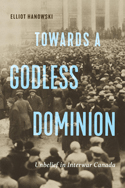
Review: Elliot Hanowski’s “Towards a Godless Dominion

A few months ago, we mentioned an intention to acquire and read a copy of Elliot Hanowski’s 2023 book, “Towards A Godless Dominion: Unbelief in Interwar Canada”. While we were a little late in discovering the book, we’re very glad that we did…and we’re very pleased with following-through on our intentions.

Our copy is a soft-cover with about 330 pages and we read the book over the course of several weekend mornings in May and June. We can confirm that our earlier expectation that it is an obvious must-read for anyone wishing to examine Canada’s humanist heritage was correct.

There are eight chapters, several of which feature a regional focus. Depictions of events in Manitoba, Ontario and Quebec dominate the book, but there is also a brief chapter covering “Unbelief on the Coasts“, as well. The bibliography is about 22 pages long, giving credit and credibility to Hanowski for what must be un-counted hours of research.

According to McGill-Queen’s University Press, Elliot Hanowski is an academic librarian at the University of Manitoba. Hanowski is the author of Towards A Godless Dominion: Unbelief in Interwar Canada. Hanowski is also one of the founders of the International SocieWety for Historians of Atheism, Secularism and Humanism.

The book’s publicity materials state, Towards a Godless Dominion explores both anti-religious activism and the organized opposition unbelievers faced from Christian Canada during the interwar period. Despite Christianity’s prominence, anti-religious ideas were propagated by lectures in theatres, through newspapers, and out on the streets. Secularist groups in Montreal, Toronto, Winnipeg, and Vancouver actively tried to win people away from religious belief. In the first two cities, they were met with stiff repression by the state, which convicted unbelievers of blasphemous libel, broke up their meetings, and banned atheistic literature from circulating. In the latter two cities unbelievers met social disapproval rather than official persecution. Looking at interwar controversies around religion, such as arguments about faith healing and fundamentalist campaigns against teaching evolution, Elliot Hanowski shows how unbelievers were able to use these conflicts to get their skeptical message across to the public. Challenging the stereotype of Canada as a tolerant, secular nation, Towards a Godless Dominion returns to a time when intolerant forms of Christianity ruled a country that was considered more religious than the United States.

What we gained from having read the book is a renewed sense of connection to the humanist heritage that is an unjustly obscured part of our Canadian identity. The Canadian humanist community has not been particularly effective in recalling and telling its own story. Hanowski’s book is a an important and effective gift to the collection of “nones” that make up such a large part of Canadian society.

The final sentence of Hanowski’s book states, “Interwar unbelievers demonstrated considerable courage and determination in their struggle to create a godless yet more humane Canada.” and that may be the best place to conclude…along with our encouragement to everyone to go ahead and acquire a copy of this book, read it over a few weekend mornings and connect with the heritage that it contains.

Up For Discussion

If you’re interested in analyzing and discussing this issue, there are actions you can take. First, here at Humanist Heritage Canada (Humanist Freedoms), we are open to receiving your well-written articles.

Second, we encourage you to visit the New Enlightenment Project’s (NEP) Facebook page and discussion group.

Citations, References And Other Reading

  1. Featured Photo Courtesy of : https://umanitoba.academia.edu/ElliotHanowski
  2. https://www.mqup.ca/towards-a-godless-dominion-products-9780228018834.php#!prettyPhoto

By continuing to access, link to, or use this website and/or podcast, you accept the HumanistFreedoms.com and HumanistHeritageCanada.ca Terms of Service in full. If you disagree with the terms of service in whole or in part, you must not use the website, podcast or other material.

The views, opinions and analyses expressed in the articles on Humanist Freedoms are those of the contributor(s) and do not necessarily reflect the views or opinions of the publishers.

A New Campaign to Oppose Ontario’s Public Funding of Religious School Systems

We have received notice that the Society of Freethinkers (SoFree)and it’s lobbying partner, Secular Connexion, based in the Hamilton/Burlington and Elmira areas (respectively), have launched a new campaign to oppose Ontario’s system of public funding of religious school systems.

Here’s what we’ve been told so far:

Secular Connexion Séculière is a national non-profit lobby group that seeks justice for non-believers. Please join The Society of Freethinkers and us in an e-mail campaign directed at Ontario MPPs to change funding for the RC separate school system by distributing the attached email and MPP contact list to your members and friends.

We want to demonstrate the overwhelming support that exists in Ontario for a change to the current funding of Catholic separate schools.  This e-mail sets out the facts about the current system and the savings that would be generated.

It is being sent to Secular Humanist organizations, religious groups, public school teachers’ organizations and others who have expressed support for this change. Our hope is that an inundation of e-mails from various sources, including from non-Catholic religious groups, will convince them that it is time for a change. Ontario is a multi-cultural, multi-ethnic, multi-religious province that differs markedly from the Ontario of 1867.

Please distribute the attached e-mail and and contact list  to members of your organizations and to others who may also support this endeavour.

There are many myths and misconceptions around the current funding of the Catholic school system. The email we are asking people to send presents these facts:

• the current full funding of the Catholic school system is not constitutionally guaranteed. The Constitution grants provinces the right to determine the amount of funding for denominational schools if they funded such school systems prior to joining Confederation. Ontario chose to fully fund Catholic elementary and high schools as did Québec. Quebec changed their school system, in 1997, to one based solely on language, not religion, by merely asking the Federal government to let them stop the funding. Newfoundland and Labrador also changed their school system to eliminate funding of Catholic schools.

• 74%1 of Ontarians are not Roman Catholic, but pay for a system that can legally refuse to hire them as teachers, and can exclude their children from its schools.

 • the municipal taxes of Catholics pay for, at most, 8% of the operating costs of the separate system: the balance is paid out of taxes paid by all Ontarians, be they Catholic, Protestant, Atheist, Jew, Muslim, Hindu, etc.

• Ontario could save over $1.5 billion a year by having one non-denominational public school system

 • parents who send their children to non-Catholic private schools pay tuition fees which are generally not tax deductible, and must also pay their municipal taxes, including the education portion


We need our children to learn what unites them, not what divides them.

Please contact either of us for additional information. Should you wish to see the source documents for the figures cited above, these can be provided.

Thank you for your consideration of our proposal.

Doug Thomas, President, Secular Connexion Séculière,
president@secularconnexion.ca
Isobel Taylor, Vice-President, SOFREE, vicepresident@sofree.ca

Up For Discussion

If you’re interested in analyzing and discussing this issue, there are actions you can take. First, here at Humanist Heritage Canada (Humanist Freedoms), we are open to receiving your well-written articles.

Second, we encourage you to visit the New Enlightenment Project’s (NEP) Facebook page and discussion group.

Citations, References And Other Reading

  1. Featured Photo Courtesy of :
  2. https://sofree.ca/
  3. https://www.secularconnexion.ca/2093-2/

By continuing to access, link to, or use this website and/or podcast, you accept the HumanistFreedoms.com and HumanistHeritageCanada.ca Terms of Service in full. If you disagree with the terms of service in whole or in part, you must not use the website, podcast or other material.

The views, opinions and analyses expressed in the articles on Humanist Freedoms are those of the contributor(s) and do not necessarily reflect the views or opinions of the publishers.

Manitoba’s Bill 40

As you may be aware, Humanist Heritage Canada emerged, primarily, from a concern with protecting the freedom of expression in Canada and in support of humanist initiatives to oppose public funding of religion – in schools and other places. It is with these core issues in mind that we note that the current Manitoba government has a bill which may be of tremendous value.

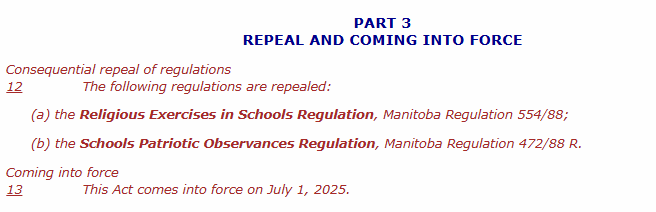
Bill 40 is titled, “AN ACT RESPECTING “O CANADA” AND OTHER OBSERVANCES AND LAND AND TREATY ACKNOWLEDGEMENTS IN SCHOOLS (EDUCATION ADMINISTRATION ACT AND PUBLIC SCHOOLS ACT AMENDED)”. On March 6, 2025, it was at First Reading.

The part that should interest Canadian secularists and humanists says:

Assuming the bill does pass and come into force, this will be a significant advancement for secularization in Canada. As we are not up-to-speed regarding any Manitoba-based humanists or secularists who may have been involved in advocating for the repeal of these regulations, we’ll content ourselves with referring further reading to the recent BC Humanist article, “In 2023, the BC Humanist Association released Religion in Public School Acts, which documented the provinces that still include provisions to permit prayers and Bible studies in schools.

We join BCHA in their encouragement to Manitoba citizens and residents to contact their Member of Legislative Assembly in support of this provision of Bill 40. The bill has other provisions which are not secularist in nature and deserve evaluation on their own merits.

We also encourage those who are interested in humanism and secularism in Manitoba to procure a copy of Elliot Hanowski’s Toward a Godless Dominion: Unbelief in Interwar Canada. We recently acquired and read a copy (a book review is forthcoming) and were greatly pleased with the thorough review of Manitoba’s significant history of humanism and atheism during that period. If you’re looking for insights into Canada’s humanist heritage, this is a treasure.

Up For Discussion

If you’re interested in analyzing and discussing this issue, there are actions you can take. First, here at Humanist Heritage Canada (Humanist Freedoms), we are open to receiving your well-written articles.

Second, we encourage you to visit the New Enlightenment Project’s (NEP) Facebook page and discussion group.

Citations, References And Other Reading

  1. Featured Photo Courtesy of : https://www.mhs.mb.ca/docs/sites/legislativebuilding.shtml
  2. https://www.bchumanist.ca/manitoba_plans_to_scrap_religion_in_public_schools_act
  3. https://www.bchumanist.ca/religion_in_public_school_acts
  4. https://www.canlii.org/en/mb/mbqb/doc/1992/1992canlii8482/1992canlii8482.html
  5. https://web2.gov.mb.ca/bills/43-2/b040e.php
  6. https://www.gov.mb.ca/legislature/business/billstatus.pdf
  7. https://web2.gov.mb.ca/laws/regs/current/554-88.php?lang=en

By continuing to access, link to, or use this website and/or podcast, you accept the HumanistFreedoms.com and HumanistHeritageCanada.ca Terms of Service in full. If you disagree with the terms of service in whole or in part, you must not use the website, podcast or other material.

The views, opinions and analyses expressed in the articles on Humanist Freedoms are those of the contributor(s) and do not necessarily reflect the views or opinions of the publishers.

Centre For Inquiry Canada’s Annual Report 2024

Each year, formally organized entities must make available an annual report of their prior year’s activity. In Canada, there are a relatively small number of organization that thar obligated to provide such a report.

Humanist Heritage Canada is not required to publish an annual report because we are not a public organization. However, we maintain an interest in documenting the activity of Canada’s humanist communities.

Centre For Inquiry Canada was founded in Toronto in 2009 and rapidly became one of Canada’s leading secular/humanist organizations. The organizations 2024 report was released via the CFIC website on March 9, 2025.

CFIC’s lead claim for the year appears to be that, “GLOBALLY AND ACROSS CANADA SECULARISM, SCIENCE AND HUMAN RIGHTS HAVE BEEN… UNDER ATTACK.” (all caps courtesy of CFIC). The report provide some description of how it has responded to the situation.

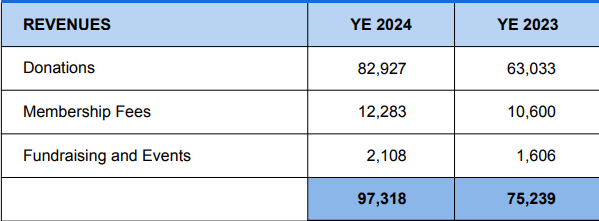
In addition to providing an annual report, CFIC makes available a statement of its financial position. This is a part of the organization’s responsibility as a registered charity. This information helps to reveal information about the organization’s scope and active membership.

Given that CFIC’s membership fees are $45 (individual) and $60 (family), we can determine that CFIC reported a membership of approximately 205-275 people for the year. The annual donation figures provide a much less precise measure of the organization’s scope as these revenues are typically skewed by a small number of large donors. In CFIC’s first years of operations, a single family foundation provided the primary sustenance of the organization.

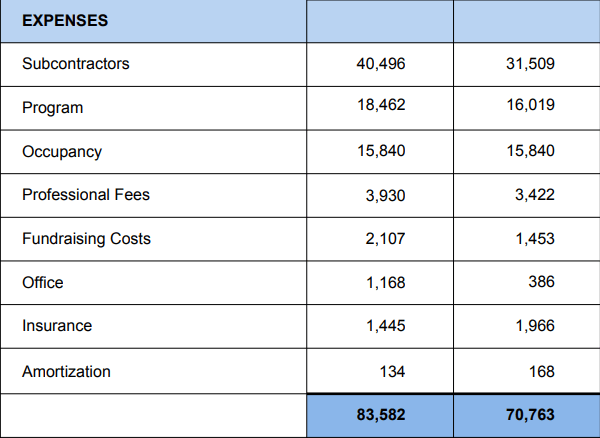
Of some reasonable concern is the distribution of the organization’s expenses as some 41.7% of the organization’s revenues appears to have been sent to “subcontractors”. The annual report does not make clear what the subcontractors did for the organization. Given that this line is the single largest in value for the organizations’ report and that it is more than double the “program” expenses, some additional transparency may be appropriate to explain what the expenses represent.

In a 2008 article, Mark Blumberg posted an article regarding the use of funds by charities, “Some people use the 80/20 rule because the Canadian disbursement quota (DQ) requires charities in most cases to spend 80% of the amount receipted by the charity in the previous year on charitable activities in the following year.  The 80/20 rule is very misleading in terms of overhead as many charities receipt little of their donations and therefore can legally spend much less than 80% of their revenue in the previous year on the subsequent year’s activities and still be compliant with the disbursement quota.  In fact, many charities could take in a lot, and spend nothing, and still be compliant with their disbursement quota obligations.”

Blumberg goes on cite Canada Revenue Agency guidance to assessing the activity of charitable organizations:

“The CRA has come up with a grid for evaluating fundraising expenses based on the percentage of “fundraising costs” to “fundraising revenue”.  The evaluation grid provides:

Ratio of fundraising cost/fundraising revenue in fiscal period

  • Rarely acceptable: more than 70% (charity nets less than 30%)
  • Generally not acceptable: 50% to 70% (charity nets 30% to 50%)
  • Potentially not acceptable: 35.1% to 49.9% (charity nets 50.1% to 64.9%)
  • Generally acceptable: 20% to 35% (charity nets 65% to 80%)
  • Acceptable: less than 20% (charity nets more than 80%)”

Given CFIC’s activity expressing concern regarding the “cost of religion in Canada’ which includes an examination of financial indicators of faith-based charities in Canada, it seems appropriate that CFIC’s financial report receive at least some public, independent third-party scrutiny.

Up For Discussion

If you’re interested in analyzing and discussing this issue, there are actions you can take. First, here at Humanist Heritage Canada (Humanist Freedoms), we are open to receiving your well-written articles.

Second, we encourage you to visit the New Enlightenment Project’s (NEP) Facebook page and discussion group.

Citations, References And Other Reading

  1. Featured Photo Courtesy of :
  2. https://www.canada.ca/en/revenue-agency/services/charities-giving/charities/operating-a-registered-charity/annual-spending-requirement-disbursement-quota/disbursement-quota-calculation.html
  3. https://centreforinquiry.ca/become-a-member-of-cfic/
  4. https://www.canadiancharitylaw.ca/blog/how_much_should_canadian_charity_spend_on_overhead/
  5. https://centreforinquiry.ca/wp-content/uploads/2021/04/CoR-charitable-tax-receipting-revised-may-6.pdf

By continuing to access, link to, or use this website and/or podcast, you accept the HumanistFreedoms.com and HumanistHeritageCanada.ca Terms of Service in full. If you disagree with the terms of service in whole or in part, you must not use the website, podcast or other material.

The views, opinions and analyses expressed in the articles on Humanist Freedoms are those of the contributor(s) and do not necessarily reflect the views or opinions of the publishers.
New Enlightenment Project 2025 Report

Following is the annual President’s message from the New Enlightenment Project (NEP), a Canadian humanist initiative. NEP was founded in 2021 to provide a platform where all subjects of concern to Humanists could be discussed freely and where civilized debate could be held without fear. Since that beginning, NEP appears to have enjoyed continuous growth in scope and activity.


Greetings, fellow humanists,


As President of The New Enlightenment Project (NEP), it is my privilege to present this report to you, reflecting on a year of meaningful progress in our mission to promote reason, science, and compassion as guiding principles in the pursuit of knowledge. I extend my heartfelt gratitude to all of you who have continued to embrace and champion Enlightenment ideals alongside us. Our national non-profit corporation, with board members from Quebec, Ontario, Saskatchewan, Alberta and British Columbia, has made significant strides this past year, and I am excited to share our accomplishments with you.


Publications and Outreach
This past year, we’ve amplified our voice through various publications and partnerships. Humanist Heritage Canada graciously supported our efforts by publishing my 2024 President’s Report online, a gesture we hope will continue in the future. Meanwhile, Humanistically Speaking Magazine, published in the United Kingdom, featured an article I coauthored with [Edan] Tasca of the Centre for Inquiry Canada, entitled Woke Ironies: Achieving the Opposite of Its Stated Goals. In it, we offer a critical analysis of Wokism, which can be viewed as a religion or as a mind virus, often at odds with Enlightenment humanism. We argue that for Wokism to align with its progressive aspirations, it must abandon regressive tendencies, shed racist assumptions, protect all vulnerable individuals regardless of perceived oppression, and foster a compassionate society by forgiving mistakes. This article, available at Woke ironies: achieving the opposite of its stated goals, has sparked discussion and was translated into French for republication in Le Québec Humaniste.

In July 2024, Humanistically Speaking Magazine published another piece I wrote, How pseudoscientific ideas about food and medicine have helped to devalue science, reason, and all things Western. This article, too, was translated into French and appeared in the December issue of Le Québec Sceptique. Additionally, I recently co-authored What Is a Man? with my son and that article is in the Winter 2024 issue of Humanist Perspectives: What is a man? Exploring the concept of gender — Humanist Perspectives Magazine.

I have also written and submitted for publication, From Lawyers to School Children: Deconstructing the Mass Grave Narrative. Starting with B.C. lawyer Jim Heller’s decision last month to suit his professional association for libel, this article examines how a proto-religion has emerged based on a “noble savage myth” that demands facts be twisted or ignored to support a pre-assumed narrative. I also interview Jim about his experiences with cults and the B.C. Law Society for our podcast series:


Events and Interviews
Our outreach efforts have extended beyond the writing of articles. In June 2024, Frances Widdowson interviewed me for her website, The Woke Academy, about the book Grave Error. That same month, I presented to Humanist Canada – Vancouver on the topic of self and identity. In October, I interviewed Nasser Yousefi, head of Toronto’s Peace School. This interview looks into the educational philosophy informing the school and can be found on the NEP website here:
Schools must adapt or become obsolete says head of Toronto’s new “Peace School” – THE NEW ENLIGHTENMENT PROJECT. Fellow board member, Scott Jacobsen, has conducted a series of interviews with the founders of the Toronto Peace School and has published them separately.


Board Contributions
Our board has been instrumental in driving NEP’s mission forward:


Robert Hamilton, Vice-President, wrote the script for our membership invitation. He has also delivered a mini-webinar on Enlightenment humanism, followed by a discussion with Scott Jacobsen. The video is available at https://www.youtube.com/watch?v=VOaUJkoZStQ.


Michel Pion, Treasurer and podcast technician, is designing our new website, set to launch in May 2025.


Ullrich Fischer, Secretary, manages our Facebook page (New Enlightenment Project Discussion Group) and is leading our pursuit of charitable status.


Scott Jacobsen, Director of Advocacy, has been contributed with print interviews such as this one with Lawrence Krauss Dr. Lawrence Krauss Talks About Nothing and Humanism – THE NEW ENLIGHTENMENT PROJECT, and a video interview with Steven Pinker (https://www.youtube.com/watch?v=WI4gSMHEDXM&t=21s). Scott also penned a letter to the federal government advocating for reduced disproportionate religious funding.


George Hewson continues crafting concise, accessible tracts on Humanism and Economics; Humanism and Religion; Humanism and Science; Humanism and The Enlightenment; Humanism and Democracy; Humanism and First Peoples; Humanism and Wokism; and Sexuality and Gender.


Michel Virard, our elder statesman, tirelessly translates and republishes our materials into French.


Frances Widdowson, our newest board member, joined us shortly after a public meeting I attended on behalf of NEP was disrupted by Woke agitators. The unedited video of that event is available at Bing Videos.

Discussion Paper on Palestine
In February 2025, our board released a discussion paper on the Palestine conflict, offering a humanistic and historical perspective. It examines the roles of colonization, nationalism, and religion in perpetuating the crisis and has sparked valuable discourse, accessible at https://nephumanism.ca/2025/02/28/discussion-paper-on-palestine/. The discussion paper is a “living document” in that it will change with new information and perspectives.


Looking Ahead
Ours is a working board of dedicated individuals each committed toward working together in humanism. As we approach the midpoint of 2025, NEP remains committed to advancing Enlightenment humanism across Canada and beyond. With a new website on the horizon, ongoing advocacy efforts, and a growing body of published work, we are poised to deepen our impact. I thank our board, members and supporters for their unwavering dedication to this cause. Together, we will continue to illuminate the path forward with reason, science, and compassion.


Going forward in humanism,


Lloyd Hawkeye Robertson, President
The New Enlightenment Project: A Canadian Humanist Initiative

Up For Discussion

If you’re interested in analyzing and discussing this issue, there are actions you can take. First, here at Humanist Heritage Canada (Humanist Freedoms), we are open to receiving your well-written articles.

Second, we encourage you to visit the New Enlightenment Project’s (NEP) Facebook page and discussion group.

Citations, References And Other Reading

  1. Featured Photo Courtesy of : New Enlightenment Project
  2. https://www.humanisticallyspeaking.org/post/woke-ironies-achieving-the-opposite-of-its-stated-goals
  3. https://nep-humanism.ca/about/
  4. https://www.humanisticallyspeaking.org/post/how-pseudoscientific-ideas-about-food-and-medicine-have-helped-to-devalue-science-reason-and-all-t
  5. https://nep-humanism.ca/2024/10/14/schools-must-adapt-or-become-obsolete-says-head-of-torontos-new-peace-school/
  6. https://nep-humanism.ca/2025/01/26/lawrence-krauss-nothing-humanism/

By continuing to access, link to, or use this website and/or podcast, you accept the HumanistFreedoms.com and HumanistHeritageCanada.ca Terms of Service in full. If you disagree with the terms of service in whole or in part, you must not use the website, podcast or other material.

The views, opinions and analyses expressed in the articles on Humanist Freedoms are those of the contributor(s) and do not necessarily reflect the views or opinions of the publishers.