Category Archives: Uncategorized

How Woke puritanism can lead to fatal consequences – Reflections on the death of Richard Bilkszto

By Dr Lloyd Hawkeye Robertson

Lloyd Hawkeye Robertson is a semi-retired psychologist with the University of Regina, Canada and President of the New Enlightenment Project: A Canadian Humanist Initiative. In this article he suggests that Wokism may have evolved into a puritanical fundamentalist religion or a mind virus. But whether it is a religion or virus, the antidote is to be found in valuing and teaching science, reason and compassion.

Author’s introductory note

Richard Bilkszto

The term “woke” when used as an adjective is often derogatory but I do not mean it as a slur. I see Wokism as a social phenomenon that combines elements of post-modernism, Marxism, Heideggerian Fascism, feminism, the 1960s civil rights movement, the 1980s self-esteem movement, Romanticism, and New Age philosophy into an evolving and often contradictory movement that gives a Gnostic feeling of superior knowing to its adherents. Cult-like, this phenomenon refuses to be named so we have to give it one so that it can be studied. My preferred name is actually “Woke Identitarianism”. In this article, I use the capitalised terms Woke and Wokism to refer to this social phenomenon.

Dawkins and the American Humanist Association

In 2021, Richard Dawkins tweeted: “In 2015, Rachel Dolezal, a White chapter president of the National Association for the Advancement of Colored People, was vilified for identifying as Black. Some men choose to identify as women, and some women choose to identify as men. You will be vilified if you deny that they literally are what they identify as. Discuss.” Dawkins, who is a humanist and evolutionary biologist, was in turn vilified on social media for posing this challenging question. The American Humanist Association went so far as to revoke the Humanist of the Year award they gave him in 1996. In a subsequent article, a co-author and I (Robertson & Tasca, 2022) predicted:

‘Dawkins will be just fine. But those who aren’t humanist legends are much more cancellable. Perceived challenges to woke orthodoxy have resulted in social isolation, career opportunities drying up, campus lectures cancelled, and firings (Applebaum, 2021). There are even professors – liberal professors – who are legitimately scared of their students (Schlosser, 2015). Still other victims of the woke attack machine, most tragically, have killed themselves (Hartocollis, 2020). It’s impossible to suspect that all this carnage is an accident. The carnage is the point; it’s meant to scare us into compliance.’ (pp. 24, 25)

A story of Richard Bilkszto

This article is about the July 13, 2023 suicide of one such non-legend. Richard Bilkszto refused to be scared into compliance when confronted by statements he knew to be false. He had been a school principal in both Canada and the United States, and he had been a lifelong activist against racism and bigotry. He had retired from education in 2019, but the Toronto District School Board asked him to return as a contract principal to assist with a faltering adult education project. He was thanked by his employer for saving the project and offered an extension, but when Kike Ojo-Thompson, a Diversity, Equity and Inclusion (DEI) trainer at a mandatory staff training session, asserted that Canada was a much more racist country than the United States, Bilkszto politely stated that the record of Canada’s public schools, progressive tax system and health care system suggested otherwise.

If the DEI instructor was a humanist we would expect that she would have either acknowledged Bilkszto’s data or countered it with data of her own. Instead, Kike Ojo-Thompson’s initial reaction to Bilkszto was to say that “We are here to talk about anti-Black racism, but you in your whiteness think that you can tell me what’s really going on for Black people.” (National Post, para. 8) The Post said that in this she “insinuated” that Bilkszto was a white supremacist. She told those in attendance, “Your job in this work, as white people, is to believe” (Subramanya & Blaff, 2023, para. 35). Bilkszto was silenced due to his race. The executive superintendent of education for his school board thanked Ojo-Thomson for modelling the way to combat anti-black racism. In the next of the series of four DEI sessions Ojo-Thompson told Bilkszto and 200 of his colleagues, “One of the ways that white supremacy is upheld, protected, reproduced, upkept, defended is through resistance… I’m so lucky that we got perfect evidence, a wonderful example of resistance that you all got to bear witness to, so we’re going to talk about it, because, I mean, it doesn’t get better than this.” (Subramanya & Blaff, 2023, para. 42). During this session other attendees were encouraged to criticize Bilkszto’s “whiteness”. No one dared defend him. The day after this session Bilkszto filed for sick leave.

Bilkszto filed a complaint with school officials. In August 2021, the Ontario Workplace Safety and Insurance Board awarded him seven weeks of lost pay for workplace harassment. But this did not end the matter. When informed that he would not receive any more contracts he began a lawsuit for damages. The lawsuit cited Ojo-Thompson’s “defamatory statements” and the unwillingness of The Toronto District School Board to stand up for him. It said Bilkszto had suffered “embarrassment, scandal, ridicule, contempt, and severe emotional distress”. In response to the law suit the school board made a statement of claim against the DEI training company, the KOJO Institute, for “breach of contract” in creating the conditions that led to Bilkszto’s distress (Sarkonak, 2023). Despite the strength of his legal case, Bilkszto continued to experience social media harassment and distress. His friend, Michael Teper, explained: “It was not only his job that was taken away from him, but his reputation, because those very people were assassinating his character. They claimed he was a white supremacist, that he was a racist. They knew nothing about him. They knew nothing about what he stood for or what he believed.” (Subramanya & Blaff, 2023, para 15)

We do not know how the social media campaign targeting Bilkszto was organised, but the New Enlightenment Project uncovered the Woke instructions to their followers when organising a counter-demonstration in Ottawa, Canada, earlier this year. Nowhere in the instructions was there any mention of the arguments of their opposition. Woke followers were only told they were demonstrating against “fascists” and “Nazis” when, in fact, they were demonstrating against people who did not want biological males in girl’s washrooms in school. Further, the Woke were instructed not to engage in conversations with other people but were given a list of slogans they should shout. If a reporter or another individual were to attempt to engage them in conversation they were to shout the slogans louder. Our observers at the event report that these counter-demonstrators followed the script they were given.

Like the Puritans during the “Great Awakenings” of the 18th and 19th centuries, the only thing these modern Woke need to know about victims of their mobbings is that they are sinners. The Great Awokening of the 21st century has changed the meaning of the word “racism” to “sin”. As we have seen, Dawkins and Bilkszto were not guilty of racism by any meaningful definition of the word, but they were guilty of challenging the words of those the Woke believe to be holy. In ordinary language, they sinned against the religion.

Steven Pinker and the formation of a quasi-religion

At the beginning of this century, Steven Pinker (2003) noted that a proto- or quasi-religion had formed that accepts on faith three myths: the blank slate, the ghost in the machine and the noble savage. The blank slate myth holds that we are totally the product of culture and can be moulded through the use of words, as is found in the practice of political correctness. The ghost in the machine myth holds that we are born with some essence that defines us – gender or race – as the Woke, so divine. The noble savage myth romanticises aboriginal people, but ultimately leads to the belief that modern civilization is evil and should be destroyed so that mankind can return to a “state of nature” as found in tribal societies. Since Pinker (2018) demonstrated that we live longer, are better educated, and experience less sexism, slavery, malnutrition, child mortality and xenophobia than at any other time in human history, he has run afoul of Woke dogma. They did not challenge his data but accused him of being a Nazi and a sympathizer of paedophilia. He was also accused of being a racist because he cited black authors in his work, thus appropriating their thoughts. Like Dawkins, Pinker may be “uncancellable” but as the example of Bilkszto demonstrates, the effect on ordinary people can be devastating.

In 2022, I engaged in a lengthy exchange with a Woke sympathizer on a humanist social media discussion group. She repeated the common trope that to be Woke is to simply be “awake” to racism. She saw herself as a “good Woke” who was against cancelling speakers, arranging to have people fired for expressing unwoke ideas, mobbing people on social media, or enforcing political correctness. I asked her why these good Woke failed to defend Steven Pinker when a petition was raised to have him cancelled as a distinguished fellow of the Linguistic Society of America. She replied that the good Woke were probably afraid of being called “right wing” by the not so good Woke. I believe this attitude is what ultimately killed Richard Bilkszto.

If Bilkszto really was a white supremacist, calling him one would not affect his social standing. His friends would still talk to him. Further, the slings thrown at this hypothetical white supremacist would merely be part of a larger war in which he participates. But Bilkszto found himself alone. His employer and colleagues deserted him. His solid legal case was not sufficient to protect his psyche.

Applebaum (2021) explained, “the first thing that happens once you have been accused of breaking a social code, when you find yourself at the center of a social-media storm because of something you said or purportedly said. The phone stops ringing. People stop talking to you. You become toxic.” She said most of the victims of the Woke, whom she calls “The New Puritans,” were liberals.

Humanists, liberals and socialists are most vulnerable to the slurs the Woke use exactly because we have traditionally opposed racism, fascism, sexism and all forms of bigotry. As a result, when people are accused of these things we tend to cast a wary eye in their direction. When we ourselves are accused we tend to assume we have been misinterpreted and we may apologize for our choice of words. The Woke view all apologies as an admission of guilt, with the result that they press with even more vigour. Humanists tend to give sympathy to people who proclaim themselves to be anti-racist, and this can lead to impotence when observing a vicious attack like the one launched against Richard Bilkszto. We need to uphold the humanist valuing of science, reason and compassion. Facts are not racist, but interpretations that ignore facts often are. The silencing of Bilkszto because of his race was itself a racist act. Humanist compassion dictates that we spring to the defence of the Richard Bilksztos of the world.

It may be that Wokism has evolved into a puritanical fundamentalist religion since Pinker made his initial observations two decades ago. I have offered an alternative explanation. Using Dawkins’ (1976, 1982) concept of the meme and taking the self as a mental analogue to the body, I have shown how evolved cultural units can act as mind viruses (Robertson, 2017) and how Woke identitarianism fits such a definition (Robertson, 2021). But whether it is a religion or a virus, the antidote is to be found in valuing and teaching science, reason and compassion. Richard Bilkszto needed the support of those who share this understanding.

References

Applebaum, A. (2021, Aug. 31). The New Puritans. The Atlantic.

Dawkins, R. (1976). The Selfish Gene. Oxford University Press.

Dawkins, R. (1982). The Extended Phenotype: The gene as the unit of selection. W.H. Freeman.

Hartocollis, A. (2020). He Was Accused of Enabling Abuse. Then Came a Downward Spiral. New York Times. https://www.nytimes.com/2020/01/04/us/dartmouth-lawsuit-bucci.html

Pinker, S. (2003). A biological understanding of human nature. In J. Brockman (Ed.), The New Humanists: Science at the edge (pp. 33-51). Barnes & Noble.

Pinker, S. (2018). Enlightenment Now: The case for reason, science, humanism, and progress. Penguin.

Robertson, L. H. (2017). The infected self: Revisiting the metaphor of the mind virus. Theory & Psychology, 27(3), 354-368. https://doi.org/10.1177/0959354317696601

Robertson, L. H. (2021). Year of the virus: Understanding the contagion effects of wokism. In-sight, 26(B). Retrieved March 1, from https://in-sightjournal.com/2021/02/22/wokism/

Robertson, L. H., & Tasca, E. (2022). Waking from Wokism: Inoculating Ourselves against a Mind Virus. Free Inquiry, June/July, 21-25.

Sarkonak, J. (2023). Principal berated for ‘white supremacy’ sues TDSB over equity training. National Post https://nationalpost.com/opinion/principal-berated-for-white-supremacy-sues-tdsb-over-equity-training

Schlosser, E. (2015). I’m a Liberal Professor, and My Liberal Students Terrify Me Vox, (June 3). https://www.vox.com/2015/6/3/8706323/college-professor-afraid

Subramanya, R., & Blaff, A. (2023). A Racist Smear. A Tarnished Career. And the Suicide of Richard Bilkszto. The Free Press. https://www.thefp.com/p/a-racist-smear-a-tarnished-career-suicide

More about the New Enlightenment Project

THE NEW ENLIGHTENMENT PROJECT – A Canadian Humanist Initiative (nep-humanism.ca)


Citations, References And Other Reading

  1. Featured Photo Courtesy of : Dr. Lloyd Robertson
  2. https://www.humanisticallyspeaking.org/post/how-woke-puritanism-can-lead-to-fatal-consequences-reflections-on-the-death-of-richard-bilkszto
  3. https://nationalpost.com/opinion/letters-tragic-suicide-of-bullied-school-principal-demands-a-full-inquiry
  4. https://nypost.com/2023/08/05/dei-teacher-mocked-principal-richard-bilkszto-who-later-killed-himself-audio/
  5. https://quillette.com/2023/07/21/rip-richard-bilkszto/

The views, opinions and analyses expressed in the articles on Humanist Freedoms are those of the contributor(s) and do not necessarily reflect the views or opinions of the publishers.

By continuing to access, link to, or use this website and/or podcast, you accept the HumanistFreedoms.com and HumanistHeritageCanada.ca Terms of Service in full. If you disagree with the terms of service in whole or in part, you must not use the website, podcast or other material.

The Humanist Freedoms Podcast by Humanist Heritage Canada: Episode One

We are proud to announce the (somewhat later-than-expected) launch of the Humanist Freedoms Podcast by Humanist Heritage Canada!

Episode One of the podcast features the first in a series of readings from Henry Beissel’s collection of essays titled, Catastrophic Glory.

We hope you enjoy the podcast episode and look forward to your feedback regarding each episode as well as your ideas for future episodes.

Citations, References And Other Reading

  1. Featured Photo Courtesy of : Henry Beissel

The views, opinions and analyses expressed in the articles on Humanist Freedoms are those of the contributor(s) and do not necessarily reflect the views or opinions of the publishers.

By continuing to access, link to, or use this website and/or podcast, you accept the HumanistFreedoms.com and HumanistHeritageCanada.ca Terms of Service in full. If you disagree with the terms of service in whole or in part, you must not use the website, podcast or other material.

Salman Rushdie in 2023: Where are contemporary attacks on Free Speech coming from?

Citations, References And Other Reading

  1. Featured Photo Courtesy of : 

The views, opinions and analyses expressed in the articles on Humanist Freedoms are those of the contributor(s) and do not necessarily reflect the views or opinions of the publishers.

By continuing to access, link to, or use this website and/or podcast, you accept the HumanistFreedoms.com and HumanistHeritageCanada.ca Terms of Service in full. If you disagree with the terms of service in whole or in part, you must not use the website, podcast or other material.
Outrage Canada: Holding the RCC Accountable


Outrage Canada is a national, non-religious coalition of outraged Canadians that hold the Roman Catholic church of Canada accountable for ongoing crimes and advocates for all victims of Catholic clergy. This new organization is committed to ensuring justice for victims, the safety of all children and the prevention of abuse by the Roman Catholic Church and its clergy.

Earlier this year, the group launched a petition on Change.org calling for the Government of Canada to investigate and act on their concerns. The petition states:

We, the undersigned, Citizens of Canada, call upon the Government of Canada to immediately begin a complete investigation of the archives of all 61 Roman Catholic dioceses in Canada to:


a. Assure the Canadian public that children and adults are safe;

b. Ensure that justice will be sought for all victims and their families;

c. Ensure that the Roman Catholic Church in Canada will be fully accountable for its actions and is no longer protecting predatory clergy; and

d.  Alert the police about all historic cases so that they can determine if there are any other victims.

The website also has valuable information and tools for those who care about these issues to get active. Perhaps this is an organization that deserves your time and attention.


Citations, References And Other Reading

  1. Featured Photo Courtesy of : 
  2. https://www.change.org/p/government-of-canada-to-investigate-the-archives-of-61-catholic-dioceses-in-canada?recruiter=1295933369&recruited_by_id=c2bc5b90-b144-11ed-b9cd-07816ca05af4&utm_source=share_petition&utm_medium=copylink&utm_campaign=petition_dashboard

The views, opinions and analyses expressed in the articles on Humanist Freedoms are those of the contributor(s) and do not necessarily reflect the views or opinions of the publishers.

By continuing to access, link to, or use this website and/or podcast, you accept the HumanistFreedoms.com and HumanistHeritageCanada.ca Terms of Service in full. If you disagree with the terms of service in whole or in part, you must not use the website, podcast or other material.

Humanism in Malta

By: Isaac Saliba, The Malta Independent

Sunday, 27 August 2023

Maltese society and culture are deeply intertwined with Catholicism and religion as a whole. The teachings of Christianity and the Catholic Church are prevalent from a young age and the subject of religion is taught in many primary and secondary schools, often also revolving around Christianity for the majority of the syllabus. Many children and teenagers are also encouraged to be part of organisations devoted to Christian teaching.

However in recent times there has been a growing trend of more people identifying as either being atheist or having no religious affiliation. When reviewing shifts in society’s treatment of religion, one must wonder if perhaps the point of contention lies with the idea of “organised religion” rather than religious belief itself.

The Malta Independent on Sunday reached out to Alison Vella, a member of Humanists Malta, and spoke about their campaigns and what could be the reasons behind this shift in society.

Vella said: “I think that with the internet and with people having access to more knowledge, people are raising more questions, and knowledge tends to spread quite a bit.” She added that with access to knowledge and data, people are likely to question more as opposed to the past where there was a lack of availability of information. “You were told this, don’t question it, and just go on about your day.

She said that religion’s origins came about in early civilisations, where scientific discoveries were still to be made. She used weather as an example, referring to things such as thunderstorms, where early civilisations linked such phenomena to gods. She attributes the increasing prevalence of atheism and humanism to more accessible science-based knowledge and discussion.

Vella was asked why humanism is so often linked to atheism despite being distinct from one another. She said that although they are similar, humanism is not exactly a form of atheism. She explained that humanism focuses on science so those who are humanists tend to also be atheists. “The idea is to work towards a more compassionate goal for humanity, there’s a lot of philosophy involved and it touches a lot with existentialism.” She emphasised Humanists Malta’s belief in bodily autonomy and that one should not harm others.

In regards to humanism’s relation to religion, she said: “We don’t mind if anyone is religious. We understand that it is culture and we understand it’s coming from a very long line of how humans have come together and society has been built.” Vella added that Humanists Malta does not condone discrimination towards any religion or those who are not religious.

An argument one may commonly find thrown around during any debate regarding religion and atheism is the claim that one cannot have good moral values without a religious guideline. Vella was asked what her thoughts about this are, to which she said that it is something that often comes up in discussions from her experience.

She added that in her opinion if someone is an atheist and a good person it is more definitive that they are truly good because they have no incentive behind their behaviour. “I do find that there are a lot of religious people who just behave in a particular way out of fear and feeling that they have to because they were always indoctrinated in that way and don’t really question it.” Vella said that this does not mean being an atheist automatically makes you a good person, as there are those who are good and those who are bad, “but the ones who are good are that way because they are genuinely good people … I don’t believe that you need to be religious to be a good person”.

Humanists Malta currently forms part of the coalition for pro-choice, but takes on the role of a supporting organisation as opposed to the “drivers”, she explained. They form part of this organisation due to their belief in bodily autonomy. Vella said that a campaign they are very interested in pushing themselves is that of Assisted Dying, commonly referred to as euthanasia. “It’s not nice, we’re not dealing with easy topics, we’re dealing with heartbreaking scenarios, but we believe that if someone would like to take their own life in the most humane way possible because they are suffering then it is entirely up to them and there should be no other person or government that can decide for you.”

Staying on the topic of bodily autonomy, we moved on to talk about the pro-choice movement in the Maltese islands. Malta has already ratified laws that go against certain doctrines, said laws being divorce and gay marriage, and the current primary point of contention is that of abortion becoming legal. Among members of the European Union, Malta has some of the most restrictions when it comes to abortion. Vella said that in this regard she has seen some improvements but thinks that there needs to be more done.

She remarked that whenever she speaks to foreigners who have not visited Malta they are always shocked to hear that abortion is illegal. “They’re always very surprised and they don’t understand it.” Vella said that from her experience, she finds a lot of pushback from most Maltese people when it comes to abortion, though she has met others who are “very pro-choice”. She explained that there are often mixed and very strong emotions from both ends.

The ones who are staunchly against it, for them it’s a sin and it’s not on. They will actually judge you if you have a different opinion. Then there’s the other side who are pro-choice and are angry at the fact that we are living in an allegedly progressive country, but it’s really not to some degree. Some things are progressive and some aren’t.” She said that the government needs to take a stance and be fair with the choices and options provided to the population, “because at this point it’s not fair and it’s very much what they want and how they want the country to perceive them for votes”.

The Malta Independent on Sunday brought up a recent situation regarding Malta’s national anthem, in which there was some discussion about adopting a new national anthem, namely Tema 79. In this instance we focused on the religious aspect of the national anthem and how it is essentially a prayer to God, and posed the question as to whether or not this is fitting for Malta as a secular country.

Vella said that when it comes to culture and secularism, one needs to look at what is actually important. “I personally like that there’s still quite a cultural influence in Malta. What I don’t like is if the Catholic side of things influences regulations and legislations.” She said that at the end of the day Malta is predominantly a Catholic country and finds no issue with the national anthem as it is. “What I don’t want is that the state imposes legislation that goes against choice … in essence it is not up to the government’s choice. It is our body and it is what we want to do.

Citations, References And Other Reading

  1. Featured Photo Courtesy of : The Malta Independent.

The views, opinions and analyses expressed in the articles on Humanist Freedoms are those of the contributor(s) and do not necessarily reflect the views or opinions of the publishers.

By continuing to access, link to, or use this website and/or podcast, you accept the HumanistFreedoms.com and HumanistHeritageCanada.ca Terms of Service in full. If you disagree with the terms o

Poetry Readings From Henry Beissel: An Event

Details

An Exclusive Evening of Poetry & Conversation with Henry Beissel

Save the Date! This October, experience an unforgettable night of literary brilliance brought to you by the Centre for Inquiry Canada (Ottawa Branch) and Humanist Ottawa.

📅 Tuesday, October 10, 2023

⏰ 7:30 PM – 9:30 PM

📍 Bronson Centre, 211 Bronson Avenue, Ottawa, ON K1R 6H5

Don’t miss this extraordinary chance to witness live readings from Henry Beissel, the award-winning poet and Distinguished Emeritus Professor at Concordia University. Henry’s contributions to the world of academia and literature are unparalleled, making this an evening you won’t want to miss!

Featured Works: Dive into the poetic world of Henry Beissel with select readings from his captivating collections:

– When Africa Calls Uhuru

– Fugitive Horizons

– Sightlines

– Footprints of Dark Energy (Ottawa Book Awards Winner, 2020)

🔗 Learn More: [www.henrybeissel.com]

Why You Should Attend:

– Engage in an enriching Q&A session with the poetic genius himself!

– Celebrate the indomitable spirit of academic freedom, freedom of expression, and freedom of the press that Henry so ardently advocates.

About Henry Beissel:

A pillar of Canada’s literary scene for over five decades, Henry founded the thriving Creative Writing program at Concordia University and is the author of over 30 books, ranging from poetry to plays and translations. His play “Inuk and the Sun” gained international acclaim and has been translated into numerous languages. A stalwart defender of freedoms, Henry led the Freedom of Expression Committee of the Book and Periodical Council of Canada in the 1980s and has been a driving force behind various influential organizations.

Seats are filling up fast, so mark your calendars and prepare for a night of inspiration and wonder. We look forward to sharing this unique experience with you!

Citations, References And Other Reading

  1. Featured Photo Courtesy of : Henry Beissel

The views, opinions and analyses expressed in the articles on Humanist Freedoms are those of the contributor(s) and do not necessarily reflect the views or opinions of the publishers.

By continuing to access, link to, or use this website and/or podcast, you accept the HumanistFreedoms.com and HumanistHeritageCanada.ca Terms of Service in full. If you disagree with the terms o

Ending Religious Objections: A Webinar by BC Humanists

Visit BC Humanists’ Website

In this webinar, we’ll speak about the Government of British Columbia’s Master Agreement with religious healthcare facilities that allows some hospitals to ‘opt-out’ of providing patients with procedures that they’re legally entitled too.

This means your right to MAID or an abortion is subject to the whims of Catholic Bishops and not the rule of law.

We’ll give you the tools to help end these religious opt-outs.

Special Guest: Dying With Dignity Canada’s CEO Helen Long will be joining us for part of the discussion.

Image credit: Wikimedia/Joe Mabel

WHEN

August 29, 2023 at 7:00pm – 8pm

WHERE

Zoom (RSVP for link)

Petition to Ontario’s Government to End Public Funding of Catholic School Systems

Posted on behalf of CRIPE, Secular Connexion, OPEN, Center For Inquiry Canada , and Humanist Ottawa and the hundreds of people who have worked on this issue for the past 30+ years.

MPP Jessica Bell (NDP University-Rosedale) has agreed to present a petition at Queen’s Park, calling for the elimination of public funding for the Catholic School systems. We need your assistance in circulating physical copies of the attached petition and returning them to Petitions / Centre for Inquiry Canada | PO Box 83045, Ottawa RPO Bank Walkley, Ontario K1V 1A3 no later than October 1, 2023.

Your signature will help to ensure that this petition is presented in the provincial legislature and will attract media attention and raise public awareness. This is another step in the eventual, inevitable withdrawal of discriminatory public funding for a school system that is not open to all.

Please help us to get signatures. Please share the petition on social media, through your website, in person at any events you hold, and by requesting that your members sign and share it. (The petition is attached to this email. You are encouraged to upload it to your website and otherwise make it available to supporters in Ontario.)

To be presented to the Legislative Assembly, a petition must meet the following rules (taken from https://www.ola.org/en/get-involved/petitions):

  • It must ask for an action that is within the jurisdiction of the Legislative Assembly.
  • It must use clear and respectful language.
  • The text of the petition must be at the top of every page of signatures.
  • All signatures must be original. They must be written directly on the petition.
  • Each petitioner must print their name and address and sign their name under the text of the petition.
  • Petitioners must be residents of Ontario.
  • The petition must be addressed to the Legislative Assembly of Ontario.
  • The petition must be written, typewritten, or printed. Emailed, faxed, photocopied, or online petitions are not allowed.

Please note:

Do not change or annotate the petition. Any changes, including written notations may invalidate the form, including all signatures on the page. If you have technical questions please contact Petitions@Centreforinquiry.caFor more information about the elimination of funding for the Catholic School system see: http://open.cripeweb.org/aboutOpen.html

Citations, References And Other Reading

  1. Featured Photo Courtesy of : 

The views, opinions and analyses expressed in the articles on Humanist Freedoms are those of the contributor(s) and do not necessarily reflect the views or opinions of the publishers.

By continuing to access, link to, or use this website and/or podcast, you accept the HumanistFreedoms.com and HumanistHeritageCanada.ca Terms of Service in full. If you disagree with the terms o

The Magdalene Laundries: Phoebe Judge and the Criminal Podcast Team Tell the Story

Episode 216 of Criminal, a podcast hosted by Phoebe Judge tells a story of Ireland’s Magdalene Laundries where some 10,000 to 30,000 women and girls were confined, abused and enslaved. The laundries were typically operated by the Roman Catholic church.

As a Canadian humanist publication, well aware of various abuses and human rights violations that the Catholic Church has been connected-to in Canada and around the world, what caught our particular attention was the podcast’s statement that, “The women did the laundry for all kinds of local businesses including the Royal Dublin Hotel, the Fitzwilliam Lawn Tennis Club and the French, Argentinian and Canadian embassies. They washed sheets for hospitals…”

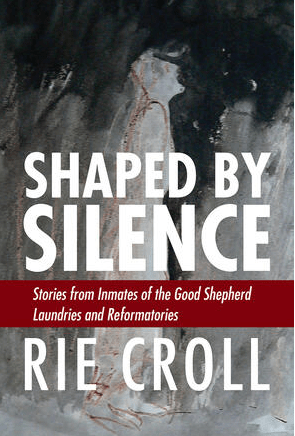
Lest we think that the Magdalene Laundries were a uniquely Irish matter that touches Canada solely via criminally lax supply chain expectations, the Toronto Star reported in 2016 about a Canadian researcher who had been gathering information regarding laundries operated in Canada as well. That research resulted in the book, Shaped By Silence: Stories from Inmates of the Good Shepherd Laundries and Reformatories published in 2019.

There is an valuable interview with Croll published in the National Post in 2019 as well…and we’ll merely quote that article briefly:

“The state was working with the Church, and families were too….“The very system of incarceration that was supposed to reform them, became a significant factor in shaping their lifelong inequality,” Croll said. “Those who the Church and state targeted for saving were simultaneously treated as bad, dirty and unsalvageable.”

The article’s title, by the way reminds us that these institutions operated in Canada as recently as the 1960s. While there seems to be significantly less information available about these operations in Canadian society than in Irish society, there seems to be every reason to assume that the Roman Catholic church is consistent in its methods.

To learn more about the (Irish) Magdalene Laundries, you may wish to visit the Justice for Magdalenes Research website. The organization has recently published, A Dublin Magdalene Laundry: Donnybrook and Church-State Power in Ireland. It is a a new collection of essays co-edited by Mark Coen, Katherine O’Donnell and Maeve O’Rourke, with further contributions by Maolíosa Boyle, Lindsey Earner-Byrne, Chris Hamill, Máiréad Enright, Brid Murphy, Martin Quinn, Lynsey Black, Laura McAtackney, Brenda Malone, Barry Houlihan and Claire McGettrick.

In the name of all of the girls and women held in the Magdalene Laundries the editors are donating all authors’ royalties to the charity Empowering People in Care.

The editors have written to Minister Roderic O’Gorman to request that the Magdalene Restorative Justice Implementation Team provide a copy of the book to every survivor who wishes to receive one.

The book’s front matter is available free of charge here.

This book offers a comprehensive exploration of the Magdalene system through a close study of Donnybrook Magdalene Laundry (DML) in Dublin. The disciplinary perspectives featured include history, philosophy, law, archaeology, criminology, accounting, architecture, archival studies and heritage management.

By focusing on this one institution–on its ethos, development, operation and built environment, and the lives of the girls and women held there–this book reveals the underlying framework of Ireland’s wider system of institutionalisation. The analysis includes a focus on the privatisation and commodification of public welfare, reproductive injustice, institutionalised misogyny, class prejudice, the visibility of supposedly ‘hidden’ institutions and the role of oral testimony in reconstructing history. In undertaking such a close study, the authors uncover truths missing from the state’s own investigations; shed new light on how these brutal institutions came to have such a powerful presence in Irish society, and highlight the significance of their continuing impact on modern Ireland.

Citations, References And Other Reading

  1. Featured Photo Courtesy of : http://jfmresearch.com/

The views, opinions and analyses expressed in the articles on Humanist Freedoms are those of the contributor(s) and do not necessarily reflect the views or opinions of the publishers.

By continuing to access, link to, or use this website and/or podcast, you accept the HumanistFreedoms.com and HumanistHeritageCanada.ca Terms of Service in full. If you disagree with the terms of service in whole or in part, you must not use the website, podcast or other material.

Majority of Canadians Choose Evolution in a Researchco.ca Poll

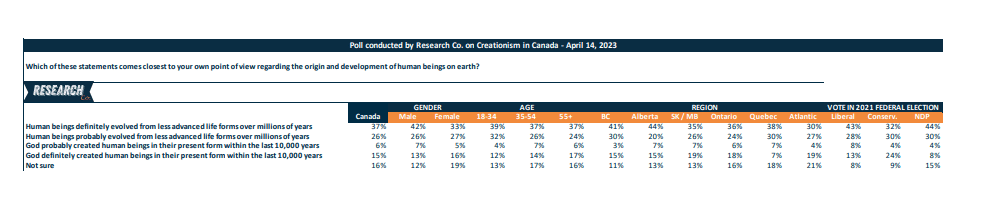
More than three-in-five  Canadians side with evolution when asked about the origin and development of human beings on earth, a new Research Co. poll has found.

In the online survey of a representative national sample, 63% of Canadians think human beings evolved from less advanced life forms over millions of years, down two points since a similar Research Co. poll conducted in March 2022.

Just over one-in-five Canadians (21%, +3) believe God created human beings in their present form within the last 10,000 years, while 16% (-2) are not sure.

Canadians aged 18-to-34 are more likely to endorse evolution (71%) than their counterparts aged 35-to-54 (63%) and aged 55 and over (61%).

More than a quarter of Canadians who voted for the Conservative Party in the 2021 federal election (28%) think God created human beings in their present form within the last 10,000 years. Fewer Canadians who cast a ballot for the Liberal Party (21%) or the New Democratic Party (NDP) (12%) feel the same way.

Consensus is not as clear when Canadians ponder whether creationism—the belief that the universe and life originated from specific acts of divine creation—should be part of the school curriculum in their province.

This year, 43% of Canadians (+5) believe there is a place for creationism in the classroom, while 38% (-4) disagree and 19% (-2) are undecided.

“Over the past three years, the numbers have fluctuated wildly on the question of discussing creationism at school,” says Mario Canseco, President of Research Co. “Support peaked at 44% in 2021, fell to 38% in 2022, and has now jumped to 43% in 2023.”

Just under half of Ontarians (47%, +3) and Atlantic Canadians (46%, +15) are in favor of teaching creationism in schools. The proportions are lower in Saskatchewan and Manitoba (41%, +4), Alberta (40%, +9) and British Columbia (39%, +11).

Methodology: Results are based on an online study conducted from April 7 to April 9, 2023, among 1,000 adults in Canada. The data has been statistically weighted according to Canadian census figures for age, gender and region. The margin of error, which measures sample variability, is +/- 3.1 percentage points, nineteen times out of twenty.

Find the data tables here.

Citations, References And Other Reading

  1. Featured Photo Courtesy of : https://chrishart.com/so-what-really-is-evolution/
  2. https://researchco.ca/2023/04/14/evolution-2023/

The views, opinions and analyses expressed in the articles on Humanist Freedoms are those of the contributor(s) and do not necessarily reflect the views or opinions of the publishers.

By continuing to access, link to, or use this website and/or podcast, you accept the HumanistFreedoms.com and HumanistHeritageCanada.ca Terms of Service in full. If you disagree with the terms of service in whole or in part, you must not use the website, podcast or other material.