Tag Archives: atheism

Steve Tomlins’ Navigating Atheist Identities

Choosing to investigate, document and publish Canada’s Humanist heritage, as we have done on this website, it quickly becomes apparent that humanism is a perspective and identity that is quickly obscured by several forces. In some cases, the significant presence of humanism is hidden by its own vocal subcomponents. Proponents of narrow ideologies are often eager to stake ownership of humanism in the service of their (often trendy) preferred ideology. In other cases, proponents of ideologies inconsistent with humanism are eager to portray this identity as less consequential than it is. Some of those proponents are supernatural and religious in nature while others are more secular and political in nature. Either way, it can require a score-card to figure it all out.

Back in 2016, Steve Tomlins submitted a 359-page thesis to the Faculty of Graduate and Postdoctoral Studies at the University of Ottawa in partial fulfillment of the requirements for the Doctorate in Philosophy degree in Religious Studies. In some areas of study, a decade would be considered a long time. The advancement of Humanism in Canada isn’t really one of those areas.

The abstract to the thesis says,

There is very little research that is empirically-based about atheism in Canada; this thesis seeks to contribute foundational knowledge in this area . It begins with a historical and contemporary overview of atheism in Canada by examining its appearance in government, law, and media. It then addresses the question: “How do atheists construct their identities in the context of a religiously diverse Canada?” through an analysis of data collected from participant-observation with an atheist university club, the Atheist Community of the University of Ottawa (ACUO), followed by an analysis of five significant themes which arose from forty life history interviews (twenty with ACUO members; twenty with Ottawa-area atheists who did not belong to an atheist community that met in person). These themes are: loss of religious identity and/or development of atheist identity; group belonging; perceptions of media and public understanding of atheism; the use of the United States for narrative or comparative purposes; and the frequency of receiving a negative reaction simply for being an atheist. This study found that most interviewees perceived the Canadian public and the media as not understanding atheism because the subject is not commonly reported on or discussed, and many said that (ir)religiosity rarely came up in conversations with strangers, acquaintances, or co-workers. These notions were often seen as resulting from a Canadian social etiquette which dictates that controversial subjects should be avoided in order to minimize the risk of causing offense. Moreover, members of the ACUO often said that they joined an atheist community because they wanted a safe space to meet like-minded people with whom they could freely discuss religion without causing offense to religious others. Unlike in findings from the United States, interviewees did not speak of their atheist identities as being considered ‘un-Canadian’ or as excluding them from their conception(s) of Canadian society. While interviewees often said they were selective with whom they decided to express their atheism, most felt quite positive about living as an atheist in Canada, especially compared to the plight of atheists living in other countries, and atheism came across as being ‘just’ another ‘idea’ in a mosaic of cultural ideas.”

Humanist, atheist and agnostic organizations in Canada ought to bear the largest responsibility for creating greater public understanding of their perspectives and for creating appropriate environments for discussion of their ideas. That may, perhaps begin with a clear-eyed study of the perspectives and ideologies contained within the universal label of Humanism. Leaders of humanist organizations across the country should hold themselves accountable to familiarize themselves with the work of Tomlins, Hanowski and others who have undertaken much needed work.

Perhaps also to replicate and publish it for their own communities.

Up For Discussion

If you’re interested in analyzing and discussing this issue, there are actions you can take. First, here at Humanist Heritage Canada, we are open to receiving your well-written articles.

Second, we encourage you to visit the New Enlightenment Project’s (NEP) Facebook page and discussion group.

Citations, References And Other Reading

  1. Featured Photo Courtesy of :
  2. https://ruor.uottawa.ca/server/api/core/bitstreams/572affce-0324-4b23-895b-2fe4d4dfd74d/content

By continuing to access, link to, or use this website and/or podcast, you accept the HumanistFreedoms.com and HumanistHeritageCanada.ca Terms of Service in full. If you disagree with the terms of service in whole or in part, you must not use the website, podcast or other material.

The views, opinions and analyses expressed in the articles on Humanist Freedoms are those of the contributor(s) and do not necessarily reflect the views or opinions of the publishers.

A New Campaign to Oppose Ontario’s Public Funding of Religious School Systems

We have received notice that the Society of Freethinkers (SoFree)and it’s lobbying partner, Secular Connexion, based in the Hamilton/Burlington and Elmira areas (respectively), have launched a new campaign to oppose Ontario’s system of public funding of religious school systems.

Here’s what we’ve been told so far:

Secular Connexion Séculière is a national non-profit lobby group that seeks justice for non-believers. Please join The Society of Freethinkers and us in an e-mail campaign directed at Ontario MPPs to change funding for the RC separate school system by distributing the attached email and MPP contact list to your members and friends.

We want to demonstrate the overwhelming support that exists in Ontario for a change to the current funding of Catholic separate schools.  This e-mail sets out the facts about the current system and the savings that would be generated.

It is being sent to Secular Humanist organizations, religious groups, public school teachers’ organizations and others who have expressed support for this change. Our hope is that an inundation of e-mails from various sources, including from non-Catholic religious groups, will convince them that it is time for a change. Ontario is a multi-cultural, multi-ethnic, multi-religious province that differs markedly from the Ontario of 1867.

Please distribute the attached e-mail and and contact list  to members of your organizations and to others who may also support this endeavour.

There are many myths and misconceptions around the current funding of the Catholic school system. The email we are asking people to send presents these facts:

• the current full funding of the Catholic school system is not constitutionally guaranteed. The Constitution grants provinces the right to determine the amount of funding for denominational schools if they funded such school systems prior to joining Confederation. Ontario chose to fully fund Catholic elementary and high schools as did Québec. Quebec changed their school system, in 1997, to one based solely on language, not religion, by merely asking the Federal government to let them stop the funding. Newfoundland and Labrador also changed their school system to eliminate funding of Catholic schools.

• 74%1 of Ontarians are not Roman Catholic, but pay for a system that can legally refuse to hire them as teachers, and can exclude their children from its schools.

 • the municipal taxes of Catholics pay for, at most, 8% of the operating costs of the separate system: the balance is paid out of taxes paid by all Ontarians, be they Catholic, Protestant, Atheist, Jew, Muslim, Hindu, etc.

• Ontario could save over $1.5 billion a year by having one non-denominational public school system

 • parents who send their children to non-Catholic private schools pay tuition fees which are generally not tax deductible, and must also pay their municipal taxes, including the education portion


We need our children to learn what unites them, not what divides them.

Please contact either of us for additional information. Should you wish to see the source documents for the figures cited above, these can be provided.

Thank you for your consideration of our proposal.

Doug Thomas, President, Secular Connexion Séculière,
president@secularconnexion.ca
Isobel Taylor, Vice-President, SOFREE, vicepresident@sofree.ca

Up For Discussion

If you’re interested in analyzing and discussing this issue, there are actions you can take. First, here at Humanist Heritage Canada (Humanist Freedoms), we are open to receiving your well-written articles.

Second, we encourage you to visit the New Enlightenment Project’s (NEP) Facebook page and discussion group.

Citations, References And Other Reading

  1. Featured Photo Courtesy of :
  2. https://sofree.ca/
  3. https://www.secularconnexion.ca/2093-2/

By continuing to access, link to, or use this website and/or podcast, you accept the HumanistFreedoms.com and HumanistHeritageCanada.ca Terms of Service in full. If you disagree with the terms of service in whole or in part, you must not use the website, podcast or other material.

The views, opinions and analyses expressed in the articles on Humanist Freedoms are those of the contributor(s) and do not necessarily reflect the views or opinions of the publishers.

Manitoba’s Bill 40

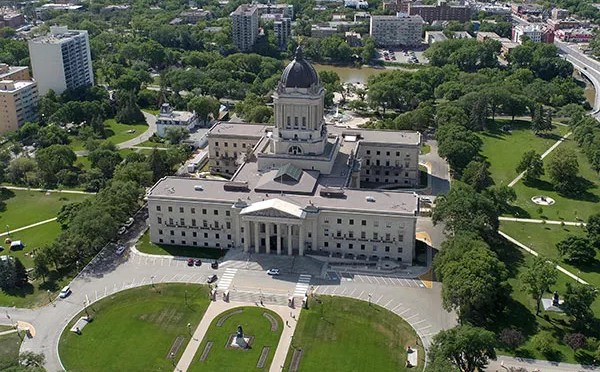
As you may be aware, Humanist Heritage Canada emerged, primarily, from a concern with protecting the freedom of expression in Canada and in support of humanist initiatives to oppose public funding of religion – in schools and other places. It is with these core issues in mind that we note that the current Manitoba government has a bill which may be of tremendous value.

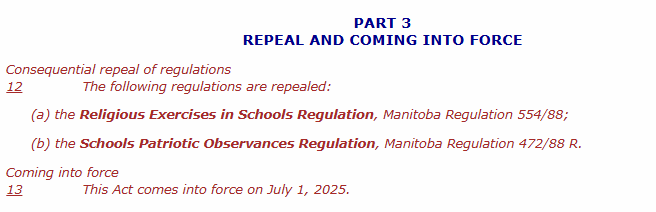
Bill 40 is titled, “AN ACT RESPECTING “O CANADA” AND OTHER OBSERVANCES AND LAND AND TREATY ACKNOWLEDGEMENTS IN SCHOOLS (EDUCATION ADMINISTRATION ACT AND PUBLIC SCHOOLS ACT AMENDED)”. On March 6, 2025, it was at First Reading.

The part that should interest Canadian secularists and humanists says:

Assuming the bill does pass and come into force, this will be a significant advancement for secularization in Canada. As we are not up-to-speed regarding any Manitoba-based humanists or secularists who may have been involved in advocating for the repeal of these regulations, we’ll content ourselves with referring further reading to the recent BC Humanist article, “In 2023, the BC Humanist Association released Religion in Public School Acts, which documented the provinces that still include provisions to permit prayers and Bible studies in schools.

We join BCHA in their encouragement to Manitoba citizens and residents to contact their Member of Legislative Assembly in support of this provision of Bill 40. The bill has other provisions which are not secularist in nature and deserve evaluation on their own merits.

We also encourage those who are interested in humanism and secularism in Manitoba to procure a copy of Elliot Hanowski’s Toward a Godless Dominion: Unbelief in Interwar Canada. We recently acquired and read a copy (a book review is forthcoming) and were greatly pleased with the thorough review of Manitoba’s significant history of humanism and atheism during that period. If you’re looking for insights into Canada’s humanist heritage, this is a treasure.

Up For Discussion

If you’re interested in analyzing and discussing this issue, there are actions you can take. First, here at Humanist Heritage Canada (Humanist Freedoms), we are open to receiving your well-written articles.

Second, we encourage you to visit the New Enlightenment Project’s (NEP) Facebook page and discussion group.

Citations, References And Other Reading

  1. Featured Photo Courtesy of : https://www.mhs.mb.ca/docs/sites/legislativebuilding.shtml
  2. https://www.bchumanist.ca/manitoba_plans_to_scrap_religion_in_public_schools_act
  3. https://www.bchumanist.ca/religion_in_public_school_acts
  4. https://www.canlii.org/en/mb/mbqb/doc/1992/1992canlii8482/1992canlii8482.html
  5. https://web2.gov.mb.ca/bills/43-2/b040e.php
  6. https://www.gov.mb.ca/legislature/business/billstatus.pdf
  7. https://web2.gov.mb.ca/laws/regs/current/554-88.php?lang=en

By continuing to access, link to, or use this website and/or podcast, you accept the HumanistFreedoms.com and HumanistHeritageCanada.ca Terms of Service in full. If you disagree with the terms of service in whole or in part, you must not use the website, podcast or other material.

The views, opinions and analyses expressed in the articles on Humanist Freedoms are those of the contributor(s) and do not necessarily reflect the views or opinions of the publishers.

Centre For Inquiry Canada’s Annual Report 2024

Each year, formally organized entities must make available an annual report of their prior year’s activity. In Canada, there are a relatively small number of organization that thar obligated to provide such a report.

Humanist Heritage Canada is not required to publish an annual report because we are not a public organization. However, we maintain an interest in documenting the activity of Canada’s humanist communities.

Centre For Inquiry Canada was founded in Toronto in 2009 and rapidly became one of Canada’s leading secular/humanist organizations. The organizations 2024 report was released via the CFIC website on March 9, 2025.

CFIC’s lead claim for the year appears to be that, “GLOBALLY AND ACROSS CANADA SECULARISM, SCIENCE AND HUMAN RIGHTS HAVE BEEN… UNDER ATTACK.” (all caps courtesy of CFIC). The report provide some description of how it has responded to the situation.

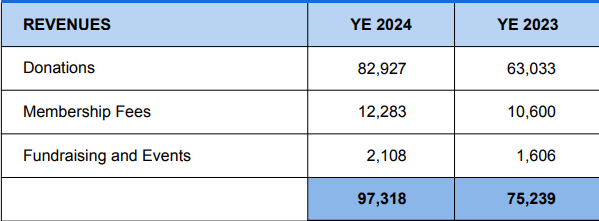
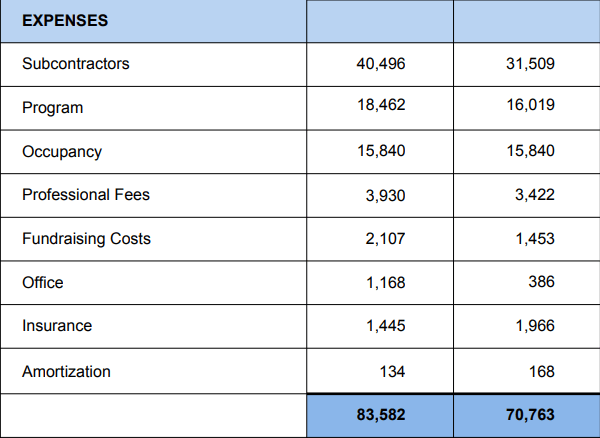
In addition to providing an annual report, CFIC makes available a statement of its financial position. This is a part of the organization’s responsibility as a registered charity. This information helps to reveal information about the organization’s scope and active membership.

Given that CFIC’s membership fees are $45 (individual) and $60 (family), we can determine that CFIC reported a membership of approximately 205-275 people for the year. The annual donation figures provide a much less precise measure of the organization’s scope as these revenues are typically skewed by a small number of large donors. In CFIC’s first years of operations, a single family foundation provided the primary sustenance of the organization.

Of some reasonable concern is the distribution of the organization’s expenses as some 41.7% of the organization’s revenues appears to have been sent to “subcontractors”. The annual report does not make clear what the subcontractors did for the organization. Given that this line is the single largest in value for the organizations’ report and that it is more than double the “program” expenses, some additional transparency may be appropriate to explain what the expenses represent.

In a 2008 article, Mark Blumberg posted an article regarding the use of funds by charities, “Some people use the 80/20 rule because the Canadian disbursement quota (DQ) requires charities in most cases to spend 80% of the amount receipted by the charity in the previous year on charitable activities in the following year.  The 80/20 rule is very misleading in terms of overhead as many charities receipt little of their donations and therefore can legally spend much less than 80% of their revenue in the previous year on the subsequent year’s activities and still be compliant with the disbursement quota.  In fact, many charities could take in a lot, and spend nothing, and still be compliant with their disbursement quota obligations.”

Blumberg goes on cite Canada Revenue Agency guidance to assessing the activity of charitable organizations:

“The CRA has come up with a grid for evaluating fundraising expenses based on the percentage of “fundraising costs” to “fundraising revenue”.  The evaluation grid provides:

Ratio of fundraising cost/fundraising revenue in fiscal period

  • Rarely acceptable: more than 70% (charity nets less than 30%)
  • Generally not acceptable: 50% to 70% (charity nets 30% to 50%)
  • Potentially not acceptable: 35.1% to 49.9% (charity nets 50.1% to 64.9%)
  • Generally acceptable: 20% to 35% (charity nets 65% to 80%)
  • Acceptable: less than 20% (charity nets more than 80%)”

Given CFIC’s activity expressing concern regarding the “cost of religion in Canada’ which includes an examination of financial indicators of faith-based charities in Canada, it seems appropriate that CFIC’s financial report receive at least some public, independent third-party scrutiny.

Up For Discussion

If you’re interested in analyzing and discussing this issue, there are actions you can take. First, here at Humanist Heritage Canada (Humanist Freedoms), we are open to receiving your well-written articles.

Second, we encourage you to visit the New Enlightenment Project’s (NEP) Facebook page and discussion group.

Citations, References And Other Reading

  1. Featured Photo Courtesy of :
  2. https://www.canada.ca/en/revenue-agency/services/charities-giving/charities/operating-a-registered-charity/annual-spending-requirement-disbursement-quota/disbursement-quota-calculation.html
  3. https://centreforinquiry.ca/become-a-member-of-cfic/
  4. https://www.canadiancharitylaw.ca/blog/how_much_should_canadian_charity_spend_on_overhead/
  5. https://centreforinquiry.ca/wp-content/uploads/2021/04/CoR-charitable-tax-receipting-revised-may-6.pdf

By continuing to access, link to, or use this website and/or podcast, you accept the HumanistFreedoms.com and HumanistHeritageCanada.ca Terms of Service in full. If you disagree with the terms of service in whole or in part, you must not use the website, podcast or other material.

The views, opinions and analyses expressed in the articles on Humanist Freedoms are those of the contributor(s) and do not necessarily reflect the views or opinions of the publishers.

Mubarak Bala 2025

According to Legit and The Cable Mubarak Bala has been freed, “Initially sentenced to 24 years in 2022, Bala’s term was reduced following an appellate court decision deeming it excessive“.

According to a BBC report on Tuesday, Bala is being housed in a secure location due to alleged threats of harm against him.

The freedom is here but also, there is an underlying threat that I will now have to face, probably all those years those threats are maybe out there while I was under the security system. The concern about my safety is always there,” Bala said.

When asked about his guilty plea in 2022, Bala said his motivation was to protect himself and others connected to the situation.

I believe that what I did then was saving not only my life but people in the state and especially those that were attached to my case, because they were also targets,” he said.


On August 9, 2020, HumanistFreedoms.com published our first article about Mubarak Bala. At that time, we featured Wole Soyinka’s all-too-prophetic condemnation of the Nigerian government’s treatment of Bala:

When I accepted the International Humanist Award at the World Humanist Congress in 2014, I spoke of the conflict between Humanists and Religionists; one of enlightenment versus the chains of enslavement. Your arbitrary incommunicado detention over the last 100 days is the cruel reality of this conflict. All too often these chains of enslavement lead directly to the gallows or a prison cell.

On April 5, 2022 – the Kano High State Court sentence Bala to 24 years imprisonment following a guilty plea to 18 charges blasphemy and public incitement. As the president of the Humanist Association of Nigeria, Mubarak Bala is a prisoner of religious tyranny.

BBC Africa has recently published a documentary titled “The Cost of Being an Atheist” which carries a terrible reminder of just how correct Wole Soyinka’s words were. Too often and far too readily, tyrants curtail free speech with arbitrary actions which lead to prison cells and worse.

Mubarak Bala is a chemical process engineer. A husband. A father. He and his family deserve better than this. They don’t just deserve better – they had a fundamental right to better.

And so does every living person, regardless of the country they live in or the beliefs or non-beliefs that they may have. That’s why the freedom of thought, freedom of expression and freedom of religion (including freedom from religion) are called Fundamental Freedoms.

Citations and References

  1. https://humanists.international/2020/08/wole-soyinka-sends-message-of-solidarity-to-mubarak-bala/
  2. https://www.theguardian.com/books/2020/aug/06/wole-soyinka-protests-imprisonment-of-nigerian-humanist-mubarak-bala
  3. https://freemubarakbala.org/
  4. https://en.wikipedia.org/wiki/Wole_Soyinka
  5. https://www.legit.ng/nigeria/1634435-muslim-man-turned-atheist-arrested-blasphemy-finally-regained-freedom-speaks/
  6. https://www.thecable.ng/my-life-is-still-at-risk-mubarak-bala-speaks-after-release-from-jail-for-blasphemy/

The views, opinions and analyses expressed in the articles on Humanist Freedoms are those of the contributor(s) and do not necessarily reflect the views or opinions of the publishers.

Featured Photo Courtesy of Humanists International

Atheistic Platonism

Looking for something to read in the new year?

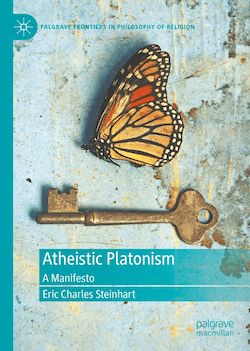
Atheistic Platonism: A Manifesto by Eric Steinhart is available as an e-book or printed format via Amazon.

Eric Charles Steinhart is Professor of Philosophy at William Paterson University.  Among many articles and books, he has authored Your Digital Afterlives: Computational Theories of Life after Death, The Logic of Metaphor and Believing in Dawkins: The New Spiritual Atheism. You may wish to visit Steinhart’s website for chapter abstracts as a sampler.

According to Steinhart, “Atheistic Platonism is an alternative to both theism and nihilistic atheism. Where atheisms based on materialism fail, atheisms based on Platonism succeed.

Atheistic Platonism provides reality with foundations that are eternal, necessary, rational, beautiful, and utterly mindless. It argues for a plenitude of mathematical objects, and an infinite plurality of possible universes.

Atheistic Platonism provides mindless rational grounds for objective values, and for objective moral laws for the persons who evolve in universes.

Atheistic Platonism defines a meaningful and spiritually deep way of life, which facilitates ethical self-improvement.

Atheistic Platonism includes computational theories of life after death, in which humans ascend through transhuman and superhuman degrees of animal excellence.

Atheistic Platonism includes a rich system of spiritual symbols. It values transformational practices and ecstatic experiences.”

  • Publisher ‏ : ‎ Palgrave Macmillan; 1st ed. 2023 edition (December 1, 2022)
  • Language ‏ : ‎ English
  • Hardcover ‏ : ‎ 352 pages
  • ISBN-10 ‏ : ‎ 3031177517
  • ISBN-13 ‏ : ‎ 978-3031177514

Citations, References And Other Reading

  1. Featured Photo Courtesy of : ericsteinhart.com
  2. https://www.cambridge.org/core/journals/religious-studies/archive-collection/platonic-atheism

The views, opinions and analyses expressed in the articles on Humanist Freedoms are those of the contributor(s) and do not necessarily reflect the views or opinions of the publishers.



By continuing to access, link to, or use this website and/or podcast, you accept the HumanistFreedoms.com and HumanistHeritageCanada.ca Terms of Service in full. If you disagree with the terms of service in whole or in part, you must not use the website, podcast or other material.

The Cost of Being an Atheist: BBC Africa’s Documentary About Mubarak Bala

Image Courtesy: Wikipedia

On August 9, 2020, HumanistFreedoms.com published our first article about Mubarak Bala. At that time, we featured Wole Soyinka’s all-too-prophetic condemnation of the Nigerian government’s treatment of Bala:

When I accepted the International Humanist Award at the World Humanist Congress in 2014, I spoke of the conflict between Humanists and Religionists; one of enlightenment versus the chains of enslavement. Your arbitrary incommunicado detention over the last 100 days is the cruel reality of this conflict. All too often these chains of enslavement lead directly to the gallows or a prison cell.

On April 5, 2022 – the Kano High State Court sentence Bala to 24 years imprisonment following a guilty plea to 18 charges blasphemy and public incitement. As the president of the Humanist Association of Nigeria, Mubarak Bala is a prisoner of religious tyranny.

BBC Africa has recently published a documentary titled “The Cost of Being an Atheist” which carries a terrible reminder of just how correct Wole Soyinka’s words were. Too often and far too readily, tyrants curtail free speech with arbitrary actions which lead to prison cells and worse.

Mubarak Bala is a chemical process engineer. A husband. A father. He and his family deserve better than this. They don’t just deserve better – they had a fundamental right to better.

And so does every living person, regardless of the country they live in or the beliefs or non-beliefs that they may have. That’s why the freedom of thought, freedom of expression and freedom of religion (including freedom from religion) are called Fundamental Freedoms.

Citations and References

  1. https://humanists.international/2020/08/wole-soyinka-sends-message-of-solidarity-to-mubarak-bala/
  2. https://www.theguardian.com/books/2020/aug/06/wole-soyinka-protests-imprisonment-of-nigerian-humanist-mubarak-bala
  3. https://freemubarakbala.org/
  4. https://en.wikipedia.org/wiki/Wole_Soyinka

The views, opinions and analyses expressed in the articles on Humanist Freedoms are those of the contributor(s) and do not necessarily reflect the views or opinions of the publishers.

Featured Photo Courtesy of Humanists International

DRL FY20 IRF: Promoting and Defending Freedom(s) Inclusive of Humanism

In our search for interesting, challenging and critical perspectives on contemporary humanism, we occasionally find articles published via other venues that we think HumanistFreedoms.com readers may enjoy. The following article was located on the US Department of State Website.

DRL FY20 IRF Promoting and Defending Religious Freedom Inclusive of Atheist, Humanist, Non-Practicing and Non-Affiliated Individuals

FUNDING OPPORTUNITY ANNOUNCEMENT

BUREAU OF DEMOCRACY, HUMAN RIGHTS, AND LABOR

APRIL 21, 2021

The U.S. Department of State, Bureau of Democracy, Human Rights and Labor (DRL) announces an open competition for organizations interested in submitting applications for projects that support Religious Freedom globally.

“Religious freedom” refers to the right set out in Article 18 of the International Covenant on Civil and Political Rights, including the freedom to adopt a religion or beliefs, change your beliefs, practice and teach your beliefs (which may include through publications, public and private speech, and the display of religious attire or symbols), gather in community with others to worship and observe your beliefs, and teach your beliefs to your children. It also states that no one shall be subject to coercion that would impair one’s freedom to have or to adopt a religion or belief of his/her choice. Proposed programming must be responsive to restrictions on religious freedom, and must be in line with the U.S. Government’s religious freedom, democracy, governance, and human rights goals.

Helpful resources for applicants include the annual country-specific International Religious Freedom Reports https://www.state.gov/reports/2019-report-on-international-religious-freedom/ and annual country-specific Human Rights Reports https://www.state.gov/reports-bureau-of-democracy-human-rights-and-labor/country-reports-on-human-rights-practices/.

Applicants will be responsible for ensuring program activities and products are implemented in accordance with the Establishment Clause of the United States Constitution.

DRL’s goal is to ensure everyone enjoys religious freedom, including the freedom to dissent from religious belief and to not practice or adhere to a religion. By not adhering to a predominant religious tradition, many individuals face discrimination in employment, housing, in civil and criminal proceedings, and other areas especially in the context of intersectional identities. DRL’s objective is to combat discrimination, harassment and abuses against atheist, humanist, non-practicing and non-affiliated individuals of all religious communities by strengthening networks among these communities and providing organizational training and resources.

Activities should take place in 2-3 countries selected within one of the following regions: South/Central Asia- countries within the SCA region as defined by the State Department; or the Middle East/North Africa (excluding Libya, Syria, and Yemen)- countries within the NEA region as defined by the State Department. Proposals are discouraged from including countries where ongoing conflict or violence would negatively affect beneficiary safety or quality of program oversight and must be accompanied by a strong justification in the proposal narrative should any such countries be included. By addressing and combatting discrimination towards those who are non-affiliated, non-practicing, or of no belief will increase the levels of religious freedom enjoyed by all people.

Expected Program Outcomes include but are not limited to:

  • Increased availability of mechanisms for members of minorities and marginalized groups – particularly atheists and nonbelievers – to advocate with community leaders and local and regional government officials regarding their religious freedom concerns;
  • Increased capacity among members of atheist and heterodox individuals to form or join networks or organizations, implement advocacy campaigns, and to engage with the public on issues of tolerance and acceptance of all regardless of faith;
  • Increased awareness and understanding among relevant government officials and law enforcement of the value and importance of human rights, peace, mutual respect, tolerance, and inclusion for all, irrespective of one’s religion or beliefs;
  • Increased awareness among citizens at the community level of concepts and implications of religious pluralism, mutual respect and inclusion for all, regardless of religion or belief;
  • Increased community-level interfaith or advocacy interactions inclusive of atheist, humanist, non-practicing and non-affiliated individuals (particularly those who are pressured, mandated and/or coerced into religious participation that is contrary to their personal non-belief system or philosophy);
  • Legal sector actors and/or local government officials are respectful and attentive towards the needs and interests of these individuals.

Program activities could include, but are not limited to:

  • Creating or strengthening networks of advocates for the diverse communities of atheist, humanist, non-practicing and non-affiliated individuals of all religious communities in target countries.
  • Strengthening the capacity of organizations representing diverse communities of atheist, humanist, non-practicing and non-affiliated individuals of all religious communities to advocate for their rights to political, legal, and societal leaders. Capacity building activities may include improving management structure, public engagement skills, legal rights advocacy, digital security, physical security, psychosocial support and coalition building techniques for these groups regardless of faith affiliation;
  • Expanding or creating opportunities for dialogue, coalition building, and joint action between faith and non-faith organizations in support of freedom of religion and belief. This can include but is not limited to public fora, town halls, journalism, public outreach/education, media campaigns, small grants, and other work;
  • Increasing capacity for monitoring and documenting religious freedom abuses or discrimination against individuals because of non-belief or on the basis of frequency/nature of an individual’s religious observance/practices- particularly those who are pressured, mandated, or coerced into religious participation that is contrary to their personal non-belief system or philosophy. Documentation can include: incident reports to support justice sector action, aggregate reports for legal or policy change advocacy, or quantitative reports for advocacy with international or multinational human rights bodies or agencies.

For all programs, projects should aim to have impact that leads to reforms and should have the potential for sustainability beyond DRL resources. DRL’s preference is to avoid duplicating past efforts by supporting new and creative approaches. This does not exclude from consideration projects that improve upon or expand existing successful projects in a new and complementary way. Programs should seek to include groups that can bring perspectives based on their religion (including non-belief), gender, disability, race, ethnicity, and/or sexual orientation and gender identity. Programs should be demand-driven and locally led to the extent possible. DRL also requires all of its programming to be non-discriminatory and expects implementers to include strategies for integration of individuals/organizations regardless of religion, gender, disability, race, ethnicity, and/or sexual orientation and gender identity.

Competitive proposals may also include a summary budget and budget narrative for 12 additional months following the proposed period of performance, indicated above. This information should indicate what objective(s) and/or activities could be accomplished with additional time and/or funds beyond the proposed period of performance.

Where appropriate, competitive proposals may include:

  • Opportunities for beneficiaries to apply their new knowledge and skills in practical efforts;
  • Solicitation of feedback and suggestions from beneficiaries when developing activities in order to strengthen the sustainability of programs and participant ownership of project outcomes;
  • Input from participants on sustainability plans and systematic review of the plans throughout the life of the project, with adjustments made as necessary;
  • Inclusion of vulnerable populations;
  • Joint identification and definition of key concepts with relevant stakeholders and stakeholder input into project activities;
  • Systematic follow up with beneficiaries at specific intervals after the completion of activities to track how beneficiaries are retaining new knowledge as well as applying their new skills.

Activities that are not typically allowed include, but are not limited to:

  • The provision of humanitarian assistance;
  • English language instruction;
  • Development of high-tech computer or communications software and/or hardware;
  • Purely academic exchanges or fellowships;
  • External exchanges or fellowships lasting longer than six months;
  • Off-shore activities that are not clearly linked to in-country initiatives and impact or are not necessary per security concerns;
  • Theoretical explorations of human rights or democracy issues, including projects aimed primarily at research and evaluation that do not incorporate training or capacity-building for local civil society;
  • Micro-loans or similar small business development initiatives;
  • Initiatives directed towards a diaspora community rather than current residents of targeted countries.

More available on the US Department of State’s website (link at the top of this article).

Atheism, Irreligious and Anarchist: A Cadre Education Perspective

In our search for interesting, challenging and critical perspectives on contemporary humanism, we occasionally find articles published via other venues that we think HumanistFreedoms.com readers may enjoy. The following article was located on CounterCurrents.org on June 17, 2022.

By: T. Vijayendra

T. Vijayendra (1943- ) was born in Mysore, grew in Indore and went to IIT Kharagpur to get a B. Tech. in Electronics (1966). After a year’s stint at the Saha Institute of Nuclear Physics, Kolkata, he got drawn into the whirlwind times of the late 60s. Since then, he has always been some kind of political-social activist. His brief for himself is the education of Left wing cadres and so he almost exclusively publishes in the Left wing journal Frontier, published from Kolkata. For the last nine years, he has been active in the field of ‘Peak Oil’ and is a founder member of Peak Oil India and Ecologise. Since 2015 he has been involved in Ecologise! Camps and in 2016 he initiated Ecologise Hyderabad. He divides his time between an organic farm at the foothills of Western Ghats, watching birds, writing fiction and Hyderabad. He has published a book dealing with resource depletions, three books of essays, two collections of short stories, a novella and an autobiography. Vijayendra has been a ‘dedicated’ cyclist all his life, meaning, he neither took a driving licence nor did he ever drive a fossil fuel based vehicle. Email: t.vijayendra@gmail.com.

India is going through a lot of communal tensions for the last few years. As a response to it some secular persons have been, among other things, organising ‘Inter – Faith Meetings’. Recently in Hyderabad we have been having such meetings. Many religious leaders came. I was asked to represent the Atheists. In the meeting I declared myself ‘atheist, irreligious and anarchist’. These three concepts are related and I believe they can play a small but significant role in reducing these tensions in our country.

The tone of this article is neither theoretical nor polemical. It is in the tradition of ‘cadre education’. This is so because neither in the mainstream nor in normal ‘secular or left wing media’ these trends are adequately represented. Often they are represented in a negative way. In this article I will begin with removing some misconceptions about them and then expound the positive role they can play in the current situation.

Atheism

Most people have not met atheists. They may well imagine atheists as an incarnation of devil with horns on their heads. The religious people denounce them as godless or those who do not fear God. They imply that atheists have no morals or ethics and they can do anything including immoral things.

As a matter fact the oldest Atheist Society was called ‘Ethical Society’ and the international organisation is called IHEU – International Humanists and Ethical Union!

The Ethical movement is an outgrowth of secular moral traditions in the 19th century, principally in Europe and the United States. At the international level, Ethical Culture and secular humanist groups have always organized jointly; the American Ethical Union and British Ethical Union were founding members of Humanists International, whose original name “International Humanist and Ethical Union” reflected the movement’s unity.  (https://en.wikipedia.org/wiki/Ethical_movement)

Humanists International (known as the International Humanist and Ethical Union, or IHEU, from 1952–2019) is an international non-governmental organisation championing secularism and human rights, motivated by secular humanist values. Founded in Amsterdam in 1952, it is an umbrella organisation made up of more than 160 secular humanist, atheist, rationalist, sceptic, free thought and Ethical Culture organisations from over 80 countries. (https://en.wikipedia.org/wiki/Humanists_International).

Atheism in Ancient India

According to popular belief, atheism is a modern invention: “God is dead. God remains dead. And we have killed him,” Friedrich Nietzsche declared in 1882. Supposedly, it was the modern European mind that invented the criticism of religions and religiosity.

But what if it was the other way around? What if philosophical skepticism, rational arguments, and non-religiosity came first, while religions developed later? What if irreligiousity was suppressed by medieval religious minds, before this worldview was resurrected in the modern era? In the beginning was … atheism?

The Indian school that rejected supernaturalism was originally named Lokāyata, which can be translated as prevalent (ayata) among the people (loka) – in addition to meaning “this-worldliness”, “worldly”. Since the last half of the first millennium CE, the term Cārvāka or Charvaka, has also been used for these atheist, skeptical, naturalist, and materialist traditions.

-The untold history of India’s vital atheist philosophy by Dag Herbjørnsrud (https://blog.apaonline.org/2020/06/16/the-untold-history-of-indias-vital-atheist-philosophy/)

Atheism Today in India

Of India’s 1.4 billion people, fewer than 33,000 are self-declared atheists. (https://religionnews.com/2022/05/17/in-india-hindu-nationalists-embolden-challenges-to-atheism/). These are census figure. ‘The religion data from 2011 Census of India was released in August 2015. It revealed that about 2,870,000 people had stated no religion in their response, about 0.27% of the nation’s population. However, the number included atheists, rationalists and also those who believed in a higher power.’ (https://en.wikipedia.org/wiki/Irreligion_in_India). Obviously they do not include Jains and Buddhists because in the census they do not declare themselves as atheists. If we include them the number will be much higher. Most of these atheists do not go about talking about atheism. Most Indians don’t even know that the Jains and Buddhists are atheists. It is only when atheism is combined with irreligiousity that it becomes a social issue and attracts the hostility of current Hindutva lobby.

Irreligiousness

All atheists are not irreligious. As we have said above, Jains and Buddhists are atheist and are religious. Today for all practical purposes Jains are indistinguishable from Hindus. There is a lot of inter marriage between Jains and Hindus. Other atheists also by and large do not wear their atheism on their sleeves.

However there are atheist organisations which promote rationalism and scientific temper. They conduct programmes in public, schools and colleges to spread the scientific temper and expose the frauds of false god men. They expose the ‘miracles’ performed by these false god men and show that they are nothing but tricks performed by magicians. In villages they protect widows who are falsely accused as witches and who allegedly cause death of infants. Their journals carry articles by atheists who are important scientists and philosophers (like Bertrand Russell). After independence to till 1990s, their activities went quietly because Nehru personally and Indian Constitution supported spread of scientific temper. Even some government departments like Department of Science and Technology actively promoted rationalism.

All this has changed drastically in the last decades. The Hindutva lobby has been propagating glories of ancient India through all kinds of unscientific readings of the past. Rationalists are regularly harassed, jailed and some time even murdered. The cases of murders of four rationalists — Narendra Dabholkar, Govind Pansare, MM Kalburgi and journalist Gauri Lankesh are well known.

(https://economictimes.indiatimes.com/news/politics-and-nation/dabholkar-pansare-kalburgi-lankesh-murder-cases-digging-out-weapons-million-rupee-question/articleshow/70301389.cms?utm_source=contentofinterest&utm_medium=text&utm_campaign=cppst)

 Anarchism

Not all atheists and irreligious people are anarchists nor are all anarchists irreligious and atheists. Before going any further, let me give a definition of anarchists: Briefly: 1. Anarchists are opposed to all authority, 2. Anarchists believe in self management within a local community on the basis of ‘a free association of free people’, 3. The Anarchist community will federate with other communities also on the basis of ‘a free association of free people’.

As in the case of atheists, there are a lot of misconceptions about anarchists. Since they are anti authoritarian, the image is that of a young man with long hair, unkempt dirty clothes, who doesn’t listen to any one, who does what he likes, in short he is an anarchist! It is true that many anarchists in the past and today have long hair, but rest of it is just an image. They forget the second point about self management within a local community. In general anarchists are gentle, low profile people, often good gardeners or have some good artistic manual skills. A large number of poets, authors, artists, theatre persons, philosophers, educationists, musicians etc. have been anarchists. The reason is obvious. Creativity needs freedom and hence anti authoritarian philosophy attracts these people.

At a social level, many poor and working people have been oppressed by authority. During medieval periods every mainstream authoritarian religion had a corresponding rebel group. Islam has Sufis, Christians have Quakers and a large number of smaller groups and Hinduism has Bhakti movement, particularly ‘Nirgun Bhakti’ movement where all the saints have been from artisan castes. As a matter of fact the philosophy of these Nirgunias and Sikhs was very close to the Sufis and most of the conversions to Islam have been from these castes.

However the mainstream revolutionary anarchist movement in modern times does combine atheism, irreligiousness with anarchism. The great anarchists have been: Proudhon, Bakunin and Kropotkin. Anarchism as a movement was largely in France, Italy, Greece, Spain and Portugal and in Latin America, though there are anarchists in all developed countries. They were a major force in Spanish Civil war and are still a major force in Mexico.

In the last twenty years global climate emergency and the response to it, that of, transition towns and the Russian Eco villages are very much in the Anarchist tradition.

Concluding Remarks

Humans have been around 3 lakh years. Until recently, that is until 9000 years ago, they lived in self managed small communities. Concepts of God, religion and state/governments etc have come since then. So 97% of the time humans did not know God, religion or state. Thus they were ‘atheists, irreligious and anarchist’ people! What happened in between and in recent times?

Man has the capacity to modify nature much more than any other species. Around 9000 years ago this capacity of Man became significant and man began to ‘exploit’ nature. Through a complex social process exploitation within the species also began and thus emerged what Frederick Engels described as ‘Origin of Family, Private Property and State’. There has been rebellion also among human species from the beginning.

This exploitation of man by man reached a very high level in the last 300 years and at the same time rebellion and revolution also reached high levels. In the latter half of the 20th century exploitation of nature also reached very high level. Rachael Carson’s book, ‘Silent Spring’ was the first important book of this kind. Since then in the last 20 years it has become clear that all this has become unsustainable and we are on the verge of collapse. ‘The only way to achieve a sustainable and just world is via a Transition Towns movement. The required sustainable social form must be based on mostly small, highly self-sufficient and self-governing, cooperative local communities, willingly embracing far simpler lifestyles and systems. (Detailed in ‘The Simpler Way’, 2019.) The Simper Way would be liberation from the consumer-capitalist rat race, enabling a far higher quality of life. It would not involve reduction in modern technology.’ (Ted Trainer, ‘Can we Strengthen the Transition towns Movement?’ Unpublished, personal communication.)

In this situation the theories of atheism, irreligiousness and anarchism have a big role to play.

Citations, References And Other Reading

  1. Feature Image Courtesy: https://countercurrents.org/2022/06/atheist-irreligious-and-anarchist/

The views, opinions and analyses expressed in the articles on Humanist Freedoms are those of the contributor(s) and do not necessarily reflect the views or opinions of the publishers.