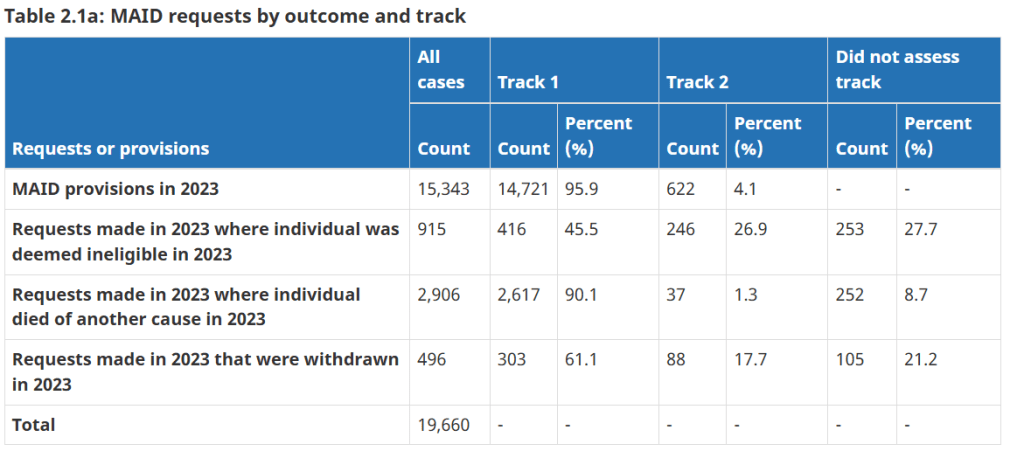
Health Canada released its fifth annual report on medical assistance in dying (MAiD) on December 11, 2024. The report “provides a summary of MAID requests, assessments and provisions for the 2023 calendar year.” To view a PDF version of he report, click the image of he cover below.
The December 2024 report is the first report to present data collected under the amended Regulations for the Monitoring of Medical Assistance in Dying, which came into force on January 1, 2023. The data includes new information on who requested MAiD, what health and other support services were offered and, where possible, how assessments were informed. Given that this was the first year collecting these additional variables, including self-identification measures such as race, Indigenous identity, and disability, there are some important data limitations to consider, including: an inability to present trends over time, some missing data, and limited quality and reliability of some measures. Nevertheless, the report provides important insight into who requested and received MAID, as well as how and where it was delivered.
TVO’s The Agenda hosted a discussion of the report early in 2025.
Humanists Should Analyze and Discuss this Issue
If you’re interested in analyzing and discussing this issue, there are actions you can take. First, here at Humanist Heritage Canada (Humanist Freedoms), we are open to receiving your well-written articles regarding MAiD.
A federal election is likely to be held in Canada in 2025. MAiD will likely be a significant “hot button” issue in the election as politicians seek out issues that will attract voters. Canadian humanists who value their rights and freedoms can help to ensure discussions of MAiD are based on fact rather than emotion and rhetoric. Is there a better place to start than within humanist publications and communities?
What do Canada’s Humanist Organizations have to say about this contemporary human rights matter?
BC Humanists: Medical assistance in dying should be available for any Canadian who freely chooses it, even if they are not terminally ill. There is no moral argument to limit access to a physician-assisted death to individuals with “a grievous and irremediable medical condition.” Safeguards should ensure that decisions are free, voluntary, and informed but should not make access unjustly difficult. Medical assistance in dying should be guaranteed through the publicly funded healthcare system and institutions that refuse should see their funding removed. Ian Bushfield, BC Humanists’ Executive Director told us that, “it’s reasonable to say we support the expansion of MAID to persons whose sole underlying condition is a mental illness.“
Continued or increased restrictions to accessing MAID do not serve to protect the disabled but rather perpetuate a paternalistic relationship between the government and those individuals. To ensure the equal dignity of all people, we must afford everyone choice in life and choice in death.
By continuing to access, link to, or use this website and/or podcast, you accept the HumanistFreedoms.com and HumanistHeritageCanada.ca Terms of Service in full. If you disagree with the terms of service in whole or in part, you must not use the website, podcast or other material.
The views, opinions and analyses expressed in the articles on Humanist Freedoms are those of the contributor(s) and do not necessarily reflect the views or opinions of the publishers.
The Ultimate Choice, a groundbreaking docuseries from TVO Today, with the Toronto Star and the Investigative Journalism Bureau was released on January 25, 2024. It follows the journey of Michael and his wife, Ann. Michael, housebound by pain and incurable disease, sees his choice for a medically assisted death (MAiD) as a powerful solution to his suffering. The series explores Michael’s motivations and how his decision affects his family, friends, and longtime doctor. Hosted by investigative reporter Rob Cribb, the podcast also challenges him to come to terms with his own family history as he dives into this highly charged story. Both a portrait of a family’s autonomy and a hard-hitting exposé, The Ultimate Choice reveals the political and ethical stakes behind Canada’s debate to expand MAID like never before.
What do Canada’s Humanist Organizations have to say about this contemporary human rights matter?
BC Humanists: Medical assistance in dying should be available for any Canadian who freely chooses it, even if they are not terminally ill. There is no moral argument to limit access to a physician-assisted death to individuals with “a grievous and irremediable medical condition.” Safeguards should ensure that decisions are free, voluntary, and informed but should not make access unjustly difficult. Medical assistance in dying should be guaranteed through the publicly funded healthcare system and institutions that refuse should see their funding removed. Ian Bushfield, BC Humanists’ Executive Director told us that, “it’s reasonable to say we support the expansion of MAID to persons whose sole underlying condition is a mental illness.“
Continued or increased restrictions to accessing MAID do not serve to protect the disabled but rather perpetuate a paternalistic relationship between the government and those individuals. To ensure the equal dignity of all people, we must afford everyone choice in life and choice in death.
By continuing to access, link to, or use this website and/or podcast, you accept the HumanistFreedoms.com and HumanistHeritageCanada.ca Terms of Service in full. If you disagree with the terms of service in whole or in part, you must not use the website, podcast or other material.
The views, opinions and analyses expressed in the articles on Humanist Freedoms are those of the contributor(s) and do not necessarily reflect the views or opinions of the publishers.



 Humanist Heritage Canada