Tag Archives: Catholic schools

Canada: Election 2025

A federal general election has been called for April 28, 2025. Throughout the month, we’ll refresh this post with any news, information or resources that may be of interest. Check back often!

1745881200

  days

  hours  minutes  seconds

until

Ontario Provincial General Election

Having achieved leadership of the Liberal Party of Canada, Mark Carney announced that voters will have their opportunity to reflect on Canadian politics and submit their vote in the 45th general election.

Elections Canada has provided an informational video to help Canadians to know what to expect when they go to vote:

This election became inevitable as confidence in the Liberal government, as led by Justin Trudeau, had been effectively lost late in 2024. However, the lack of confidence in Trudeau’s Liberals has not been the dominant issue in the news. Canadian’s attention has shifted from whether the Liberals could be trusted to govern in the post-COVID global environment to what Canada and Canadians must do in light of dramatic changes in the foreign and trade policies of the United States of America.

In the meantime, what can we expect politicians and media to focus on until election day? Here are a few obvious topics:

  • National Unity and Federalism: Quebec separatism, Western alienation, US-Canada relations and the role of the federal government in addressing regional concerns and national unity.
  • Foreign Aid Policy, Trade, International Relations: Global relationships are getting a shake-up. Canadians may be getting a wake-up.
  • Climate Change and Environment: Canada’s commitment to reducing greenhouse gas emissions, renewable energy policies, and addressing the impacts of climate change, selling oil.
  • Economic Growth and Inequality: A few decades ago, Jean Chretien won an election on a chant of Jobs! Jobs! Jobs!….in 2025, it may be time for a politician to chant Homes! Homes! Homes.
  • Immigration and Border Security: The management of Canada’s immigration system, border security, and the balance between economic growth, social cohesion and pressures imposed by the USA.
  • Gun Control and Public Safety: Gun control laws and measures to address public safety concerns, including mental health and community well-being and human rights.

Some potential (and perennial) concerns for Canadian humanists in the 2025 federal election might include:

  • Secularism and Church-State Separation: Humanists in Canada should continue to be concerned about the role of religion in public life and the separation of church and state.
  • Science, Education and Critical Thinking: Humanists will want nee to be on the watch for science and critical-thinking in policy-making.
  • Social Justice and Human Rights: Humanists often prioritize social justice, equality, and human rights, including issues like LGBTQ+ rights, access to healthcare, and Indigenous reconciliation.
  • Freedom of Expression and Speech: Humanists may advocate for the protection of freedom of expression and speech, including the right to criticize religion and other forms of oppression.
  • Social Justice: Addressing issues of poverty, inequality, and systemic racism, including promoting affordable housing, increasing the minimum wage, and supporting marginalized communities.
  • Environmental Protection: Taking action to address climate change, promoting renewable energy, and protecting Ontario’s natural resources for future generations.

Canadians are well-aware that the primary options for electing a candidate in their riding include, along with the already-mentioned Liberals, the Conservative Party of Canada as led by Pierre Poilievre, Jagmeet Singh New Democratic Party , the Green Party of Canada and the Bloc Quebecois (for those living in Quebec).

Certainly, there are a few aspiring hopefuls, like Maxime Bernier’s People’s Party of Canada, but Canadians also know the real contest of who will form the next government is between team blue and team red.

Pundits, experts and horse-race fans will be eager to pitch their favorite team based on their individual biases. And that may be the biggest hint that any humanist voter needs to make their local selection. Take heed of your preferences, biases and priorities and vote for whichever party or candidate that seems likeliest to make decisions the way you want them made.

Up For Discussion

If you’re interested in analyzing and discussing this issue, there are actions you can take. First, here at Humanist Heritage Canada (Humanist Freedoms), we are open to receiving your well-written articles.

Second, we encourage you to visit the New Enlightenment Project’s (NEP) Facebook page and discussion group.

Citations, References And Other Reading

  1. Featured Photo Courtesy of :
  2. https://www.elections.ca/home.aspx
  3. https://www.elections.ca/content.aspx?section=pol&dir=par&document=index&lang=e

By continuing to access, link to, or use this website and/or podcast, you accept the HumanistFreedoms.com and HumanistHeritageCanada.ca Terms of Service in full. If you disagree with the terms of service in whole or in part, you must not use the website, podcast or other material.

The views, opinions and analyses expressed in the articles on Humanist Freedoms are those of the contributor(s) and do not necessarily reflect the views or opinions of the publishers.
Ontario Election 2025

A provincial general election has been called for February 27, 2025. Throughout the month, we’ll refresh this post with any news, information or resources that may be of interest. Check back often!

1740697200

  days

  hours  minutes  seconds

until

Ontario Provincial General Election

It is probably clear to most Ontario electors that Premier Doug Ford called the election now, rather than waiting until 2026, primarily because the timing is better for him and his Progressive Conservative Party of Ontario.

According to Joshua Freedman at CP24, the leading reasons for an early election in Ontario include strong polling for the PCs, threats of punitive tariffs by the current President of the United States of America, and Ontario’s frequent tendency to elect provincial liberals when a federal conservative government is in power (and vice versa). These reasons all seem correctly assumed.

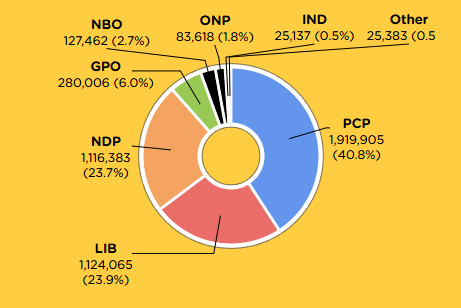
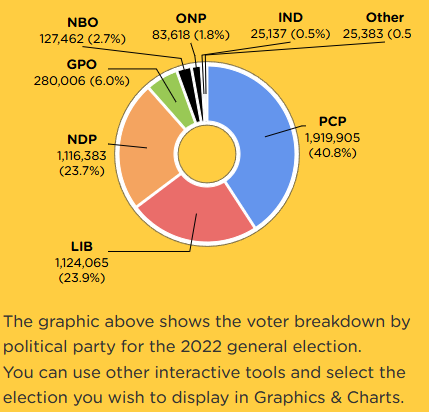
Polling the electorate is valued by the media and political parties in our first past the post system. It isn’t necessary in Canadian politics to be more popular than the other candidate(s). As a candidate, it’s great if you and your party happen to be more popular, but it isn’t really the bottom line. Consider the 2022 Ontario election results:

If you weren’t already familiar with our system, you’d wonder how a party with 40.8 percent of the vote was able to achieve a majority government. You’d be baffled to see that 40.8 can get you a 66.9 percent majority of seats.

That is indeed what you can get when every riding is its own horse-race. It takes a lot for Canadians to send a political party packing. Premier Ford does not want to wait until the Ontario electorate is completely sick of hearing his name. In Canadian politics, our tendency is not to vote FOR a government, but to vote to GET RID of a government.

This informs Ontario’s tendency to have a red party in power provincially when a blue party is in power federally (and vice versa). Once we’ve gotten sick of seeing red….we’re sick of it regardless of whether they’re sitting in Ottawa or Toronto. Is it more complicated than that? Probably…or maybe. But it’s not a popular myth for no reason.

Did you know that there are 25 registered political parties in Ontario? We checked the Elections Ontario website today to get an idea of who’s who. That’s a lot of parties to try to explore and we’ll do our best to run through the lot (probably in a separate post). For now…starting at the top the alphabetically sorted list, the Canadians’ Choice Party website states that their mandate is to, “help Independent Candidates across Ontario to better represent their ridings and to bring a fair measure of direct democracy to all Ontarians and Canadians.” and that they have four “pillars” grouped under the somewhat uncomfortable acronym FIST: Fiscal responsibility and respect for taxpayers, Individual freedom and the right to free speech, Sovereignty and protection of common-law rights, Transparency and accountability in government. Apparently these folks have been around since 2011 with “A bottom-up approach to engage citizens.” We’ll let you work out the pun(s) that inevitably (and perhaps, deservedly) comes to mind. The initiative seems to be earnestly motivated, but doesn’t really present a credible, self-consistent philosophy.

Meanwhile, perhaps the biggest motivation for the election that’s been posited so far is the threat of tariffs and/or financial hard times. Some pundits will suggest that non-blue candidates will be wise to stay away from the issue. For those who oppose the ongoing financial and human rights embarrassment of funding religious schools…this is an opportunity.

Our reasoning goes like this: Given the RISKS associated with unreliable global trading partners, supply chain business practices that destroy Ontario-based value-added business and the ever-increasing probability of continued financial hard-times….can Ontario really afford the anachronistic, misguided, wasteful and discriminatory practice of funding the Catholic school system with public money any longer?

There has never been a more pressing time to push Ontario’s conservative politicians to set aside their puppy-eyed adoration of Bill Davis, admit that discriminatory funding of one religious group’s schools is a bad and wasteful idea and rip the band-aid off.

As a very modest side note (and speaking of puppy-eyed adoration), Ontario humanists may do well to spend some time with Steve Paikin’s biography of Bill Davis titled, Bill Davis: Nation Builder, and Not So Bland After All. If you read the book and between the lines, you may come away with important insight into why Ontario perpetuates this recognized human rights violation and what it may take to finally get the province back on track for a single school system.

Lest we be accused of being a one-trick-pony kind of place, we asked an AI to generate a list of issues in the current provincial election. The response we got back was:

  • Jobs and the economy, with a focus on creating new opportunities and supporting workers
  • Healthcare, including the need for more family doctors and improved access to healthcare services
  • Affordability, with parties proposing various solutions to address the rising cost of living in Ontario
  • Gridlock and transportation, with discussions on highway expansion, public transit, and the removal of tolls on Highway 407
  • Education, with the NDP proposing to invest an additional $830 million a year to clear the repair backlog in schools and create a universal School Food Program
  • Housing, with the NDP proposing to create 60,000 new supportive housing units and establish Homes Ontario to build permanently affordable housing
  • Energy and the environment, with the PC party proposing to permanently cut the provincial tax on gas and diesel5
  • Indigenous issues, with a focus on reconciliation and supporting Indigenous communities
  • Long-term care, with a need for improved services and support for seniors
  • Infrastructure, with the PC party proposing to invest up to $15 billion more over three years to speed up key capital projects
  • Social assistance, with the NDP and Liberal parties proposing to double ODSP
  • Tariff response, with the PC party proposing $10 billion in cash-flow support for Ontario employ

When we asked, what issues should be of importance to humanists in this coming election, we were advised that, “As a humanist, you may be particularly interested in issues that promote the well-being, dignity, and flourishing of all individuals in Ontario,” and the following list of priorities was presented:

  • Education: Investing in public education, promoting critical thinking, and ensuring that all students have access to quality education, regardless of their background or socioeconomic status.
  • Healthcare: Ensuring that all Ontarians have access to quality, publicly-funded healthcare, including mental health services, reproductive health, and palliative care.
  • Social Justice: Addressing issues of poverty, inequality, and systemic racism, including promoting affordable housing, increasing the minimum wage, and supporting marginalized communities.
  • Environmental Protection: Taking action to address climate change, promoting renewable energy, and protecting Ontario’s natural resources for future generations.
  • Human Rights: Ensuring that all Ontarians are treated with dignity and respect, regardless of their identity, including promoting LGBTQ2+ rights, Indigenous reconciliation, and anti-racism initiatives.
  • Access to Justice: Ensuring that all Ontarians have access to justice, including affordable legal services, mental health support, and community resources.
  • Science and Critical Thinking: Promoting the use of evidence-based decision-making, critical thinking, and scientific literacy in policy-making.

Up For Discussion

If you’re interested in analyzing and discussing this issue, there are actions you can take. First, here at Humanist Heritage Canada (Humanist Freedoms), we are open to receiving your well-written articles.

Second, we encourage you to visit the New Enlightenment Project’s (NEP) Facebook page and discussion group.

Citations, References And Other Reading

  1. Featured Photo Courtesy of : https://results.elections.on.ca/en/results-overview
  2. https://www.ontario.ca/page/premier
  3. https://ontariopc.ca/
  4. https://www.cp24.com/news/2025/01/29/why-doug-ford-called-an-early-ontario-election-and-everything-else-you-need-to-know-as-the-campaign-begins/
  5. https://www.fairvote.ca/04/06/2022/pcs-form-majority-government-with-40-83-of-the-vote-ontario-voters-cheated-by-first-past-the-post/
  6. https://finances.elections.on.ca/en/registered-parties

By continuing to access, link to, or use this website and/or podcast, you accept the HumanistFreedoms.com and HumanistHeritageCanada.ca Terms of Service in full. If you disagree with the terms of service in whole or in part, you must not use the website, podcast or other material.

The views, opinions and analyses expressed in the articles on Humanist Freedoms are those of the contributor(s) and do not necessarily reflect the views or opinions of the publishers.

Petition to Ontario’s Government to End Public Funding of Catholic School Systems

Posted on behalf of CRIPE, Secular Connexion, OPEN, Center For Inquiry Canada , and Humanist Ottawa and the hundreds of people who have worked on this issue for the past 30+ years.

MPP Jessica Bell (NDP University-Rosedale) has agreed to present a petition at Queen’s Park, calling for the elimination of public funding for the Catholic School systems. We need your assistance in circulating physical copies of the attached petition and returning them to Petitions / Centre for Inquiry Canada | PO Box 83045, Ottawa RPO Bank Walkley, Ontario K1V 1A3 no later than October 1, 2023.

Your signature will help to ensure that this petition is presented in the provincial legislature and will attract media attention and raise public awareness. This is another step in the eventual, inevitable withdrawal of discriminatory public funding for a school system that is not open to all.

Please help us to get signatures. Please share the petition on social media, through your website, in person at any events you hold, and by requesting that your members sign and share it. (The petition is attached to this email. You are encouraged to upload it to your website and otherwise make it available to supporters in Ontario.)

To be presented to the Legislative Assembly, a petition must meet the following rules (taken from https://www.ola.org/en/get-involved/petitions):

  • It must ask for an action that is within the jurisdiction of the Legislative Assembly.
  • It must use clear and respectful language.
  • The text of the petition must be at the top of every page of signatures.
  • All signatures must be original. They must be written directly on the petition.
  • Each petitioner must print their name and address and sign their name under the text of the petition.
  • Petitioners must be residents of Ontario.
  • The petition must be addressed to the Legislative Assembly of Ontario.
  • The petition must be written, typewritten, or printed. Emailed, faxed, photocopied, or online petitions are not allowed.

Please note:

Do not change or annotate the petition. Any changes, including written notations may invalidate the form, including all signatures on the page. If you have technical questions please contact Petitions@Centreforinquiry.caFor more information about the elimination of funding for the Catholic School system see: http://open.cripeweb.org/aboutOpen.html

Citations, References And Other Reading

  1. Featured Photo Courtesy of : 

The views, opinions and analyses expressed in the articles on Humanist Freedoms are those of the contributor(s) and do not necessarily reflect the views or opinions of the publishers.

By continuing to access, link to, or use this website and/or podcast, you accept the HumanistFreedoms.com and HumanistHeritageCanada.ca Terms of Service in full. If you disagree with the terms o