Tag Archives: election

Statistics Canada: Migration from USA to Canada

In light of recent interest in Canada-USA relations, Statistics Canada has released an analysis of migration flows from the US to Canada.

The analysis, and the information it is based on, is not interesting merely to satisfy curiosity about how many “Americans” are moving to Canada – nor even to fuel narrow and competitive nationalist views between the two countries. Instead, this information seems valuable to understand who may be interested to move to Canada as policies within the USA change over time. And, incidentally, what perspectives they may wish to bring to Canada as their new home.

This interest to know who may wish to join Canadian society, and why, is stimulated by recent USA politics, but a similar curiosity ought to extend to any jurisdiction from which Canada accepts a significant quantity of immigrants.

Humanists should use controversial topics of this kind to inform their humanist principles…and use their humanist principles to inform their outlook on controversial topics of this kind.

We present the StatsCan report in full below for those who may be interested.

Recent trends in migration flows from the United States to Canada

by Feng Hou and Max Stick

Release date: March 26, 2025

Introduction

Canada has long been a destination for American expatriates because of its geographic proximity, familiar culture and similar socioeconomic environment. However, migration flows have historically fluctuated in response to economic, political and social factors (Boyd, 1981; Kobayashi & Ray, 2005). Notably, shifts in U.S. administration policies—particularly those affecting immigration, labour markets and social stability—have influenced U.S. residents’ intentions to move north (Croucher, 2011).

Media reports have offered mixed assessments of how political shifts in the United States impact migration to Canada (Benenson & Mattey, 2025; Cain, 2016; Singer, 2024). These reports primarily focus on U.S. citizens, overlooking the migration of U.S. non-citizen residents. This group is often more affected by U.S. immigration policy changes and is a key target of Canada’s efforts to attract high-skilled workers (Arnold, 2020; Rose, 2020). Additionally, little attention has been given to Canadian-born individuals and permanent residents who previously resided in the United States but returned to live in Canada.

This article examines recent trends in migration flows from the United States to Canada. U.S. immigrants are individuals who obtained permanent residency in Canada and whose country of birth, citizenship or last residence was the United States.Note  The analysis distinguishes five immigrant categories: (1) U.S.-born individuals whose last country of residence was the United States, (2) U.S. citizens born outside the United States, (3) U.S. non-citizen residents, (4) U.S. citizens who were temporary residents in Canada before obtaining Canadian permanent residencyNote  and (5) U.S. citizens who were temporary residents in a third country before obtaining Canadian permanent residency. The analysis draws on data from the Longitudinal Immigration Database. The article also uses Canadian census data to estimate the number of Canadian-born individuals and Canadian permanent residents who previously lived in the United States and returned to live in Canada.  

While this study explores whether migration flows from the United States to Canada align with changes in U.S. administrations, any observed patterns should not be interpreted as causal. Beyond political factors, economic conditions and personal motivations also influence migration decisions. The relative strength of U.S. and Canadian labour markets affects cross-border movement, as seen during the 2008 financial crisis, which led more Americans to seek jobs abroad (Singer & Wilson, 2009). Additionally, Canadian immigration policies—such as Express Entry for skilled workers and targeted programs for health care and technology professionals—may have facilitated migration from the United States since 2015 (Arnold, 2020).

Migration flows of U.S. citizens and residents to Canada

Chart 1 presents the number of U.S. immigrants to Canada, revealing several salient trends in their composition and numbers.

First, there have been significant changes in the composition of U.S. immigrant inflows to Canada based on U.S. citizenship status, country of birth and country of last residence. In the early 1980s, almost all immigrants were U.S. citizens, with more than three-quarters born and last residing in the United States. While this share declined in the following decade, it remained above two-thirds until the early 2010s, when it began to drop rapidly. Meanwhile, the proportion of U.S. non-citizen residents immigrating to Canada rose sharply from the early 2010s, reaching 45% in 2019—the year before the COVID-19 pandemic. The share of U.S. citizens who were previously temporary residents in Canada also increased significantly during this period, peaking at 54% in 2017 and fluctuating in subsequent years. The proportion of immigrants who were not born in the United States but acquired U.S. citizenship ranged from about 8% to 12% before the early 2010s but declined to 2% by the early 2020s. As a result of these shifts, the majority of U.S. immigrants to Canada in recent years have been either U.S. non-citizen residents or U.S. citizens who had already been living in Canada.Note 

Second, there was no clear correlation between changes in U.S. government administrations and the number of U.S. immigrants to Canada from the early 1980s to mid-2005. The decline in inflows during the early 1980s was a continuation of the gradual decline from a peak in the mid-1970s, following the end of the Vietnam War, and coincided with recessions in the United States and Canada (Kobayashi & Ray, 2005). Similarly, the decline in the early 1990s corresponded with an economic downturn and a reduction in overall immigration levels in Canada. Inflows of U.S. immigrants remained low until the early 2000s.

Chart 1: Numbers of new permanent residents to Canada who were U.S. citizens or U.S. residents before immigrating to Canada, 1980 to 2023

Data table for Chart 1

Third, fluctuations in U.S. immigration to Canada following changes in U.S. government administrations since the mid-2000s were associated with different categories of U.S. immigrants. U.S. citizen residents (both those born in and outside the United States) were the primary drivers of the increase in migration to Canada during the second term of the 43rd presidential administration and the decline in the early years of the 44th administration. In contrast, the rise in inflows during the initial years of the 45th administration was driven primarily by U.S. non-citizen residents whose numbers quadrupled from 2,100 in 2016 to 9,310 in 2019. This may suggest that restrictive U.S. immigration policies—such as visa caps, delays in employment-based green cards and heightened deportation risks—pushed temporary migrants (e.g., H-1B workers and international students) to seek more stable opportunities in Canada. Conversely, U.S. immigration to Canada decreased by 20% in the first three years of the 46th administration compared with the same point in the 45th administration, despite a 38% increase in overall immigration during this period. This decline was primarily driven by U.S. non-citizen residents.

Returning Canadians from the United States

Chart 2 presents the estimated number of returning Canadian-born individuals and permanent residentsNote  who lived in the United States five years prior but resided in Canada at the time of the census.Note 

The number of returning Canadian-born individuals increased by 92% from 1996 (under the 42nd presidential administration) to 2006 (under the 43rd administration) before declining by 29% from 2006 to 2016 (under the 44th administration). Similarly, the number of returning Canadian permanent residents rose by 122% from 1996 to 2006, followed by a 23% decline over the next decade. These trends suggest that the trend of returning Canadians broadly aligned with changes in U.S. government administrations from the mid-1990s to the mid-2010s. From 2016 to 2021, there was a small decrease in the number of returning Canadian-born individuals (-6%), while the number of returning permanent residents increased by 15%. The inflow in the 2016-to-2021 period was likely affected by COVID-19 travel restrictions.

Chart 2: Estimated number of Canadian-born individuals and Canadian permanent residents returning from the United States to Canada in the previous five years

Data table for Chart 2

Returning Canadian-born individuals and permanent residents were more likely to be in their prime working years and had higher educational attainment than other Canadian-born individuals and permanent residents in Canada. In 2021, 58% of returning Canadian-born individuals and 72% of returning permanent residents were aged 25 to 64, compared with 50% of other Canadian-born individuals and 64% of other permanent residents. Among those in this age group, 64% of returning Canadian-born individuals and 70% of returning permanent residents held a bachelor’s degree or higher, compared with 27% of other Canadian-born individuals and 42% of other permanent residents. These findings suggest that individuals with higher levels of human capital tend to be more mobile.

In sum, there have been significant shifts in the composition of U.S. immigrants to Canada since the 1980s, when migration inflows were dominated by U.S. residents born in the United States. In recent years, the majority of U.S. immigrants to Canada have been either U.S. non-citizen residents or U.S. citizens who were temporary residents in Canada. These changes are likely driven in part by the large increase of temporary foreign workers in Canada and the increasing selection of immigrants from this pool (Hou, Crossman & Picot, 2020).

Additionally, the number of U.S. citizen residents (both those born in and outside the United States) moving to Canada increased during the second term of the 43rd presidential administration and declined during the 44th administration, whereas U.S. non-citizen residents moving to Canada quadrupled in the first three years of the 45th administration and decreased under the 46th administration. The movement of Canadian-born individuals and permanent residents returning from the United States also reflected shifts in U.S. government administrations.

Looking ahead, given the changing political and economic landscape in the United States, the results of this study could inform the potential immigration patterns of U.S. non-citizen and Canadian-born individuals currently living in the U.S. to Canada over the next several years.

Authors

Feng Hou and Max Stick are with the Social Analysis and Modelling Division, Analytical Studies and Modelling Branch, at Statistics Canada.

References

Arnold, Z. (2020). Canada’s skilled immigration system increasingly draws talent from the United States.

Benenson, L. & Mattey. (2025). Trump’s First 100 Days: Potential Immigration Actions. Accessed February 12, 2025.

Boyd, M. (1981). The American emigrant in Canada: Trends and consequences. International Migration Review15(4), 650-670.

Cain, P. (2016.) Some U.S. liberals walk the walk: Immigration to Canada doubled after Bush’s 2004 re-election. Global News. Accessed February 11, 2025.

Croucher, S. (2011). The nonchalant migrants: Americans living north of the 49th parallel. International Migration & Integration,12:113–131.

Hou, F., Crossman, E., & Picot, G. (2020). Two-step immigration selection: An analysis of its expansion in Canada. Statistics Canada: Economic Insights, Catalogue no. 11-626-X — 2020009 – No. 112.

IRCC. (n.d.). Permanent Residents – Monthly IRCC Updates – Canada – Permanent Residents by Country of Citizenship. Open Government Portal. Accessed February 15, 2025.

Kobayashi, A., & Ray, B. (2005). Placing American emigration to Canada in context. Migration Policy Institute. Accessed February 11, 2025.

Rose, J. (2020). Canada wins, U.S. loses in global fight for high-Tech workers. NPR.

Singer, A. & Wilson, J. (2009). How the Recession’s Affecting Immigration. The Brookings Institution. Accessed February 13, 2025.

Singer, C. (2022). What Americans Should Know About Canada Immigration in Light of Trump’s Election Victory – Canada Immigration and Visa Information. Canadian Immigration Services and Free Online Evaluation. Accessed February 15, 2025.

Statistics Canada. (2022). Immigrants make up the largest share of the population in over 150 years and continue to shape who we are as Canadians. Statistics Canada, The Daily. Accessed February 13, 2025.

Notes

Note 

Immigration, Refugees and Citizenship Canada (IRCC) usually uses the country of citizenship to define the source country in reporting immigrant statistics (e.g., IRCC n.d.), while statistics from Canadian census data generally use the country of birth (e.g., Statistics Canada, 2022).  

Note 

This group includes those who reported Canada as their country of last residence or held temporary residency permits in Canada before obtaining Canadian permanent residency.

Note 

Additional analysis revealed variations in sociodemographic characteristics across different types of U.S. immigrants (table not shown). In 2019, 92% of U.S. non-citizen residents were admitted through the economic class, compared with 35% of U.S. citizens who were temporary residents in Canada and 59% of U.S. citizen residents. Among economic principal applicants, 89% of U.S. non-citizen residents held a graduate degree, compared with 47% of U.S. citizens who were temporary residents in Canada and 66% of U.S. citizen residents born in the United States.

Note 

Returning permanent residents are individuals who obtained Canadian permanent residency at least six years before the census. Similar trends are observed when a restriction criterion of five or seven years before the census was used.

Note 

This method is different from that of the Demographic Estimates Program at Statistics Canada.

Up For Discussion

If you’re interested in analyzing and discussing this issue, there are actions you can take. First, here at Humanist Heritage Canada (Humanist Freedoms), we are open to receiving your well-written articles.

Second, we encourage you to visit the New Enlightenment Project’s (NEP) Facebook page and discussion group.

Citations, References And Other Reading

  1. Featured Photo Courtesy of :
  2. https://www150.statcan.gc.ca/n1/pub/36-28-0001/2025003/article/00004-eng.htm

By continuing to access, link to, or use this website and/or podcast, you accept the HumanistFreedoms.com and HumanistHeritageCanada.ca Terms of Service in full. If you disagree with the terms of service in whole or in part, you must not use the website, podcast or other material.

The views, opinions and analyses expressed in the articles on Humanist Freedoms are those of the contributor(s) and do not necessarily reflect the views or opinions of the publishers.
Canada: Election 2025

A federal general election has been called for April 28, 2025. Throughout the month, we’ll refresh this post with any news, information or resources that may be of interest. Check back often!

1745881200

  days

  hours  minutes  seconds

until

Ontario Provincial General Election

Having achieved leadership of the Liberal Party of Canada, Mark Carney announced that voters will have their opportunity to reflect on Canadian politics and submit their vote in the 45th general election.

Elections Canada has provided an informational video to help Canadians to know what to expect when they go to vote:

This election became inevitable as confidence in the Liberal government, as led by Justin Trudeau, had been effectively lost late in 2024. However, the lack of confidence in Trudeau’s Liberals has not been the dominant issue in the news. Canadian’s attention has shifted from whether the Liberals could be trusted to govern in the post-COVID global environment to what Canada and Canadians must do in light of dramatic changes in the foreign and trade policies of the United States of America.

In the meantime, what can we expect politicians and media to focus on until election day? Here are a few obvious topics:

  • National Unity and Federalism: Quebec separatism, Western alienation, US-Canada relations and the role of the federal government in addressing regional concerns and national unity.
  • Foreign Aid Policy, Trade, International Relations: Global relationships are getting a shake-up. Canadians may be getting a wake-up.
  • Climate Change and Environment: Canada’s commitment to reducing greenhouse gas emissions, renewable energy policies, and addressing the impacts of climate change, selling oil.
  • Economic Growth and Inequality: A few decades ago, Jean Chretien won an election on a chant of Jobs! Jobs! Jobs!….in 2025, it may be time for a politician to chant Homes! Homes! Homes.
  • Immigration and Border Security: The management of Canada’s immigration system, border security, and the balance between economic growth, social cohesion and pressures imposed by the USA.
  • Gun Control and Public Safety: Gun control laws and measures to address public safety concerns, including mental health and community well-being and human rights.

Some potential (and perennial) concerns for Canadian humanists in the 2025 federal election might include:

  • Secularism and Church-State Separation: Humanists in Canada should continue to be concerned about the role of religion in public life and the separation of church and state.
  • Science, Education and Critical Thinking: Humanists will want nee to be on the watch for science and critical-thinking in policy-making.
  • Social Justice and Human Rights: Humanists often prioritize social justice, equality, and human rights, including issues like LGBTQ+ rights, access to healthcare, and Indigenous reconciliation.
  • Freedom of Expression and Speech: Humanists may advocate for the protection of freedom of expression and speech, including the right to criticize religion and other forms of oppression.
  • Social Justice: Addressing issues of poverty, inequality, and systemic racism, including promoting affordable housing, increasing the minimum wage, and supporting marginalized communities.
  • Environmental Protection: Taking action to address climate change, promoting renewable energy, and protecting Ontario’s natural resources for future generations.

Canadians are well-aware that the primary options for electing a candidate in their riding include, along with the already-mentioned Liberals, the Conservative Party of Canada as led by Pierre Poilievre, Jagmeet Singh New Democratic Party , the Green Party of Canada and the Bloc Quebecois (for those living in Quebec).

Certainly, there are a few aspiring hopefuls, like Maxime Bernier’s People’s Party of Canada, but Canadians also know the real contest of who will form the next government is between team blue and team red.

Pundits, experts and horse-race fans will be eager to pitch their favorite team based on their individual biases. And that may be the biggest hint that any humanist voter needs to make their local selection. Take heed of your preferences, biases and priorities and vote for whichever party or candidate that seems likeliest to make decisions the way you want them made.

Up For Discussion

If you’re interested in analyzing and discussing this issue, there are actions you can take. First, here at Humanist Heritage Canada (Humanist Freedoms), we are open to receiving your well-written articles.

Second, we encourage you to visit the New Enlightenment Project’s (NEP) Facebook page and discussion group.

Citations, References And Other Reading

  1. Featured Photo Courtesy of :
  2. https://www.elections.ca/home.aspx
  3. https://www.elections.ca/content.aspx?section=pol&dir=par&document=index&lang=e

By continuing to access, link to, or use this website and/or podcast, you accept the HumanistFreedoms.com and HumanistHeritageCanada.ca Terms of Service in full. If you disagree with the terms of service in whole or in part, you must not use the website, podcast or other material.

The views, opinions and analyses expressed in the articles on Humanist Freedoms are those of the contributor(s) and do not necessarily reflect the views or opinions of the publishers.

Ontario Election 2025

A provincial general election has been called for February 27, 2025. Throughout the month, we’ll refresh this post with any news, information or resources that may be of interest. Check back often!

1740697200

  days

  hours  minutes  seconds

until

Ontario Provincial General Election

It is probably clear to most Ontario electors that Premier Doug Ford called the election now, rather than waiting until 2026, primarily because the timing is better for him and his Progressive Conservative Party of Ontario.

According to Joshua Freedman at CP24, the leading reasons for an early election in Ontario include strong polling for the PCs, threats of punitive tariffs by the current President of the United States of America, and Ontario’s frequent tendency to elect provincial liberals when a federal conservative government is in power (and vice versa). These reasons all seem correctly assumed.

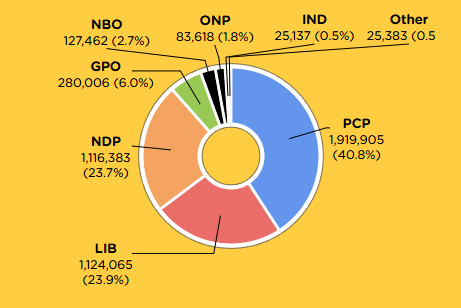
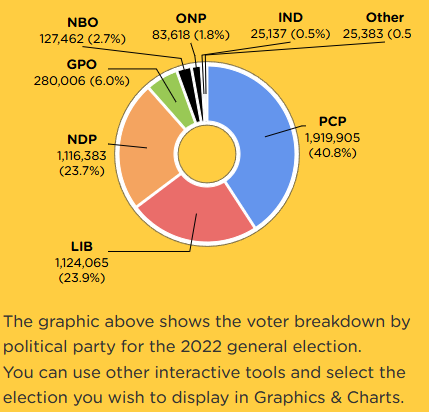
Polling the electorate is valued by the media and political parties in our first past the post system. It isn’t necessary in Canadian politics to be more popular than the other candidate(s). As a candidate, it’s great if you and your party happen to be more popular, but it isn’t really the bottom line. Consider the 2022 Ontario election results:

If you weren’t already familiar with our system, you’d wonder how a party with 40.8 percent of the vote was able to achieve a majority government. You’d be baffled to see that 40.8 can get you a 66.9 percent majority of seats.

That is indeed what you can get when every riding is its own horse-race. It takes a lot for Canadians to send a political party packing. Premier Ford does not want to wait until the Ontario electorate is completely sick of hearing his name. In Canadian politics, our tendency is not to vote FOR a government, but to vote to GET RID of a government.

This informs Ontario’s tendency to have a red party in power provincially when a blue party is in power federally (and vice versa). Once we’ve gotten sick of seeing red….we’re sick of it regardless of whether they’re sitting in Ottawa or Toronto. Is it more complicated than that? Probably…or maybe. But it’s not a popular myth for no reason.

Did you know that there are 25 registered political parties in Ontario? We checked the Elections Ontario website today to get an idea of who’s who. That’s a lot of parties to try to explore and we’ll do our best to run through the lot (probably in a separate post). For now…starting at the top the alphabetically sorted list, the Canadians’ Choice Party website states that their mandate is to, “help Independent Candidates across Ontario to better represent their ridings and to bring a fair measure of direct democracy to all Ontarians and Canadians.” and that they have four “pillars” grouped under the somewhat uncomfortable acronym FIST: Fiscal responsibility and respect for taxpayers, Individual freedom and the right to free speech, Sovereignty and protection of common-law rights, Transparency and accountability in government. Apparently these folks have been around since 2011 with “A bottom-up approach to engage citizens.” We’ll let you work out the pun(s) that inevitably (and perhaps, deservedly) comes to mind. The initiative seems to be earnestly motivated, but doesn’t really present a credible, self-consistent philosophy.

Meanwhile, perhaps the biggest motivation for the election that’s been posited so far is the threat of tariffs and/or financial hard times. Some pundits will suggest that non-blue candidates will be wise to stay away from the issue. For those who oppose the ongoing financial and human rights embarrassment of funding religious schools…this is an opportunity.

Our reasoning goes like this: Given the RISKS associated with unreliable global trading partners, supply chain business practices that destroy Ontario-based value-added business and the ever-increasing probability of continued financial hard-times….can Ontario really afford the anachronistic, misguided, wasteful and discriminatory practice of funding the Catholic school system with public money any longer?

There has never been a more pressing time to push Ontario’s conservative politicians to set aside their puppy-eyed adoration of Bill Davis, admit that discriminatory funding of one religious group’s schools is a bad and wasteful idea and rip the band-aid off.

As a very modest side note (and speaking of puppy-eyed adoration), Ontario humanists may do well to spend some time with Steve Paikin’s biography of Bill Davis titled, Bill Davis: Nation Builder, and Not So Bland After All. If you read the book and between the lines, you may come away with important insight into why Ontario perpetuates this recognized human rights violation and what it may take to finally get the province back on track for a single school system.

Lest we be accused of being a one-trick-pony kind of place, we asked an AI to generate a list of issues in the current provincial election. The response we got back was:

  • Jobs and the economy, with a focus on creating new opportunities and supporting workers
  • Healthcare, including the need for more family doctors and improved access to healthcare services
  • Affordability, with parties proposing various solutions to address the rising cost of living in Ontario
  • Gridlock and transportation, with discussions on highway expansion, public transit, and the removal of tolls on Highway 407
  • Education, with the NDP proposing to invest an additional $830 million a year to clear the repair backlog in schools and create a universal School Food Program
  • Housing, with the NDP proposing to create 60,000 new supportive housing units and establish Homes Ontario to build permanently affordable housing
  • Energy and the environment, with the PC party proposing to permanently cut the provincial tax on gas and diesel5
  • Indigenous issues, with a focus on reconciliation and supporting Indigenous communities
  • Long-term care, with a need for improved services and support for seniors
  • Infrastructure, with the PC party proposing to invest up to $15 billion more over three years to speed up key capital projects
  • Social assistance, with the NDP and Liberal parties proposing to double ODSP
  • Tariff response, with the PC party proposing $10 billion in cash-flow support for Ontario employ

When we asked, what issues should be of importance to humanists in this coming election, we were advised that, “As a humanist, you may be particularly interested in issues that promote the well-being, dignity, and flourishing of all individuals in Ontario,” and the following list of priorities was presented:

  • Education: Investing in public education, promoting critical thinking, and ensuring that all students have access to quality education, regardless of their background or socioeconomic status.
  • Healthcare: Ensuring that all Ontarians have access to quality, publicly-funded healthcare, including mental health services, reproductive health, and palliative care.
  • Social Justice: Addressing issues of poverty, inequality, and systemic racism, including promoting affordable housing, increasing the minimum wage, and supporting marginalized communities.
  • Environmental Protection: Taking action to address climate change, promoting renewable energy, and protecting Ontario’s natural resources for future generations.
  • Human Rights: Ensuring that all Ontarians are treated with dignity and respect, regardless of their identity, including promoting LGBTQ2+ rights, Indigenous reconciliation, and anti-racism initiatives.
  • Access to Justice: Ensuring that all Ontarians have access to justice, including affordable legal services, mental health support, and community resources.
  • Science and Critical Thinking: Promoting the use of evidence-based decision-making, critical thinking, and scientific literacy in policy-making.

Up For Discussion

If you’re interested in analyzing and discussing this issue, there are actions you can take. First, here at Humanist Heritage Canada (Humanist Freedoms), we are open to receiving your well-written articles.

Second, we encourage you to visit the New Enlightenment Project’s (NEP) Facebook page and discussion group.

Citations, References And Other Reading

  1. Featured Photo Courtesy of : https://results.elections.on.ca/en/results-overview
  2. https://www.ontario.ca/page/premier
  3. https://ontariopc.ca/
  4. https://www.cp24.com/news/2025/01/29/why-doug-ford-called-an-early-ontario-election-and-everything-else-you-need-to-know-as-the-campaign-begins/
  5. https://www.fairvote.ca/04/06/2022/pcs-form-majority-government-with-40-83-of-the-vote-ontario-voters-cheated-by-first-past-the-post/
  6. https://finances.elections.on.ca/en/registered-parties

By continuing to access, link to, or use this website and/or podcast, you accept the HumanistFreedoms.com and HumanistHeritageCanada.ca Terms of Service in full. If you disagree with the terms of service in whole or in part, you must not use the website, podcast or other material.

The views, opinions and analyses expressed in the articles on Humanist Freedoms are those of the contributor(s) and do not necessarily reflect the views or opinions of the publishers.