
Tag Archives: Eliot Hanowski

Steve Tomlins’ Navigating Atheist Identities

Choosing to investigate, document and publish Canada’s Humanist heritage, as we have done on this website, it quickly becomes apparent that humanism is a perspective and identity that is quickly obscured by several forces. In some cases, the significant presence of humanism is hidden by its own vocal subcomponents. Proponents of narrow ideologies are often eager to stake ownership of humanism in the service of their (often trendy) preferred ideology. In other cases, proponents of ideologies inconsistent with humanism are eager to portray this identity as less consequential than it is. Some of those proponents are supernatural and religious in nature while others are more secular and political in nature. Either way, it can require a score-card to figure it all out.

Back in 2016, Steve Tomlins submitted a 359-page thesis to the Faculty of Graduate and Postdoctoral Studies at the University of Ottawa in partial fulfillment of the requirements for the Doctorate in Philosophy degree in Religious Studies. In some areas of study, a decade would be considered a long time. The advancement of Humanism in Canada isn’t really one of those areas.

The abstract to the thesis says,

There is very little research that is empirically-based about atheism in Canada; this thesis seeks to contribute foundational knowledge in this area . It begins with a historical and contemporary overview of atheism in Canada by examining its appearance in government, law, and media. It then addresses the question: “How do atheists construct their identities in the context of a religiously diverse Canada?” through an analysis of data collected from participant-observation with an atheist university club, the Atheist Community of the University of Ottawa (ACUO), followed by an analysis of five significant themes which arose from forty life history interviews (twenty with ACUO members; twenty with Ottawa-area atheists who did not belong to an atheist community that met in person). These themes are: loss of religious identity and/or development of atheist identity; group belonging; perceptions of media and public understanding of atheism; the use of the United States for narrative or comparative purposes; and the frequency of receiving a negative reaction simply for being an atheist. This study found that most interviewees perceived the Canadian public and the media as not understanding atheism because the subject is not commonly reported on or discussed, and many said that (ir)religiosity rarely came up in conversations with strangers, acquaintances, or co-workers. These notions were often seen as resulting from a Canadian social etiquette which dictates that controversial subjects should be avoided in order to minimize the risk of causing offense. Moreover, members of the ACUO often said that they joined an atheist community because they wanted a safe space to meet like-minded people with whom they could freely discuss religion without causing offense to religious others. Unlike in findings from the United States, interviewees did not speak of their atheist identities as being considered ‘un-Canadian’ or as excluding them from their conception(s) of Canadian society. While interviewees often said they were selective with whom they decided to express their atheism, most felt quite positive about living as an atheist in Canada, especially compared to the plight of atheists living in other countries, and atheism came across as being ‘just’ another ‘idea’ in a mosaic of cultural ideas.”

Humanist, atheist and agnostic organizations in Canada ought to bear the largest responsibility for creating greater public understanding of their perspectives and for creating appropriate environments for discussion of their ideas. That may, perhaps begin with a clear-eyed study of the perspectives and ideologies contained within the universal label of Humanism. Leaders of humanist organizations across the country should hold themselves accountable to familiarize themselves with the work of Tomlins, Hanowski and others who have undertaken much needed work.

Perhaps also to replicate and publish it for their own communities.

Up For Discussion

If you’re interested in analyzing and discussing this issue, there are actions you can take. First, here at Humanist Heritage Canada, we are open to receiving your well-written articles.

Second, we encourage you to visit the New Enlightenment Project’s (NEP) Facebook page and discussion group.

Citations, References And Other Reading

  1. Featured Photo Courtesy of :
  2. https://ruor.uottawa.ca/server/api/core/bitstreams/572affce-0324-4b23-895b-2fe4d4dfd74d/content

By continuing to access, link to, or use this website and/or podcast, you accept the HumanistFreedoms.com and HumanistHeritageCanada.ca Terms of Service in full. If you disagree with the terms of service in whole or in part, you must not use the website, podcast or other material.

The views, opinions and analyses expressed in the articles on Humanist Freedoms are those of the contributor(s) and do not necessarily reflect the views or opinions of the publishers.

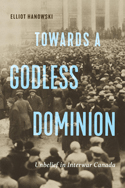
Review: Elliot Hanowski’s “Towards a Godless Dominion

A few months ago, we mentioned an intention to acquire and read a copy of Elliot Hanowski’s 2023 book, “Towards A Godless Dominion: Unbelief in Interwar Canada”. While we were a little late in discovering the book, we’re very glad that we did…and we’re very pleased with following-through on our intentions.

Our copy is a soft-cover with about 330 pages and we read the book over the course of several weekend mornings in May and June. We can confirm that our earlier expectation that it is an obvious must-read for anyone wishing to examine Canada’s humanist heritage was correct.

There are eight chapters, several of which feature a regional focus. Depictions of events in Manitoba, Ontario and Quebec dominate the book, but there is also a brief chapter covering “Unbelief on the Coasts“, as well. The bibliography is about 22 pages long, giving credit and credibility to Hanowski for what must be un-counted hours of research.

According to McGill-Queen’s University Press, Elliot Hanowski is an academic librarian at the University of Manitoba. Hanowski is the author of Towards A Godless Dominion: Unbelief in Interwar Canada. Hanowski is also one of the founders of the International SocieWety for Historians of Atheism, Secularism and Humanism.

The book’s publicity materials state, Towards a Godless Dominion explores both anti-religious activism and the organized opposition unbelievers faced from Christian Canada during the interwar period. Despite Christianity’s prominence, anti-religious ideas were propagated by lectures in theatres, through newspapers, and out on the streets. Secularist groups in Montreal, Toronto, Winnipeg, and Vancouver actively tried to win people away from religious belief. In the first two cities, they were met with stiff repression by the state, which convicted unbelievers of blasphemous libel, broke up their meetings, and banned atheistic literature from circulating. In the latter two cities unbelievers met social disapproval rather than official persecution. Looking at interwar controversies around religion, such as arguments about faith healing and fundamentalist campaigns against teaching evolution, Elliot Hanowski shows how unbelievers were able to use these conflicts to get their skeptical message across to the public. Challenging the stereotype of Canada as a tolerant, secular nation, Towards a Godless Dominion returns to a time when intolerant forms of Christianity ruled a country that was considered more religious than the United States.

What we gained from having read the book is a renewed sense of connection to the humanist heritage that is an unjustly obscured part of our Canadian identity. The Canadian humanist community has not been particularly effective in recalling and telling its own story. Hanowski’s book is a an important and effective gift to the collection of “nones” that make up such a large part of Canadian society.

The final sentence of Hanowski’s book states, “Interwar unbelievers demonstrated considerable courage and determination in their struggle to create a godless yet more humane Canada.” and that may be the best place to conclude…along with our encouragement to everyone to go ahead and acquire a copy of this book, read it over a few weekend mornings and connect with the heritage that it contains.

Up For Discussion

If you’re interested in analyzing and discussing this issue, there are actions you can take. First, here at Humanist Heritage Canada (Humanist Freedoms), we are open to receiving your well-written articles.

Second, we encourage you to visit the New Enlightenment Project’s (NEP) Facebook page and discussion group.

Citations, References And Other Reading

  1. Featured Photo Courtesy of : https://umanitoba.academia.edu/ElliotHanowski
  2. https://www.mqup.ca/towards-a-godless-dominion-products-9780228018834.php#!prettyPhoto

By continuing to access, link to, or use this website and/or podcast, you accept the HumanistFreedoms.com and HumanistHeritageCanada.ca Terms of Service in full. If you disagree with the terms of service in whole or in part, you must not use the website, podcast or other material.

The views, opinions and analyses expressed in the articles on Humanist Freedoms are those of the contributor(s) and do not necessarily reflect the views or opinions of the publishers.

Reading List: Eliot Hanowski’s “Towards a Godless Dominion

According to McGill-Queen’s University Press, Elliot Hanowski is an academic librarian at the University of Manitoba. Hanowski is the author of Towards A Godless Dominion: Unbelief in Interwar Canada. Hanowski is also one of the founders of the International Society for Historians of Atheism, Secularism and Humanism.

The book appears to be an obvious must-read for anyone wishing to examine Canada’s humanist heritage…and we’ll be acquiring a copy soon so that we may share our impressions.

In the meantime, we’ll make do with an overview provided by the publishers:

In recent surveys, one in four Canadians say they have no religion. A century ago Canada was widely considered to be a Christian nation, and the vast majority of Canadians claimed they were devoutly religious. But some were determined to resist. In the 1920s and ’30s, groups of militant unbelievers formed across Canada to push back against the dominance of religion.

Towards a Godless Dominion explores both anti-religious activism and the organized opposition unbelievers faced from Christian Canada during the interwar period. Despite Christianity’s prominence, anti-religious ideas were propagated by lectures in theatres, through newspapers, and out on the streets. Secularist groups in Montreal, Toronto, Winnipeg, and Vancouver actively tried to win people away from religious belief. In the first two cities, they were met with stiff repression by the state, which convicted unbelievers of blasphemous libel, broke up their meetings, and banned atheistic literature from circulating. In the latter two cities unbelievers met social disapproval rather than official persecution. Looking at interwar controversies around religion, such as arguments about faith healing and fundamentalist campaigns against teaching evolution, Elliot Hanowski shows how unbelievers were able to use these conflicts to get their skeptical message across to the public.

Challenging the stereotype of Canada as a tolerant, secular nation, Towards a Godless Dominion returns to a time when intolerant forms of Christianity ruled a country that was considered more religious than the United States.

Up For Discussion

If you’re interested in analyzing and discussing this issue, there are actions you can take. First, here at Humanist Heritage Canada (Humanist Freedoms), we are open to receiving your well-written articles.

Second, we encourage you to visit the New Enlightenment Project’s (NEP) Facebook page and discussion group.

Citations, References And Other Reading

  1. Featured Photo Courtesy of : https://umanitoba.academia.edu/ElliotHanowski
  2. https://www.mqup.ca/towards-a-godless-dominion-products-9780228018834.php#!prettyPhoto

By continuing to access, link to, or use this website and/or podcast, you accept the HumanistFreedoms.com and HumanistHeritageCanada.ca Terms of Service in full. If you disagree with the terms of service in whole or in part, you must not use the website, podcast or other material.

The views, opinions and analyses expressed in the articles on Humanist Freedoms are those of the contributor(s) and do not necessarily reflect the views or opinions of the publishers.