The following content is drawn directly from the WHR website. HumanistFreedoms.com makes no claim to copyright, authorship or accuracy of the mater. We recommend that you visit WHR to review and consider the World Happiness Report’s full 212-pages of observations and analysis.
This year’s report focuses on the effects of COVID-19 on happiness and how countries have differed in their success in reducing the deaths and maintaining connected and healthy societies. The effects of the pandemic on happiness, mental health, social connections, and the workplace are covered in Chapters 2, 5, 6, and 7 respectively. The choice of strategies for dealing with COVID-19 are covered in Chapters 2,3,4, and 8. The countries that performed best in minimising the direct death toll from COVID-19 were also able to do better on other fronts, including income, employment, and the mental and physical health of the rest of the population.
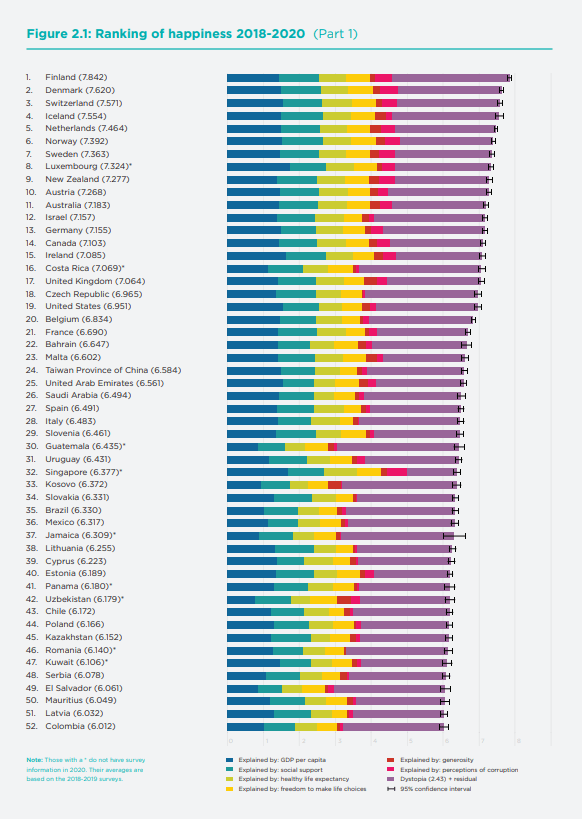
WHR Figure 2.1 Part 1
The rankings in Figure 2.1 of World Happiness Report 2021 use data that come from the Gallup World Poll surveys from 2018 to 2020. They are based on answers to the main life evaluation question asked in the poll. This is called the Cantril ladder: it asks respondents to think of a ladder, with the best possible life for them being a 10, and the worst possible life being a 0. They are then asked to rate their own current lives on that 0 to 10 scale. The rankings are from nationally representative samples, for the years 2018-2020. They are based entirely on the survey scores, using the Gallup weights to make the estimates representative. The sub-bars in Figure 2.1 show the estimated extent to which each of six factors – levels of GDP, life expectancy, generosity, social support, freedom, and corruption – are estimated to contribute to making life evaluations higher in each country than they are in Dystopia, a hypothetical country that has values equal to the world’s lowest national averages for each of the six factors (see FAQs: What is Dystopia?). The sub-bars have no impact on the total score reported for each country, but instead are just a way of explaining for each country the implications of the model estimated in Table 2.1. People often ask why some countries rank higher than others – the sub-bars (including the residuals, which show what is not explained) are an attempt to provide an answer to that question.
WHR Figure 2.1 Part 2
We use the most recent years in order to provide an up-to-date measure, and to measure changes over time. We combine data from the years 2018-2020 to make the sample size large enough to reduce the random sampling errors. (The horizontal lines at the right-hand end of each of the main bars show the 95% confidence interval for the estimate.) The typical annual sample for each country is 1,000 people. If a country had surveys in each year, then the sample size would be 3,000 people. However, there are many countries that have not had annual surveys, in which case the sample size is smaller than 3,000. Tables 1-3 of the online Statistical Appendix 1 show the sample size for each country in each year. Because of our interest in exploring how COVID-19 has influenced happiness for people in different countries and circumstances, we have done much of our analysis (as reported in Tables 2.2, 2.4, and 2.4).
WHR Figure 2.1 Part 3
At HumanistFreedoms.com we can’t help but wish for a comparative analysis of the WHR’s findings and the establishment of secular conditions around the globe.
The views, opinions and analyses expressed in the articles on Humanist Freedoms are those of the contributor(s) and do not necessarily reflect the views or opinions of the publishers.
Thomas Jefferson, writing to worried Baptists in Danbury, Connecticut in 1802, pledged that his administration would adhere to the “supreme will of the nation” on behalf of the rights of conscience and the free exercise of religion. The First Amendment, he said, had built “a wall of separation between Church & State.” America would have an impenetrable barrier to religious involvement in affairs of state.
Thomas Jefferson
One hundred and eighty years later, on April 17, 1982, Queen Elizabeth II gave royal assent to a new Canadian Constitution at a rainy outdoor ceremony in Ottawa. It contained a much heralded Charter of Rights and Freedoms guaranteeing “freedom of conscience and religion” while asserting that Canada was founded on “principles that recognize the supremacy of God.”
Both countries had set out to build secular and humanist societies. The United States, to all appearances, rejected any role for religion in its founding documents. Canada, in contrast, subjected itself – at least titularly – to God’s will. It guaranteed public funding of Roman Catholic schools and accepted the Queen’s role as head of state and “defender of the faith,” as symbolized by the Anglican Church.
Move forward to 2021 and a world slowly emerging from a global pandemic. What do we find? In the United States, relentless Christian evangelical attacks on secularism; in Canada, almost universal public acceptance for secular social policies. Arrived at free of religious interference, Canada guarantees, among other secular rights, freedom of choice (abortion rights), the right to medically assisted dying, medical and recreational use of marijuana, and a long-standing ban on capital punishment.
Ironically, the most contentious secular issue in Canada is not the defence of secularism, but whether the Province of Quebec has adopted too rigid a form of secularism through its ban on the wearing of religious symbols (i.e., the hijab) by public service workers in positions of authority. Civil libertarians see Quebec’s “Act Respecting the Laicity of the State” as an unreasonable curtailment of individual rights.
Quebec’s National Assembly
Around the world, secularism is under siege from religious forces ranging from populist Christian movements in Europe to extremist Islamic elements engaged in terrorist acts. Hindu nationalism in India has fractured a century of secular tolerance of Muslims and Hindus and China – ignoring its own secular constitution – is brutally suppressing its Uighur Muslim minority.
I gained a fuller appreciation of the ferocity of these attacks while researching Inventing Secularism, my biography of secularism’s founder, George Jacob Holyoake. The dangers I saw impelled me to add an epilogue identifying the actors and their strategies behind the assault on secularism which are now mounting around the world.
Thomas Jefferson’s proscription of religious involvement in affairs of state lasted until the mid -20th century. Then, Congress ordered the phrase “In God We Trust” to appear on U.S. currency and inserted “Under God” into the Pledge of Allegiance. The third Thursday in May was designated as a National Day of Prayer. A secularist organization, Americans United for Separation of Church and State, sees this contrivance for what it is: “… a vehicle for spreading religious misinformation and fundamentalist Christian doctrine under the aegis of the government – precisely what the framers [of the Constitution] were seeking to prohibit.”
These largely symbolic acts, while contrary to the principle that religion should have no place in lawmaking, stand today as minor irritants compared to the systematic attack on secularism that has been unfolding in U.S. courts and legislative bodies, and in countries around the world. The flow of public funds to U.S churches and faith groups through executive orders and court decisions, including an undetermined billions of dollars in COVID-19 relief intended for states and communities, is unprecedented in American history.
Under the guise of strengthening individual freedom, recent decisions of the U.S. Supreme Court have enabled local governments to fund and maintain public religious displays, provide access to public funding for certain religious schools, and allow service providers to discriminate among those whose lifestyles or religious principles they find disagreeable. From a humanist perspective, these actions amount to a reinterpretation of the religion clauses of the First Amendment – one prohibiting the “establishment” of a state religion and the other guaranteeing the “free exercise of faiths.”
“A person’s doctor or boss should not be able to use personal religious beliefs to dictate the healthcare their families can or cannot receive,” – American Atheists
As an example of anti-secular legislation by various U.S. states, a new Arkansas law would allow doctors, insurance companies, and employers to deny patients necessary healthcare on the basis of religious beliefs. “A person’s doctor or boss should not be able to use personal religious beliefs to dictate the healthcare their families can or cannot receive,” the watchdog group American Atheists said in a statement.
An air of optimism surrounded the first inter-faith meeting held by Pope Francis when he spent five days with Russian Orthodox Patriarch Kirill in Havana in February, 2013. It was the first such meeting in the nearly thousand years since the Great Schism of 1054 split Christianity between Greek East and Roman West. The newly ordained Pontiff had brought a breath of liberalism to the Vatican and his ability to communicate church doctrine in simple, homespun ways was impressing Catholics and non-Catholics alike.
Any expectation that Francis, as head of the oldest and arguably most influential Christian church would lead his 1.2 billion adherents to a new reality of modern life was quickly dashed. A thirty-point declaration out of Havana confirmed traditional teachings of both the Russian Orthodox and Roman churches. Most notably, the statement marked the Pontiff’s endorsement of a fresh crusade against secularism.
“The transformation of some countries into secularized societies, estranged from all references to God and his truth, constitutes a grave threat to religious freedom,” the statement declared. It attacked the “very aggressive secularist ideology” that seeks to relegate religion “to the margins of public life.” It also declared that “Europe must remain faithful to its Christian roots.”
Aside from alarming humanists, the declaration troubled some Catholics. Jon O’Brien, president of the Washington-based Catholics for Choice, said it misrepresented the true meaning of secularism. “A secular society is not one in which one religion or religious belief is in any way opposed, but one in which all citizens can practice as they see fit. In a secular society, we can have freedom of religion and freedom from religion.”
Since Havana, Pope Francis has stepped up his assaults on secularism. In 2017 he traveled to Egypt to meet President al-Sisi and defend a “vision of healthy secularism” that he would like to see accepted by Muslim countries. The Pontiff’s remarks made it evident that the trade-off for acceptance of his version of a neutered secularism would allow religion to dictate public policies on issues the Church regards itself and the Bible as sole arbiters. He pressed his attack in celebrating World Mission Day in 2019. “Rampant secularism”, he said, “when it becomes an aggressive cultural rejection of God’s active fatherhood in our history, is an obstacle to authentic human fraternity.”
During Pope Francis’s reign, virulent attacks on secularism have emerged in the American Catholic press. The National Catholic Register, which describes itself as the most faithful Catholic news source in the United States, has blamed secularism for the crimes of Nazi Germany and Soviet Russia, declaring “Secularism in any of its guises is deadly.” Its article was headed ‘Beware the Stormtroopers of Secularism’ and was illustrated with a picture of Nazi troops in Poland taking a Catholic priest to his execution. Such hyperbole overlooks the fact that the Nazis defied secularist principles by persecuting a people based on their religious identity, while the Soviet campaign of atheism invaded the secularist right to freedom of religion.
This preoccupation with secularism is consistent with Pope Francis’s staunchly conservative theology, despite occasional flashes of liberality. Having cheerfully asserted that atheists should follow their conscience and can still go to heaven if they approach God “with a sincere and contrite heart,” Pope Francis also spoke tolerantly of same-sex relationships. “Who am I to judge?” he replied off-handedly in answer to a question about a gay priest. More recently, he has warned that priestly celibacy must be strictly adhered to and on other issues has reflected traditional Catholic views: opposition to abortion, birth control and gay marriage, denial of the right to assisted death, and restrictions on the role of women in the Church. Pope Francis has dealt with child sex abuse, a phenomenon endemic within the Catholic priesthood, by ending the edict imposing secrecy on anyone reporting sexual abuse, and has ordered church leaders to report sex abuse cases and sex abuse cover-ups.
Former President Donald Trump Holding Christian Bible
In the United States, the deep strain of religiosity running through American politics has encouraged militant Christian evangelists in their determination to apply religious tests to civil legislation, and to gain public funding through means that violate the First Amendment. A 2020 survey by the respected Pew Institute had half of Americans (49%) saying the Bible should have at least “some influence” on U.S. laws, with more than a quarter (28%) holding the view that the Bible should take priority over the will of the people. Well known examples include denial of LGBTQ rights, restrictions to abortion, withdrawal of funding to organizations like Planned Parenthood, and cancellation of foreign aid to countries permitting family planning (a policy reversed by President Biden).
In such an environment, politicians are generally reluctant to express a commitment to humanist values. There are exceptions. Nancy Pelosi, Speaker of the House of Representatives, declined to attend the 2020 National Prayer Breakfast and just over a dozen Democrats make up the Congressional Freethought Caucus. Its most recent recruit is Rep. Rashida Tlaib of Michigan, a Muslim. Its perhaps most notable member is Rep. Jared Huffman of California who has declared himself a “non-religious humanist.”
Between 2017 and 2021, President Donald Trump and members of his cabinet came down consistently in favor of evangelical political positions. According to Mat Staver, president of Liberty Counsel, a legal advisory organization, about ninety per cent of fundamentalist goals were achieved under the Trump administration. “He’s been the most pro-religious freedom and pro-life president in modern history,” Staver told the Associated Press.
“We will not let anyone push God from the public square,” President Trump declared. American states began to require schools to post the slogan In God We Trust on classroom walls. The State of Mississippi, in design of a new state flag, dictated it bear the same words.
These challenges to secularism were echoed in U.S. Attorney-General William Barr’s claim, made in a speech to the University of Notre Dame law school, that “militant secularists” were behind a “campaign to destroy the traditional moral order”.
Appointments to the Supreme Court by Republican presidents – in power for 24 years between 1981 and 2021 – have securely embedded conservative and pro-religious views on the nation’s highest judicial body. Trump appointees Neil Gorsuch, Brent Kavanagh and Amy Coney Barrett tilted the Court further to the right.
The United States faces anti-secularism on other fronts, including white Christian nationalist groups like the Proud Boys and the instigators of QAnon who participated in the January 6 putative insurrection in Washington, and neo-Nazi groups of the type that gathered in Charlottesville, Virginia, to defend a Civil War monument and chant “Blood and Soil”, a Nazi rallying cry.
Secularists have welcomed the election of Joe Biden, a practicing Catholic, as President. But they look with concern on his repeated invoking of God and prayer and his description of America as a nation “sustained by faith.” Such comments are seen as a contradiction to the separation of church and state and an expression of disrespect to the nearly one-third of Americans – atheists, agnostics and other non-religious – who hold dissenting views.
Blasphemy prosecutions abound across the Muslim world. They provide a convenient legal process that near-theocratic states employ to control dissent and repress humanist expression. The connection with secularism as known in the West may seem remote, but every charge of blasphemy is an offence to secularism and everything secularism stands for – democratic rule, human rights, religious freedom and freedom from religion, the exclusion of religion from public life, and government non-involvement in religious natters.
Rafida Bonya Ahmed and Avijit Roy
In Bangladesh, human rights advocate Rafida Bonya Ahmed and her husband were attacked by a machete-wielding gang enraged by his online anti-religious, secularist comments. Police stood by as he was murdered. Appearing before a U.S. House of Representatives Foreign Affairs subcommittee, she identified 83 countries with blasphemy laws carrying penalties of fines, torture, imprisonment, and death.
While blasphemy – showing contempt or lack of reverence for God – is considered a major crime in Muslim countries, apostasy – abandoning the faith – is considered an even greater offence. Ten countries impose the penalty of death for apostasy.
An Asian nation beset by the disintegration of secularism is India, where the Hindu nationalist government of Narendra Modi and his ruling Bharatiya Janata Party (BJP) has embarked on policies that repudiate the country’s long secularist tradition. The BJP’s policies are having the effect of turning religions that did not originate on Indian soil – notably Islam and Christianity – into alien essences. The most controversial is a Citizenship Act that provides for refugees who came to India from Pakistan, Bangladesh, and Nepal to be given expedited access to citizenship – providing they are not Muslims. A U.S. government commission on international religious freedom has called for punitive measures against India, citing a “drastic turn downward” in religious freedom.
Across Europe, secularism is under siege in many nations. In Poland, the ruling Law and Justice party has imposed a near-total ban on abortion, criminalized sex education in schools; and equated homosexuality with pedophilia. The German state of Bavaria mandated that government buildings display a crucifix to show the region’s “social and cultural identity.” In Hungary a populist government led by Viktor Orban has cracked down on the press and driven the Central European University, a research-focused institute founded by billionaire George Soros, out of the country.
Turkey, once the most secular of Muslim nations, has almost totally abandoned secularism under a government that has repudiated the policies of Mustafa Kemal “Ataturk”, who initiated modernization of the country in the 1920s. After jailing opponents and gaining control of most Turkish media, President Recep Erdogan has openly called for re-establishment of an Islamic state. In a dramatic move toward this goal, the historic Hagia Sophia, a secular museum since 1936, has been restored as a mosque. Within a month the mediaeval Church of the Holy Saviour, one of Istanbul’s most celebrated Byzantine buildings that has been a secular museum for more than 70 years, was also converted into a mosque.
England and France also have been affected by the strains of anti-secularism. The two countries have taken different historic paths to secularism but both have suffered terrorist attacks – notably the Charlie Hebdo and Bataclan Concert bombings in Paris and a London subway bombing and an attack on a Manchester concert venue in which 22 people were killed. These events traumatized people in both countries, although the victims were far fewer than the 3,000 who died in New York on September 11, 2001.
Secularists in the United Kingdom accept, reluctantly, the role of the Queen as head of its established church, but wage an unrelenting campaign to remove religious control from state-funded schools. They also oppose the appointment of the 26 Church of England bishops who sit in the House of Lords, pointing out that Iran is the only other state where the clergy are represented as of right.
Attacks on secularism, if not vigorously opposed, will lead inevitably to a world of less freedom and more oppression. A more positive alternative has been articulated by George Jacob Holyoake, the English social reformer who invented the term secularism in 1851. Writing in his groundbreaking Principles of Secularism, he saw it a duty to promote “the immediate and material welfare of humanity … amid whatever diversity of opinion may subsist in a Secular Society.” This is the challenge secularism still must meet, if it is to withstand the attacks of resurgent religious forces throughout the world.
Ray Argyle is author of Inventing Secularism: The Radical Life of George JacobHolyoake, published by McFarland & Co, USA.. He lives in Kingston, Ontario.
The views, opinions and analyses expressed in the articles on Humanist Freedoms are those of the contributor(s) and do not necessarily reflect the views or opinions of the publishers.
In our search for interesting, challenging and critical perspectives on contemporary humanism, we occasionally find articles published in other venues that we think humanistfreedoms.com readers may enjoy. The following article was published by The Arnold P. Gold Foundation.
The Canadian Conference on Medical Education (CCME) 2021 will take place from Saturday, April 17-Tuesday April 20, bringing 4 full days of CCME content! Each day will bring you one of our 4 plenary sessions, 4 major sessions, live workshops, asynchronous oral sessions, and constant access to our poster sessions.
The Conference program will feature interactive workshops, pre-recorded oral sessions followed by live Q&As and poster presentations that are grouped into themes. Each theme covers current and emerging issues in medical education, varying from diversity and equity, Covid-19, health & wellness, continuing professional development to faculty development, teaching & learning, curriculum, professionalism, postgraduate affairs and more. With CCME 2021 organized around many different tracks of educational content, attendees will find ample opportunities for learning, networking and collaboration.
Given the current global situation, CCME has chosen to move from an in-person conference to a virtual one. Join the conference from anywhere in the world, from the comfort of your home for an inspirational program and impactful networking opportunities. This year, the conference theme is Making Waves: Exploring the Waters of Medical Education. Register Here
Together with the Association of Faculties of Medicine of Canada (AFMC), the Gold Foundation for Humanistic Healthcare, Canada is pleased to announce the recipient of the 2021 AFMC-Gold Humanism Award and Lecture: Dr. Marie-Ève Goyer, a leader in caring for people with addiction and an exemplar of humanism in healthcare.
Dr. Goyer is a family physician at the new Notre-Dame Hospital in the Addiction and Urban Medicine Department. She is Assistant Medical Chief of Specific Services in Homelessness, Addiction and Mental Health at CIUSSS Centre-Sud-de-l’île-de-Montréal and Scientific Director of the Clinical and Organizational Support Team in Addiction and Homelessness at the Institut universitaire sur les dépendances.
“Dr. Goyer has been an exceptional leader of humanism during the opioid crisis, during an era of surprising difficulty, caring for her patients with both deep empathy and innovative, practical solutions. As a medical educator, she multiples her success by helping illuminate humanistic values for her students,” said Dr. Richard I. Levin, President and CEO of The Arnold P. Gold Foundation. “We are delighted to join with AFMC to honor her contributions.”
Both Dr. Goyer and Dr. Jillian Horton, the 2020 AFMC-Gold Award recipient, will be honored in April at theCanadian Conference on Medical Education award ceremony, and both will be presenting at sessions. (The 2020 CCME conference was cancelled due to the COVID-19 pandemic. Please see the 2020 announcement of Dr. Horton’s award.)
The AFMC Gold Humanism Award and Lecture was created in 2018 by both organizations to emphasize, reinforce and enhance the importance of humanistic qualities among medical school students and faculty. The nominations are open to physicians, nurses and other members of the health care team who practice in Canada or practitioners and researchers in health professions education.
“We are thrilled to honour Dr. Marie-Ève Goyer as this year’s AFMC-Gold Humanism Award winner,” said Dr. Geneviève Moineau, President and CEO of the AFMC. “Dr. Goyer inspires compassion and creates a humanistic learning environment, which motivates students and residents to get involved with underserved populations.”
Dr. Goyer participated in the implementation of the supervised injection services and the PROFAN naloxone program in Montreal and is responsible for the implementation of the first service for the treatment of opioid dependence via injectable medication. She is a clinical assistant professor at the University of Montreal as well as professor for the graduate microprogram in clinical addictology at the University of Sherbrooke. She is a medical advisor to the director of the Ministry of Health for the province of Quebec’s addiction and homelessness services.
She holds a Master’s degree in Community Health from the University of Montreal and the CFPC’s Certificate in Additional Competence in Addiction Medicine.
In his nomination of Dr. Goyer, Dr. Patrick Cossette, Dean, Faculty of Medicine, Université de Montréal, wrote: “As evidenced by her patients, Dr. Goyer inspires benevolence and compassion towards fragile populations. Fostering cooperation among many professionals, she knows how to create a humanistic learning environment and motivate current and future physicians to get involved with underserved communities. Community care, adapted access to opioid addiction treatment, and the experience of users facing low-threshold services are examples of her daily work, reflecting a humanistic practice environment.”
The views, opinions and analyses expressed in the articles on Humanist Freedoms are those of the contributor(s) and do not necessarily reflect the views or opinions of the publishers.
In our search for interesting, challenging and critical perspectives on contemporary humanism, we occasionally find articles published in other venues that we think humanistfreedoms.com readers may enjoy. The following article was published by San Francisco Bayview.
According to hiphophumanism.com, “Hip Hop Humanism is a not a new form of Humanism. It has always been a part of Hip Hop. Why? Throughout the years Hip Hop as brought all types of people together. It has been a platform for the people to express themselves through art and skill. Telling their stories, our stories and the stories that we refuse to be ignored. We embrace all Humanist, because we want humanity better for us all, not for all of us except… It is an all inclusive culture initiative that uses art to speak to the self that rational ideas can be reached. We believe the creative aspect of Human beings is the essence of our humanity. It is the secret weapon of our consciousness. We may be rational intelligent and morally structured beings, but we are primarily sentiment beings so where we feel, laugh, cry, dance and love lays the greatest opportunity for making Human connections. It is the realm of the creative self where we find meaning, while rationality and integrity are the traits more equipped to address the search for purpose.….” (learn more on hiphophumanism.com)
By: Jay Rene Shakur
Humanists – Where Are You?
Humanism is a rational philosophy informed by science, inspired by art and motivated by compassion. Affirming the dignity of each human being, it supports the maximization of individual liberty and opportunity consonant with social and planetary responsibility. It advocates the extension of participatory democracy and the expansion of the open society, standing for human rights and social justice. Free of supernaturalism, it recognizes human beings as a part of nature and holds that values – be they religious, ethical, social or political – have their source in human experience and culture. Humanism thus derives the goals of life from human need and interest rather than from theological or ideological abstractions and asserts that humanity must take responsibility for its own destiny. – from The Humanist Magazine
When I first heard about humanism, I wanted to research everything about it. I’m not the type of person to just jump on the bandwagon. I like to know what I’m getting myself into and know it well enough that I can support it wholeheartedly.
The more I learned about humanism and what it stood for, I realized that I was a natural humanist from birth.
From as long as I can remember I cared about other humans just because I cared. It didn’t matter what they looked like or where they came from, I always had a heart for humanity and for the care of others.
As I continued to think more about it, I realized that hip-hop music artists who first began the craft were also humanists. They often talked about their neighborhood and giving back to it and they wanted to uplift people and give them knowledge and support for the simple fact that we were all brothers and sisters of the human race.
When I started Hip-Hop Humanism, it was based on what I believed humanism to be – supporting the betterment of humans as a whole as well as individually.
I wanted to give back in any way that I could by creating grassroots programs for children and promoting hip-hop artists that were about positivity and uplifting the human race.
And it continued to grow. It grew into social justice and rightfully so. As a humanist I feel totally inclined to get involved in what is going on in America. It was surprising to me, however, that when I looked to my left and right, I was the only humanist there.
I expected to see humanists more involved, not only on the ground protesting but through literature of some kind, making some noticeable contribution.
Now, if this literature exists, I have yet to see it and I would love to. However, as much as the humanist stands for, I expected to see all of us out here in the forefront. I expected to see humanism as a major leader and household name in the fight for social justice.
For what is going on in the United States, why wouldn’t humanists be the ones to really help aid this problem?
As humanists we aren’t in it because of a person’s race or their gender. It doesn’t matter their class or how much money they have in the bank. What matters is that they are human.
As humanists we care about our fellow man, woman and child and do our part simply for them. It’s compassion and it’s love. It is human decency.
Reflecting on the ultimate demise of many Black Panthers, Bobby Seale sums up the goals of the party, goals which speak to a universal humanist agenda:
“We need activists who cross all ethnic and religious backgrounds and color lines who will establish civil and human rights for all, including the right to an ecologically balanced, pollution-free environment. We must create a world of decent human relationships where revolutionary humanism is grounded in democratic human rights for every person on earth. Those were the political revolutionary objectives of my old Black Panther Party. They must now belong to the youth of today,” said Bobby Seale, quoted by Anthony B. Pinn in “Anybody there? Reflections on African American Humanism,” published in 1997 by the UU Humanist Association.
Why have I seen no humanists out here? Where is everyone?
Did I learn to believe that humanism is something that it isn’t? Has everyone forgotten?
Or maybe I am supposed to take the lead and make it become what it’s supposed to have already been.
The support of the humanist thought is needed in the social justice fight. We are everywhere – from all occupations and walks of life.
Who more to understand the plight of mankind and care about it with no agenda but for the upliftment of humans for humans? That’s what I understand humanists to be.
Was I wrong? Well, if I was wrong, dear old humanist, please be prepared for a revamp of what we do.
Signed,
The New Humanist
Jay Rene, founder of Hip Hop Humanism, documentarian and wife of imprisoned writer Kwame Teague, can be reached on Instagram at @thejayrene, by email at hiphophumanismhr@gmail.com and online at www.hiphophumanism.com.
The views, opinions and analyses expressed in the articles on Humanist Freedoms are those of the contributor(s) and do not necessarily reflect the views or opinions of the publishers.
On February 18, 2021 NASA’s Perseverance rover landed on the surface of Mars. Perseverance is the largest, most advanced rover NASA has sent to another world. It travelled 472 million kilometers over 203 days and the intact landing was broadcast live via the internet for anyone with an internet connection to witness.
Humanity is deep into exploration of another planet. If that doesn’t whet your appetite to know more about the possibilities of planetary exploration and planetary biology – including all of the philosophical and metaphysical implications they bring…we’re not sure what will!
Sarah Stewart Johnson’s The Sirens of Mars
In 2020, Sarah Steward Johnson‘s publishers released The Sirens of Mars – Search for Life on Another World. At a little-over 200 pages in hardcover, the publisher’s categorize the book as “biography and memoir” given the frequent inclusion of personal anecdotes and reflections of the author’s life and relationship to the subject.
Sarah Stewart Johnson is an assistant professor of planetary science at Georgetown University. A former Rhodes Scholar and White House Fellow, she received her PhD from MIT and has worked on NASA’s Spirit, Opportunity, and Curiosity rovers. She is also a visiting scientist with the Planetary Environments Lab at NASA’s Goddard Space Flight Center.
Stewart Johnson’s writing style is very approachable and relatable. It is a meaningful and worthwhile trend that scientists publish books which reflect their individual humanity as well as the humanistic principles that are deeply embedded in the work that they do.
The book includes a history of Mars exploration beginning with Plato, Galileo and Isaac Newton through to both NASA’s and Russia’s programs as well as informative glimpses of the science behind one of humanity’s most astounding projects. The book is aimed at a broad and general audience but it isn’t a “picture book”, so if you’re looking to be inspired by photos of the red planet, the internet is a better source.
At the end of the book, Stewart Johnson writes, “In writing this book, I’ve come to understand better the meaning I find in searching for life. I’ve also come to appreciate all the people who came down this path before me and the astonishing lives they led, as well as the remarkable colleagues with whom I have the privilege of working today. In my final acknowledgements, I wish to extend my gratitude to all of those people, throughout the generations and across the disciplines, who have created and continue to deepen this field. If we find life on Mars, we will have done it together. In the meantime, we have this great human project, and we have one another.”
The book is worth the time and resources you may spend in its acquisition and study.
The views, opinions and analyses expressed in the articles on Humanist Freedoms are those of the contributor(s) and do not necessarily reflect the views or opinions of the publishers.
In a 2015 article on gartner.com, Christy Pettey wrote an important article titled Embracing Digital Humanism. The article states, ” By 2020, our planet will be home to 30 billion things with embedded intelligence combined with nearly 8 billion smart devices. That means by 2020, there will be a ratio of approximately six intelligent devices/things for every human on the planet. In a world of digital business, IT leaders will need to orchestrate all these new devices, new data streams and new experiences to create value. But what principles will these IT leaders apply? The emerging digital world requires human-centric digital leadership.” That last sentence is an important concept to have formulated and launched and bears significant attention and therefore repetition:
The emerging digital world requires human-centric digital leadership.
Pettey then continued by providing a definition of digital humanism as “the notion that people are the central focus in the manifestation of digital businesses and digital workplaces.” As we will see, the concept has broadened since 2015, but this was an important conceptual milestone for humanism and for humanity. For those interested in the ethical and philosophical advancement of humanist ideas, digital humanism is a significant developing field for exploration.
Before we get to the manifesto, let’s also detour to Martin Recke’s article on the NEXT website wherein Recke suggests that digital humanism “stands for the shift away from computer-literate people to people-literate technology.” Recke also provides some useful differentiation between digital humanism and digital humanities; the latter seems to be most easily reduced to humanities practiced and/or studied via digital technologies and media.
Recke finished his primer on digital humanism by writing “Seen this way, Digital Humanism refers to the age-old concern to put humankind, in all its aspects, at the centre of our work. The early, 14th century humanists started a cultural revolution that peaked in the Renaissance era. Maybe it is time for a new cultural revolution, a new Renaissance. Or is it already happening?“
Digital Humanism: Informatics in Times of COVID-19, one of Dighum’s many online seminars on their YouTube Channel.
And now we arrive a Vienna, May 2019 when the Vienna Manifesto for Digital Humanism was published. Below, we reproduce the manifesto as we found it on the Dighum website. The bolded text is original to the Dighum site while the underlined text is our emphasis.
Are you a current or aspiring digital humanism journalist, academic or professional? We want your articles on humanistfreedoms.com.
“The system is failing” – stated by the founder of the Web, Tim Berners-Lee – emphasizes that while digitalization opens unprecedented opportunities, it also raises serious concerns: the monopolization of the Web, the rise of extremist opinions and behavior orchestrated by social media, the formation of filter bubbles and echo chambers as islands of disjoint truths, the loss of privacy, and the spread of digital surveillance. Digital technologies are disrupting societies and questioning our understanding of what it means to be human. The stakes are high and the challenge of building a just and democratic society with humans at the center of technological progress needs to be addressed with determination as well as scientific ingenuity. Technological innovation demands social innovation, and social innovation requires broad societal engagement.
This manifesto is a call to deliberate and to act on current and future technological development. We encourage our academic communities, as well as industrial leaders, politicians, policy makers, and professional societies all around the globe, to actively participate in policy formation. Our demands are the result of an emerging process that unites scientists and practitioners across fields and topics, brought together by concerns and hopes for the future. We are aware of our joint responsibility for the current situation and the future – both as professionals and citizens.
Today, we experience the co-evolution of technology and humankind. The flood of data, algorithms, and computational power is disrupting the very fabric of society by changing human interactions, societal institutions, economies, and political structures. Science and the humanities are not exempt. This disruption simultaneously creates and threatens jobs, produces and destroys wealth, and improves and damages our ecology. It shifts power structures, thereby blurring the human and the machine.
The quest is for enlightenment and humanism. The capability to automate human cognitive activities is a revolutionary aspect of computer science / informatics. For many tasks, machines surpass already what humans can accomplish in speed, precision, and even analytic deduction. The time is right to bring together humanistic ideals with critical thoughts about technological progress. We therefore link this manifesto to the intellectual tradition of humanism and similar movements striving for an enlightened humanity.
Like all technologies, digital technologies do not emerge from nowhere. They are shaped by implicit and explicit choices and thus incorporate a set of values, norms, economic interests, and assumptions about how the world around us is or should be. Many of these choices remain hidden in software programs implementing algorithms that remain invisible. In line with the renowned Vienna Circle and its contributions to modern thinking, we want to espouse critical rational reasoning and the interdisciplinarity needed to shape the future.
We must shape technologies in accordance with human values and needs, instead of allowing technologies to shape humans. Our task is not only to rein in the downsides of information and communication technologies, but to encourage human-centered innovation. We call for a Digital Humanism that describes, analyzes, and, most importantly, influences the complex interplay of technology and humankind, for a better society and life, fully respecting universal human rights.
In conclusion, we proclaim the following core principles:
Digital technologies should be designed to promote democracy and inclusion. This will require special efforts to overcome current inequalities and to use the emancipatory potential of digital technologies to make our societies more inclusive.
Privacy and freedom of speech are essential values for democracy and should be at the center of our activities. Therefore, artifacts such as social media or online platforms need to be altered to better safeguard the free expression of opinion, the dissemination of information, and the protection of privacy.
Effective regulations, rules and laws, based on a broad public discourse, must be established. They should ensure prediction accuracy, fairness and equality, accountability, and transparency of software programs and algorithms.
Regulators need to intervene with tech monopolies. It is necessary to restore market competitiveness as tech monopolies concentrate market power and stifle innovation. Governments should not leave all decisions to markets.
Decisions with consequences that have the potential to affect individual or collective human rights must continue to be made by humans. Decision makers must be responsible and accountable for their decisions. Automated decision making systems should only support human decision making, not replace it.
Scientific approaches crossing different disciplines are a prerequisite for tackling the challenges ahead. Technological disciplines such as computer science / informatics must collaborate with social sciences, humanities, and other sciences, breaking disciplinary silos.
Universities are the place where new knowledge is produced and critical thought is cultivated. Hence, they have a special responsibility and have to be aware of that.
Academic and industrial researchers must engage openly with wider society and reflect upon their approaches. This needs to be embedded in the practice of producing new knowledge and technologies, while at the same time defending the freedom of thought and science.
Practitioners everywhere ought to acknowledge their shared responsibility for the impact of information technologies. They need to understand that no technology is neutral and be sensitized to see both potential benefits and possible downsides.
A vision is needed for new educational curricula, combining knowledge from the humanities, the social sciences, and engineering studies. In the age of automated decision making and AI, creativity and attention to human aspects are crucial to the education of future engineers and technologists.
Education on computer science / informatics and its societal impact must start as early as possible. Students should learn to combine information-technology skills with awareness of the ethical and societal issues at stake.
We are at a crossroads to the future; we must go into action and take the right direction!
The views, opinions and analyses expressed in the articles on Humanist Freedoms are those of the contributor(s) and do not necessarily reflect the views or opinions of the publishers.
In our January 2021 Call for Submissions, we asked for articles in consideration of “Contemporary Humanism’s Biggest Priorities and Challenges for 2021“. In Canada, two leading humanist organizations, Centre For Inquiry Canada (CFIC) and Humanist Canada announced their backing of Parliamentary e-Petition 3114.
The meat of this e-Petition, which was opened for signatures on January 25, 2021, is a call upon Canada’s Minister of Immigration, Refugees and Citizenshipto change the policy regarding Less Complex Claims to include atheists in the list of people eligible for the status, so that they will be treated equally with those people belonging to the religions currently listed in the Less Complex Claims policy.
While you will find the text of the e-Petition via the link to the e-Petition’s government website (above), we have provided the text at the bottom of this article.
Canada’s system of Parliamentary e-Petitions was introduced in December of 2015. The e-Petition system follows the same principles as paper petitions, but with particular procedural rules in place for the digital age. These rules include, but are not limited to:
the petitioners completes a petition form (250 word maximum) based on the classic model on the government website
the petitioners submit names and contact information of at least five individuals who support the process
the e-petition must be sponsored by a Member of Parliament
when an e-petition has cleared all preliminary screening, it is published and remains open for signature for 120 days
individuals who sign an e-petition must provide their contact information, confirm that they are a resident of Canada or a Canadian citizen living outside of Canada
e-petitions that have a minimum of 500 valid signatures are sent to the sponsoring Member of Parliament for presentation to the House of Commons
In an email we received from Centre For Inquiry Canada, we learned that CFIC’s involvement in the e-Petition is tied to their involvement in assisting atheist and humanist refugees. Currently, CFIC is “supporting Omer (a pseudonym) [a refugee from Pakistan] while he waits to come to Canada. In 2011, after a heated debate about religion with a friend, Omer was abducted and beaten by five men. Omer was sexually assaulted, his finger was cut off, and the abductors used a burning cigarette to write Tauba (“repent”) on his arm.” CFIC has been involved in assisting atheist refugees since 2015 when it led a successful campaign to support another atheist targeted for attack, Raihan Abir.
CFIC also appears to have been tracking Canada’ e-Petition system since the system was launched. In a 2016 article on the CFIC website, the organization states: “Some of these e-petitions will fail to garner the support they require to justify a response by Parliament; others will be ill-timed to existing legislation (e.g. the physician assisted death petitions above) and as identified by the limited responses by Parliament to date, a great many that do reach Parliament are likely to be dismissed, shuffled to the side or otherwise punted by the politicians. It is possibly, however, that some e-petitions may result in policy change. At minimum, these e-petitions offer an opportunity to communicate directly to Parliament on federal issues such as Canada’s blasphemous libel law or other federal policy. As leading secular citizens of Canada – it is a process which CFIC and its members should monitor and participate in.”
CFIC and Humanist Canada were leading organizers of e-Petition 382, opposing Canada’s blasphemous libel law in 2016. The two organizations were essential to garnering 7406 signatures on the e-Petition. The targeted section of the Criminal Code was repealed in 2018.
As of February 17, 2021, e-Petition 3114 has collected 1139 signatures and remains open for signature through to April 25, 2021.
The Member of Parliament whose name currently appears with e-Petition 3114 is Nathaniel Erskine-Smith from the Beaches—East York riding.
It will be interesting to observe whether CFIC and Humanist Canada release further education regarding the Parliamentary e-Petition process and the particular regulation that e-Petition 3114 targets. At this time, it is not clear whether either organization has developed a related position paper or policy brief on the matter. It is also not yet clear whether the national leaders of these organizations are actively engaged with their provincial and local counterpart organizations to raise awareness and action on the issues in Canada. Nor whether this may be a part of international partnerships regarding atheist, humanist and apostate refugees. We welcome an opportunity to publish any articles that may be made available.
Changing government policy or federal law is a significant challenge in any country. As may be the case with the Less Complex Claims policy, strategic targets for change may also be an important part of furthering and fostering humanism around the globe.
Petition to the House of Commons in Parliament assembled
Whereas:
Atheists are persecuted in several countries both by government and the public;
Atheist persecution can result in serious injury, imprisonment, or death at the hands of family members, street mobs, or governments;
Some countries, including Saudi Arabia, label all atheists as terrorists: this alone should not disqualify them for refugee status;
The Supreme Court of Canada has ruled several times that the Canadian Charter of Rights and Freedoms guarantees the right to freedom from religion as much as the right to freedom of religion, a standard which applies to refugees as well as citizens;
Atheists are denied access to the Less Complex Claims Policy of Canada because they are excluded from the list of those who qualify, all of whom are members of a religion; and
This is an urgent matter because the lives of several atheists are currently in danger while awaiting their refugee hearings, which would be avoided if atheists were included in the less complex claims process.
We, the undersigned, residents of Canada, call upon the Minister of Immigration, Refugees and Citizenship to change the policy regarding Less Complex Claims to include atheists in the list of people eligible for the status, so that they will be treated equally with those people belonging to the religions currently listed in the Less Complex Claims policy.
The views, opinions and analyses expressed in the articles on Humanist Freedoms are those of the contributor(s) and do not necessarily reflect the views or opinions of the publishers.
In our January 2021 Call for Submissions, we asked for articles in consideration of “Contemporary Humanism’s Biggest Priorities and Challenges for 2021“. In the United States of America (USA), one of the leading humanist organizations, American Humanist Association has left the gates with a clear indication that the identity of leadership within humanist organizations is a leading priority.
Roy Speckhardt announced that he will be leaving his position as American Humanist Association Executive Director by the fall of 2021
Speckhardt, who joined the American Humanist Association (“AHA”) staff 20 years ago and was appointed Executive Director in 2005, says his decision to open his position for a new voice is the right one for the AHA and the humanist movement.
Speckhardt explained that, “Being at the helm of such an organization as the AHA, whose mission is so critical to our times and whose influence far outstrips its size, was the greatest honor of my life, but I’ve decided it’s time for me to step down and make room for new leadership. It is my emphatic hope that my seat is filled with a Black or Brown humanist because our movement has gone too long without such diversity at the helm and this would open the door for the AHA to truly achieve its potential as a humanist and anti-racist institution.”
Speckhardt oversaw the AHA’s exponential growth and evolution from a small organization focused more on the philosophical aspects of humanism to an advocacy powerhouse with significant access in all levels of government. During his tenure, the organization quadrupled its capacity and membership, and its annual reach grew explosively from thousands previously to millions today. He helped move the organization from a modest townhouse to a statement headquarters building in the heart of the nation’s capital, a venue where the founding members of the Congressional Freethought Caucus gathered to determine its mission. Speckhardt saw the organization achieve many firsts, from seeing humanists and other nontheists named in federal legislation, to launching the movement’s first staffed social justice department, to seeing the first time an AHA staff attorney argued a case before the U.S. Supreme Court.
“I have gratitude for everything our team, members, and supporters invested. It’s because of you that we were able to achieve successes together,” Speckhardt added. Coming to the AHA after serving six years with the Interfaith Alliance and once appointed the AHA’s Executive Director, Speckhardt made hundreds of public appearances, wrote scores of published articles, and authored the AHA’s primer, Creating Change Through Humanism. His next book, Justice Centered Humanism, will be released in April 2021.
Sunil Panikkath, President of the AHA Board of Directors, praised Speckhardt for his many years of service.
“Roy drove the humanist perspective to new heights of awareness, acceptance, and prominence. He traveled the nation meeting with local leaders and other supporters, regularly defended humanist viewpoints in the media, and assembled a team of professionals ready to make a difference in Washington,” said Panikkath.
Panikkath said that a search is underway to find a new Executive Director for the AHA, which will celebrate its 80th anniversary next year. Speckhardt will remain at the AHA through the transition and will continue to be closely involved as chair of a new AHA Board Committee on Advancement.
“With the help of our chosen executive search firm Professionals For Non Profits, who have posted the position, we are getting started on a thorough, nationwide search to find new leadership for the American Humanist Association, a search that will involve all AHA stakeholders,” said Panikkath. “I am confident we will find a new leader who will be well qualified to meet the challenges before us and to take advantage of opportunities for further growth and development of humanism.”
The American Humanist Association (AHA) works to protect the rights of humanists, atheists, and other nontheistic Americans. The AHA advances the ethical and life-affirming worldview of humanism, which—without beliefs in gods or other supernatural forces—encourages individuals to live informed and meaningful lives that aspire to the greater good of humanity.
The views, opinions and analyses expressed in the articles on Humanist Freedoms are those of the contributor(s) and do not necessarily reflect the views or opinions of the publishers.
In our January 2021 Call for Submissions, we asked for your submissions on topics relating to humanism, including a request for articles on the theme of Humanism’s Biggest Priorities and Challenges for 2021. As a website devoted to providing information about the fundamental links between humanism and human rights & freedoms, we cannot ignore the worst deprivations of human dignity during our aspirations for the highest of human freedoms.
On February 2, 2021 the United Nations Office on Drugs and Crime released the fifth edition of its Global Report on Trafficking in Persons. The report covers 148 countries and provides an overview of patterns and flows of trafficking in persons at global, regional and national levels, based primarily on trafficking cases detected between 2016 and 2019. As UNODC has been systematically collecting data on trafficking in persons for more than a decade, trend information is presented for a broad range of indicators.
Divided into six sections (Global Overview, Socio-Economic Factors and Risks of the COVID-19 Recession, Children – Easy to Target, Trafficking for Forced Labour, Traffickers use of Internet and Regional Overview) and pushing 200-pages, the report provides a sobering perspective on one of humanity’s oldest and most odious problems.
Traffickers see their victims as commodities without regard for human dignity and rights. They sell fellow human beings for a price that can range from tens of US dollars to tens of thousands, with large criminal organizations making the highest incomes.
The report is produced every two years. The 2020 edition covers data from the world’s largest database on trafficking victims, compiling figures from official sources across 148 countries. It also analyses 489 court cases from 71 different countries, providing qualitative information on the perpetrators and the characteristics of the crimes.
The article below the infographic is a related press release that had been embargoed until February 3, 2021.
Share of children among trafficking victims increases, boys five times; COVID-19 seen worsening overall trend in human trafficking, says UNODC Report
Vienna 2 February 2021 – The number of children among detected trafficking victims has tripled in the past 15 years, while the share of boys has increased five times. Girls are mainly trafficked for sexual exploitation, while boys are used for forced labour, according to the Global Report on Trafficking in Persons, launched by the United Nations Office on Drugs and Crime (UNODC) today.
In 2018 about 50,000 human trafficking victims were detected and reported by 148 countries. However, given the hidden nature of this crime, the actual number of victims trafficked is far higher. The Report shows traffickers particularly target the most vulnerable, such as migrants and people without jobs. The COVID-19-induced recession is likely to expose more people to the risk of trafficking.
“Millions of women, children and men worldwide are out of work, out of school and without social support in the continuing COVID-19 crisis, leaving them at greater risk of human trafficking. We need targeted action to stop criminal traffickers from taking advantage of the pandemic to exploit the vulnerable,” said UNODC Executive Director Ghada.
“The UNODC Global Report on Trafficking in Persons 2020, coupled with the technical assistance UNODC provides through its global programmes and field network, aims to inform governments’ anti-trafficking responses, end impunity, and support victims as part of integrated efforts to build forward from the pandemic.”
Profile of the Victims
Female victims continue to be the primary targets for trafficking in persons. For every 10 victims detected globally in 2018, about five were adult women and two were young girls. Around 20 per cent of human trafficking victims were adult men and 15 per cent were young boys.
Over the last 15 years, the number of detected victims has increased, while their profile has changed. The share of adult women among the detected victims fell from more than 70 per cent to less than 50 per cent in 2018, while the share of children detected has increased, from around 10 per cent to over 30 per cent. In the same period, the share of adult men has nearly doubled, from around 10 per cent to 20 per cent in 2018.
Overall, 50 per cent of detected victims were trafficked for sexual exploitation, 38 per cent were exploited for forced labour, six per cent were subjected to forced criminal activity, while one per cent were coerced into begging and smaller numbers into forced marriages, organ removal, and other purposes.
Victims’ profiles differ according to the form of exploitation. In 2018, most women and girls detected were trafficked for sexual exploitation, whereas men and boys were mainly trafficked for forced labour.
The share of detected victims trafficked for forced labour has steadily increased for more than a decade. Victims are exploited across a wide range of economic sectors, particularly in those where work is undertaken in isolated circumstances including agriculture, construction, fishing, mining, and domestic work.
Profile of the Offenders
Globally, most persons prosecuted and convicted of trafficking in persons continue to be male, with around 64 and 62 per cent respectively. Offenders can be members of organized crime groups, which traffic the great majority of victims, to individuals operating on their own or in small groups on an opportunistic basis.
Traffickers see their victims as commodities without regard for human dignity and rights. They sell fellow human beings for a price that can range from tens of US dollars to tens of thousands, with large criminal organizations making the highest incomes.
Traffickers have integrated technology into their business model at every stage of the process, from recruiting to exploiting victims. Many children are approached by traffickers on social media and they are an easy target in their search for acceptance, attention, or friendship. UNODC has identified two types of strategies: “hunting” involving a trafficker actively pursuing a victim, typically on social media; and “fishing”, when perpetrators post job advertisements and wait for potential victims to respond. The internet allows traffickers to live stream the exploitation of their victims, which enables the simultaneous abuse of one victim by many consumers around the globe.
The views, opinions and analyses expressed in the articles on Humanist Freedoms are those of the contributor(s) and do not necessarily reflect the views or opinions of the publishers.
Evolution. It’s only one word, but how many hundreds or thousands of other words, ideas and opinions does that one word conjure up? How many books have been written about evolution since Charles Darwin’s The Origin of Species was published in 1859? A comprehensive collection that included all books for, against, explaining, confusing, misrepresenting, re-purposing and otherwise largely or wholly devoted to evolution were included, it would make an astounding and enjoyable library.
Even in the absence of such a devoted library, it is entirely possible for the average enthusiast to delve the shelves of their public library and reach a point when it seems like there isn’t much more to be considered. Perhaps academics, biologists and others of specialist sort may have further footnotes to add, but really – is there anything fresh?
Well, yes there is. In 2020, Gaia Vince published Transcendence: How Humans Evolved Through Fire, Language, Beauty and Time. According to the author’s website, Gaia Vince is an “award-winning science journalist, author, broadcaster and speaker…. particularly interested in how human systems and Earth’s planetary systems interact.” who feels that “this is a unique time in Earth’s history, in which climate change, globalisation, communications technology and increasing human population are changing our world – and us – as never before.”
At about 350 pages, the book incorporates a mix of anecdotes, storytelling, and science journalism that is often but not always effective on the first read. But that may be a characteristic in its favour. Like evolution, the book requires a commitment of time. It isn’t exactly like all the other books on evolution. It needs to be read and considered – and sometimes even re-read.
It’s fresh.
In a unique time in Earth’s history when human population is rapidly changing the world, fresh perspective-taking is needed. We shouldn’t be glazing over our routine understandings of the fundamental processes of life. We need to struggle with them a bit more. We need to deepen and widen our perspectives. That is what it seems that Gaia Vince has tried to do with this book.
The book is worth the time and resources you may spend.
The views, opinions and analyses expressed in the articles on Humanist Freedoms are those of the contributor(s) and do not necessarily reflect the views or opinions of the publishers.



















 Humanist Heritage Canada