During the latter half of 2023 and most of 2024, we had been less active in sharing humanist news and events than we were from 2020 to 2023 (as HumanistFreedoms.com). We weren’t quite fully hibernated, but we were very sleepy. Now, in 2025, we’ve refocused on our new branding, Humanist Heritage Canada, with plans to document and share the ongoing history of humanism in Canada.
We’ll still be sharing important humanist stories from around the world when they seem to have special insights on how humanism is unfolding in Canada.
We hope that frequent visitors to HumanistHeritageCanada.ca have noticed that we’re developing a timeline of Canada’s humanist heritage. For that endeavor to tell the story of goals, achievements and important events, we are looking for your participation!
Please send us your timeline suggestions, articles, stories, biographies or whatever comes to mind that will flesh-out our timeline of Canada’s humanist heritage.
Please follow our website, share articles with your friends and help us grow.
Up For Discussion
If you’re interested in analyzing and discussing issues from a contemporary humanist position, there are actions you can take. First, here at Humanist Heritage Canada (Humanist Freedoms), we are open to receiving your well-written articles regarding artificial intelligence.
By continuing to access, link to, or use this website and/or podcast, you accept the HumanistFreedoms.com and HumanistHeritageCanada.ca Terms of Service in full. If you disagree with the terms of service in whole or in part, you must not use the website, podcast or other material.
The views, opinions and analyses expressed in the articles on Humanist Freedoms are those of the contributor(s) and do not necessarily reflect the views or opinions of the publishers.
A provincial general election has been called for February 27, 2025. Throughout the month, we’ll refresh this post with any news, information or resources that may be of interest. Check back often!
1740697200
days
hours minutes seconds
until
Ontario Provincial General Election
It is probably clear to most Ontario electors that Premier Doug Ford called the election now, rather than waiting until 2026, primarily because the timing is better for him and his Progressive Conservative Party of Ontario.
According to Joshua Freedman at CP24, the leading reasons for an early election in Ontario include strong polling for the PCs, threats of punitive tariffs by the current President of the United States of America, and Ontario’s frequent tendency to elect provincial liberals when a federal conservative government is in power (and vice versa). These reasons all seem correctly assumed.
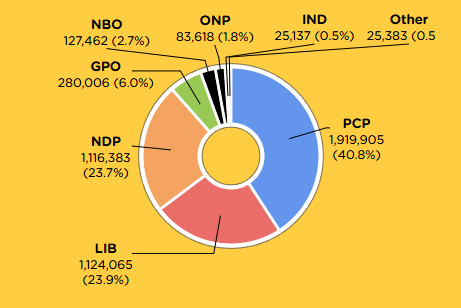
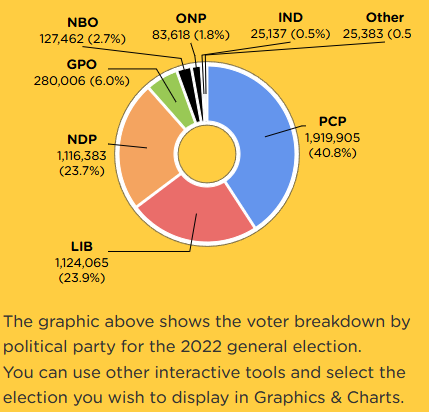
Polling the electorate is valued by the media and political parties in our first past the post system. It isn’t necessary in Canadian politics to be more popular than the other candidate(s). As a candidate, it’s great if you and your party happen to be more popular, but it isn’t really the bottom line. Consider the 2022 Ontario election results:
If you weren’t already familiar with our system, you’d wonder how a party with 40.8 percent of the vote was able to achieve a majority government. You’d be baffled to see that 40.8 can get you a 66.9 percent majority of seats.
That is indeed what you can get when every riding is its own horse-race. It takes a lot for Canadians to send a political party packing. Premier Ford does not want to wait until the Ontario electorate is completely sick of hearing his name. In Canadian politics, our tendency is not to vote FOR a government, but to vote to GET RID of a government.
This informs Ontario’s tendency to have a red party in power provincially when a blue party is in power federally (and vice versa). Once we’ve gotten sick of seeing red….we’re sick of it regardless of whether they’re sitting in Ottawa or Toronto. Is it more complicated than that? Probably…or maybe. But it’s not a popular myth for no reason.
Did you know that there are 25 registered political parties in Ontario? We checked the Elections Ontario website today to get an idea of who’s who. That’s a lot of parties to try to explore and we’ll do our best to run through the lot (probably in a separate post). For now…starting at the top the alphabetically sorted list, the Canadians’ Choice Party website states that their mandate is to, “help Independent Candidates across Ontario to better represent their ridings and to bring a fair measure of direct democracy to all Ontarians and Canadians.” and that they have four “pillars” grouped under the somewhat uncomfortable acronym FIST: Fiscal responsibility and respect for taxpayers, Individual freedom and the right to free speech, Sovereignty and protection of common-law rights, Transparency and accountability in government. Apparently these folks have been around since 2011 with “A bottom-up approach to engage citizens.” We’ll let you work out the pun(s) that inevitably (and perhaps, deservedly) comes to mind. The initiative seems to be earnestly motivated, but doesn’t really present a credible, self-consistent philosophy.
Meanwhile, perhaps the biggest motivation for the election that’s been posited so far is the threat of tariffs and/or financial hard times. Some pundits will suggest that non-blue candidates will be wise to stay away from the issue. For those who oppose the ongoing financial and human rights embarrassment of funding religious schools…this is an opportunity.
Our reasoning goes like this: Given the RISKS associated with unreliable global trading partners, supply chain business practices that destroy Ontario-based value-added business and the ever-increasing probability of continued financial hard-times….can Ontario really afford the anachronistic, misguided, wasteful and discriminatory practice of funding the Catholic school system with public money any longer?
There has never been a more pressing time to push Ontario’s conservative politicians to set aside their puppy-eyed adoration of Bill Davis, admit that discriminatory funding of one religious group’s schools is a bad and wasteful idea and rip the band-aid off.
As a very modest side note (and speaking of puppy-eyed adoration), Ontario humanists may do well to spend some time with Steve Paikin’s biography of Bill Davis titled, Bill Davis: Nation Builder, and Not So Bland After All. If you read the book and between the lines, you may come away with important insight into why Ontario perpetuates this recognized human rights violation and what it may take to finally get the province back on track for a single school system.
Lest we be accused of being a one-trick-pony kind of place, we asked an AI to generate a list of issues in the current provincial election. The response we got back was:
Jobs and the economy, with a focus on creating new opportunities and supporting workers
Healthcare, including the need for more family doctors and improved access to healthcare services
Affordability, with parties proposing various solutions to address the rising cost of living in Ontario
Gridlock and transportation, with discussions on highway expansion, public transit, and the removal of tolls on Highway 407
Education, with the NDP proposing to invest an additional $830 million a year to clear the repair backlog in schools and create a universal School Food Program
Housing, with the NDP proposing to create 60,000 new supportive housing units and establish Homes Ontario to build permanently affordable housing
Energy and the environment, with the PC party proposing to permanently cut the provincial tax on gas and diesel5
Indigenous issues, with a focus on reconciliation and supporting Indigenous communities
Long-term care, with a need for improved services and support for seniors
Infrastructure, with the PC party proposing to invest up to $15 billion more over three years to speed up key capital projects
Social assistance, with the NDP and Liberal parties proposing to double ODSP
Tariff response, with the PC party proposing $10 billion in cash-flow support for Ontario employ
When we asked, what issues should be of importance to humanists in this coming election, we were advised that, “As a humanist, you may be particularly interested in issues that promote the well-being, dignity, and flourishing of all individuals in Ontario,” and the following list of priorities was presented:
Education: Investing in public education, promoting critical thinking, and ensuring that all students have access to quality education, regardless of their background or socioeconomic status.
Healthcare: Ensuring that all Ontarians have access to quality, publicly-funded healthcare, including mental health services, reproductive health, and palliative care.
Social Justice: Addressing issues of poverty, inequality, and systemic racism, including promoting affordable housing, increasing the minimum wage, and supporting marginalized communities.
Environmental Protection: Taking action to address climate change, promoting renewable energy, and protecting Ontario’s natural resources for future generations.
Human Rights: Ensuring that all Ontarians are treated with dignity and respect, regardless of their identity, including promoting LGBTQ2+ rights, Indigenous reconciliation, and anti-racism initiatives.
Access to Justice: Ensuring that all Ontarians have access to justice, including affordable legal services, mental health support, and community resources.
Science and Critical Thinking: Promoting the use of evidence-based decision-making, critical thinking, and scientific literacy in policy-making.
Up For Discussion
If you’re interested in analyzing and discussing this issue, there are actions you can take. First, here at Humanist Heritage Canada (Humanist Freedoms), we are open to receiving your well-written articles.
By continuing to access, link to, or use this website and/or podcast, you accept the HumanistFreedoms.com and HumanistHeritageCanada.ca Terms of Service in full. If you disagree with the terms of service in whole or in part, you must not use the website, podcast or other material.
The views, opinions and analyses expressed in the articles on Humanist Freedoms are those of the contributor(s) and do not necessarily reflect the views or opinions of the publishers.
Toyin Falola is a Nigerian historian and professor of African Studies. He is currently the Jacob and Frances Sanger Mossiker Chair in the Humanities at the University of Texas at Austin. He joined the faculty at the University of Texas at Austin in 1991, and has also held short-term teaching appointments at the University of Cambridge in England, York University in Canada, Smith College of Massachusetts in the United States, The Australian National University in Canberra, Australia and the Nigerian Institute of International Affairs in Lagos, Nigeria. Falola is author and editor of more than one hundred books, and he is the general editor of the Cambria African Studies Series (Cambria Press).
Excerpt of the Convocation Lecture
2021 Nigerian Academy of Letters
Many would agree that when the core principles and values inherent in humanism–rationality, reason, compassion, human dignity, fellow-feeling, freedom, love, and kindness–are in deficit in society, a vacuum is created and all manner of dogmas, doctrines, superstitions, theories, and abstractions hold sway. Human values are required to be reassembled and restored as a result of these failings and pitfalls– which include war mongering, stoked by the availability of superior and sophisticated weaponry, moral bankruptcy such as corruption and the corruptibility of power, pride, greed, rapacious avarice, religious fanaticism, ethnic irredentism. They defray from humanism and all need to be eliminated for the re-affirmation of humanity. Among these pitfalls, also is the “robotization” and “thingification” of humanity, resulting from advanced technological innovation and artificial intelligence.
By electing to deploy literature, music, and the media among the diverse tools and fields of the humanities, to mediate its ideology, humanism, the thought of the choice of three, just three, rests on the three witches at the opening of William Shakespeare’s Macbeth. There is tempo-spatiality (time and space–of when and where); There is so much metaphorical witchcraft in the arts–all of them, literature, theatre, film, music, and the media. When you fold or scaffold time and ages into a few hours, “hold eternity in the air,” take on persons and characters into oneself, remove costumes and make-ups, and wake up instantly from death to active life without the miracle of Christ, confer immediacy upon news and news paces, record events into soundtracks and sound bites, and make them live in the real world, you confront the witchcraft and the magic of the arts–the humanities. So, the idea of echoing the witches and their witchcraft is not too far-fetched; after all; it is not stretching the imagination too thin, as is done in our vocational engagement in the arts.
The Yoruba Nollywood talks of Idan, which is magic. Apidan, the magic-makers, the theatricians, the actors, the storytellers, and the whole process of their art of creation on stage, screen, studios, and so on. And timing (the duration) of the clap-trap of lightning–the age of cataclysm, violent eruptions in the streets, outright warfare, which is actually what the witches were referring to, plagues, epidemics and pandemics, tornadoes, massive flooding, ravaging fires, earthquakes; chaos, banditry, kidnapping, dystopia, and the likes. These do not make the echoes of witches, magic, and the cult of Iyas (mothers) too intriguing or too dissimilar to the world of the arts.
In all the ages, writers covet the news space for self-expression to say the things that must be said urgently and to test the waters of their creation as they form words from their thoughts–poetry, prose, drama sketches. In that sense, there is an intriguing love relationship between the media and literature. Throughout time, men of letters seek refuge in the media as they mold their blocks of expression that are later turned into books. The role of newspapers in the evolution of literature drew the writers into the waiting arms of the media, newspapers to be specific, in a relationship that has become permanent, as the newspapers, periodicals, and journals and their creators themselves became a new type of literature and literary artists. Therefore, from the 18th century on, the inventors of the periodical essays extended the tactic of the fictitious self into the new territory and became writers.
All over the world, including in Nigeria, overt and subtle control proved incapable of stemming the growth of the media industry. The creeping in of censorship to control the opinions and feelings expressed in rapidly popularizing media had begun to accommodate issues and topics on politics, the lives of public individuals and businesses. Its popularity generated the desire of governments to control what would come out in the newspaper the following morning. Patricians and politicians tried hard to control the press, to dictate its views, and to contain its criticisms, but in Britain (and I daresay everywhere, including in Nigeria), the media and literary realms and phenomena proved too large for such ‘arrant limitations.’
Getting too hot and pinching the skin and the nerves, the government created “licensers of the press” to hunt down heretical and seditious publications and through strict licensing laws to limit the flow and narrow the range of newsprint, but whenever these laws lapsed, innovations in newspapers abounded before new forbidding laws are created. The bid to kill freedom of speech, arising from the gradual dehumanizing capacity and strategies of the powerful, had been there and it remains with us today. We must reach out to our society where the contribution of the media in those early days of independence struggle was valiantly resisted by the colonial authority. The politicians (civilian and military) inherited that strategy to control and censor the media. The draconic decrees to muzzle and snuff out freedom of the press and literature are evidence of the descent from humanism, derived from debased and depraved corruption of power in our country and continent.
Literature stands as a bridge-head between music and the media. Just as the media and literature are inextricably linked in a Siamese-twins relationship, so do literature and music bond in close affinity such that, many times, it became difficult to draw distinct lines between the two. Poets were considered as failed musicians and musicians as failed poets, and when those whom the world considers pop culture musicians began to win the Nobel Prize for literature (Bob Dylan, for instance), the separation line between the two blurs and melts into oblivion. Music became a friend of the media as literature, a friend of music, is the original friend of the media. So much for the justification of the meeting of three subfields of the humanities for mediating humanism!
As succinctly captured above, humanism, which I consider the ideological plank of humanity, reclines on the principles of reason and rationality. To attain a better society where love, humane value, and freedom reign, away from excessive religiosity (not religion), the human agency places the power for individual action in some other forces outside of the self and has brought so much human destruction since many centuries ago. There abound myriad theories of humanism since the age of the Renaissance. For instance, humanistic psychology emerged in the mid-20th century as a rebuttal to the limiting cynicisms of Sigmund Freud’s psychoanalytic theory, and B. F. Skinner’s behaviourism provides “a perspective that emphasizes’’ and ‘stresses concepts such as free will and self-efficacy.” In line with my offering above, humanism has been rendered as a “philosophy that stresses the importance of human factors rather than looking at religious, divine, or spiritual matters.” It is perceived as being “rooted in the idea that people have an ethical responsibility to lead lives that are personally fulfilling while at the same breath, contributing to the greater good for all people.”
The essence of humanism is its advancement of the significance of human values and dignity. People possess the capacity to solve their problems through rational and scientific means to attain the fulfilment of individual and communal ideals and to transform the world into a better liveable place for all people. For many centuries, the tragic emotions and irrationality that dominate religious dogmas and fanaticism, leading to extreme violent movements on intra-religious bases, have had lethal and mortal outcomes on humanity. To the media, the question is, how much information have they rendered to us in recent times, and in our search for truth which ought to promote peace but have provoked wars and battlements?
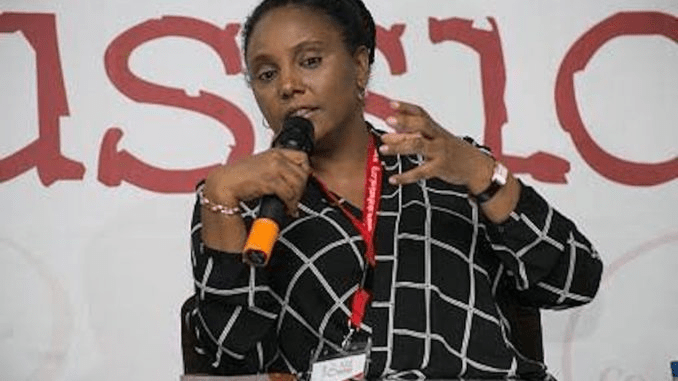
I will like to write on the passionate assessment of the descent to the barbarism of the media–traditional and social–in Nigeria and elsewhere to get a perspective of the state of our and the world’s media. On February 21, a prominent Nigerian female journalist, Kadaria Ahmed, gave a very passionate, captivating, and no holds barred address titled “My Message to the Nigeria Media,” whose altruism has been challenged by other prominent journalists. Kadaria Ahmed’s address would have simply gone down as a classic on the need and essence of media practitioners to shun ethnic profiling and return to the traditional, noble profession of truth-telling and leading the nation aright in times of national crisis. Kadaria wrote thus:
It is with a heavy heart, worried of Nigeria and a sense of impending doom
That I am sending this to you, my colleagues,
Let me begin with a question;
What exactly will we gain if Nigeria descends into war?
How does it advance us if our fellow citizens turn on each other
And begin large-scale ethnic killings against each other…
How does enabling ethnic strife help to achieve this objective?
For some time now, a lot of us has thrown away the book on ethical reporting
Propelled by emotion, we have betrayed every moral consideration
That assigns our noble profession
But the critical probing to the other side of the coin happily carried out by Tayo Olu in The Whistler of February 15, 2021, titled “Attack on Nigerian Media,” has helped to put the “attack” by Kadaria in context without necessarily defraying from the value of her address.
Tayo Olu shed light on the reaction of Kadaria’s colleagues’ overt “scathing criticism of journalists’ reportage of the herdsmen crisis in the country” and for “fanning the flames of ethnic hate through their coverage of the crisis involving mainly the Fulani ethnic group.” Reactions came first from the Chairman of the Nigerian Union of Journalists (NUJ) FCT Chapter, Emmanuel Ogbeche, Ibanga Isine of Next Edition, and Ekhator Ehi, among others. The rationale of these accusations and counter-accusations among media practitioners is the reality of crass partisanship in the media at a time when they should be the true watchdog of the common folks on whose behalf they ought to speak truth to power and denounce agents of violence and crime. At a time when our humanity is badly assailed on all fronts, the media should be a rallying point and not a house of raucous voices.
Social media, on its part, has nearly swamped the traditional media in this digital age. Facebook, Twitter, Instagram, WhatsApp, Linked In, and the likes have become dominant tools of engagement all over the world, and our country has embraced it irreversibly. Whereas it has increased the democratic space and has been deployed by both government and the citizens, it is radically redefining the nature of engagement (especially political) between the citizens and the state all over the world. It has also generated a lot of conflict and tension because of its massive usage and has brought the two into more direct interaction, and the government can no longer monopolize free speech. Its power (the power of technology that it uses) lies in its immediacy, speed, political reach, and its uncontrollability.
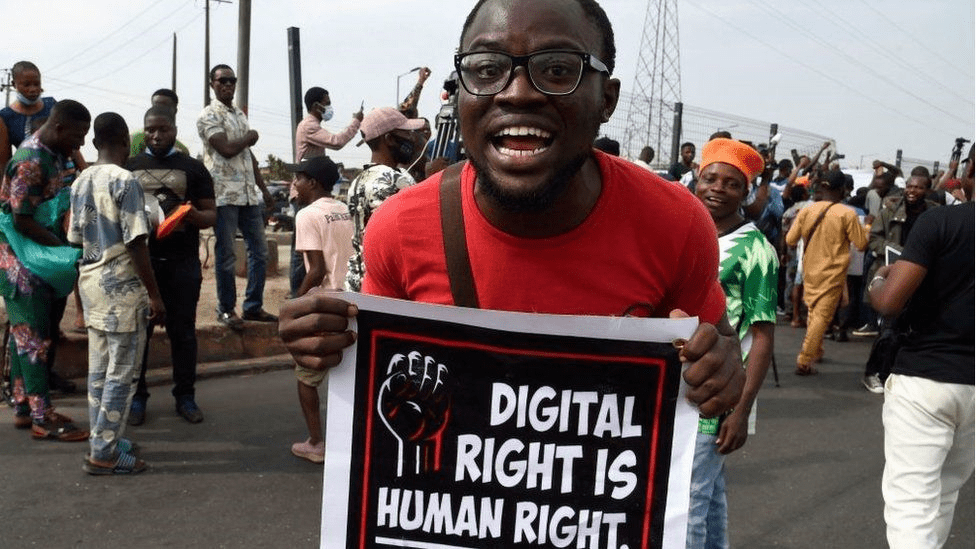
It is projected that in the next few years in Nigeria, the deployment of social media will increase “by more than 80 percent with more than 44 million people accessing online forms in a demography of about 200 million.” The state worries about the potential of social media abuses to undermine the state and ‘threaten the corporate existence of the nation. Yet, apart from its capacity to widen dialogue space, its economic development/utility reality, put at about 10 percent of the nation’s gross domestic product and used by nearly 25 million people, makes it unstoppable in Nigeria. There is the debate of the mutual advantage of communication technology (in which Twitter is critical) to both government and the citizens and, thus, the increasing local, national, and international criticism of Twitter’s censor as impeding the nation’s humanity and freedom of expression. As this debate rages, the state must tread softly in its drive to hammer social media, recognize its universal nature, its mutual advantage in a democracy, and its humanizing power.
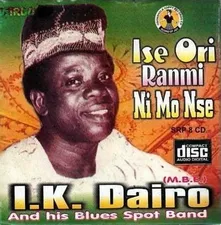
And to music, I find the danger of the descent of humanism pointedly depicted in the music of I. K. Dairo, as far back as the early sixties, and which still rings screamingly prophetic today. His album Ise Ori Ran mi ni mo se (loosely translated as “I do the job assigned to me by destiny”) ramifies this message of the need to restore humanism in society. Every line of this album warns against the dehumanizing power of greed and self-debasement in the search for sudden and filthy wealth. The inordinate search for crass materialism demeans and dehumanizes the world and sets it on the path of descending humanism. Many of our musicians; Fela, Idreez, and so on, make this frantic call on all of us, especially the state, to pursue the path of humanizing society.
As we all know, literature is a reflection of society, in the manner of a mirror. Beyond mere reflection, it refracts society in the way that the soul breathes life into the body. Literature, therefore, as an arm of the creative industry, endows, ennobles, and enriches a nation’s humanity. It advertises and tells its story. Politics and matters of an imperatively political nature have, for instance, in the African experience, preoccupied the literary establishment. Since the colonial aegis, our writers have put their songs and stories in the service of humanizing our society, committed to the fact that “the poet speaks not for himself only but also for his fellowmen. His cry is their cry, which only he can utter.” All this is in the project of reconstructing society in the moment of declining, degenerating humanity, and the pursuit of viable nationhood and the world order.
Generally speaking, Nigeria’s literature predating the fratricidal war of 1967 to 1970 was essentially in search of a certain socio-spiritual and cultural stability. This is especially so during the cultural nationalism phase, which set the tone for political independence from the hegemonic clutch of colonialism and imperialism. But the war, with all its absurdity and catastrophic devastation of the individual writers, due to suffering and considerable loss of lives at very close and personal levels, compel the literary characterization of the decline or indeed descent of our nation’s humanism.
Even though I had described in a previous study on the Civil War, that the war wrought a serious body of national literature, its blight compelled a certain kind of dark pessimism and cynicism in the emerging visions. This may have been caused by the deep sense of loss, personal and collective, which the war generated. Okigbo died in the war, Soyinka suffered protracted solitary confinement, and Achebe and Clark, on different sides of the nation’s pole, carried huge emotional and psychological burdens. The sowing of regenerative seeds in the flesh of the country carried tragic overtones, as we found in some of the war and post-war writings. Additionally, the Nigerian Civil War is used as a background against which the human condition is examined in its perverseness. War is absurd and irrational. The regime of bestiality characterized by war–pogroms and genocides–which tend toward the deployment of technology and war weaponry can lead to ultimate human extinction. Through war, wanton killing of one’s kind is the expression of the philosophy of the absurd and the descent from humanism.
With the ravaging impact and the trauma inflicted by the COVID-19 pandemic, the arts of creation and creativity, with a positive, cathartic sensibility, have moved on, as we find in Of Shadows and Rainbows: Musings in Times of Covid (2021), a COVID-19, PEN Nigerian publication of poems, short stories, playlets, and essays edited by Olu Obafemi and Folu Agoi. Leaping out of the pages of this publication are lines from the authors “gripped by emotions, paroxysms, compassion, searching for startling enlightenment, illumination and, in many cases, reconstructive tropes” as an affirmation of humanism. Other evolving creative works include the Platform, All Poets Network (APNET), created to promote poetry in English and native languages in this pestilent era and administered by Dzukogi, Khalid Imam, Ola Ifatimehin, and Ismael Baba to “give voice to young and established poets from all continents of the world,” and many more.
The Nigerian society is going through a transition of bleakness and blight, which has raged since the war and truly never ended, reaching very precipitous climaxes even under civil democracy. I have called it the descent from humanism which I have chosen to illustrate with music, the media, and literature. Unorthodox warfare through insurgency, insurrection, frightening banditry, armed herdsmen, lethal violence, dystopia, and wild social incoherence manifests our nation’s descent from humanism. The mediatory and recuperative essence and power have been explored here somewhat. Part of my recommendations is that the media, music, and literature should become more prophetic and politically more engaged in raising mass awareness to restore, rekindle, and promote humanism and humanity. Also, the essentialist principle of humanism, which deals with identity retrieval and identity marking, should be more robustly engaged by the media through investigative and development journalism in tracking the concrete character and identity of the bandits, herdsmen, and other agencies of insurrection and insurgency on our land.
Taking due cognizance of the present realities in the country as imposed by the pandemic, we must wake to the need for science, technology, and the humanities to focus conversations on humanistic issues, and human and social welfare. We must also concentrate our efforts on the centrality of the human race rather than building knowledge that will lead to its destruction and extinction. Innovations should focus on the discovery of the human inner strength and capacities through critical and constructive reasoning to sustain humanity and the security of the coming generations. To conclude, in order to establish an inclusive democratic society for everyone, the nation, the states, in particular, should work in collaboration with agencies of humanism, as extolled in this essay, rather than foster mutual distrust and resentment.
The views, opinions and analyses expressed in the articles on Humanist Freedoms are those of the contributor(s) and do not necessarily reflect the views or opinions of the publishers.




 Humanist Heritage Canada