Tag Archives: human rights

HumanistHeritageCanada.ca – Getting Ready for the Upcoming Years!

In a few weeks, we will be celebrating the completion of our sixth year of publication here at Humanist Heritage Canada (HHC). Our first posts, under the name HumanistFreedoms.ca, were created in December of 2019.

Since then, we have provided ongoing, if sometimes infrequent, news and information about humanism in Canada and around the world. Most recently, we’ve taken an interest in telling the story of humanism in Canada – thus the name “Humanist Heritage Canada”. We believe that the humanists in Canada need to do a better job of communicating the important role that humanism plays in our lives and in the way that we help shape our communities.

From 2019 to 2022, our community grew each year, then declined in 2023 and 2024. The decline coincided with a decline in our efforts to keep the site continuously fresh and improving. In 2025, we recommitted time and energy and our readership responded in kind. Thank you for visiting HHC and telling your friends about our work!

The Humanist Heritage Canada audience trend since our founding in 2019.

Following is a rough plan Humanist Heritage Canada for the period 2026-2030.

One of our most recent initiatives is to produce timeline of secularism and humanism in Canada. We see the timeline as a valuable tool to connect with significant events in Canadian and global history. A timeline helps provide context to the advancement of the humanist movement. We will develop the timeline with events significant to the humanist movement in Canada.

Our original goal as HumanistFreedoms.ca was to promote contemporary applied humanism with a focus on the freedom of expression. As we have always done, we will continue to provide news and information about humanism in Canada and around the world.

While we have always been open to contributions of content from others, solicitation and inclusion of additional content has not been a significant focus of effort. We’ve been content to feature our own material and include additional material on a casual basis only. We will actively search for and invite contributions from Canada’s humanist community to help tell the story of humanism in Canada.

HHC has primarily been a text-based website. We will explore production of audio and video content. See our Youtube channel.

Advancement of humanism in Canada is often a result of the action of organizations that focus energy on humanist goals and objectives. We will investigate and report on the history and ongoing status of Canada’s humanist organizations and the individuals who drive them forward.

Do you think there are other ways that HHC can tell the story of humanism in Canada? Let us know.

Citations, References And Other Reading

  1. Featured Photo Courtesy of

The views, opinions and analyses expressed in the articles on Humanist Freedoms are those of the contributor(s) and do not necessarily reflect the views or opinions of the publishers.

A New Campaign to Oppose Ontario’s Public Funding of Religious School Systems

We have received notice that the Society of Freethinkers (SoFree)and it’s lobbying partner, Secular Connexion, based in the Hamilton/Burlington and Elmira areas (respectively), have launched a new campaign to oppose Ontario’s system of public funding of religious school systems.

Here’s what we’ve been told so far:

Secular Connexion Séculière is a national non-profit lobby group that seeks justice for non-believers. Please join The Society of Freethinkers and us in an e-mail campaign directed at Ontario MPPs to change funding for the RC separate school system by distributing the attached email and MPP contact list to your members and friends.

We want to demonstrate the overwhelming support that exists in Ontario for a change to the current funding of Catholic separate schools.  This e-mail sets out the facts about the current system and the savings that would be generated.

It is being sent to Secular Humanist organizations, religious groups, public school teachers’ organizations and others who have expressed support for this change. Our hope is that an inundation of e-mails from various sources, including from non-Catholic religious groups, will convince them that it is time for a change. Ontario is a multi-cultural, multi-ethnic, multi-religious province that differs markedly from the Ontario of 1867.

Please distribute the attached e-mail and and contact list  to members of your organizations and to others who may also support this endeavour.

There are many myths and misconceptions around the current funding of the Catholic school system. The email we are asking people to send presents these facts:

• the current full funding of the Catholic school system is not constitutionally guaranteed. The Constitution grants provinces the right to determine the amount of funding for denominational schools if they funded such school systems prior to joining Confederation. Ontario chose to fully fund Catholic elementary and high schools as did Québec. Quebec changed their school system, in 1997, to one based solely on language, not religion, by merely asking the Federal government to let them stop the funding. Newfoundland and Labrador also changed their school system to eliminate funding of Catholic schools.

• 74%1 of Ontarians are not Roman Catholic, but pay for a system that can legally refuse to hire them as teachers, and can exclude their children from its schools.

 • the municipal taxes of Catholics pay for, at most, 8% of the operating costs of the separate system: the balance is paid out of taxes paid by all Ontarians, be they Catholic, Protestant, Atheist, Jew, Muslim, Hindu, etc.

• Ontario could save over $1.5 billion a year by having one non-denominational public school system

 • parents who send their children to non-Catholic private schools pay tuition fees which are generally not tax deductible, and must also pay their municipal taxes, including the education portion


We need our children to learn what unites them, not what divides them.

Please contact either of us for additional information. Should you wish to see the source documents for the figures cited above, these can be provided.

Thank you for your consideration of our proposal.

Doug Thomas, President, Secular Connexion Séculière,
president@secularconnexion.ca
Isobel Taylor, Vice-President, SOFREE, vicepresident@sofree.ca

Up For Discussion

If you’re interested in analyzing and discussing this issue, there are actions you can take. First, here at Humanist Heritage Canada (Humanist Freedoms), we are open to receiving your well-written articles.

Second, we encourage you to visit the New Enlightenment Project’s (NEP) Facebook page and discussion group.

Citations, References And Other Reading

  1. Featured Photo Courtesy of :
  2. https://sofree.ca/
  3. https://www.secularconnexion.ca/2093-2/

By continuing to access, link to, or use this website and/or podcast, you accept the HumanistFreedoms.com and HumanistHeritageCanada.ca Terms of Service in full. If you disagree with the terms of service in whole or in part, you must not use the website, podcast or other material.

The views, opinions and analyses expressed in the articles on Humanist Freedoms are those of the contributor(s) and do not necessarily reflect the views or opinions of the publishers.

Manitoba’s Bill 40

As you may be aware, Humanist Heritage Canada emerged, primarily, from a concern with protecting the freedom of expression in Canada and in support of humanist initiatives to oppose public funding of religion – in schools and other places. It is with these core issues in mind that we note that the current Manitoba government has a bill which may be of tremendous value.

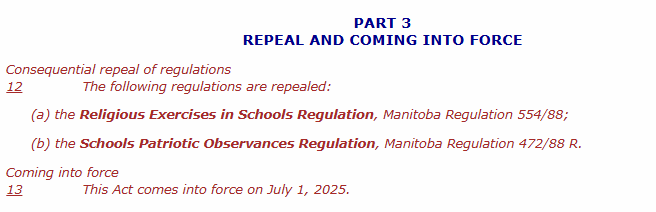
Bill 40 is titled, “AN ACT RESPECTING “O CANADA” AND OTHER OBSERVANCES AND LAND AND TREATY ACKNOWLEDGEMENTS IN SCHOOLS (EDUCATION ADMINISTRATION ACT AND PUBLIC SCHOOLS ACT AMENDED)”. On March 6, 2025, it was at First Reading.

The part that should interest Canadian secularists and humanists says:

Assuming the bill does pass and come into force, this will be a significant advancement for secularization in Canada. As we are not up-to-speed regarding any Manitoba-based humanists or secularists who may have been involved in advocating for the repeal of these regulations, we’ll content ourselves with referring further reading to the recent BC Humanist article, “In 2023, the BC Humanist Association released Religion in Public School Acts, which documented the provinces that still include provisions to permit prayers and Bible studies in schools.

We join BCHA in their encouragement to Manitoba citizens and residents to contact their Member of Legislative Assembly in support of this provision of Bill 40. The bill has other provisions which are not secularist in nature and deserve evaluation on their own merits.

We also encourage those who are interested in humanism and secularism in Manitoba to procure a copy of Elliot Hanowski’s Toward a Godless Dominion: Unbelief in Interwar Canada. We recently acquired and read a copy (a book review is forthcoming) and were greatly pleased with the thorough review of Manitoba’s significant history of humanism and atheism during that period. If you’re looking for insights into Canada’s humanist heritage, this is a treasure.

Up For Discussion

If you’re interested in analyzing and discussing this issue, there are actions you can take. First, here at Humanist Heritage Canada (Humanist Freedoms), we are open to receiving your well-written articles.

Second, we encourage you to visit the New Enlightenment Project’s (NEP) Facebook page and discussion group.

Citations, References And Other Reading

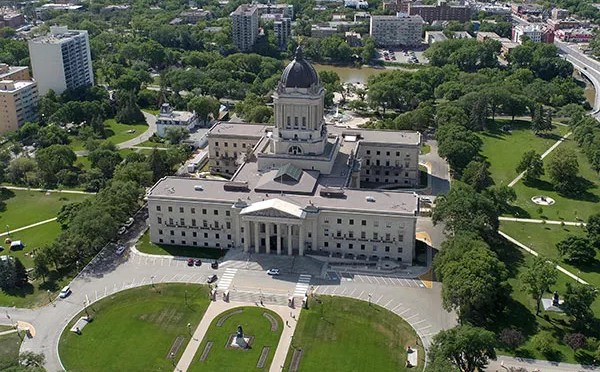
  1. Featured Photo Courtesy of : https://www.mhs.mb.ca/docs/sites/legislativebuilding.shtml
  2. https://www.bchumanist.ca/manitoba_plans_to_scrap_religion_in_public_schools_act
  3. https://www.bchumanist.ca/religion_in_public_school_acts
  4. https://www.canlii.org/en/mb/mbqb/doc/1992/1992canlii8482/1992canlii8482.html
  5. https://web2.gov.mb.ca/bills/43-2/b040e.php
  6. https://www.gov.mb.ca/legislature/business/billstatus.pdf
  7. https://web2.gov.mb.ca/laws/regs/current/554-88.php?lang=en

By continuing to access, link to, or use this website and/or podcast, you accept the HumanistFreedoms.com and HumanistHeritageCanada.ca Terms of Service in full. If you disagree with the terms of service in whole or in part, you must not use the website, podcast or other material.

The views, opinions and analyses expressed in the articles on Humanist Freedoms are those of the contributor(s) and do not necessarily reflect the views or opinions of the publishers.

Canada: Election 2025

A federal general election has been called for April 28, 2025. Throughout the month, we’ll refresh this post with any news, information or resources that may be of interest. Check back often!

1745881200

  days

  hours  minutes  seconds

until

Ontario Provincial General Election

Having achieved leadership of the Liberal Party of Canada, Mark Carney announced that voters will have their opportunity to reflect on Canadian politics and submit their vote in the 45th general election.

Elections Canada has provided an informational video to help Canadians to know what to expect when they go to vote:

This election became inevitable as confidence in the Liberal government, as led by Justin Trudeau, had been effectively lost late in 2024. However, the lack of confidence in Trudeau’s Liberals has not been the dominant issue in the news. Canadian’s attention has shifted from whether the Liberals could be trusted to govern in the post-COVID global environment to what Canada and Canadians must do in light of dramatic changes in the foreign and trade policies of the United States of America.

In the meantime, what can we expect politicians and media to focus on until election day? Here are a few obvious topics:

  • National Unity and Federalism: Quebec separatism, Western alienation, US-Canada relations and the role of the federal government in addressing regional concerns and national unity.
  • Foreign Aid Policy, Trade, International Relations: Global relationships are getting a shake-up. Canadians may be getting a wake-up.
  • Climate Change and Environment: Canada’s commitment to reducing greenhouse gas emissions, renewable energy policies, and addressing the impacts of climate change, selling oil.
  • Economic Growth and Inequality: A few decades ago, Jean Chretien won an election on a chant of Jobs! Jobs! Jobs!….in 2025, it may be time for a politician to chant Homes! Homes! Homes.
  • Immigration and Border Security: The management of Canada’s immigration system, border security, and the balance between economic growth, social cohesion and pressures imposed by the USA.
  • Gun Control and Public Safety: Gun control laws and measures to address public safety concerns, including mental health and community well-being and human rights.

Some potential (and perennial) concerns for Canadian humanists in the 2025 federal election might include:

  • Secularism and Church-State Separation: Humanists in Canada should continue to be concerned about the role of religion in public life and the separation of church and state.
  • Science, Education and Critical Thinking: Humanists will want nee to be on the watch for science and critical-thinking in policy-making.
  • Social Justice and Human Rights: Humanists often prioritize social justice, equality, and human rights, including issues like LGBTQ+ rights, access to healthcare, and Indigenous reconciliation.
  • Freedom of Expression and Speech: Humanists may advocate for the protection of freedom of expression and speech, including the right to criticize religion and other forms of oppression.
  • Social Justice: Addressing issues of poverty, inequality, and systemic racism, including promoting affordable housing, increasing the minimum wage, and supporting marginalized communities.
  • Environmental Protection: Taking action to address climate change, promoting renewable energy, and protecting Ontario’s natural resources for future generations.

Canadians are well-aware that the primary options for electing a candidate in their riding include, along with the already-mentioned Liberals, the Conservative Party of Canada as led by Pierre Poilievre, Jagmeet Singh New Democratic Party , the Green Party of Canada and the Bloc Quebecois (for those living in Quebec).

Certainly, there are a few aspiring hopefuls, like Maxime Bernier’s People’s Party of Canada, but Canadians also know the real contest of who will form the next government is between team blue and team red.

Pundits, experts and horse-race fans will be eager to pitch their favorite team based on their individual biases. And that may be the biggest hint that any humanist voter needs to make their local selection. Take heed of your preferences, biases and priorities and vote for whichever party or candidate that seems likeliest to make decisions the way you want them made.

Up For Discussion

If you’re interested in analyzing and discussing this issue, there are actions you can take. First, here at Humanist Heritage Canada (Humanist Freedoms), we are open to receiving your well-written articles.

Second, we encourage you to visit the New Enlightenment Project’s (NEP) Facebook page and discussion group.

Citations, References And Other Reading

  1. Featured Photo Courtesy of :
  2. https://www.elections.ca/home.aspx
  3. https://www.elections.ca/content.aspx?section=pol&dir=par&document=index&lang=e

By continuing to access, link to, or use this website and/or podcast, you accept the HumanistFreedoms.com and HumanistHeritageCanada.ca Terms of Service in full. If you disagree with the terms of service in whole or in part, you must not use the website, podcast or other material.

The views, opinions and analyses expressed in the articles on Humanist Freedoms are those of the contributor(s) and do not necessarily reflect the views or opinions of the publishers.

Black History Month and Humanism

According to the Government of Canada, February is Black History Month and “the 2025 theme for Black History Month is: Black Legacy and Leadership: Celebrating Canadian History and Uplifting Future Generations.” The federal government’s website provides further information regarding the motivation for the official designation as well as an invitation to, “learn more about Black Canadian communities, and how they continue to help shape Canada.” A number of resources and tools are provided to support this invitation -including a timeline of significant events in “Black history in Canada.”

For our part, we decided to investigate whether there may be evidence that “Black history in Canada” and “humanism” overlap in clear and meaningful ways.

Prior to the modern era, the history of Black communities in Canada is closely connected to the global history of slavery. An excellent place to begin learning about this history is Amherstburg Freedom Museum (AFM). The museum was founded in 1975 by residents of Amherstburg, Ontario. It preserves and presents artifacts and tells the story of African-Canadians’ journey and contributions.

According to the AFM , between they years 1800 and 1860, some 50,000 people fled slavery to Amherstburg, now well known for its place in the “Underground Railroad.” The AFM also explains that, “the ‘Underground Railroad’, as it became known, is commemorated at the Amherstburg Museum, so that we may all continue to seek solace and inspiration from what human beings can achieve when they offer an open hand of kindness to those driven by determination.” and, “We will vigorously champion the power of human beings to come together across the dividing lines of our societies. We will openly challenge those who limit the dreams of others through racial, economic, or social oppression. We will work tirelessly to scale and dismantle the barricades that prevent people from building new lives and new futures.” If there are more definitively humanist sentiments linking humanism to Black history in Canada, we look forward to reading them.

Ontario-based inquirers may also wish to use the DestinationOntario.com resource to identify information about (early) Black settlement in Ontario.

The history of humanism in the modern era is irrevocably linked to the advancement of human rights. To pinpoint what “the modern era” means, we look to the creation of the Universal Declaration of Human Rights in 1948. Perhaps more precisely, we look to that document as the beginning of the modern era for humanism and the human rights that humanist principles imply. In this way, we may have an expectation that humanists and the organizations which they create are positively aligned with the promotion of human rights for Black Canadians as individuals and as communities.

This is not quite evidence of what form such an alignment might take. We look forward to receiving and publishing details as they are discovered or are provided to us.

In the meantime, we found a 2020 blog post by Andrew Copson (of Humanists UK) which had some words that resonated with our inquiry and thought it would be worthwhile sharing them here, “Humanists, who care about the building of a more rational and fairer society, should always be ready to combat not just hate and prejudice but the injustice that arises from long standing inequalities. Humanists UK co-organised the first global congress against racism in the UK in 1911 and was a campaigner against colonialism, and its social and intellectual forebears have a good record on opposing slavery and injustice. What we don’t do as often is celebrate the black humanists who have shaped the humanist movement and are part of our modern tradition so here are seven of the best!

We also found a CBC’s Ideas episode titled, Négritude: The birth of Black humanism. Historian Merve Fejzula had presented a talk at the University of Toronto in November 2022 which led to the Ideas episode.

Throughout our publication history, Humanist Heritage Canada (formerly HumanistFreedoms), we have covered stories and issues connected to African and Black humanists, most recently and frequently concerning Mubarak Bala. In the sprit of Copson’s seven best, here are seven of our best posts:

Humanism, which I consider the ideological plank of humanity, reclines on the principles of reason and rationality. To attain a better society where love, humane value, and freedom reign, away from excessive religiosity (not religion), the human agency places the power for individual action in some other forces outside of the self and has brought so much human destruction since many centuries ago.” Toyin Falola 2021

Note: Humanist Heritage Canada will continue to expand this article as additional information is identified.

Up For Discussion

If you’re interested in analyzing and discussing this issue, there are actions you can take. First, here at Humanist Heritage Canada (Humanist Freedoms), we are open to receiving your well-written articles regarding “Black history month in Canada’ and any links to the history of humanism in Canada.

Second, we encourage you to visit the New Enlightenment Project’s (NEP) Facebook page and discussion group.

Citations, References And Other Reading

  1. Featured Photo Courtesy of :
  2. https://www.cbc.ca/radio/ideas/n%C3%A9gritude-movement-black-humanism-1.6771763
  3. https://www.canada.ca/en/canadian-heritage/campaigns/black-history-month.html
  4. https://andrewcopson.com/2020/07/black-humanists-who-have-shaped-the-humanist-movement/
  5. https://bcblackhistory.ca/

By continuing to access, link to, or use this website and/or podcast, you accept the HumanistFreedoms.com and HumanistHeritageCanada.ca Terms of Service in full. If you disagree with the terms of service in whole or in part, you must not use the website, podcast or other material.

The views, opinions and analyses expressed in the articles on Humanist Freedoms are those of the contributor(s) and do not necessarily reflect the views or opinions of the publishers.

February 2025 – Humanist Heritage Canada Update and Call for Submissions

During the latter half of 2023 and most of 2024, we had been less active in sharing humanist news and events than we were from 2020 to 2023 (as HumanistFreedoms.com). We weren’t quite fully hibernated, but we were very sleepy. Now, in 2025, we’ve refocused on our new branding, Humanist Heritage Canada, with plans to document and share the ongoing history of humanism in Canada.

We’ll still be sharing important humanist stories from around the world when they seem to have special insights on how humanism is unfolding in Canada.

We hope that frequent visitors to HumanistHeritageCanada.ca have noticed that we’re developing a timeline of Canada’s humanist heritage. For that endeavor to tell the story of goals, achievements and important events, we are looking for your participation!

Please send us your timeline suggestions, articles, stories, biographies or whatever comes to mind that will flesh-out our timeline of Canada’s humanist heritage.

Please follow our website, share articles with your friends and help us grow.

Up For Discussion

If you’re interested in analyzing and discussing issues from a contemporary humanist position, there are actions you can take. First, here at Humanist Heritage Canada (Humanist Freedoms), we are open to receiving your well-written articles regarding artificial intelligence.

Second, we encourage you to visit the New Enlightenment Project’s (NEP) Facebook page and discussion group.

Citations, References And Other Reading

  1. Featured Photo Courtesy of :

By continuing to access, link to, or use this website and/or podcast, you accept the HumanistFreedoms.com and HumanistHeritageCanada.ca Terms of Service in full. If you disagree with the terms of service in whole or in part, you must not use the website, podcast or other material.

The views, opinions and analyses expressed in the articles on Humanist Freedoms are those of the contributor(s) and do not necessarily reflect the views or opinions of the publishers.

Ontario Election 2025

A provincial general election has been called for February 27, 2025. Throughout the month, we’ll refresh this post with any news, information or resources that may be of interest. Check back often!

1740697200

  days

  hours  minutes  seconds

until

Ontario Provincial General Election

It is probably clear to most Ontario electors that Premier Doug Ford called the election now, rather than waiting until 2026, primarily because the timing is better for him and his Progressive Conservative Party of Ontario.

According to Joshua Freedman at CP24, the leading reasons for an early election in Ontario include strong polling for the PCs, threats of punitive tariffs by the current President of the United States of America, and Ontario’s frequent tendency to elect provincial liberals when a federal conservative government is in power (and vice versa). These reasons all seem correctly assumed.

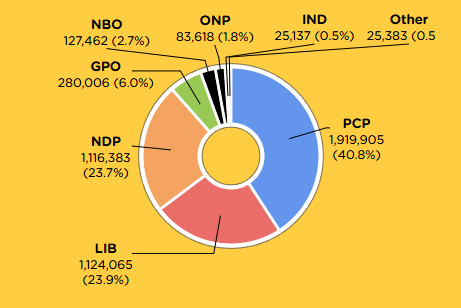
Polling the electorate is valued by the media and political parties in our first past the post system. It isn’t necessary in Canadian politics to be more popular than the other candidate(s). As a candidate, it’s great if you and your party happen to be more popular, but it isn’t really the bottom line. Consider the 2022 Ontario election results:

If you weren’t already familiar with our system, you’d wonder how a party with 40.8 percent of the vote was able to achieve a majority government. You’d be baffled to see that 40.8 can get you a 66.9 percent majority of seats.

That is indeed what you can get when every riding is its own horse-race. It takes a lot for Canadians to send a political party packing. Premier Ford does not want to wait until the Ontario electorate is completely sick of hearing his name. In Canadian politics, our tendency is not to vote FOR a government, but to vote to GET RID of a government.

This informs Ontario’s tendency to have a red party in power provincially when a blue party is in power federally (and vice versa). Once we’ve gotten sick of seeing red….we’re sick of it regardless of whether they’re sitting in Ottawa or Toronto. Is it more complicated than that? Probably…or maybe. But it’s not a popular myth for no reason.

Did you know that there are 25 registered political parties in Ontario? We checked the Elections Ontario website today to get an idea of who’s who. That’s a lot of parties to try to explore and we’ll do our best to run through the lot (probably in a separate post). For now…starting at the top the alphabetically sorted list, the Canadians’ Choice Party website states that their mandate is to, “help Independent Candidates across Ontario to better represent their ridings and to bring a fair measure of direct democracy to all Ontarians and Canadians.” and that they have four “pillars” grouped under the somewhat uncomfortable acronym FIST: Fiscal responsibility and respect for taxpayers, Individual freedom and the right to free speech, Sovereignty and protection of common-law rights, Transparency and accountability in government. Apparently these folks have been around since 2011 with “A bottom-up approach to engage citizens.” We’ll let you work out the pun(s) that inevitably (and perhaps, deservedly) comes to mind. The initiative seems to be earnestly motivated, but doesn’t really present a credible, self-consistent philosophy.

Meanwhile, perhaps the biggest motivation for the election that’s been posited so far is the threat of tariffs and/or financial hard times. Some pundits will suggest that non-blue candidates will be wise to stay away from the issue. For those who oppose the ongoing financial and human rights embarrassment of funding religious schools…this is an opportunity.

Our reasoning goes like this: Given the RISKS associated with unreliable global trading partners, supply chain business practices that destroy Ontario-based value-added business and the ever-increasing probability of continued financial hard-times….can Ontario really afford the anachronistic, misguided, wasteful and discriminatory practice of funding the Catholic school system with public money any longer?

There has never been a more pressing time to push Ontario’s conservative politicians to set aside their puppy-eyed adoration of Bill Davis, admit that discriminatory funding of one religious group’s schools is a bad and wasteful idea and rip the band-aid off.

As a very modest side note (and speaking of puppy-eyed adoration), Ontario humanists may do well to spend some time with Steve Paikin’s biography of Bill Davis titled, Bill Davis: Nation Builder, and Not So Bland After All. If you read the book and between the lines, you may come away with important insight into why Ontario perpetuates this recognized human rights violation and what it may take to finally get the province back on track for a single school system.

Lest we be accused of being a one-trick-pony kind of place, we asked an AI to generate a list of issues in the current provincial election. The response we got back was:

  • Jobs and the economy, with a focus on creating new opportunities and supporting workers
  • Healthcare, including the need for more family doctors and improved access to healthcare services
  • Affordability, with parties proposing various solutions to address the rising cost of living in Ontario
  • Gridlock and transportation, with discussions on highway expansion, public transit, and the removal of tolls on Highway 407
  • Education, with the NDP proposing to invest an additional $830 million a year to clear the repair backlog in schools and create a universal School Food Program
  • Housing, with the NDP proposing to create 60,000 new supportive housing units and establish Homes Ontario to build permanently affordable housing
  • Energy and the environment, with the PC party proposing to permanently cut the provincial tax on gas and diesel5
  • Indigenous issues, with a focus on reconciliation and supporting Indigenous communities
  • Long-term care, with a need for improved services and support for seniors
  • Infrastructure, with the PC party proposing to invest up to $15 billion more over three years to speed up key capital projects
  • Social assistance, with the NDP and Liberal parties proposing to double ODSP
  • Tariff response, with the PC party proposing $10 billion in cash-flow support for Ontario employ

When we asked, what issues should be of importance to humanists in this coming election, we were advised that, “As a humanist, you may be particularly interested in issues that promote the well-being, dignity, and flourishing of all individuals in Ontario,” and the following list of priorities was presented:

  • Education: Investing in public education, promoting critical thinking, and ensuring that all students have access to quality education, regardless of their background or socioeconomic status.
  • Healthcare: Ensuring that all Ontarians have access to quality, publicly-funded healthcare, including mental health services, reproductive health, and palliative care.
  • Social Justice: Addressing issues of poverty, inequality, and systemic racism, including promoting affordable housing, increasing the minimum wage, and supporting marginalized communities.
  • Environmental Protection: Taking action to address climate change, promoting renewable energy, and protecting Ontario’s natural resources for future generations.
  • Human Rights: Ensuring that all Ontarians are treated with dignity and respect, regardless of their identity, including promoting LGBTQ2+ rights, Indigenous reconciliation, and anti-racism initiatives.
  • Access to Justice: Ensuring that all Ontarians have access to justice, including affordable legal services, mental health support, and community resources.
  • Science and Critical Thinking: Promoting the use of evidence-based decision-making, critical thinking, and scientific literacy in policy-making.

Up For Discussion

If you’re interested in analyzing and discussing this issue, there are actions you can take. First, here at Humanist Heritage Canada (Humanist Freedoms), we are open to receiving your well-written articles.

Second, we encourage you to visit the New Enlightenment Project’s (NEP) Facebook page and discussion group.

Citations, References And Other Reading

  1. Featured Photo Courtesy of : https://results.elections.on.ca/en/results-overview
  2. https://www.ontario.ca/page/premier
  3. https://ontariopc.ca/
  4. https://www.cp24.com/news/2025/01/29/why-doug-ford-called-an-early-ontario-election-and-everything-else-you-need-to-know-as-the-campaign-begins/
  5. https://www.fairvote.ca/04/06/2022/pcs-form-majority-government-with-40-83-of-the-vote-ontario-voters-cheated-by-first-past-the-post/
  6. https://finances.elections.on.ca/en/registered-parties

By continuing to access, link to, or use this website and/or podcast, you accept the HumanistFreedoms.com and HumanistHeritageCanada.ca Terms of Service in full. If you disagree with the terms of service in whole or in part, you must not use the website, podcast or other material.

The views, opinions and analyses expressed in the articles on Humanist Freedoms are those of the contributor(s) and do not necessarily reflect the views or opinions of the publishers.

Alumni to Amend Section 93 Ontario

Opposition to Ontario’s public funding of faith-based schools is almost exactly as old as the funding itself. Unfortunately, organized opposition to public funding has not yet pulled together the right combination of strategy and execution to succeed the goal to put an end to the human rights violation at the core of Ontario’s education system.

However – the ambition continues. Alumni to Amend Section 93 Ontario (AA93) represents former students and their supporters fighting to end the public funding of Catholic education in Ontario. Ontarian taxpayers pay for an inefficient, discriminatory education system that causes both Catholic and Public boards to divert resources away from their classrooms.

The organizations’ website states that it was founded in May of 2023 by Christina Cody. Cody comes from a long line of Catholic school attendees and was educated via the York Catholic District School Board. It was that board’s adoption of a set of anti-LGBTQ+ policies that Cody couldn’t accept. Disheartened to see that the faith-based school system’s ideologies and actions hadn’t changed, Cody was inspired by other former attendees who disavowed the actions of the YCDSB. 

AA93 states that it is driven by and centered on “the experiences of former students and teachers who have attended and been employed by Catholic school boards. Those who have worked and been educated within these boards paint a picture of systematic bullying, abuse, and marginalization that is encouraged and supported by church teachings.”

Opposition to public funding of faith-based schools is, of itself, a correct and worthy thing. Perhaps strategies borne of the alumni of the system will be more successful than those that have started outside the machinations of the Catholic church. We can only hope so, and encourage renewed efforts to bring greater fairness, equality and efficiency to Ontario.

Citations, References And Other Reading

  1. Featured Photo Courtesy of :

By continuing to access, link to, or use this website and/or podcast, you accept the HumanistFreedoms.com and HumanistHeritageCanada.ca Terms of Service in full. If you disagree with the terms of service in whole or in part, you must not use the website, podcast or other material.

The views, opinions and analyses expressed in the articles on Humanist Freedoms are those of the contributor(s) and do not necessarily reflect the views or opinions of the publishers.

Humanist Ottawa Calls Out Canadian Governments via United Nations’ Universal Periodic Review

Humanist Ottawa Calls for Action to Address Religious Discrimination in Canada

OTTAWA, April 5, 2023 — Humanist Ottawa (HO) has identified significant concerns with the Canadian legislative framework, citing evidence that it perpetuates systemic religious discrimination in violation of the Universal Declaration of Human Rights (UDHR) and the International Covenant on Civil and Political Rights (ICCPR). The organisation is advocating for change in two key areas: state-funded separate school systems for minority religious populations and the inconsistent regulation of marriage solemnization across provinces.

“There’s an enormous loophole in Canada’s legal framework”, said Robert Hamilton, President of Humanist Ottawa. “It drives preferential religious practices in the funding and administration of Ontario, Alberta, and Saskatchewan schools to the detriment of believers in other faiths as well as non-believers in any religion.”

The Ontario Superior Court’s recent dismissal of a case addressing state-funded separate school systems for minority Catholic and Protestant populations highlights the deep-rooted religious discrimination in Canada’s legislation. This situation is compounded by the inconsistencies in provincial regulations governing marriage solemnization, which creates a discriminatory environment for humanists and the non-religious.

HO argues that these discriminatory practices damage Canada’s reputation as a nation that upholds human rights and equality. As a result, the organisation is recommending a series of actions:

  1. Establish by November 2025 a publicly accessible legal defence fund for Canadians who have human rights claims against any federal/provincial/territorial government or its agencies in matters of systemic faithism, and freedom of religion or belief.
  2. Establish by April 2026 a task force responsible jointly to the Canadian Human Rights Commission and The Council of the Federation to research and propose solutions to Canada’s ongoing funding of faith-based educational institutions and establish an action-oriented plan, within three years, which treats all Canadians equally and fairly.
  3. By November 2026, hold a referendum vote on the fair treatment of all Canadians in matters of public funding of faith-based educational institutions. The referendum question should solicit the perspective of Canadians as to whether they support the claims of constitutionality of discriminatory funding.
  4. By November 2027, amend the Canadian Charter of Rights and Freedoms to formally assert neutrality in all matters of religion, whether historically based or not, and reject systemic faithism as a violation of the human rights of all Canadians. 

Humanist Ottawa is dedicated to promoting the principles of fairness, equality, and the right to freedom of thought, conscience, and religion. HO is committed to advocating for change to ensure that all Canadians, regardless of their province of residence, have access to the same rights and freedoms.

Citations, References And Other Reading


Featured Photo Courtesy of :

The views, opinions and analyses expressed in the articles on Humanist Freedoms are those of the contributor(s) and do not necessarily reflect the views or opinions of the publishers.

By continuing to access, link to, or use this website and/or podcast, you accept the HumanistFreedoms.com and HumanistHeritageCanada.ca Terms of Service in full. If you disagree with the terms

The Morgentaler Decision: 35 Years-on

On January 28, 1988, the Supreme Court of Canada struck down Criminal Code provisions which made abortion illegal in Canada. Only 35 years ago! Known as the “Morgentaler decision”, the case stands as one of Canada’s strongest legal precedents for the advancement of human rights. 

Dr. Henry Morgentaler (1923-2013) was born in Poland but moved to Canada in 1950, having survived the holocaust. He started a medical practice in Montreal in 1955; In 1967, Dr. Morgentaler presented a brief before a House of Commons Health and Welfare Committee that was investigating illegal abortion. At the time, medical practitioners could, under Canada’s criminal code, face life in prison for attempting to induce an abortion; women could also face up to two years in prison. Typical of his deep compassion and humanism, Morgentaler presented the position that any woman should have the right to end her pregnancy without risking death.

Initially, Dr. Morgentaler refused requests to end pregnancies, referring to two other physicians providing abortions. In 1968, however, Dr. Morgentaler founded the Montreal Morgentaler Clinic, the first freestanding clinic to offer safe abortion services in Canada. It was established when Dr. Morgentaler, as an activist with the Canadian Humanist Association, began protesting Canada’s restrictive laws. The clinic was situated in the same house where Dr. Morgentaler had his family medicine practice, and remained there until 1995.

Despite raides by policy, criminal charges and conviction, firebombing of his Toronto clinic and decades of opposition, Dr. Morgentaler persevered in his fight to advance and sustain human rights of women in Canada and was appointed to the Order of Canada for his commitment to increased health care options for women in 2008. Polling indicted that two-thirds of Canadians agreed at that time.

Should you wish to learn more about Dr. Morgentaler and the Morgentaler Decision, you may wish to visit the 25th-Anniversary Celebratory website which remains available at this time.

Citations, References And Other Reading

  1. Featured Photo Courtesy of :
  2. http://www.morgentaler25years.ca/

The views, opinions and analyses expressed in the articles on Humanist Freedoms are those of the contributor(s) and do not necessarily reflect the views or opinions of the publishers.


By continuing to access, link to, or use this website and/or podcast, you accept the HumanistFreedoms.com and HumanistHeritageCanada.ca Terms of Service in full. If you disagree with the terms of service in whole or in part, you must not use the website, podcast or other material.