Tag Archives: humanism

The Vienna Manifesto on Digital Humanism

In a 2015 article on gartner.com, Christy Pettey wrote an important article titled Embracing Digital Humanism. The article states, ” By 2020, our planet will be home to 30 billion things with embedded intelligence combined with nearly 8 billion smart devices. That means by 2020, there will be a ratio of approximately six intelligent devices/things for every human on the planet. In a world of digital business, IT leaders will need to orchestrate all these new devices, new data streams and new experiences to create value. But what principles will these IT leaders apply? The emerging digital world requires human-centric digital leadership.” That last sentence is an important concept to have formulated and launched and bears significant attention and therefore repetition:

The emerging digital world requires human-centric digital leadership.

Pettey then continued by providing a definition of digital humanism as “the notion that people are the central focus in the manifestation of digital businesses and digital workplaces.” As we will see, the concept has broadened since 2015, but this was an important conceptual milestone for humanism and for humanity. For those interested in the ethical and philosophical advancement of humanist ideas, digital humanism is a significant developing field for exploration.

Before we get to the manifesto, let’s also detour to Martin Recke’s article on the NEXT website wherein Recke suggests that digital humanism “stands for the shift away from computer-literate people to people-literate technology.” Recke also provides some useful differentiation between digital humanism and digital humanities; the latter seems to be most easily reduced to humanities practiced and/or studied via digital technologies and media.

Recke finished his primer on digital humanism by writing “Seen this way, Digital Humanism refers to the age-old concern to put humankind, in all its aspects, at the centre of our work. The early, 14th century humanists started a cultural revolution that peaked in the Renaissance era. Maybe it is time for a new cultural revolution, a new Renaissance. Or is it already happening?

Digital Humanism: Informatics in Times of COVID-19, one of Dighum’s many online seminars on their YouTube Channel.

And now we arrive a Vienna, May 2019 when the Vienna Manifesto for Digital Humanism was published. Below, we reproduce the manifesto as we found it on the Dighum website. The bolded text is original to the Dighum site while the underlined text is our emphasis.

Are you a current or aspiring digital humanism journalist, academic or professional? We want your articles on humanistfreedoms.com.


“The system is failing” – stated by the founder of the Web, Tim Berners-Lee – emphasizes that while digitalization opens unprecedented opportunities, it also raises serious concerns: the monopolization of the Web, the rise of extremist opinions and behavior orchestrated by social media, the formation of filter bubbles and echo chambers as islands of disjoint truths, the loss of privacy, and the spread of digital surveillance. Digital technologies are disrupting societies and questioning our understanding of what it means to be human. The stakes are high and the challenge of building a just and democratic society with humans at the center of technological progress needs to be addressed with determination as well as scientific ingenuity. Technological innovation demands social innovation, and social innovation requires broad societal engagement.

This manifesto is a call to deliberate and to act on current and future technological development. We encourage our academic communities, as well as industrial leaders, politicians, policy makers, and professional societies all around the globe, to actively participate in policy formation. Our demands are the result of an emerging process that unites scientists and practitioners across fields and topics, brought together by concerns and hopes for the future. We are aware of our joint responsibility for the current situation and the future – both as professionals and citizens.

Today, we experience the co-evolution of technology and humankind. The flood of data, algorithms, and computational power is disrupting the very fabric of society by changing human interactions, societal institutions, economies, and political structures. Science and the humanities are not exempt. This disruption simultaneously creates and threatens jobs, produces and destroys wealth, and improves and damages our ecology. It shifts power structures, thereby blurring the human and the machine.

Computer Scientists Create Most Accurate Digital Human ...

The quest is for enlightenment and humanism. The capability to automate human cognitive activities is a revolutionary aspect of computer science / informatics. For many tasks, machines surpass already what humans can accomplish in speed, precision, and even analytic deduction. The time is right to bring together humanistic ideals with critical thoughts about technological progress. We therefore link this manifesto to the intellectual tradition of humanism and similar movements striving for an enlightened humanity.

Like all technologies, digital technologies do not emerge from nowhere. They are shaped by implicit and explicit choices and thus incorporate a set of values, norms, economic interests, and assumptions about how the world around us is or should be. Many of these choices remain hidden in software programs implementing algorithms that remain invisible. In line with the renowned Vienna Circle and its contributions to modern thinking, we want to espouse critical rational reasoning and the interdisciplinarity needed to shape the future.

We must shape technologies in accordance with human values and needs, instead of allowing technologies to shape humans. Our task is not only to rein in the downsides of information and communication technologies, but to encourage human-centered innovation. We call for a Digital Humanism that describes, analyzes, and, most importantly, influences the complex interplay of technology and humankind, for a better society and life, fully respecting universal human rights.

In conclusion, we proclaim the following core principles:

  • Digital technologies should be designed to promote democracy and inclusion. This will require special efforts to overcome current inequalities and to use the emancipatory potential of digital technologies to make our societies more inclusive.
  • Privacy and freedom of speech are essential values for democracy and should be at the center of our activities. Therefore, artifacts such as social media or online platforms need to be altered to better safeguard the free expression of opinion, the dissemination of information, and the protection of privacy.
  • Effective regulations, rules and laws, based on a broad public discourse, must be established. They should ensure prediction accuracy, fairness and equality, accountability, and transparency of software programs and algorithms.
  • Regulators need to intervene with tech monopolies. It is necessary to restore market competitiveness as tech monopolies concentrate market power and stifle innovation. Governments should not leave all decisions to markets.
  • Decisions with consequences that have the potential to affect individual or collective human rights must continue to be made by humans. Decision makers must be responsible and accountable for their decisions. Automated decision making systems should only support human decision making, not replace it.
  • Scientific approaches crossing different disciplines are a prerequisite for tackling the challenges ahead. Technological disciplines such as computer science / informatics must collaborate with social sciences, humanities, and other sciences, breaking disciplinary silos.
  • Universities are the place where new knowledge is produced and critical thought is cultivated. Hence, they have a special responsibility and have to be aware of that.
  • Academic and industrial researchers must engage openly with wider society and reflect upon their approaches. This needs to be embedded in the practice of producing new knowledge and technologies, while at the same time defending the freedom of thought and science.
  • Practitioners everywhere ought to acknowledge their shared responsibility for the impact of information technologies. They need to understand that no technology is neutral and be sensitized to see both potential benefits and possible downsides.
  • A vision is needed for new educational curricula, combining knowledge from the humanities, the social sciences, and engineering studies. In the age of automated decision making and AI, creativity and attention to human aspects are crucial to the education of future engineers and technologists.
  • Education on computer science / informatics and its societal impact must start as early as possible. Students should learn to combine information-technology skills with awareness of the ethical and societal issues at stake.

We are at a crossroads to the future; we must go into action and take the right direction!


Citations, References And Other Reading

  1. Featured Photo Courtesy of : https://www.imeche.org/news/news-article/the-human-s-digital-twin
  2. https://dighum.ec.tuwien.ac.at/
  3. https://www.gartner.com/smarterwithgartner/embracing-digital-humanism/
  4. https://nextconf.eu/2017/11/what-is-digital-humanism/
  5. https://www.cioreview.com/cioviewpoint/going-digitaldigital-humanism-design-thinking-operating-principle-nid-26810-cid-7.html
  6. https://www.engineering.com/story/what-is-the-digital-twin-and-why-should-simulation-and-iot-experts-care
  7. https://arts.uottawa.ca/en/programs/digital-humanities
  8. Image: https://sputniknews.com/science/201705021053202821-3D-facial-modelling-recognition/
  9. https://futurism.com/the-next-stage-of-evolution-how-will-the-human-species-evolve
  10. image: https://inhabitat.com/the-first-humans-were-smaller-and-scrappy-new-study-shows/

The views, opinions and analyses expressed in the articles on Humanist Freedoms are those of the contributor(s) and do not necessarily reflect the views or opinions of the publishers.

CANADIAN PARLIAMENTARY PETITION e-3114:

In our January 2021 Call for Submissions, we asked for articles in consideration of “Contemporary Humanism’s Biggest Priorities and Challenges for 2021“. In Canada, two leading humanist organizations, Centre For Inquiry Canada (CFIC) and Humanist Canada announced their backing of Parliamentary e-Petition 3114.

The meat of this e-Petition, which was opened for signatures on January 25, 2021, is a call upon Canada’s Minister of Immigration, Refugees and Citizenship to change the policy regarding Less Complex Claims to include atheists in the list of people eligible for the status, so that they will be treated equally with those people belonging to the religions currently listed in the Less Complex Claims policy.

While you will find the text of the e-Petition via the link to the e-Petition’s government website (above), we have provided the text at the bottom of this article.

Canada’s system of Parliamentary e-Petitions was introduced in December of 2015. The e-Petition system follows the same principles as paper petitions, but with particular procedural rules in place for the digital age. These rules include, but are not limited to:

  • the petitioners completes a petition form (250 word maximum) based on the classic model on the government website
  •  the petitioners submit names and contact information of at least five individuals who support the process
  • the e-petition must be sponsored by a Member of Parliament
  • when an e-petition has cleared all preliminary screening, it is published and remains open for signature for 120 days
  • individuals who sign an e-petition must provide their contact information, confirm that they are a resident of Canada or a Canadian citizen living outside of Canada
  • e-petitions that have a minimum of 500 valid signatures are sent to the sponsoring Member of Parliament for presentation to the House of Commons

In an email we received from Centre For Inquiry Canada, we learned that CFIC’s involvement in the e-Petition is tied to their involvement in assisting atheist and humanist refugees. Currently, CFIC is “supporting Omer (a pseudonym) [a refugee from Pakistan] while he waits to come to Canada. In 2011, after a heated debate about religion with a friend, Omer was abducted and beaten by five men. Omer was sexually assaulted, his finger was cut off, and the abductors used a burning cigarette to write Tauba (“repent”) on his arm.” CFIC has been involved in assisting atheist refugees since 2015 when it led a successful campaign to support another atheist targeted for attack, Raihan Abir.

CFIC also appears to have been tracking Canada’ e-Petition system since the system was launched. In a 2016 article on the CFIC website, the organization states: “Some of these e-petitions will fail to garner the support they require to justify a response by Parliament; others will be ill-timed to existing legislation (e.g. the physician assisted death petitions above) and as identified by the limited responses by Parliament to date, a great many that do reach Parliament are likely to be dismissed, shuffled to the side or otherwise punted by the politicians.  It is possibly, however, that some e-petitions may result in policy change.  At minimum, these e-petitions offer an opportunity to communicate directly to Parliament on federal issues such as Canada’s blasphemous libel law or other federal policy.  As leading secular citizens of Canada – it is a process which CFIC and its members should monitor and participate in.”

CFIC and Humanist Canada were leading organizers of e-Petition 382, opposing Canada’s blasphemous libel law in 2016. The two organizations were essential to garnering 7406 signatures on the e-Petition. The targeted section of the Criminal Code was repealed in 2018.

As of February 17, 2021, e-Petition 3114 has collected 1139 signatures and remains open for signature through to April 25, 2021.

The Member of Parliament whose name currently appears with e-Petition 3114 is Nathaniel Erskine-Smith from the Beaches—East York riding.

It will be interesting to observe whether CFIC and Humanist Canada release further education regarding the Parliamentary e-Petition process and the particular regulation that e-Petition 3114 targets. At this time, it is not clear whether either organization has developed a related position paper or policy brief on the matter. It is also not yet clear whether the national leaders of these organizations are actively engaged with their provincial and local counterpart organizations to raise awareness and action on the issues in Canada. Nor whether this may be a part of international partnerships regarding atheist, humanist and apostate refugees. We welcome an opportunity to publish any articles that may be made available.

Changing government policy or federal law is a significant challenge in any country. As may be the case with the Less Complex Claims policy, strategic targets for change may also be an important part of furthering and fostering humanism around the globe.


Petition to the House of Commons in Parliament assembled

Whereas:

  • Atheists are persecuted in several countries both by government and the public;
  • Atheist persecution can result in serious injury, imprisonment, or death at the hands of family members, street mobs, or governments;
  • Some countries, including Saudi Arabia, label all atheists as terrorists: this alone should not disqualify them for refugee status;
  • The Supreme Court of Canada has ruled several times that the Canadian Charter of Rights and Freedoms guarantees the right to freedom from religion as much as the right to freedom of religion, a standard which applies to refugees as well as citizens;
  • Atheists are denied access to the Less Complex Claims Policy of Canada because they are excluded from the list of those who qualify, all of whom are members of a religion; and
  • This is an urgent matter because the lives of several atheists are currently in danger while awaiting their refugee hearings, which would be avoided if atheists were included in the less complex claims process.

We, the undersigned, residents of Canada, call upon the Minister of Immigration, Refugees and Citizenship to change the policy regarding Less Complex Claims to include atheists in the list of people eligible for the status, so that they will be treated equally with those people belonging to the religions currently listed in the Less Complex Claims policy.


Citations, References And Other Reading

  1. Featured Photo Courtesy of : https://www.dreamstime.com/royalty-free-stock-images-immigration-canada-close-up-concept-image33437539
  2. https://petitions.ourcommons.ca/en/Petition/Details?Petition=e-3114
  3. https://irb-cisr.gc.ca/en/legal-policy/policies/Pages/instructions-less-complex-claims.aspx
  4. https://petitions.ourcommons.ca/en/Home/About
  5. HOUSE OF COMMONS PROCEDURE AND PRACTICEThird Edition, 2017 Edited by Marc Bosc and André Gagnon
  6. https://www.theglobeandmail.com/news/world/couple-finds-sanctuary-in-canada-to-escape-killings-of-writers-in-bangladesh/article27890972/
  7. https://centreforinquiry.ca/canadas-new-parliamentary-e-petition-system/
  8. https://centreforinquiry.ca/parliamentary-e-petition-opposing-canadas-blasphemy-law/
  9. https://www.jpierimmigration.com/streamlined-process-less-complex-refugee-claims
  10. https://atheist-refugees.com/en/the-foundation-story-ranas-escape/

The views, opinions and analyses expressed in the articles on Humanist Freedoms are those of the contributor(s) and do not necessarily reflect the views or opinions of the publishers.

February 2021 Call for Submissions

2020 was HumanistFreedoms.com’s first full year of operation. We enjoyed publishing content which promoted and celebrated humanism and our common humanity. We thank our contributors, readers and visitors for making http://www.humanistfreedoms.com a unique online magazine.

Now for 2021 we are looking for even more essays, articles and stories to share. We are not able to pay for articles (yet) but we want to hear what you have to say. This month, themes that we want to explore include:

  • Contemporary Humanism’s Biggest Priorities and Challenges for 2021
  • Leadership Within The Humanist Movement
  • Humanism and Secularism
  • Humanism and Human Trafficking
  • Humanism and Global Population
  • At Home with a Humanist: Stories from the Lockdown
  • A Humanist Perspective of Radical Politics
  • Humanist Photography: Photographer Review
  • Humanism in the Arts
  • Humanism Behind the Mask: Maintaining Respect and Compassion During the Pandemic
  • Humanism and the Environment
  • Humanism and Freedom of Expression: Lessons From 2020
  • Humanism and Freedom of/from Religion: Global Lessons
  • Book Review: A Humanist Recommends….

Do you have an idea that isn’t on our list? Let us know. Inquire at humanistfreedoms@gmail.com

Leadership Change at American Humanist Association

In our January 2021 Call for Submissions, we asked for articles in consideration of “Contemporary Humanism’s Biggest Priorities and Challenges for 2021“. In the United States of America (USA), one of the leading humanist organizations, American Humanist Association has left the gates with a clear indication that the identity of leadership within humanist organizations is a leading priority.


Roy Speckhardt announced that he will be leaving his position as American Humanist Association Executive Director by the fall of 2021

Speckhardt, who joined the American Humanist Association (“AHA”) staff 20 years ago and was appointed Executive Director in 2005, says his decision to open his position for a new voice is the right one for the AHA and the humanist movement.

Speckhardt explained that, “Being at the helm of such an organization as the AHA, whose mission is so critical to our times and whose influence far outstrips its size, was the greatest honor of my life, but I’ve decided it’s time for me to step down and make room for new leadership. It is my emphatic hope that my seat is filled with a Black or Brown humanist because our movement has gone too long without such diversity at the helm and this would open the door for the AHA to truly achieve its potential as a humanist and anti-racist institution.”

Speckhardt oversaw the AHA’s exponential growth and evolution from a small organization focused more on the philosophical aspects of humanism to an advocacy powerhouse with significant access in all levels of government. During his tenure, the organization quadrupled its capacity and membership, and its annual reach grew explosively from thousands previously to millions today. He helped move the organization from a modest townhouse to a statement headquarters building in the heart of the nation’s capital, a venue where the founding members of the Congressional Freethought Caucus gathered to determine its mission. Speckhardt saw the organization achieve many firsts, from seeing humanists and other nontheists named in federal legislation, to launching the movement’s first staffed social justice department, to seeing the first time an AHA staff attorney argued a case before the U.S. Supreme Court.

“I have gratitude for everything our team, members, and supporters invested. It’s because of you that we were able to achieve successes together,” Speckhardt added. Coming to the AHA after serving six years with the Interfaith Alliance and once appointed the AHA’s Executive Director, Speckhardt made hundreds of public appearances, wrote scores of published articles, and authored the AHA’s primer, Creating Change Through Humanism. His next book, Justice Centered Humanism, will be released in April 2021.

Sunil Panikkath, President of the AHA Board of Directors, praised Speckhardt for his many years of service.

“Roy drove the humanist perspective to new heights of awareness, acceptance, and prominence. He traveled the nation meeting with local leaders and other supporters, regularly defended humanist viewpoints in the media, and assembled a team of professionals ready to make a difference in Washington,” said Panikkath.

Panikkath said that a search is underway to find a new Executive Director for the AHA, which will celebrate its 80th anniversary next year. Speckhardt will remain at the AHA through the transition and will continue to be closely involved as chair of a new AHA Board Committee on Advancement.

“With the help of our chosen executive search firm Professionals For Non Profits, who have posted the position, we are getting started on a thorough, nationwide search to find new leadership for the American Humanist Association, a search that will involve all AHA stakeholders,” said Panikkath. “I am confident we will find a new leader who will be well qualified to meet the challenges before us and to take advantage of opportunities for further growth and development of humanism.”

The American Humanist Association (AHA) works to protect the rights of humanists, atheists, and other nontheistic Americans. The AHA advances the ethical and life-affirming worldview of humanism, which—without beliefs in gods or other supernatural forces—encourages individuals to live informed and meaningful lives that aspire to the greater good of humanity.


Citations, References And Other Reading

  1. Featured Photo Courtesy of :
  2. https://americanhumanist.org/press-releases/longtime-executive-director-of-the-american-humanist-association-to-step-down-calls-for-new-leadership/

The views, opinions and analyses expressed in the articles on Humanist Freedoms are those of the contributor(s) and do not necessarily reflect the views or opinions of the publishers.

January 2021 Call for Submissions

2020 was Humanist Freedoms first full year of operation and we enjoyed publishing content which promoted and celebrated humanism and our common humanity. We thank our contributors, readers and visitors for making http://www.humanistfreedoms.com a unique online magazine.

Now for 2021 we are looking for even more essays, articles and stories to share. We are not able to pay for articles (yet) but we want to hear what you have to say. This month, themes that we want to explore include:

  • Contemporary Humanism’s Biggest Priorities and Challenges for 2021
  • At Home with a Humanist: Stories from the Lockdown
  • A Humanist Perspective of Radical Politics
  • Humanist Photography: Photographer Review
  • Humanism in the Arts
  • Humanism Behind the Mask: Maintaining Respect and Compassion During the Pandemic
  • Humanism and the Environment
  • Humanism and Freedom of Expression: Lessons From 2020
  • Humanism and Freedom of/from Religion: Global Lessons
  • Book Review: A Humanist Recommends….

Do you have an idea that isn’t on our list? Let us know. Inquire at humanistfreedoms@gmail.com

Essay: The Five Allegiances

In our search for interesting, challenging and critical perspectives on contemporary humanism, we occasionally find articles published in other venues that we think humanistfreedoms.com readers may enjoy. The following article was published on Manuel Garcia, Jr.’s personal website as well as CounterPunch in December 2020 and is republished with the author’s permission.


By: Manuel Garcia, Jr.

The Five Allegiances

“We be of one blood, ye and I” — Mowgli, in The Jungle Book, by Rudyard Kipling

The hierarchy of the five allegiances is: nepotism, tribalism, classism, nationalism, humanism.

Family connection is the emblem of conformity with nepotism.

Group identity is the emblem of conformity with tribalism. That emblem can be: race, religion, language, ethnicity, cult bondage.

Money wealth is the emblem of conformity with classism.

National identity is the emblem of conformity with nationalism.

Species-wide identification as homo sapiens is the emblem of conformity with humanism.

Each allegiance is a strategy to gain competitive advantage over other human beings. That competitiveness decreases from extremely intense with nepotism, to absent with pure humanism.

For each allegiance, those above it are barriers to its complete success. Humanism, being the least competitive relationship between humans, is also the most stymied by the combination of: nationalism, classism, tribalism and nepotism. We see this reflected in the inhumanity of homo sapiens world society, for which deprivation there is no compelling physical nor sociological reason.

Nationalism is stymied by the combination of classist greed, tribalist bigotry and family-linked corruption; and it is slightly diluted by expansive humanist cosmic consciousness. The managers of national governments, who are too often motivated by the three higher ranked allegiances, may at times try to unite a multicultural national population with the imagery of democracy, equality, inclusion and diversity. This is particularly so when armies have to be raised for wars of national defense and foreign conquest.

Nationalism is most successful when applied through a lush and expansive economy providing a high standard of living for all. In providing secure and fulfilling jobs with good pay, and which ease the existential anxieties of individuals and gives them roles they can adopt as emblems of self worth, economic nationalism in essence pays people off to relinquish their reliance on classism, tribalism and nepotism. As the equitable economics of any nation withers, so does its mass appeal to national allegiance, and deepens its fragmentation by classist greed, tribalist bigotry and nepotistic corruption.

Homo sapiens world society is devolving through a planetary sustainability crisis, of which global warming climate change is one compelling symptom. That crisis is driven by classism — economic greed — which is exacerbated by the other allegiances except humanism. The solution for overcoming that crisis is well-known: humanism applied with reverence for Nature and All Life, and in perpetuity.

Merely stating that solution illuminates all the barriers to its implementation. Besides being structural and non-personal in the sense of nationalistic competitions and economic exclusivities, such barriers are also weaves of egotistical personal attitudes and failures of moral character dominated by selfishness and bigotry.

It is clear, from looking at the aggregate of homo sapiens world society today, that the prospects for reversing that devolutionary planetary crisis are very dim indeed. For too many people, the idea of eliminating all the old socio-economic structures along with all their personal prejudices, and replacing them with a planetary humanism of species-wide solidarity to fashion a sustainable human-with-Nature world and truly radiant civilization, is just too fearful to even imagine let alone seriously consider. Certain death inequitably distributed by relentless impoverishment is by far preferred, even though most people suffer from it. The tragedy of human existence is that most people prefer to live out their lives and die without changing their ideas even when those ideas are harmful to them.

Frustrated humanists can easily imagine a worldwide French Revolution breaking out in defiance of that tragedy, with the decapitation of the nepotistic, tribalist and classist national managements, and with the eruption of a liberating world socialist nirvana. This is like the aspirational dream of Christianity held by the millions of slaves in the Roman Empire.

But in the sad reality of our present world, could any violent outburst by the impoverished and oppressed be motivated by a globalist liberating humanism, instead of merely reactionary survivalism for family, tribe and class? What few revolutions of this type not quashed in their embryonic stages by the economic and national managers, would soon recycle the same poisonous exclusivities of former times but with a new cast of leading characters.

To transcend this pernicious eddy and actually evolve humanity out of its present decaying stagnation would require a universal enlightenment of human attitudes and consciousness. And that is an unrealistically utopian thought indeed. But incredibly, it is neither a logical nor physical impossibility, just an extreme improbability.

Is it possible for us as individuals to increase that probability? Based on a realistic view of the long arc of human history the clear answer is “no,” despite the numerous temporary blooms of localized enlightened society that have occurred during the lifetime of our homo sapiens species. But it is depressing and dispiriting to live with that “no” dominating one’s thinking. The mere fact of having been born entitles you and every other human being with the right to enjoy a fulfilling life with a liberated consciousness, the right to seek achieving your full human potential.

One can seek that fulfillment along the simultaneous parallel paths of supporting a family of whatever kind, caring for others through both personal and societal means, creative immersion in arts, sciences and craftsmanship, and championing global socialist humanism by both intellectual allegiance to it and personal engagement with it in the political and societal arenas you are a part of, at whatever level. Ultimately, the course and fate of humanity is the sum total of the courses and fates of the individual lives comprising it, and the greatest impact we each can have on helping to steer that great stream is made by the quality of the choices we each make regarding the conduct of our own personal lives.

Achieving a morally enlightened personal fulfillment in no way guarantees the morally enlightened success of any subgroup the homo sapiens species — your family, your tribe, your class, your nation — and least of all of humanity as a whole; but it helps! And living with that as personal experience is very satisfying indeed.


Manuel Garcia, Jr. is a retired physicist who blogs at https://manuelgarciajr.com on “energy, nature, society,” like on global warming; plus idiosyncratic poetry. During his working career he designed many experiments in high power, high energy and explosive energy physics. His orientation is rationalist, leftist, Zen and humanist.

Citations, References And Other Reading

  1. Featured Photo Courtesy of:
  2. https://www.counterpunch.org/2020/12/16/the-five-allegiances/.
  3. https://manuelgarciajr.com/

The views, opinions and analyses expressed in the articles on Humanist Freedoms are those of the contributor(s) and do not necessarily reflect the views or opinions of the publishers.

Stanford Medicine: Fostering Humanism Through PPE

PPE. Personal Protective Equipment. Such a cold and distant term, isn’t it? Due to the current social and regulatory environment stimulated by the ongoing COVID-19 pandemic, this clinical term is rapidly becoming part of routine conversation in non-clinical settings. Are the service providers in your community (retail clerks, travel-industry personnel, bank tellers, automotive mechanics) wearing their PPE? Are you wearing yours?

A rallying-cry for 2020/2021 may well turn out to be something like Mask-Up-For-Health! However, with all of this masking that has been going-on, it may be argued that some essential components of human interaction are being lost. It is comforting to observe that some folks in the healthcare field have begun to consider and act on this possibility.

A team at Stanford Medicine and partnered with The Arnold P. Gold Foundation and Occidental College have asked: How can we foster humanism in medicine, when the use of personal protective equipment (PPE) is required and providers don masks, glasses and gowns to protect their eyes, noses, and mouths from COVID-19?

Now there is an excellent and necessary question.

ppe

Lead: Cati Brown-Johnson, PhD

Team: Mary Beth Heffernan, Paige Parsons, Juliana Baratta, Alexis Amano, Mae Verano, Cynthia Perez

The team states that, “We believe PPE Portraits may support patient care and health, and even healthcare team function and provider wellness.

PPE Portraits are one possible solution: disposable provider portrait picture stickers (4×5) affixed to PPE where patients can see them. Our brief pilot showed signs of interest and adoption: a participating physician requested PPE Portraits at their clinic and masked medical assistant team-members required PPE Portraits to wear over scrubs.

How does it work? The Stanford Medicine team is taking a position that it is not unlike how a placebo works, ” we know that provider warmth and competence are positively associated with health at the biological level. Personal protective equipment (PPE) signals competence; portraits could be one of the only signals of warmth for patients who have, or may have, COVID-19. PPE Portraits are disposable portrait picture stickers (4×5 inches) put on PPE that can help patients and providers form a personal connection to positively impact patient health.

In a Smithsonian article, the project is described as “a way to reintroduce the aesthetic of kindness into patient care“. Fostering humanism is fostering an aesthetic of kindness. No surprise to the humanistfreedoms.com team!

The concept has been with Heffernan since at least 2014, based on an article on hyperallergic.com. Journalist Laura C. Mallonee quoted Heffernan as saying about an ebola epidemic in the news at the time, “Wouldn’t they be less frightening if the person on the inside was pictured on the outside?

A humanist approach could make a pandemic less frightening? No surprise to the humanistfreedoms.com team! Good ideas deserve to be shared.

Health care workers
Photo Courtesy of SmithosianMag.com (reference below)

If you are affiliated-with or aware-of an institution whose clientele may benefit by a PPE portraits launch or by participating in ongoing research, you may wish to consider contacting Cati Brown-Johnson or Mary Beth Heffernan.

If you found this article interesting, you may also wish to see these earlier articles:

  1. Critically Thinking About COVID 19 – Part I
  2. Critically Thinking About COVID 19- Part II
  3. Gold Humanism Society Inducts Class of 2021

Sources, Citations and References

  1. Featured Photo Courtesy of https://med.stanford.edu/pcph/research/ppe-project.html
  2. https://www.smithsonianmag.com/smart-news/health-worker-portraits-buoy-spirits-covid-19-patients-180974681/
  3. https://hyperallergic.com/199732/picturing-the-people-inside-ebola-hazmat-suits/

The views, opinions and analyses expressed in the articles on Humanist Freedoms are those of the contributor(s) and do not necessarily reflect the views or opinions of the publishers.

Little Book of Humanism

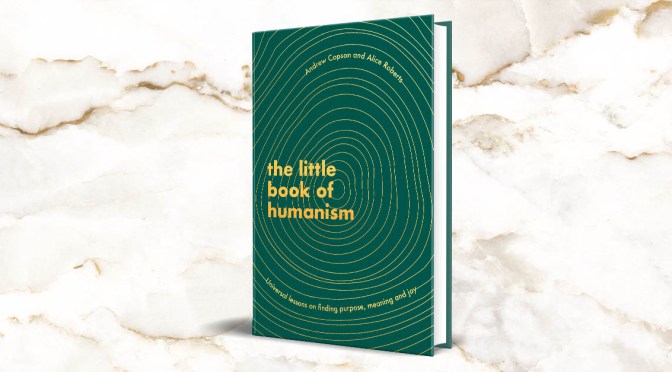
A timely new book by Humanists UK President Alice Roberts and Chief Executive Andrew Copson is to offer universal lessons on finding meaning, purpose, and joy in our ever more uncertain world.

The Little Book of Humanism, published on 27 August, shares over two thousand years of humanist wisdom through an uplifting collection of illustrations, stories, quotes, and meditations on how to live an ethical and fulfilling life, grounded in reason and humanity. The book quotes everyone from ancient philosophers like Epicurus and Mencius, through to contemporary humanist sources of inspiration such as Frozen and The Good Place actor Kristen Bell, the novelists Zadie Smith and Margaret Atwood, and the playwright and poet Wole Soyinka.

It examines how humanity came to be, our unique place in the world, and why humanists reject religious explanations, before offering reflections on how to be good, how to live well, and how to think clearly. It emphasises the need to celebrate diversity and promote equality and why we should rely on science for the answers to many of life’s most important questions. Finally, it offers some particularly timely reflections on death and dealing with loss. It does all of this whilst drawing upon a cornucopia of humanist thought from many of the world’s greatest thinkers, accompanied by beautiful original illustrations.

Welcoming the publication of their book, authors Andrew Copson and Alice Roberts commented: ‘In the past, people were more likely to turn to religion during times of crisis than look to other sources of guidance. But there has always been an alternative – the humanist approach – and in today’s UK, where most people are now not religious, that alternative is more relevant than ever.  We hope this book offers timely sources of guidance, comfort, and inspiration, in a way that has a positive and lasting impact on people’s lives.’

The book can be purchased from Waterstones, Amazon, Blackwell’s, and all good bookshops, with both hardback and eBook available at £7.99 RRP. It is published by Piatkus Books, an imprint of Little, Brown. Author royalties from the book go towards supporting the work of Humanists UK.

About the authors

Professor Alice Roberts is a writer, broadcaster, and President of Humanists UK. She is the bestselling author of eight popular science books including Evolution: The Human Story, The Incredible Unlikeliness of Being and Tamed: Ten Species that Changed Our World. Making her television debut on Time Team in 2001, she has become one of Britain’s best-known broadcasters and has written and presented a huge range of television series for BBC2, BBC4 and Channel 4, including The Incredible Human Journey, Origins of Us and Ice Age Giants, and several Horizon programmes. Her humanist ‘mini-sermons’ on Twitter have been liked and shared many thousands of times.

Andrew Copson is the Chief Executive of Humanists UK and President of Humanists International. He has provided a humanist voice on many television and radio programmes and written on humanism for publications including The Economist, New Statesman, Guardian, Prospect, The Times and Buzzfeed. With AC Grayling, he edited the Wiley Blackwell Handbook of Humanism and his most recent book is Secularism: A Very Short Introduction.


The views, opinions and analyses expressed in the articles on Humanist Freedoms are those of the contributor(s) and do not necessarily reflect the views or opinions of the publishers.

Featured Photo Courtesy of: http://www.lbabooks.com/cover-reveal-the-little-book-of-humanism-by-andrew-copson-and-alice-roberts/

Philosophy Now Issue 138: The Religion & Society Issue

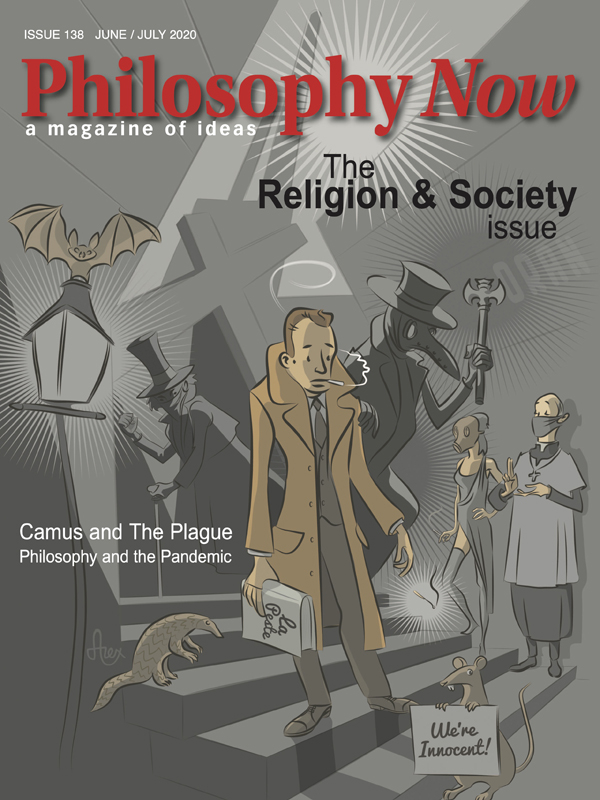
Issue 138 of Philosophy Now (June/July 2020) bears the bold sub-title: The Religion & Society Issue. While it was Robert Griffith’s article entitled “Beyond Humanism?” that first caught our attention, the issue’s Table of Contents offers a number of great articles, including a feature section on religion and secularism. The periodical’s website appears to allow complimentary viewing of up to four articles per month – so select carefully! Or subscribe and enjoy some interesting reading. Here are a few of our favorites:

Einstein & The Rebbe

Ronald Pies sets up a dialogue between science and religion.

Christianity & Homosexuality

Rick Aaron argues that religious recommendations are sometimes unrealistic.

Beyond Humanism?

Robert Griffiths argues that humanist ethics has significant limitations.

Suffering & the Media

Ian Church queries the influence the media has on our perception of evil.

Buddha Travels West

Peter Abbs follows Buddhism’s path towards becoming a Western humanism.

Philosophy & The Creation of the Individual

Mark Vernon chronicles a revolution in consciousness.

The Character Gap by Christian B. Miller

Massimo Pigliucci is frank about human character.

Issue 138

Visit the Philosophy Now website.

Featured Image courtesy of Philosophy Now.

Auckland Festival of Photography: Marco Bischof

Unseen – Werner Bischof

Queens Wharf Fence • 23 May – 21 June

Hours 8pm 27 May | 1 June Freeview CH 200
Where outdoor exhibition 24 hrs/7 days – 89 Quay St, City
09 307 7055
http://www.wernerbischof.com
yes
Artists Werner Bischof
ThemeExhibitions

Auckland Festival of Photography is excited to present an exclusive outdoor waterfront exhibition of work by Werner Bischof, Switzerland.

Werner started his career in his studio in Zurich, Switzerland, where he perfected his artistic photography in “painting with light and shadow”. In 1945 he creates maybe the most significant photographic documentation of Europe in the aftermath of WWII. 1949 he joins Magnum Photos and travels two years in Asia: India, Japan, Korea, Hong Kong and Indochina he continues his humanistic photography, combining form and content.

His untimely death in a car accident in Peru at age 38 was the catalyst to maintain his photography in an archive for future generations.

USA is a series of work that brings early 1950s America vividly to life, yet Bischof’s tragic death at 38 meant the photographs were never printed during his lifetime. This is the first time they are being shown to the public in New Zealand.

Werner Bischof; Americana

Bischof was the first non-founding member to be welcomed into the then-fledgling Magnum collective, in 1949 joining Robert Capa, David  Seymour, Henri Cartier-Bresson and George Rodger. He had already become recognised for his pioneering use of colour photography, and was one of the first documentary photographers to take the format seriously. At the time of joining Magnum, most of Bischof’s contemporaries still predominantly worked in monochrome, a trend that continued well into the 1960s.

The photographs serve as a fleeting snapshot of a unique point in history: Bischof arrived in post-war United States from Switzerland in 1953, and stayed there for just one year, chronicling a booming and optimistic America through the eyes of an outsider. The 25 photographs that make up the series comprise few suggestions of interaction, they are instead stolen moments through shop windows and cars that blur past, evoking anonymity, and a contemplative look at everyday life in America during a period of immense change. (some text courtesy of the British Journal of Photography).

Thanks to Pro Helvetia – Swiss Arts Council, Panuku Development, Lion Foundation and Werner Bischof Estate.

Talking Culture – Artist Talk 12pm (noon)-1pm Wed 27 May 
10am-11am Sat 30 May
Marco will give a talk about his father, Werner Bischof’s photography ‘USA’ series. Read more and Zoom in to join the talk…

Further Information

  1. Marco Bischof on curating his father’s photography for a written and 16-minute audio article by Radio New Zealand
  2. www.wernerbischof.com/main.html

Feature Image Courtesy:ndmagazine.net