2020 was HumanistFreedoms.com’s first full year of operation. Today we reached a new milestone!
At the end of July 2021, we had surpassed the total visitors to the site in 2020. Effective today, October 23, 2022, we are thrilled to see that we’ve surpassed the 2021’s annual total visitors and pages read. By year’s end we expect to have grown 25% in 2021!
We have enjoyed publishing articles which promoting and celebrating humanism and our common humanity. We thank our contributors, readers and visitors for making http://www.humanistfreedoms.com a unique online magazine.
By contemporary internet standards, HumanistFreedoms.com is still a new and growing project. But we think that every small project has the potential to bring humanist values, outlooks and news to a continuously-growing audience; we look forward, therefore, to promoting other start-up Humanist-themed projects. Recently, the “Reasons for Reason” Youtube channel caught our attention. The channel features R4R, The Rational Robot, undertaking a number of classic counter-apologetics exercises. Currently, the channel’s most popular video is one devoted to the so-called Shroud of Turin.
If you enjoyed the R4R’s adventures in reason, please share your thoughts below and share the video with those who may be interested to learn more bour Reasons for Reason, counter-apologetics and humanism.
For the remainder of 2022 and looking forward to the new year, we are looking for even more essays, articles and stories to share! We are not able to pay for articles (yet) but we want to hear what you have to say. This month, themes that we want to explore include:
Contemporary Humanism’s Biggest Priorities and Challenges for 2022
Leadership Within The Humanist Movement
Humanism and Secularism
Humanism and Human Trafficking
Digital Humanism
Humanism and Global Population
A Humanist Perspective of Radical Politics
Humanist Photography: Photographer Review
Humanism in the Arts
Humanism and the Environment
Humanism and Freedom of Expression: Lessons of the 2020’s
Humanism and Freedom of/from Religion: Global Lessons
Humanism and Architecture
Book/Movie/Music/Arts Review: A Humanist Recommends….
Do you have an idea that isn’t on our list? Let us know. Inquire at humanistfreedoms@gmail.com
There’s something about elected office(s) and democracy that doesn’t quite match-up well with religious prerequisites. The concepts are fundamentally opposed. Elected office and democracy puts the leadership selection process in the hands of the people that the system is intended to serve while religious prerequisites place the selection process in the hands of religious authorities, regardless of who may be within that system. That seems fairly obvious doesn’t it?
Canadian media outlets have recently reported the outcome of a legal case wherein an Ontario student sued the York Catholic District School Board after having been barred from running for elected office within the school system. It seems that Dasha Kandaharian, an Orthodox Christian (i.e. not a Roman Catholic), was not allowed to run for student trustee at the high school she attended because of that sectarian difference.
Media stories have referred to the case as a “landmark” – which it undoubtedly is. The decision undoubtedly addresses the situation faced by thousands of non-Catholic students who have attended publicly-funded Catholic schools in the past (clearly, Kandaharian was not he first and only student to be barred from the elected office) – and the thousands more who may do so in the future.
What the media have not (that we can find) spent much time in considering is where the Catholic School Board(s) of Ontario may have gotten this notion that a sectarian religious prerequisite for elected office is an acceptable thing.
A person is qualified to be elected as a school board trustee if the person is qualified to vote in a school board election and is a resident of the school board district.
When filing a nomination a candidate must meet all of the following requirements:
a resident within the jurisdiction of the board;
a supporter of the board (“supporter” refers to the individual’s support for one of the four publicly funded school systems. A list of supporters for each system is kept by the Municipal Property Assessment Corporation);
a Canadian citizen;
at least 18 years old;
Roman Catholic (if running for a Catholic school board);
not legally prohibited from voting; and
not disqualified by any legislation from holding school board office.
Note: A candidate, if nominated, must remain qualified throughout the election and, if elected, throughout the term of office. The term of office is 4 years. School board candidates should confirm that they have the qualifications described here and in section 219 of the Education Act. It is the responsibility of the candidate to determine whether he or she is qualified to be elected to and hold office.
In case you’re interested, Section 219 of the Education Act doesn’t seem to actually bear the qualification that we’ve bolded in the language above. Perhaps the argument is implicit or explicit in some other section of the Act. But for the moment, we can skip over that murky inconsistency and observe that the York Catholic District School Board (and any other publicly funded Catholic School Board) appears merely to have been applying the same criteria to the selection and election of Student Trustees as the Government of Ontario appears to tolerate for the selection and election of School Board Trustees.
Well, this landmark court decision rather brings to question whether what’s good for the goose (students) may also be good for the gander (adult politicians).
So let us consider, in the spirit of taking note of landmarks, an entirely fictional scenario: a hypothetical Secular Humanist who happens to be a (legally defined) ‘supporter’ of the Catholic School system in their area decides that they would like to be Board Trustee of that system. Regardless of how they might fare in an open election – how well do you imagine this hypothetical individual might fare in the qualification screening process?
Here is a separate and perhaps more fundamental question: Can you imagine any other elected office in a 21st-century democratic country named Canada where membership in a religious sect would be accepted as a pre-requisite condition?
And here, in an un-related way, is an observation from our recent Preamble, schmeable article:
Did you notice that the US Supreme Court Judges who turned against Roe v Wade are all Catholic? Well, according to Catholic News Agency, they appear to be. A coincidence, no doubt.
Clearly, religious sectarian membership and elected/selected public office in a contemporary democracy is a match made in….
The views, opinions and analyses expressed in the articles on Humanist Freedoms are those of the contributor(s) and do not necessarily reflect the views or opinions of the publishers.
When was the last time there was a meeting of Secular Humanists in Canada, or indeed all of North America which could proudly affirm 10,000 attendees? Or even 5,000? The Reason Rally website (as of October 5, 2022) appears to still have branding from 2016 and proclaims “The Reason Rally is proud to have hosted the two largest gatherings to celebrate secular identity and speak up for reason in American history.” Despite a bit of mis-place modifier action going-on in that proclamation, we can take it that things were still happening in 2016.
In Canada, the most recent iteration of the Imagine No Religion conference (INR7) was held in Toronto during the summer of 2017. We remember it fondly as HumanistFreedoms.com stands as a product of friendships developed and sustained at that time.
Time has indeed passed and one must only wonder if it isn’t perhaps time for Secular Humanists in North America to look around and take stock. Where is everybody? Where is that solidarity to promote reason and secular values?
Maybe it’s also time to take note of undertakings on other continents.
Image Courtesy: Wikipedia
The first edition of Litmus, the annual meet of esSENSE Global, was held in Thiruvananthapuram, India, in Oct 2018. The next one was held in Kozhikode in 2019. Litmus is noted for all round participation from the secular-atheist community and the general public in the state of Kerala. Expatriate Malayalees also participate in this annual event in large numbers.
According to TheNewsMinute.com, “Around 10,000 people gathered at the Rajiv Gandhi Indoor Stadium at Kadavanthara in Kerala’s Ernakulam district on October 2, Sunday, to attend an annual meet named ‘Litmus 22’, pitched as “the world’s biggest atheist meet in ‘god’s own country’”.
‘Let evidence lead’ is the motto of Litmus and stated on the event website that:
No pompous fanfare by parading of caparisoned elephants through packed streets. No vengeful god with their inherent fury or priests with their greedy interests. No eardrum shattering high decibel fireworks or loudspeakers.
Instead, this session entails a celebration that promotes the advancement of humanity through enhancing scientific temper and freethinking as per article 51 a(h) of the constitution of India.
esSENSE GLOBAL is a registered organization under the Registrar of Societies, Government of Kerala, India with ‘ESSENSE CLUB GLOBAL’ as the registered name. Via internet, social and printed media the organization is known as esSENSE GLOBAL.
The goal of esSENSE GLOBAL is to promote the scientific temper, humanism and the spirit of inquiry and reform in the society inspired by the Article 51 A (h) of Constitution of India which insists “It shall be the duty of every citizen of India to develop the scientific temper, humanism and the spirit of inquiry and reform”. esSENSE GLOBAL strives to liberate the society of Kerala from religious and secular superstitions, dogmas and intellectual bondage. Unbiased freethinking is the stand we espouse without flinch. esSENSE Global always holds the view that Kerala society requires a real handshake with science and its methodology so as to advance to the next level of human civilization. When we defend science, in fact, we defend our civilization.
esSENSE GLOBAL organizes Seminars, Study classes, Panel discussions, Presentations, Debates, Aid missions throughout the state of Kerala to spread the ideas and values mentioned above. All programs are recorded and published in YouTube and social media.
The views, opinions and analyses expressed in the articles on Humanist Freedoms are those of the contributor(s) and do not necessarily reflect the views or opinions of the publishers.
In our search for interesting, challenging and critical perspectives on contemporary humanism, we occasionally find articles published via other venues that we think HumanistFreedoms.com readers may enjoy. This week, we found news that Chile has a brand new, legal Humanist political party. While we aren’t experts in Chilean politics, we are aware that this development follows a difficult period in Chilean history – most recently demonstrated by constitutional challenges. Indeed, in a world that seems to face no shortage of political challenges, it is interesting to note that Humanist political parties exist in many countries around the world. Currently, there is no Humanist political party in Canada that we are aware of. Perhaps Chileans have recognized what we’ve not yet seen in Canada: there’s a deep and urgent need for reason in politics.
The following article was located on the Pressenza website on October 2, 2022.
Image Courtesy: Wikipedia
Today the more than necessary signatures to legaliseAcción Humanistaas a political party in Chile were presented to the Electoral Service.
After two and a half years since some 300 militants left the Humanist Party and left that collectivity as a mere movement that did not seek to sustain the original organisation, this new movement is being legalised today.
They worked during the pandemic, they gave themselves their statutes, added adherents, launched their membership campaign and were raising a contagious energy with which they took to the streets while also sustaining their virtual activities. They developed that very special mix that was militancy in times of pandemic.
In this context and after the Chilean social awakening, they supported the “Apruebo” option in the Plebiscite, they sought to elect constituents by running candidates in several districts, and they still presented themselves as a movement in the municipal elections where they obtained the first favourable results that allowed them to elect their councillors. Subsequently, they supported the elections of Governors and CORES, and concluded with a very strong campaign both in the Primaries and for the parliamentary elections in which they won the re-election of Deputy Tomás Hirsch and the inclusion in their ranks of the recently elected Deputy Ana María Gazmuri. They campaigned for the second round of the elections where, with all the forces of Apruebo Dignidad, they achieved the massive vote that put Gabriel Boric Font in the Presidency of the country.
They then went on to form, albeit still as the Acción Humanista movement, the political team on which the new government is relying. Marilén Cabrera was nominated to the Undersecretary of National Assets, they obtained several Seremías in different regions and also a series of other public posts.
While they were trying to gather all the signatures that would allow them to become a legal political party, they worked day by day for the possibility of approving the new constitutional charter in the exit plebiscite and, together with 38% of the population, this time they failed miserably.
However, their work over the last two and a half years has been plagued by solidarity campaigns, forums, retreats, activities, meetings, gatherings and so on. There has been a strong press coverage, especially by Deputy Tomás Hirsch, but also by several others.
And today they have been legalised. With this, Humanism once again has a legal political party in Chile, and that is good news. Tremendous news. It is now called #AcciónHumanista and it carries the spirit that has characterised humanists since the 1980s.
The views, opinions and analyses expressed in the articles on Humanist Freedoms are those of the contributor(s) and do not necessarily reflect the views or opinions of the publishers.
Following Humanists International‘s expression of deep concern regarding what it has called “the judicial harassment of poet and filmmaker Leena Manimekalai“, Humanist Ottawa has issued a letter to the Canada Excellence Research Chair in Migration and Integration, Dr. Anna Triandafyllidou.
In the letter, Humanist OttawaPresident Robert Hamilton expressed the organization’s “deep concern for the egregious actions taken by CERC Migration and Integration and Toronto Metropolitan University against filmmaker Leena Manimekalia and her short artistic film, “Kaali.“
Image Courtesy of Humanist Ottawa
Humanist Ottawa asserted that CERC “asserted a privileged position of your organization over a person of colour and a member of the 2SLGBTQ+ community – in glaring opposition to your own stated values of diversity, equity and inclusion. As well, these action unequivocally contravened Article 18 of the United Nations Declaration of Human Rights supporting freedom of thought, conscience and religion.“
Manimekalai, who has previously identified as bi-sexual, had been selected to produce a creative piece on multiculturalism in Canada as part of the national level academic programme ‘Under the Tent’ organized by CERC Migration – Toronto Metropolitan University. The film, ‘Kaali’ was launched at the Aga Khan Museum on July 2, 2022.
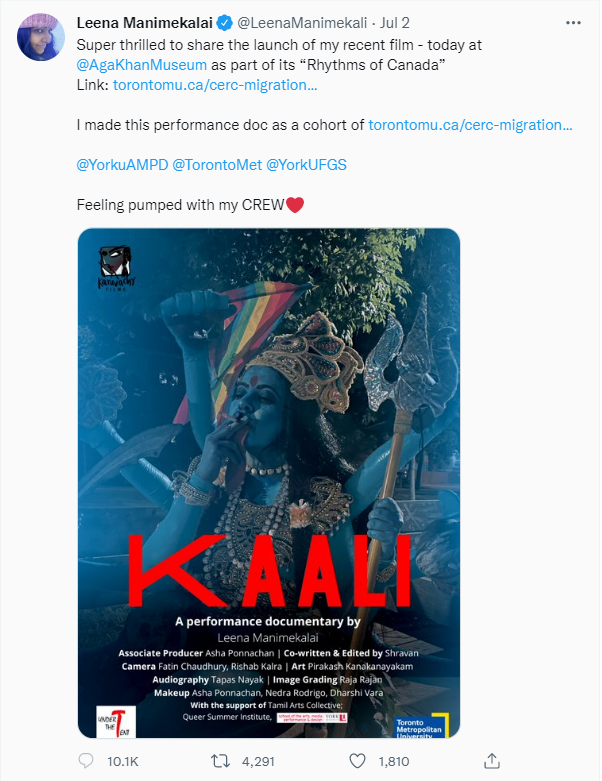
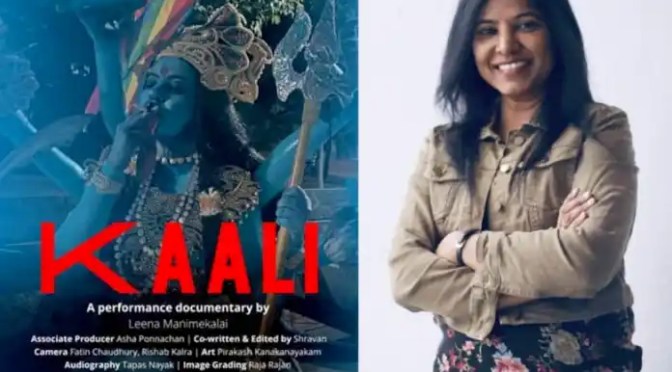
The documentary film documents Manimekalai in the guise of the Hindu goddess Kali wandering the streets of Toronto at night during a pride festival. Manimekalai observes groups of people out on the town, riding the subway, stopping at a bar, taking selfies with members of the public, and sharing a cigarette with a man on a park bench.
Humanist Ottawa pointed out in their letter to Dr. Triandafyllidou that CERC’s actions “directly empowered others who have disseminated hate speech posters and other social media advocating violence and death against Leena Manimekalai. Your actions have cause the perpetration of flagrant injustice and have forced Leena to take steps to protect her safety.”
Maintaining an intent to promote diversity and inclusive values, Maimekalai was quoted in the New Indian Express as saying: “Kaali, the film is all about choosing love and championing humanity. Trolls who are witch-hunting me are fueled by hate. They have nothing to do with faith. If they are patient enough to watch the film they might choose love. But that’s exactly why they want the film to be banned.”
Taking aim at CERC’s status as a federally-funded status, Robert Hamilton also wrote, “In addition, your acquiescent public apology to vague assertions of offence were not only short sighted, but were indeed corrosive to individual freedoms that Canadians cherish and have fought to preserve including the freedom to express artistic and religious idea.
Finally, you took quick actions against the filmmaker without due consideration to the foreseeably dangerous consequences that could ensue. This speaks to a failure in judgement and accountability unworthy of a federally-funded program and an institution of higher learning. Canadians deserve and expect better than this.“
On 4 July, the High Commission of India in Ottawa issued a statement calling on the Canadian authorities and event organizers to withdraw her film. Her film was subsequently withdrawn and her name removed from the ‘Under the Tent’ programme by Toronto Metropolitan University, while Toronto’s Aga Khan Museum host to a screening of her film apologized for any offence caused by the film.In India, a de facto ‘blasphemy’ provision , Section 295A of the IPC allows up to three years imprisonment for “whoever, with deliberate and malicious intention of outraging the religious feelings of any class of citizens of India, by words, either spoken or written, or by signs or by visible representations or otherwise, insults or attempts to insult the religion or the religious beliefs of a class.”
To date, CERC does not appear to have provided any public statement of how it may plan to take accountability for its contributions to the risks faced by Manimekalai. Humanist Ottawa provided some expectations from the perspective of the organization’s inclusive humanist values:
Accordingly, we therefore urge you to:
Promptly express a public apology to the filmmaker, Leena Manimekalai
Publicly articulate support for the legal, free expression of thoughts and ideas
Financially compensate the filmmaker for the pain and suffering that she continues to endure
Financially underwrite all expenses needed to ensure the safety and security of the filmmaker
HumanistFreedoms.com encourages you to share your perspective on this situation with Dr. Triandafyllidou by writing a letter of your own – and by commenting in this post.
The views, opinions and analyses expressed in the articles on Humanist Freedoms are those of the contributor(s) and do not necessarily reflect the views or opinions of the publishers.
In our search for interesting, challenging and critical perspectives on contemporary humanism, we occasionally find articles published via other venues that we think HumanistFreedoms.com readers may enjoy. The following articles and studies were located on the Humanists International website and in several online publications.
Humanists International is deeply concerned to learn of the judicial harassment of poet and filmmaker Leena Manimekalai, who is currently facing accusations of “hurting religious sentiments” in connection with her latest documentary short ‘Kaali’.
Leena Manimekalai – a published poet and award-winning filmmaker, who is studying for an MFA in Canada – was selected to produce a creative piece on multiculturalism in Canada as part of the national level academic programme ‘Under the Tent’ organized by CERC Migration – Toronto Metropolitan University. Her project, ‘Kaali’ was launched at Aga Khan Museum on 2 July 2022.
The short film shows the Hindu goddess Kali wandering the streets of Toronto at night during a pride festival, observing groups of people out on the town, riding the subway, stopping at a bar, taking selfies with members of the public, and sharing a cigarette with a man on a park bench. The poster for the film shows Kaali – played by Manimekalai – smoking, holding an LGBTI+ flag.
She is quoted in the New Indian Express as saying: “Kaali, the film is all about choosing love and championing humanity. Trolls who are witch-hunting me are fueled by hate. They have nothing to do with faith. If they are patient enough to watch the film they might choose love. But that’s exactly why they want the film to be banned.”
Manimekalai announces the screening of her film ‘Kaali’ on social media
Since sharing the poster which went viral on social media, Manimekalai has faced a barrage of death threats, a campaign of harassment on social media – with the hashtag #arrestleenamanimekalai trending on Twitter India – and legal complaints filed against her by right-wing Hindu nationalists in India.
On 4 July, the High Commission of India in Ottawa issued a statement calling on the Canadian authorities and event organizers to withdraw her film. Her film was subsequently withdrawn and her name removed from the ‘Under the Tent’ programme by Toronto Metropolitan University, while Toronto’s Aga Khan Museum host to a screening of her film apologized for any offence caused by the film.
Speaking to The Hindu, Manimekalai stated, “My intention is not to provoke. […] By succumbing to fundamentalist elements, Toronto Metropolitan University and Aga Khan Museum have compromised on academic and artistic freedom.”
To date, Manimekalai is aware of at least nine First Information Reports (FIR) – an official legal complaint that initiates a police investigation – filed with local authorities in the states of Uttar Pradesh, Delhi, Uttarakhand, and Madhya Pradesh. The petitioners allege that Manimekalai has breached a range of laws, including Article 295A of the Indian Penal Code (IPC) and section 153A (promoting enmity between different groups on grounds of religion.
A de facto ‘blasphemy’ provision, Section 295A of the IPC allows up to three years imprisonment for “whoever, with deliberate and malicious intention of outraging the religious feelings of any class of citizens of India, by words, either spoken or written, or by signs or by visible representations or otherwise, insults or attempts to insult the religion or the religious beliefs of a class.”
In addition, a court in Delhi has reportedly issued a summons for Manimekalai and her company to appear in court on 6 August in connection with a civil complaint filed against her.
Humanists International fears that filmmaker Leena Manimekalai is being targeted for her peaceful exercise of her rights to freedom of religion or belief and expression. The organization calls on the Indian authorities to drop all investigations relating to the film, and to repeal its ‘blasphemy’ laws.
The views, opinions and analyses expressed in the articles on Humanist Freedoms are those of the contributor(s) and do not necessarily reflect the views or opinions of the publishers.
In a communiqué entitled “Nonviolence, an urgent commitment”, the Humanist Movement of Cordoba welcomed the initiative of the League of Governors to “make visible the need to install Peace and Nonviolence as guiding principles of life in common in Argentinean society”.
The mention refers to the document signed by the governors of 15 Argentine provinces a few days afterwards the failed attack against Vice-President Cristina Fernández, which, among other issues, expresses the recommendation to President Alberto Fernández to create a “Commission for Peace and Non-Violence”. We want to reaffirm the need to contribute together to a climate of national pacification,” the governors said.
For their part, the militants of New Humanism pointed out how their movement has worked since its origins “to forge and expand a culture of non-violence, promoting numerous actions in all fields of social activity”.
It is important to remember, in the context of this statement, the hostile framework in which the movement emerged. Its first public event took place in 1969, in the midst of the Onganía dictatorship, in a mountainous area near the Andes, due to the military regime’s repeated prohibitions on making its message heard in urban centres. Proscription and persecution continued and forced many of its activists into exile.
Already in that first harangue, its founder, Silo, would expand the vulgar conception of the term “violence” by saying: “Violence in man, moved by desires, does not remain only as a disease in his consciousness, but acts in the world of other men, exercising itself with the rest of the people. Do not think that I speak of violence as referring only to the armed act of war, where men tear other men to pieces. That is a form of physical violence. There is economic violence: economic violence is violence that makes you exploit another; economic violence is when you steal from another, when you are no longer a brother to another, but a bird of prey for your brother. There is also racial violence: do you think you do not exercise violence when you persecute someone who is of a different race to you, do you think you do not exercise violence when you defame them because they are of a different race to you? There is religious violence: do you think that you do not exercise violence when you give us work, or close the doors, or fire someone, because he is not of your own religion? Do you think that it is not violence to encircle someone who does not agree with your principles by defamation; to encircle him in his family, to encircle him among his beloved people, because he does not agree with your religion?
In line with this message, the signatories of the communiqué affirm that non-violence should be the central axis of a state policy that aims to “transform the conditions that generate different forms of violence.
The statement released affirms that, in addition to overcoming unworthy social situations, it is necessary “a profound process of reflection so that the universal premise of relationship is to treat others the same way we want to be treated.”
Image Courtesy Pressenza
Finally, it calls on each person to actively commit themselves to Nonviolence, from their place of influence, in order to “build the world that we want, need and deserve as human beings”.
The Humanist Movement of Cordoba welcomes the initiative of the League of Governors to make visible the need to install Peace and Nonviolence as guiding principles of life in common in Argentinean society.
Since its origins, New Humanism has worked tirelessly to forge and expand a culture of Nonviolence, promoting numerous actions in all fields of social activity.
We believe that Nonviolence must become the axis of State policies aimed at transforming the conditions that generate different forms of violence.
We also affirm that well-intentioned declarations and regulations will not be enough to achieve this goal if people do not intend to initiate a profound process of reflection so that the universal premise of relationships is to treat others in the same way we want to be treated.
We call on society as a whole to make an active commitment to Nonviolence in order to build the world we want, need and deserve as human beings.
HUMANIST MOVEMENT OF CORDOBA Cordoba, September 2022
First adhesions:
World Without Wars and Without Violence Cordoba Centre for Humanist Studies of Cordoba Humanist Party Cordoba The Community for Human Development Cordoba Humanist Feminists Cassandra Base Team Humanist Party The Community for Human Development Salta Intentional Community Abriendo Futuro (Opening the Future) Social Humanism. Puerto General San Martín, Santa Fe Humanist Neighbourhood Movement Moreno THE COMMUNITY for Human Development (Aso.Civil) Humanist Feminists La Pampa. Humanist Feminists Cordoba Community of Silo’s Message, Cordoba Community of Silo’s Message Humanist Party of Entre Rios Humanist Feminists Alberti COPEHU- Cordoba. Universalist Humanist Pedagogical Current of Cordoba Convex Concave Community of Villa Crespo CABA Collective for nonviolence Mar del Plata
Individual supporters
Pamela Facello, humanist from Entre Rios Diana Varela, retired. Alejandra Elena Vittar, Teacher Tala Gonzalez, Arturo Lorusso – retired Alberto José Castro, teacher Nélida Ester Rey, retired. Claudia Monica Varela, Kinesiologist Ana Tolcachier, Student Eloy de LLamas, visual arts Haro Paz Juanito, computer scientist Margarita Ponce de Leon, retired Conny Henrichmann, translator Andrea Franco, Humanist activist. Mum, trader. Noe Costas Silvia Tabarini – retired Ochoa Graciela, Humanist feminist. Sandra Lewy Smith Marello, Danilo. Teacher Guillermina Rodríguez, Peronist, Mataderos Ana Maria Ferreyra, Pensioner Hugo Alberto Cammarata Gerardo Spidalieri Omar Abraham, Trader Cynthia Fisdel, Humanist Javier Tolcachier, Communicator Bernardita Zalisñak Gabriela Inés Adorni, Psychologist. Susana Malvasio, Pensioner Paulina Peralta, student Valentina Cusmai, student Pamela Taverna – Psychologist Juan Armando Caro – Designer Pablo Sequeira, Salesman César Almada Carmela Acebedo, student Carlos Alberto Flores, Independent Juana Aurora Barragan, Socio Therapist Operator Agostina Beccaria, employee Sol Arrieta, work in an electronics repair shop Alejandro Tolcachier, Lic. in Mathematics, Doctoral Student Hugo Omar Moyano, Humanist T. Miriam Moyano, retired teacher
The views, opinions and analyses expressed in the articles on Humanist Freedoms are those of the contributor(s) and do not necessarily reflect the views or opinions of the publishers.
Toyin Falola is a Nigerian historian and professor of African Studies. He is currently the Jacob and Frances Sanger Mossiker Chair in the Humanities at the University of Texas at Austin. He joined the faculty at the University of Texas at Austin in 1991, and has also held short-term teaching appointments at the University of Cambridge in England, York University in Canada, Smith College of Massachusetts in the United States, The Australian National University in Canberra, Australia and the Nigerian Institute of International Affairs in Lagos, Nigeria. Falola is author and editor of more than one hundred books, and he is the general editor of the Cambria African Studies Series (Cambria Press).
Excerpt of the Convocation Lecture
2021 Nigerian Academy of Letters
Many would agree that when the core principles and values inherent in humanism–rationality, reason, compassion, human dignity, fellow-feeling, freedom, love, and kindness–are in deficit in society, a vacuum is created and all manner of dogmas, doctrines, superstitions, theories, and abstractions hold sway. Human values are required to be reassembled and restored as a result of these failings and pitfalls– which include war mongering, stoked by the availability of superior and sophisticated weaponry, moral bankruptcy such as corruption and the corruptibility of power, pride, greed, rapacious avarice, religious fanaticism, ethnic irredentism. They defray from humanism and all need to be eliminated for the re-affirmation of humanity. Among these pitfalls, also is the “robotization” and “thingification” of humanity, resulting from advanced technological innovation and artificial intelligence.
By electing to deploy literature, music, and the media among the diverse tools and fields of the humanities, to mediate its ideology, humanism, the thought of the choice of three, just three, rests on the three witches at the opening of William Shakespeare’s Macbeth. There is tempo-spatiality (time and space–of when and where); There is so much metaphorical witchcraft in the arts–all of them, literature, theatre, film, music, and the media. When you fold or scaffold time and ages into a few hours, “hold eternity in the air,” take on persons and characters into oneself, remove costumes and make-ups, and wake up instantly from death to active life without the miracle of Christ, confer immediacy upon news and news paces, record events into soundtracks and sound bites, and make them live in the real world, you confront the witchcraft and the magic of the arts–the humanities. So, the idea of echoing the witches and their witchcraft is not too far-fetched; after all; it is not stretching the imagination too thin, as is done in our vocational engagement in the arts.
The Yoruba Nollywood talks of Idan, which is magic. Apidan, the magic-makers, the theatricians, the actors, the storytellers, and the whole process of their art of creation on stage, screen, studios, and so on. And timing (the duration) of the clap-trap of lightning–the age of cataclysm, violent eruptions in the streets, outright warfare, which is actually what the witches were referring to, plagues, epidemics and pandemics, tornadoes, massive flooding, ravaging fires, earthquakes; chaos, banditry, kidnapping, dystopia, and the likes. These do not make the echoes of witches, magic, and the cult of Iyas (mothers) too intriguing or too dissimilar to the world of the arts.
In all the ages, writers covet the news space for self-expression to say the things that must be said urgently and to test the waters of their creation as they form words from their thoughts–poetry, prose, drama sketches. In that sense, there is an intriguing love relationship between the media and literature. Throughout time, men of letters seek refuge in the media as they mold their blocks of expression that are later turned into books. The role of newspapers in the evolution of literature drew the writers into the waiting arms of the media, newspapers to be specific, in a relationship that has become permanent, as the newspapers, periodicals, and journals and their creators themselves became a new type of literature and literary artists. Therefore, from the 18th century on, the inventors of the periodical essays extended the tactic of the fictitious self into the new territory and became writers.
All over the world, including in Nigeria, overt and subtle control proved incapable of stemming the growth of the media industry. The creeping in of censorship to control the opinions and feelings expressed in rapidly popularizing media had begun to accommodate issues and topics on politics, the lives of public individuals and businesses. Its popularity generated the desire of governments to control what would come out in the newspaper the following morning. Patricians and politicians tried hard to control the press, to dictate its views, and to contain its criticisms, but in Britain (and I daresay everywhere, including in Nigeria), the media and literary realms and phenomena proved too large for such ‘arrant limitations.’
Getting too hot and pinching the skin and the nerves, the government created “licensers of the press” to hunt down heretical and seditious publications and through strict licensing laws to limit the flow and narrow the range of newsprint, but whenever these laws lapsed, innovations in newspapers abounded before new forbidding laws are created. The bid to kill freedom of speech, arising from the gradual dehumanizing capacity and strategies of the powerful, had been there and it remains with us today. We must reach out to our society where the contribution of the media in those early days of independence struggle was valiantly resisted by the colonial authority. The politicians (civilian and military) inherited that strategy to control and censor the media. The draconic decrees to muzzle and snuff out freedom of the press and literature are evidence of the descent from humanism, derived from debased and depraved corruption of power in our country and continent.
Literature stands as a bridge-head between music and the media. Just as the media and literature are inextricably linked in a Siamese-twins relationship, so do literature and music bond in close affinity such that, many times, it became difficult to draw distinct lines between the two. Poets were considered as failed musicians and musicians as failed poets, and when those whom the world considers pop culture musicians began to win the Nobel Prize for literature (Bob Dylan, for instance), the separation line between the two blurs and melts into oblivion. Music became a friend of the media as literature, a friend of music, is the original friend of the media. So much for the justification of the meeting of three subfields of the humanities for mediating humanism!
As succinctly captured above, humanism, which I consider the ideological plank of humanity, reclines on the principles of reason and rationality. To attain a better society where love, humane value, and freedom reign, away from excessive religiosity (not religion), the human agency places the power for individual action in some other forces outside of the self and has brought so much human destruction since many centuries ago. There abound myriad theories of humanism since the age of the Renaissance. For instance, humanistic psychology emerged in the mid-20th century as a rebuttal to the limiting cynicisms of Sigmund Freud’s psychoanalytic theory, and B. F. Skinner’s behaviourism provides “a perspective that emphasizes’’ and ‘stresses concepts such as free will and self-efficacy.” In line with my offering above, humanism has been rendered as a “philosophy that stresses the importance of human factors rather than looking at religious, divine, or spiritual matters.” It is perceived as being “rooted in the idea that people have an ethical responsibility to lead lives that are personally fulfilling while at the same breath, contributing to the greater good for all people.”
The essence of humanism is its advancement of the significance of human values and dignity. People possess the capacity to solve their problems through rational and scientific means to attain the fulfilment of individual and communal ideals and to transform the world into a better liveable place for all people. For many centuries, the tragic emotions and irrationality that dominate religious dogmas and fanaticism, leading to extreme violent movements on intra-religious bases, have had lethal and mortal outcomes on humanity. To the media, the question is, how much information have they rendered to us in recent times, and in our search for truth which ought to promote peace but have provoked wars and battlements?
I will like to write on the passionate assessment of the descent to the barbarism of the media–traditional and social–in Nigeria and elsewhere to get a perspective of the state of our and the world’s media. On February 21, a prominent Nigerian female journalist, Kadaria Ahmed, gave a very passionate, captivating, and no holds barred address titled “My Message to the Nigeria Media,” whose altruism has been challenged by other prominent journalists. Kadaria Ahmed’s address would have simply gone down as a classic on the need and essence of media practitioners to shun ethnic profiling and return to the traditional, noble profession of truth-telling and leading the nation aright in times of national crisis. Kadaria wrote thus:
It is with a heavy heart, worried of Nigeria and a sense of impending doom
That I am sending this to you, my colleagues,
Let me begin with a question;
What exactly will we gain if Nigeria descends into war?
How does it advance us if our fellow citizens turn on each other
And begin large-scale ethnic killings against each other…
How does enabling ethnic strife help to achieve this objective?
For some time now, a lot of us has thrown away the book on ethical reporting
Propelled by emotion, we have betrayed every moral consideration
That assigns our noble profession
But the critical probing to the other side of the coin happily carried out by Tayo Olu in The Whistler of February 15, 2021, titled “Attack on Nigerian Media,” has helped to put the “attack” by Kadaria in context without necessarily defraying from the value of her address.
Tayo Olu shed light on the reaction of Kadaria’s colleagues’ overt “scathing criticism of journalists’ reportage of the herdsmen crisis in the country” and for “fanning the flames of ethnic hate through their coverage of the crisis involving mainly the Fulani ethnic group.” Reactions came first from the Chairman of the Nigerian Union of Journalists (NUJ) FCT Chapter, Emmanuel Ogbeche, Ibanga Isine of Next Edition, and Ekhator Ehi, among others. The rationale of these accusations and counter-accusations among media practitioners is the reality of crass partisanship in the media at a time when they should be the true watchdog of the common folks on whose behalf they ought to speak truth to power and denounce agents of violence and crime. At a time when our humanity is badly assailed on all fronts, the media should be a rallying point and not a house of raucous voices.
Social media, on its part, has nearly swamped the traditional media in this digital age. Facebook, Twitter, Instagram, WhatsApp, Linked In, and the likes have become dominant tools of engagement all over the world, and our country has embraced it irreversibly. Whereas it has increased the democratic space and has been deployed by both government and the citizens, it is radically redefining the nature of engagement (especially political) between the citizens and the state all over the world. It has also generated a lot of conflict and tension because of its massive usage and has brought the two into more direct interaction, and the government can no longer monopolize free speech. Its power (the power of technology that it uses) lies in its immediacy, speed, political reach, and its uncontrollability.
It is projected that in the next few years in Nigeria, the deployment of social media will increase “by more than 80 percent with more than 44 million people accessing online forms in a demography of about 200 million.” The state worries about the potential of social media abuses to undermine the state and ‘threaten the corporate existence of the nation. Yet, apart from its capacity to widen dialogue space, its economic development/utility reality, put at about 10 percent of the nation’s gross domestic product and used by nearly 25 million people, makes it unstoppable in Nigeria. There is the debate of the mutual advantage of communication technology (in which Twitter is critical) to both government and the citizens and, thus, the increasing local, national, and international criticism of Twitter’s censor as impeding the nation’s humanity and freedom of expression. As this debate rages, the state must tread softly in its drive to hammer social media, recognize its universal nature, its mutual advantage in a democracy, and its humanizing power.
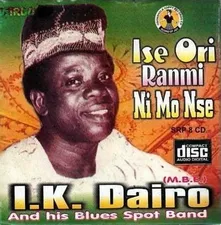
And to music, I find the danger of the descent of humanism pointedly depicted in the music of I. K. Dairo, as far back as the early sixties, and which still rings screamingly prophetic today. His album Ise Ori Ran mi ni mo se (loosely translated as “I do the job assigned to me by destiny”) ramifies this message of the need to restore humanism in society. Every line of this album warns against the dehumanizing power of greed and self-debasement in the search for sudden and filthy wealth. The inordinate search for crass materialism demeans and dehumanizes the world and sets it on the path of descending humanism. Many of our musicians; Fela, Idreez, and so on, make this frantic call on all of us, especially the state, to pursue the path of humanizing society.
As we all know, literature is a reflection of society, in the manner of a mirror. Beyond mere reflection, it refracts society in the way that the soul breathes life into the body. Literature, therefore, as an arm of the creative industry, endows, ennobles, and enriches a nation’s humanity. It advertises and tells its story. Politics and matters of an imperatively political nature have, for instance, in the African experience, preoccupied the literary establishment. Since the colonial aegis, our writers have put their songs and stories in the service of humanizing our society, committed to the fact that “the poet speaks not for himself only but also for his fellowmen. His cry is their cry, which only he can utter.” All this is in the project of reconstructing society in the moment of declining, degenerating humanity, and the pursuit of viable nationhood and the world order.
Generally speaking, Nigeria’s literature predating the fratricidal war of 1967 to 1970 was essentially in search of a certain socio-spiritual and cultural stability. This is especially so during the cultural nationalism phase, which set the tone for political independence from the hegemonic clutch of colonialism and imperialism. But the war, with all its absurdity and catastrophic devastation of the individual writers, due to suffering and considerable loss of lives at very close and personal levels, compel the literary characterization of the decline or indeed descent of our nation’s humanism.
Even though I had described in a previous study on the Civil War, that the war wrought a serious body of national literature, its blight compelled a certain kind of dark pessimism and cynicism in the emerging visions. This may have been caused by the deep sense of loss, personal and collective, which the war generated. Okigbo died in the war, Soyinka suffered protracted solitary confinement, and Achebe and Clark, on different sides of the nation’s pole, carried huge emotional and psychological burdens. The sowing of regenerative seeds in the flesh of the country carried tragic overtones, as we found in some of the war and post-war writings. Additionally, the Nigerian Civil War is used as a background against which the human condition is examined in its perverseness. War is absurd and irrational. The regime of bestiality characterized by war–pogroms and genocides–which tend toward the deployment of technology and war weaponry can lead to ultimate human extinction. Through war, wanton killing of one’s kind is the expression of the philosophy of the absurd and the descent from humanism.
With the ravaging impact and the trauma inflicted by the COVID-19 pandemic, the arts of creation and creativity, with a positive, cathartic sensibility, have moved on, as we find in Of Shadows and Rainbows: Musings in Times of Covid (2021), a COVID-19, PEN Nigerian publication of poems, short stories, playlets, and essays edited by Olu Obafemi and Folu Agoi. Leaping out of the pages of this publication are lines from the authors “gripped by emotions, paroxysms, compassion, searching for startling enlightenment, illumination and, in many cases, reconstructive tropes” as an affirmation of humanism. Other evolving creative works include the Platform, All Poets Network (APNET), created to promote poetry in English and native languages in this pestilent era and administered by Dzukogi, Khalid Imam, Ola Ifatimehin, and Ismael Baba to “give voice to young and established poets from all continents of the world,” and many more.
The Nigerian society is going through a transition of bleakness and blight, which has raged since the war and truly never ended, reaching very precipitous climaxes even under civil democracy. I have called it the descent from humanism which I have chosen to illustrate with music, the media, and literature. Unorthodox warfare through insurgency, insurrection, frightening banditry, armed herdsmen, lethal violence, dystopia, and wild social incoherence manifests our nation’s descent from humanism. The mediatory and recuperative essence and power have been explored here somewhat. Part of my recommendations is that the media, music, and literature should become more prophetic and politically more engaged in raising mass awareness to restore, rekindle, and promote humanism and humanity. Also, the essentialist principle of humanism, which deals with identity retrieval and identity marking, should be more robustly engaged by the media through investigative and development journalism in tracking the concrete character and identity of the bandits, herdsmen, and other agencies of insurrection and insurgency on our land.
Taking due cognizance of the present realities in the country as imposed by the pandemic, we must wake to the need for science, technology, and the humanities to focus conversations on humanistic issues, and human and social welfare. We must also concentrate our efforts on the centrality of the human race rather than building knowledge that will lead to its destruction and extinction. Innovations should focus on the discovery of the human inner strength and capacities through critical and constructive reasoning to sustain humanity and the security of the coming generations. To conclude, in order to establish an inclusive democratic society for everyone, the nation, the states, in particular, should work in collaboration with agencies of humanism, as extolled in this essay, rather than foster mutual distrust and resentment.
The views, opinions and analyses expressed in the articles on Humanist Freedoms are those of the contributor(s) and do not necessarily reflect the views or opinions of the publishers.
In our search for interesting, challenging and critical perspectives on contemporary humanism, we occasionally find articles published via other venues that we think HumanistFreedoms.com readers may enjoy. The following articles and studies were located on The Maravi Post and in several online publications.
Image Courtesy: Wikipedia
By Leo Igwe
The Advocacy for Alleged Witches (AfAW) is organizing its first seminar on witch persecution and superstitions in Benue Central Nigeria. Benue is a hotbed of witchcraft imputation and witch hunting because belief in the occult force called Tsav among the Tivs is pervasive. To properly situate this historic event, a local advocate explains the significance of the meeting. He said: “This event is very important because it would allow us to understand the different perceptions of witchcraft and the various ways that alleged witches are persecuted in.“
Advocacy for Alleged Witches (AfAW ) is a humanist organization that campaigns to end witch persecution in Africa by 2030. As the advocate noted, “Witchcraft belief is a big issue in Benue! Everyone believes in it, and anything can be linked to it. As kids, it was normal to tag along this path, imbibe these superstitions and live in deep fear of occult forces”.
Witchcraft is popular and entrenched because people are socialized to believe, and not question witchcraft claims from childhood. And as adults, they find it difficult to abandon the superstitious mindset. People pass on these irrational beliefs to their children, perpetuating the cycle of ignorance, unreason, and misconceptions. These misconceptions are not innocuous sentiments; they drive abusive treatment of suspected witches. Incidentally, it is not everyone that is a target witchcraft accusation and witch persecution. A local advocate further states, “The most vulnerable, the people most likely to be accused of witchcraft, are the elderly. Aged people, who are perceived to have lived long while losing family members, children or grand children; those considered different/unusual, like those with autism, including atheists and members of the LGBTQ community”.
In Benue, alleged witches are believed to cause illness, death, and accidents. They are subjected to horrific abuses. A local source told AfAW that the “accused are often treated as horribly as can be imagined, but this depends on the scale of social frailty and vulnerability. A person who has people who could stand up and defend them would be less at risk than those who seem to have none like widows or orphans. When accusations originate from within the family, the accused are worse off, the support base weakens and the protection cover quickly disappears. The stigma and name soiling do much damage. They make suspected witches lose their humanity”.
Witch hunting ended in Europe centuries ago but this wild and vicious phenomenon rages in Africa. An advocate in Benue explains why this is the case: “Witch persecution persists because religions, traditional, Christian and Islamic use witchcraft claims to manipulate people and attract followership and patronage. Knowing the cultural depths of this supposed evil, there are mass healing centers and crusades where people go. In these places, people want to hear that an uncle or mother-in-law or a husband’s girlfriend is the cause of the instability in their lives and that something can be done about it. Religion feeds that want”. Witchcraft belief is used to scapegoat individuals; incite persecution and violence against an innocent family or community member.
In a recent incident, some youths attacked an elderly woman after consulting a local diviner who confirmed that the woman bewitched a young man who had cancer. Angry youths attacked and destroyed the woman’s house. Family members were able to rescue the woman and took her to a safe location. In many cases, accused persons are not lucky. They are tortured to death or lynched by an angry mob. In some parts of Benue, witch hunters strangle or stone accused persons to death. They act with impunity. These atrocities continue because perpetrators are seldom punished. Victims of witch persecution and their families often reign to their fate because of the notion that justice would not be served or that efforts to ensure justice would lead to further victimization. The police expect victims and their relatives to come and lodge complaints before they could intervene in cases of witch persecution. Even when complaints have been lodged, the police often expect the complainants to bribe or mobilize them before they could arrest the suspects or investigate the incident. In situations where the cases are charged to court, the matter suffers so many adjournments. Victims or their families are forced to abandon their case.
On what could be done to end witchcraft accusations and witch persecution in Benue, a local source said: “Education could play a great part in changing the mindset of the people. Nowadays, any sickness is presumed to be inflicted through witchcraft. Maybe, people need to understand that there are other causes of diseases and misfortune that can be verifiable through scientific testing”.
Indeed, education could loosen the grip of witchcraft and other superstitions on the minds of people in Benue. But the tragedy is that educated Nigerians, nay Africans, are part of the problem. Many educated Africans are witchcraft apologists. They defend and justify witchcraft as a codification of African science, philosophy, and logic. Like western anthropologists, educated Africans espouse an exoticized notion of African witchcraft. They propagate the stereotypic idea that, unlike westerners, witchcraft is not a form of superstition; that witchcraft is a demonstration of black power. This mistaken, prejudicial misrepresentation of African witchcraft will be keenly challenged, interrogated, and examined at this event in Benue state.
The views, opinions and analyses expressed in the articles on Humanist Freedoms are those of the contributor(s) and do not necessarily reflect the views or opinions of the publishers.
The Banned Books Week Coalition is an international alliance of organizations joined in a commitment to increase awareness of the freedom to read. The coalition seeks to engage various communities and inspire participation in Banned Books Week through education, advocacy, and the creation of programming about the problem of book censorship.
Humanist Society of Scotland
Join Humanist Society of Scotland for an online evening of discussion to mark Banned Books Week 2022. In light of the recent horrific attack on Salman Rushdie and the increase in book banning in schools in the US driven by Christian fundamentalists, we wanted to create an event that highlights religious censorship of books. OMG, you can’t write that! Books, Censorship, and Religion
The panel discussion will be hosted by our CEO Fraser Sutherland and will include playwright and Lyceum artistic director David Greig, cartoonist and Executive Director of Cartoonists Rights Network International Terry Anderson, Emma Wadsworth-Jones of Humanists International and formerly of PEN International, and Professor Emerita of Royal Conservatoire Scotland, theatre director, and co-chair of Humanist Society Scotland Maggie Kinloch. The panel discussion will be followed by an audience Q&A.
The event is free to attend, with donations to the legal fund of former Scottish Award for Humanism winner Mubarak Bala welcomed. Bala is serving a 24 year sentence in Nigeria after being found guilty in 2022 of 18 counts of public disturbance in relation to a ‘blasphemous’ Facebook post that he wrote.
The views, opinions and analyses expressed in the articles on Humanist Freedoms are those of the contributor(s) and do not necessarily reflect the views or opinions of the publishers.




























 Humanist Heritage Canada