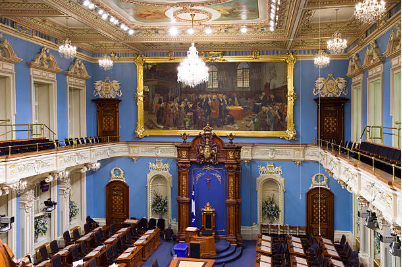
On February 10, 2026, Amnesty International released a statement in opposition to Québec’s Bill 1. You can find the organization’s full statement on their website.
Bill 1, the Quebec Constitution Act, 2025 was tabled by the government of Quebec on 9 October 2025. From a humanist standpoint — one that prioritizes human dignity, individual rights, and inclusive democracy — Quebec’s Bill 1 appears to raise serious concerns. To what extent these concerns might be genuinely problematic for the people of Québec and Canada is not yet clear. With law, it is a very reasonable approach to give serious thought to the potential for unintended consequences before jumping wholly in or wholly out of the bandwagon.
Amnesty International’s objections are championed by Agnès Callamard, global Secretary General of Amnesty International. Callamard is a French (not Québecoise) human rights advocate. According to the OHCRH website, Dr. Agnes Callamard was the UN Special Rapporteur on Extra-Judicial summary or arbitrary Executions from August 2016 to March 2021. She is the Director of Columbia University Global Freedom of Expression. Dr Callamard spent nine years as the Executive Director of ARTICLE 19, the international human rights organization promoting freedom of expression globally. She also founded and led Humanitarian Accountability Partnership (now CHS Alliance), the first international self-regulatory body for humanitarian agencies. Prior to this, she taught and conducted research on international refugee movements for the Center for Refugee Studies at York University in Toronto. She has led human rights investigations in more than 30 countries and published extensively, in both English and French, on human rights, women’s rights, freedom of expression, refugee movements and the methodology of human rights investigation.
Following is condensed bullet list of the organization’s assertions regarding the bill:
- several articles jeopardize the rights of linguistic and cultural minorities and Indigenous Peoples in Québec.
- it lacks any legitimacy as no public consultation of any kind was conducted.
- it contradicts the Universal Declaration of Human Rights, adopted in 1948
- the bill diminishes Québec’s Charter of Human Rights by imposing new limits on it.
- it weakens individual and collective rights by placing them in a hierarchy.
- it denies the rights of Indigenous Peoples and further marginalizes their economic, social and cultural rights.
- It restricts access to justice, creating barriers to defending the rights of the most vulnerable.
- It ignores the procedural requirements that arise from human rights law
- If Bill 1 is adopted and enters into force, not only will Québec be in breach of its international human rights commitments, but it will also place Canada in the same position.
- By including an absolute derogation clause that allows all fundamental rights to be overridden without justification or contextualization, Bill 1 violates international law, which allows for such provisions only in extremely limited circumstances and requires that, for certain specific rights, all such derogations – regardless of the severity of the situation – must be justified on their merits.
- Several provisions of Bill 1 fail to recognize bearers of Indigenous rights and their own representative institutions and contravene Indigenous Peoples’ rights to self-determination, participation and free, prior and informed consent, which are enshrined in international and Canadian law.
- The rights of linguistic and cultural minorities are absent from Bill 1
- Bill 1 includes measures to restrict many organizations’ ability to challenge laws and would place Québec in clear violation of international law by effectively preventing the implementation of the appeals mechanisms required by its instruments.
- No adequate and effective public consultation process was held before tabling Bill 1, therefore the bill is devoid of legitimacy and stands in complete contradiction to international law on civic engagement.
This is a long and not insignificant set of concerns that should be examined by all citizens of Canada, including those in Québec. Humanists in particular should examine these criticisms, determine if they are a valid basis of concern on their own and in application to the language of Bill 1.
There is a long and complicated history in Canada and Québec of inconsistent, if not always completely incompatible, approaches to human rights and secularism. Concerns championed by Dr. Callamard and Amnesty International may have responses or counter-arguments from other legal, secularist, constitutional and human rights experts.
For now, let us present one version of a humanist perspective on Bill 1 informed by both its critics and a preference to avoid potentially significant harmful unintended consequences. A history of seemingly contradictory and implacable perspectives suggests that there may be very significant gaps and blind-spots in each of the entrenched attitudes.
Bill 1 establishes a clear hierarchy between collective and individual rights. If enacted, the Constitution of Québec would enshrine the “intrinsic and inalienable rights” of the francophone majority. This seems to contradict a perspective that human dignity and equality belongs to every person, not just those who fit a dominant cultural identity.
A humanist framework would expect that a constitution would emerge from broad, inclusive public engagement. Yet Bill 1 was introduced with no public consultation between the Proulx-Rousseau Report (November 2024) and its tabling . A legitimate constitution should guarantee fundamental rights and prevent authoritarian tendencies.
Bill 1 would allow the National Assembly to invoke the notwithstanding clause without justification, and would block judicial review of laws framed as protecting the “Quebec nation”. Independent courts are a vital safeguard against majoritarian overreach — removing that check concentrates power dangerously.
We can acknowledge a legitimate desire of Québecers to protect a genuinely distinct language and culture on the North American continent. The tension between cultural preservation and individual rights is real. But the means matter: a constitution that would protect one group by subordinating others would contradict the universalist and progressive core of humanist ethics.
We look forward to learning what Canada’ individual and collective humanists think about Québec’s Bill 1.
AI Disclosure
This article was drafted using a process that included artificial intelligence tools. If you have any stylistic concerns or find any factual errors or omissions, please let us know.
Up For Discussion
If you’re interested in analyzing and discussing this issue, there are actions you can take. First, here at Humanist Heritage Canada (Humanist Freedoms), we are open to receiving your well-written articles.
Second, we encourage you to visit the New Enlightenment Project’s (NEP) Facebook page and discussion group.
Citations, References And Other Reading
- Featured Photo Courtesy of:
- https://amnesty.ca/human-rights-news/amnesty-international-expresses-concern-quebec-bill-1/
- https://cultmtl.com/2026/02/amnesty-international-calls-for-full-withdrawal-of-legaults-constitution-for-violating-laws-human-rights/
- https://www.assnat.qc.ca/fr/travaux-parlementaires/projets-loi/projet-loi-1-43-2.html
- https://www.ohchr.org/en/special-procedures/sr-executions/dr-agnes-callamard-former-special-rapporteur-2016-2021
- https://www.youtube.com/watch?v=LpJcrcLfVrg
The views, opinions and analyses expressed in the articles on Humanist Freedoms are those of the contributor(s) and do not necessarily reflect the views or opinions of the publishers.




 Humanist Heritage Canada