Tag Archives: medicine

The God Effect: Placebo in Religion and Medicine

While we may not be quite synchronized to December’s gift giving “season”, forthcoming title has been brought to our attention that may be just the thing for your on library or a special occasion.

Colin Brewer is a retired psychiatrist and was a lecturer and research fellow in the department of psychiatry at Birmingham university in the 1970s. He was subsequently director of the alcoholism unit at the Westminster hospital before becoming the medical director and later research director of the Stapleford Centre in London. His published scientific papers cover abortion, obesity, suicide, anti-depressants, alcoholic brain damage and behavioural psychotherapy as well as addiction treatment.

Placebo and non-specific effects, which can be very powerful, are a major reason why religions arose and why people believe in gods and feel better after prayers, pilgrimages and religious rituals, as they do after taking objectively inactive medications but they can have most of these benefits without believing in the doctrines or in gods.


Using a mixture of personal case-histories, published research and history, The God Effect describes the many similarities between the benefits regularly claimed for religious ritual and prayer and the benefits claimed for the procedures and rituals of Complementary and Alternative Medicine (CAM). Most people had similar faith in orthodox medicine and its practitioners. They often felt better after treatment, though until about 1920, hardly anything that physicians did had useful effects on the symptoms, course and outcome of most illnesses. Many medicines were toxic as well as ineffective but impressive side effects, like impressive and demanding religious rituals, could persuade people that they were being healed even when diseases progressed. Illnesses with a large psychological component, including many illnesses with a physical basis, are especially susceptible to medical and religious placebo effects.

The God Effect describes modern versions of hysteria and demonic possession and gives previously unpublished case histories of Brewer’s successful use of placebo medicines and sham/placebo ECT (electro-convulsive treatment) at a time when this was not regarded as unethical.

Brewer summarizes modern randomized controlled trials (RCTs) which show that in some conditions, sham surgery has large placebo effects that are just as helpful as the full operation and describe the placebo effects that have been important in fields like war, sport and politics.

Brewer discusses prayers of intercession, miraculous cures and saint-making as a sceptical physician but also in the context of the Vatican’s long history of corruption and exploiting credulity. The God Effect rescues from undeserved obscurity Father Jean Meslier, an early atheist ‘placebo priest’ and introduce his modern equivalents. It examines in detail the psychological processes underlying placebo effects and their similarity with hypnosis.

A friendly critique of the ‘Three Horsemen of Atheism’ (Dawkins, Dennett, Harris) refutes their dismissal or neglect of placebo effects as an important factor in religion and notes a serious error by Stephen Pinker. It suggests that the therapeutic hubris of the founders of psychoanalysis and homoeopathy is as much a reason for rejecting them as negative RCTs.

The God Effect also examines and dismisses the claims of acupuncture but describes a unique study of patients who improved after sham acupuncture and were then debriefed. Other topics include the importance of charisma in healing professions, placebo effects in animals, and a newly-described ‘Katyn Massacre’ syndrome affecting religion and CAM. It offers persuasive evidence that our behaviour is strongly influenced by overt or subliminal reminders of death and mortality and integrate it with philosophical arguments that cheerful pessimism is better for mental health than positive thinking. Starting from the little-known fact that Britain’s first open atheist was a physician, Brewer argues that doctors may find it particularly difficult to believe in a benevolent deity. While Brewer notes the evidence of increasing disbelief among educated European citizens in a caring, personal God, he also recognizes and discusses the attractions and benefits of religious adherence. The experience of Denmark suggests that these benefits are essentially tribal in nature and that many of them can be obtained without belief in God or supernatural doctrines.

The God Effect ends with suggestions for research into using placebo effects deliberately and ethically with the aim of improving treatment outcomes. While it encourages cooperation between medical and religious healers, it emphasizes the need for doctrinaire believers to accept the fundamental human right of individuals to change or leave their religion and to reject belief in a deity.

Details of where (and when) the title may be acquired have not yet reached us…but we’ll update this article when they do.

Up For Discussion

If you’re interested in analyzing and discussing this issue, there are actions you can take. First, here at Humanist Heritage Canada (Humanist Freedoms), we are open to receiving your well-written articles.

Second, we encourage you to visit the New Enlightenment Project’s (NEP) Facebook page and discussion group.

Citations, References And Other Reading

  1. Featured Photo Courtesy of : Colin Brewer
  2. https://www.datathistle.com/event/598247-god-the-greatest-placebo-ever-sold-by-colin-brewer/

By continuing to access, link to, or use this website and/or podcast, you accept the HumanistFreedoms.com and HumanistHeritageCanada.ca Terms of Service in full. If you disagree with the terms of service in whole or in part, you must not use the website, podcast or other material.

The views, opinions and analyses expressed in the articles on Humanist Freedoms are those of the contributor(s) and do not necessarily reflect the views or opinions of the publishers.

Conference: Humanism and Medicine

In our search for interesting, challenging and critical perspectives on contemporary humanism, we occasionally find articles published in other venues that we think humanistfreedoms.com readers may enjoy. The following article was published by The Arnold P. Gold Foundation.


The Canadian Conference on Medical Education (CCME) 2021 will take place from Saturday, April 17-Tuesday April 20, bringing 4 full days of CCME content! Each day will bring you one of our 4 plenary sessions, 4 major sessions, live workshops, asynchronous oral sessions, and constant access to our poster sessions.

The Conference program will feature interactive workshops, pre-recorded oral sessions followed by live Q&As and poster presentations that are grouped into themes. Each theme covers current and emerging issues in medical education, varying from diversity and equity, Covid-19, health & wellness, continuing professional development to faculty development, teaching & learning, curriculum, professionalism, postgraduate affairs and more. With CCME 2021 organized around many different tracks of educational content, attendees will find ample opportunities for learning, networking and collaboration.

Given the current global situation, CCME has chosen to move from an in-person conference to a virtual one. Join the conference from anywhere in the world, from the comfort of your home for an inspirational program and impactful networking opportunities. This year, the conference theme is Making Waves: Exploring the Waters of Medical Education. Register Here


Together with the Association of Faculties of Medicine of Canada (AFMC), the Gold Foundation for Humanistic Healthcare, Canada is pleased to announce the recipient of the 2021 AFMC-Gold Humanism Award and Lecture: Dr. Marie-Ève Goyer, a leader in caring for people with addiction and an exemplar of humanism in healthcare.

Dr. Goyer is a family physician at the new Notre-Dame Hospital in the Addiction and Urban Medicine Department. She is Assistant Medical Chief of Specific Services in Homelessness, Addiction and Mental Health at CIUSSS Centre-Sud-de-l’île-de-Montréal and Scientific Director of the Clinical and Organizational Support Team in Addiction and Homelessness at the Institut universitaire sur les dépendances.

“Dr. Goyer has been an exceptional leader of humanism during the opioid crisis, during an era of surprising difficulty, caring for her patients with both deep empathy and innovative, practical solutions. As a medical educator, she multiples her success by helping illuminate humanistic values for her students,” said Dr. Richard I. Levin, President and CEO of The Arnold P. Gold Foundation. “We are delighted to join with AFMC to honor her contributions.”

Both Dr. Goyer and Dr. Jillian Horton, the 2020 AFMC-Gold Award recipient, will be honored in April at the Canadian Conference on Medical Education award ceremony, and both will be presenting at sessions. (The 2020 CCME conference was cancelled due to the COVID-19 pandemic. Please see the 2020 announcement of Dr. Horton’s award.)

The AFMC Gold Humanism Award and Lecture was created in 2018 by both organizations to emphasize, reinforce and enhance the importance of humanistic qualities among medical school students and faculty. The nominations are open to physicians, nurses and other members of the health care team who practice in Canada or practitioners and researchers in health professions education.

“We are thrilled to honour Dr. Marie-Ève Goyer as this year’s AFMC-Gold Humanism Award winner,” said Dr. Geneviève Moineau, President and CEO of the AFMC. “Dr. Goyer inspires compassion and creates a humanistic learning environment, which motivates students and residents to get involved with underserved populations.”

Dr. Goyer participated in the implementation of the supervised injection services and the PROFAN naloxone program in Montreal and is responsible for the implementation of the first service for the treatment of opioid dependence via injectable medication. She is a clinical assistant professor at the University of Montreal as well as professor for the graduate microprogram in clinical addictology at the University of Sherbrooke. She is a medical advisor to the director of the Ministry of Health for the province of Quebec’s addiction and homelessness services.

She holds a Master’s degree in Community Health from the University of Montreal and the CFPC’s Certificate in Additional Competence in Addiction Medicine.

In his nomination of Dr. Goyer, Dr. Patrick Cossette, Dean, Faculty of Medicine, Université de Montréal, wrote: As evidenced by her patients, Dr. Goyer inspires benevolence and compassion towards fragile populations. Fostering cooperation among many professionals, she knows how to create a humanistic learning environment and motivate current and future physicians to get involved with underserved communities. Community care, adapted access to opioid addiction treatment, and the experience of users facing low-threshold services are examples of her daily work, reflecting a humanistic practice environment.”

Learn more about the AFMC-Gold Award and Lecture, the Gold Foundation, and AFMC.


References and Resources

  1. Featured Image Courtesy of:
  2. https://www.gold-foundation.org/
  3. https://www.gold-foundation.org/newsroom/news/dr-marie-eve-goyer-selected-as-the-2021-afmc-gold-humanism-award-recipient/
  4. https://mededconference.ca/attend/schedule-and-program
  5. https://mededconference.ca/

The views, opinions and analyses expressed in the articles on Humanist Freedoms are those of the contributor(s) and do not necessarily reflect the views or opinions of the publishers.

Stanford Medicine: Fostering Humanism Through PPE

PPE. Personal Protective Equipment. Such a cold and distant term, isn’t it? Due to the current social and regulatory environment stimulated by the ongoing COVID-19 pandemic, this clinical term is rapidly becoming part of routine conversation in non-clinical settings. Are the service providers in your community (retail clerks, travel-industry personnel, bank tellers, automotive mechanics) wearing their PPE? Are you wearing yours?

A rallying-cry for 2020/2021 may well turn out to be something like Mask-Up-For-Health! However, with all of this masking that has been going-on, it may be argued that some essential components of human interaction are being lost. It is comforting to observe that some folks in the healthcare field have begun to consider and act on this possibility.

A team at Stanford Medicine and partnered with The Arnold P. Gold Foundation and Occidental College have asked: How can we foster humanism in medicine, when the use of personal protective equipment (PPE) is required and providers don masks, glasses and gowns to protect their eyes, noses, and mouths from COVID-19?

Now there is an excellent and necessary question.

ppe

Lead: Cati Brown-Johnson, PhD

Team: Mary Beth Heffernan, Paige Parsons, Juliana Baratta, Alexis Amano, Mae Verano, Cynthia Perez

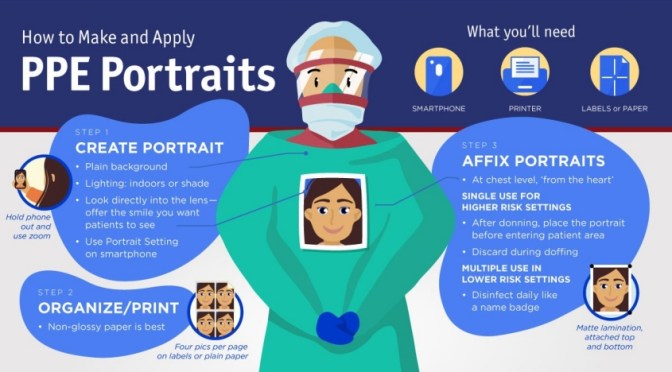
The team states that, “We believe PPE Portraits may support patient care and health, and even healthcare team function and provider wellness.

PPE Portraits are one possible solution: disposable provider portrait picture stickers (4×5) affixed to PPE where patients can see them. Our brief pilot showed signs of interest and adoption: a participating physician requested PPE Portraits at their clinic and masked medical assistant team-members required PPE Portraits to wear over scrubs.

How does it work? The Stanford Medicine team is taking a position that it is not unlike how a placebo works, ” we know that provider warmth and competence are positively associated with health at the biological level. Personal protective equipment (PPE) signals competence; portraits could be one of the only signals of warmth for patients who have, or may have, COVID-19. PPE Portraits are disposable portrait picture stickers (4×5 inches) put on PPE that can help patients and providers form a personal connection to positively impact patient health.

In a Smithsonian article, the project is described as “a way to reintroduce the aesthetic of kindness into patient care“. Fostering humanism is fostering an aesthetic of kindness. No surprise to the humanistfreedoms.com team!

The concept has been with Heffernan since at least 2014, based on an article on hyperallergic.com. Journalist Laura C. Mallonee quoted Heffernan as saying about an ebola epidemic in the news at the time, “Wouldn’t they be less frightening if the person on the inside was pictured on the outside?

A humanist approach could make a pandemic less frightening? No surprise to the humanistfreedoms.com team! Good ideas deserve to be shared.

Health care workers
Photo Courtesy of SmithosianMag.com (reference below)

If you are affiliated-with or aware-of an institution whose clientele may benefit by a PPE portraits launch or by participating in ongoing research, you may wish to consider contacting Cati Brown-Johnson or Mary Beth Heffernan.

If you found this article interesting, you may also wish to see these earlier articles:

  1. Critically Thinking About COVID 19 – Part I
  2. Critically Thinking About COVID 19- Part II
  3. Gold Humanism Society Inducts Class of 2021

Sources, Citations and References

  1. Featured Photo Courtesy of https://med.stanford.edu/pcph/research/ppe-project.html
  2. https://www.smithsonianmag.com/smart-news/health-worker-portraits-buoy-spirits-covid-19-patients-180974681/
  3. https://hyperallergic.com/199732/picturing-the-people-inside-ebola-hazmat-suits/

The views, opinions and analyses expressed in the articles on Humanist Freedoms are those of the contributor(s) and do not necessarily reflect the views or opinions of the publishers.

Gold Humanism Society Inducts Class of 2021

UC faculty, residents and medical students honored for delivery of care, compassion and teaching

The UC College of Medicine’s Gold Humanism Honor Society Chapter, sponsored by the Arnold P. Gold Foundation, will induct the GHHS class of 2021 and present several humanism awards to residents and faculty during a virtual ceremony available online Wednesday, May 20.

Dr. Melissa Klein, professor in the UC Department of Pediatrics and Cincinnati Children’s physician, will be recognized as the Leonard Tow Humanism in Medicine Faculty honoree. Klein will officially be presented the award, which recognizes a College of Medicine faculty member who best demonstrates outstanding compassion in the delivery of care, as well as clinical excellence.

Fourth-year medical student, Caroline Hensley is the recipient of the Leonard Tow Student Award this year.  Dr. Melissa Klein

Dr. Melissa Klein/photo submitted

The purpose of the Gold Humanism Honor Society (GHHS) is to promote a culture of humanism in the practice of medicine by publicly recognizing students, residents, and faculty whose clinical competence and professionalism include exceptional humanistic behavior and commitment to service. 

Each spring, the UC College of Medicine’s chapter of GHHS recognizes those students who at the end of their third year have demonstrated exemplary attitudes and behaviors characteristic of the most humanistic physicians: integrity, excellence, compassion, altruism, respect, empathy, and service.

Twenty-six students will be inducted into GHHS: Sarah Appeadu, Rachel Azriel, Matt Byrne, Saige Camara, Margaret Carney, Thomas Daley, Adam Darwiche, Hagar Elgendy, Olivia Gobble, Caroline Horton, Kristen Humphrey, Basil Jafri, Jun Kim, Shawn Krishnan and Derrick Lin. 

Other inductees will include Sarah Marshall, Katherine Melink, Kevin Milligan, Jasmine Prince, Mia Samaha, Alex Schoenberger, Santiago Serna, Dylan Sexton, Zach St. Clair, Vanessa Wagner and Max Yang.Caroline Hensley

Caroline Hensley/photo submitted

All students were nominated by their peers and faculty as students who best exemplify integrity, compassion, altruism, respect, empathy and a dedication to service. Their awards will be presented by Laura Malosh, assistant dean of student affairs, during the virtual ceremony on Wednesday, May 20.

Finally, the society will recognize two residents with the Arnold P. Gold Humanism Teaching Awards this year. It recognizes outstanding humanistic teaching residents as identified by their students. Third year medical students select residents to receive The Arnold P. Gold Foundation Humanism and Excellence in Teaching Award, based on their exceptional teaching skills and commitment to the compassionate treatment of patients and families, students and colleagues. This year the M3 class recognized Dr. Young King, Department of Surgery and Dr. Megan Sax, Department of Obstetrics and Gynecology.Dr. Megan Sax

Dr. Megan Sax/photo by Colleen Kelley of UC Creative + BrandDr. Young King

Dr. Young Kim/photo by UC Department of Surgery

Original article by Cedric Ricks re-published from University of Cincinnati News