Tag Archives: public funding

A New Campaign to Oppose Ontario’s Public Funding of Religious School Systems

We have received notice that the Society of Freethinkers (SoFree)and it’s lobbying partner, Secular Connexion, based in the Hamilton/Burlington and Elmira areas (respectively), have launched a new campaign to oppose Ontario’s system of public funding of religious school systems.

Here’s what we’ve been told so far:

Secular Connexion Séculière is a national non-profit lobby group that seeks justice for non-believers. Please join The Society of Freethinkers and us in an e-mail campaign directed at Ontario MPPs to change funding for the RC separate school system by distributing the attached email and MPP contact list to your members and friends.

We want to demonstrate the overwhelming support that exists in Ontario for a change to the current funding of Catholic separate schools.  This e-mail sets out the facts about the current system and the savings that would be generated.

It is being sent to Secular Humanist organizations, religious groups, public school teachers’ organizations and others who have expressed support for this change. Our hope is that an inundation of e-mails from various sources, including from non-Catholic religious groups, will convince them that it is time for a change. Ontario is a multi-cultural, multi-ethnic, multi-religious province that differs markedly from the Ontario of 1867.

Please distribute the attached e-mail and and contact list  to members of your organizations and to others who may also support this endeavour.

There are many myths and misconceptions around the current funding of the Catholic school system. The email we are asking people to send presents these facts:

• the current full funding of the Catholic school system is not constitutionally guaranteed. The Constitution grants provinces the right to determine the amount of funding for denominational schools if they funded such school systems prior to joining Confederation. Ontario chose to fully fund Catholic elementary and high schools as did Québec. Quebec changed their school system, in 1997, to one based solely on language, not religion, by merely asking the Federal government to let them stop the funding. Newfoundland and Labrador also changed their school system to eliminate funding of Catholic schools.

• 74%1 of Ontarians are not Roman Catholic, but pay for a system that can legally refuse to hire them as teachers, and can exclude their children from its schools.

 • the municipal taxes of Catholics pay for, at most, 8% of the operating costs of the separate system: the balance is paid out of taxes paid by all Ontarians, be they Catholic, Protestant, Atheist, Jew, Muslim, Hindu, etc.

• Ontario could save over $1.5 billion a year by having one non-denominational public school system

 • parents who send their children to non-Catholic private schools pay tuition fees which are generally not tax deductible, and must also pay their municipal taxes, including the education portion


We need our children to learn what unites them, not what divides them.

Please contact either of us for additional information. Should you wish to see the source documents for the figures cited above, these can be provided.

Thank you for your consideration of our proposal.

Doug Thomas, President, Secular Connexion Séculière,
president@secularconnexion.ca
Isobel Taylor, Vice-President, SOFREE, vicepresident@sofree.ca

Up For Discussion

If you’re interested in analyzing and discussing this issue, there are actions you can take. First, here at Humanist Heritage Canada (Humanist Freedoms), we are open to receiving your well-written articles.

Second, we encourage you to visit the New Enlightenment Project’s (NEP) Facebook page and discussion group.

Citations, References And Other Reading

  1. Featured Photo Courtesy of :
  2. https://sofree.ca/
  3. https://www.secularconnexion.ca/2093-2/

By continuing to access, link to, or use this website and/or podcast, you accept the HumanistFreedoms.com and HumanistHeritageCanada.ca Terms of Service in full. If you disagree with the terms of service in whole or in part, you must not use the website, podcast or other material.

The views, opinions and analyses expressed in the articles on Humanist Freedoms are those of the contributor(s) and do not necessarily reflect the views or opinions of the publishers.
Manitoba’s Bill 40

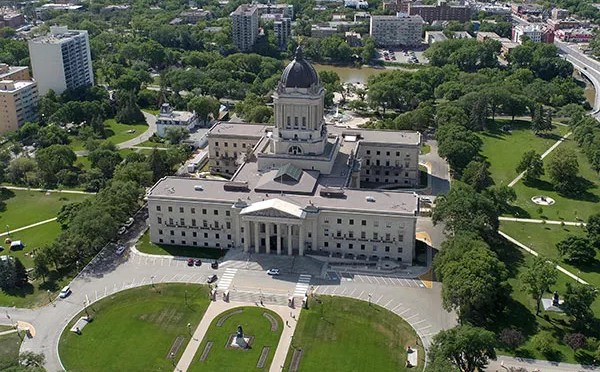
As you may be aware, Humanist Heritage Canada emerged, primarily, from a concern with protecting the freedom of expression in Canada and in support of humanist initiatives to oppose public funding of religion – in schools and other places. It is with these core issues in mind that we note that the current Manitoba government has a bill which may be of tremendous value.

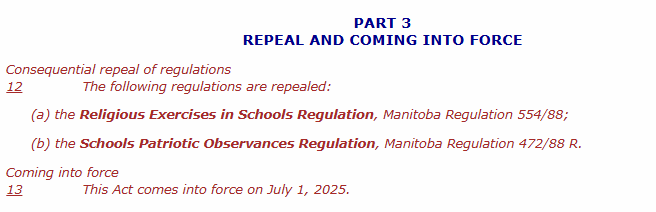
Bill 40 is titled, “AN ACT RESPECTING “O CANADA” AND OTHER OBSERVANCES AND LAND AND TREATY ACKNOWLEDGEMENTS IN SCHOOLS (EDUCATION ADMINISTRATION ACT AND PUBLIC SCHOOLS ACT AMENDED)”. On March 6, 2025, it was at First Reading.

The part that should interest Canadian secularists and humanists says:

Assuming the bill does pass and come into force, this will be a significant advancement for secularization in Canada. As we are not up-to-speed regarding any Manitoba-based humanists or secularists who may have been involved in advocating for the repeal of these regulations, we’ll content ourselves with referring further reading to the recent BC Humanist article, “In 2023, the BC Humanist Association released Religion in Public School Acts, which documented the provinces that still include provisions to permit prayers and Bible studies in schools.

We join BCHA in their encouragement to Manitoba citizens and residents to contact their Member of Legislative Assembly in support of this provision of Bill 40. The bill has other provisions which are not secularist in nature and deserve evaluation on their own merits.

We also encourage those who are interested in humanism and secularism in Manitoba to procure a copy of Elliot Hanowski’s Toward a Godless Dominion: Unbelief in Interwar Canada. We recently acquired and read a copy (a book review is forthcoming) and were greatly pleased with the thorough review of Manitoba’s significant history of humanism and atheism during that period. If you’re looking for insights into Canada’s humanist heritage, this is a treasure.

Up For Discussion

If you’re interested in analyzing and discussing this issue, there are actions you can take. First, here at Humanist Heritage Canada (Humanist Freedoms), we are open to receiving your well-written articles.

Second, we encourage you to visit the New Enlightenment Project’s (NEP) Facebook page and discussion group.

Citations, References And Other Reading

  1. Featured Photo Courtesy of : https://www.mhs.mb.ca/docs/sites/legislativebuilding.shtml
  2. https://www.bchumanist.ca/manitoba_plans_to_scrap_religion_in_public_schools_act
  3. https://www.bchumanist.ca/religion_in_public_school_acts
  4. https://www.canlii.org/en/mb/mbqb/doc/1992/1992canlii8482/1992canlii8482.html
  5. https://web2.gov.mb.ca/bills/43-2/b040e.php
  6. https://www.gov.mb.ca/legislature/business/billstatus.pdf
  7. https://web2.gov.mb.ca/laws/regs/current/554-88.php?lang=en

By continuing to access, link to, or use this website and/or podcast, you accept the HumanistFreedoms.com and HumanistHeritageCanada.ca Terms of Service in full. If you disagree with the terms of service in whole or in part, you must not use the website, podcast or other material.

The views, opinions and analyses expressed in the articles on Humanist Freedoms are those of the contributor(s) and do not necessarily reflect the views or opinions of the publishers.

An Unfulfilled Guarantee: OPEN Update to a Legal Challenge to Public Funding of Catholic Schools in Ontario

Image Courtesy: Wikipedia

In January of 2022, HumanistFreedoms.com reported on a human rights challenge to the Province of Ontario’s public-funding of Catholic schools led by an organizations named One Public Education Now (OPEN). Recently, OPEN has sent us an update on their work.


Two members of OPEN are plaintiffs in a Charter of Rights challenge to the current funding of separate schools in Ontario. The lawsuit states the funding of non-Catholics in separate schools and the funding of Grades 11 and 12 are not protected from Charter challenge and violate the s.15(1) guarantee of equal protection and benefit of the law for all religions and beliefs (including beliefs in no religion).


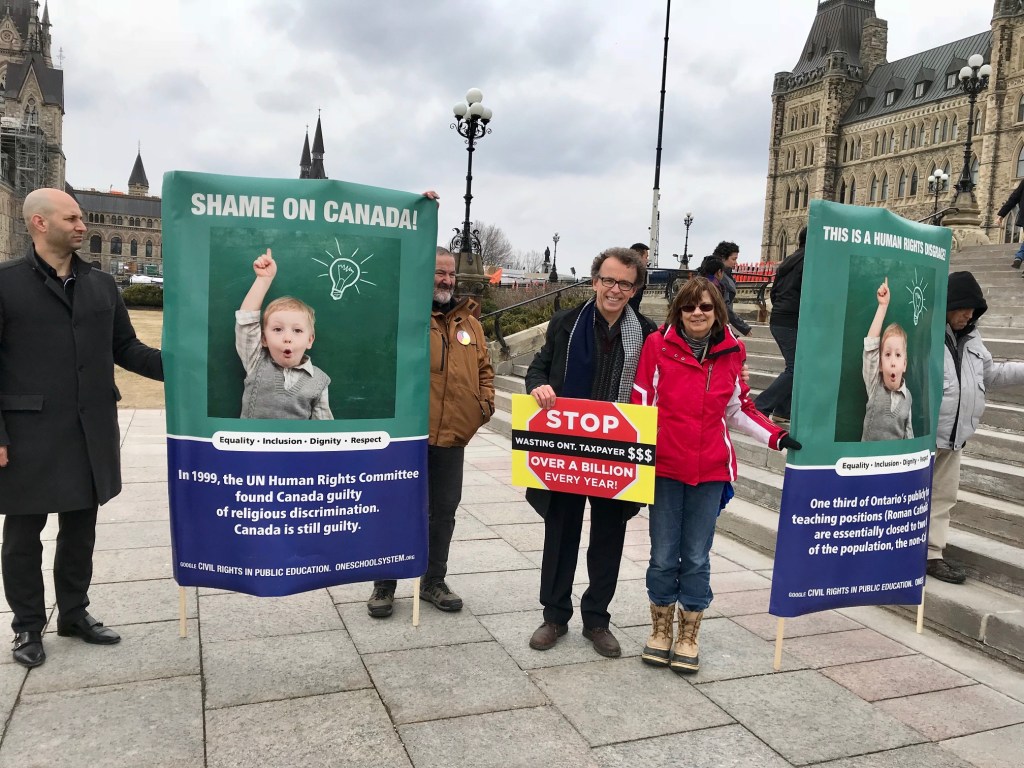
The two plaintiffs are a teacher who cannot obtain a teaching position in one-third of publicly-funded separate schools because she is not Catholic, and a parent whose children must travel an extra 80 minutes per day in order for them to have a non-denominational public education, and not a publicly-funded Catholic education.


The Attorney-General of Ontario has brought a Motion to Dismiss the Application before it even gets to a full hearing. The Motion is scheduled for Friday, November 25, 2022 and we think it will not be successful for various reasons including that the funding of non-Catholics in separate schools has not been ruled on by any court in Ontario. But obviously it means further delay and further expenses. We have already raised over $175,000, but we know we need to raise more. People can find out more on our website, https://open.cripeweb.org/, where they can also donate through secure PayPal or by E-transfer to open@cripeweb.org.

Citations, References And Other Reading

  1. Featured Photo Courtesy ofhttps://www.ontariocourts.ca/scj/about/
  2. https://open.cripeweb.org/aboutOpen.html
  3. http://www.cripeweb.org/home.php
  4. https://humanistfreedoms.com/2022/01/19/human-rights-challenge-to-government-funding-of-catholic-schools-in-ontario/

The views, opinions and analyses expressed in the articles on Humanist Freedoms are those of the contributor(s) and do not necessarily reflect the views or opinions of the publishers.

Elected Office(s) and the Catholic School System in Ontario: A Match Made In…

Image Courtesy: Wikipedia

There’s something about elected office(s) and democracy that doesn’t quite match-up well with religious prerequisites. The concepts are fundamentally opposed. Elected office and democracy puts the leadership selection process in the hands of the people that the system is intended to serve while religious prerequisites place the selection process in the hands of religious authorities, regardless of who may be within that system. That seems fairly obvious doesn’t it?

Canadian media outlets have recently reported the outcome of a legal case wherein an Ontario student sued the York Catholic District School Board after having been barred from running for elected office within the school system. It seems that Dasha Kandaharian, an Orthodox Christian (i.e. not a Roman Catholic), was not allowed to run for student trustee at the high school she attended because of that sectarian difference.

Media stories have referred to the case as a “landmark” – which it undoubtedly is. The decision undoubtedly addresses the situation faced by thousands of non-Catholic students who have attended publicly-funded Catholic schools in the past (clearly, Kandaharian was not he first and only student to be barred from the elected office) – and the thousands more who may do so in the future.

What the media have not (that we can find) spent much time in considering is where the Catholic School Board(s) of Ontario may have gotten this notion that a sectarian religious prerequisite for elected office is an acceptable thing.

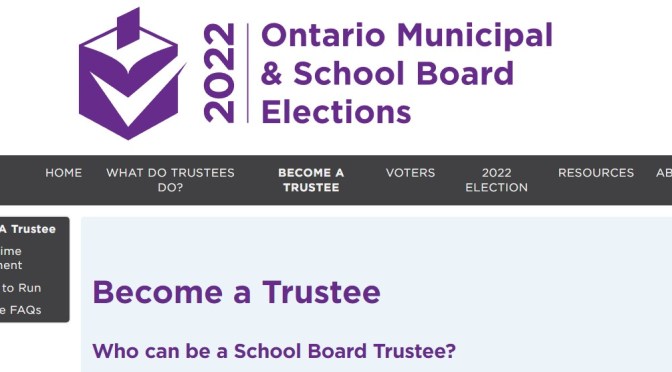
Perhaps a peek at the Ontario Municipal & School Board Elections (2022) webstie might offer some perspective. The “Become A Trustee” page clearly states:

A person is qualified to be elected as a school board trustee if the person is qualified to vote in a school board election and is a resident of the school board district.

When filing a nomination a candidate must meet all of the following requirements:

  • a resident within the jurisdiction of the board;
  • a supporter of the board (“supporter” refers to the individual’s support for one of the four publicly funded school systems. A list of supporters for each system is kept by the Municipal Property Assessment Corporation);
  • a Canadian citizen;
  • at least 18 years old;
  • Roman Catholic (if running for a Catholic school board);
  • not legally prohibited from voting; and
  • not disqualified by any legislation from holding school board office.

Note: A candidate, if nominated, must remain qualified throughout the election and, if elected, throughout the term of office. The term of office is 4 years. School board candidates should confirm that they have the qualifications described here and in section 219 of the Education Act. It is the responsibility of the candidate to determine whether he or she is qualified to be elected to and hold office.

In case you’re interested, Section 219 of the Education Act doesn’t seem to actually bear the qualification that we’ve bolded in the language above. Perhaps the argument is implicit or explicit in some other section of the Act. But for the moment, we can skip over that murky inconsistency and observe that the York Catholic District School Board (and any other publicly funded Catholic School Board) appears merely to have been applying the same criteria to the selection and election of Student Trustees as the Government of Ontario appears to tolerate for the selection and election of School Board Trustees.

Well, this landmark court decision rather brings to question whether what’s good for the goose (students) may also be good for the gander (adult politicians).

So let us consider, in the spirit of taking note of landmarks, an entirely fictional scenario: a hypothetical Secular Humanist who happens to be a (legally defined) ‘supporter’ of the Catholic School system in their area decides that they would like to be Board Trustee of that system. Regardless of how they might fare in an open election – how well do you imagine this hypothetical individual might fare in the qualification screening process?

Here is a separate and perhaps more fundamental question: Can you imagine any other elected office in a 21st-century democratic country named Canada where membership in a religious sect would be accepted as a pre-requisite condition?

And here, in an un-related way, is an observation from our recent Preamble, schmeable article:

Did you notice that the US Supreme Court Judges who turned against Roe v Wade are all Catholic? Well, according to Catholic News Agency, they appear to be. A coincidence, no doubt.

Clearly, religious sectarian membership and elected/selected public office in a contemporary democracy is a match made in….

Citations, References And Other Reading

  1. Featured Photo Courtesy of
  2. https://www.thestar.com/news/gta/2022/10/13/teen-wins-landmark-case-against-york-catholic-school-board-heres-what-it-could-mean-for-others.html
  3. https://www.yorkregion.com/news-story/10741916-teen-wins-landmark-case-against-york-catholic-district-school-board/
  4. https://elections.ontarioschooltrustees.org/BecomeATrustee/

The views, opinions and analyses expressed in the articles on Humanist Freedoms are those of the contributor(s) and do not necessarily reflect the views or opinions of the publishers.

Dr. Richard Thain Versus… “We consider this matter closed.”

On September 20, 2014, the Canadian Museum for Human Rights was opened to the public. Located in the City of Winnipeg, one of the Museum’s guiding principles is to inspire human rights, reflection and dialogue. It is a principle that ought, perhaps, to have been given closer attention when Dr. Richard Thain was advised that his interest to place a series of advertisements on the City of Winnipeg’s buses was rejected.

Dr. Thain had planned to advertise his opposition to the public funding of Catholic school systems in Canada. His idea was to leverage local and national media coverage of the museum’s grand opening to bring attention to his position on this issue. Thain worked with a professional advertising designer to develop a series of simple and elegant bus-ads. The theme of the ads was that the system of public funding for Catholic schools in Ontario is a human rights disgrace. The ads contained no images, words or phrases that could reasonably be considered offensive. The only contained a message that some people might disagree with.

Thain grounded his views with a position taken in 1999 by the United Nations Human Rights Committee when indicating that the provision of funding to Catholic school systems while simultaneously denying it to all other religious groups is discriminatory. Thain hoped to inspire intelligent, reasonable public discourse on this long-standing issue.

Thain contacted Pattison Outdoor Advertising, the firm responsible for the management of the City of Winnipeg’s bus advertising at the time, to gain access to advertising space. During the back-and-forth of price negotiations and content review, he began to understand that that some of the “higher-ups” did not agree with his views and planned to put an end to his campaign. It was then that he received a letter advising that his ads would not appear via the Winnipeg Transit system and that he would not be provided an explanation of why his ads had been blocked. No one from the City of Winnipeg called him as he had requested.

Thain says that he received a letter from the City of Winnipeg’s agent, one of Canada’s most powerful and influential advertising agencies, that contained a five-word sentence which altered his view of human rights in ways that he could not have imagined. The sentence read, “We consider this matter closed.”

No dialogue. No reflection. No right to self-expression.

Thain’s initial shock soon passed and he was struck by the need to confront a deep and worrisome dilemma. What do you when authorities tell you to go away? How do you fight City Hall? Thain decided that the matter was not closed. He decided to sue the City of Winnipeg and Pattison Outdoor Advertising.

In the summer of 2017, Thain procured Winnipeg-based legal counsel, Thompson Dorfman Sweatman LLP to represent him in his response. Thain believes that he has been denied his charter right to freedom of expression. and has launched a legal suit against the City of Winnipeg and Pattison Outdoor Advertising.  The parties in the suite are set for an examination for discovery on January 30 & 31. 2020 – 62 months since the attempted advertising campaign. An examination for discovery process is intended to help all parties in a law suit find out about the other side’s case. Generally the idea is for each party to find out what the other parties have to say about the matters contained in the lawsuit, to see whether there are areas of agreement and to try to obtain admissions which could be used during a trial.

Want to learn more? Reach out to us via our contact page.

Citations, References And Other Reading

  1. Featured Photo Courtesy of Dr. Richard Thain

The views, opinions and analyses expressed in the articles on Humanist Freedoms are those of the contributor(s) and do not necessarily reflect the views or opinions of the publishers.


By continuing to access, link to, or use this website and/or podcast, you accept the HumanistFreedoms.com and HumanistHeritageCanada.ca Terms of Service in full. If you disagree with the terms of service in whole or in part, you must not use the website, podcast or other material.