Tag Archives: religion

Humanist International’s 2024 Freedom of Thought Report

At an event hosted by the American Humanist Association, Humanists International launched the 2024 Key Countries Edition of the Freedom of Thought Report. Introducing the event, Executive Director of the American Humanist Association, Fish Stark, stated:

“For much of human history despots and tyrants have used belief as a weapon to consolidate power and compel conformity, to narrow minds and silence critics, to rob people of the dignity and empowerment of choosing for themselves the sources from which they draw their meaning and their inspiration. […] Attacks on freedom of thought are attacks on universal human rights, attacks on civil liberties, and attacks on the human spirit. It’s our job not to just to be aware of them, not just to investigate them, but to protect our fellow humans from them.”

The 2024 report is the 13th annual report. Humanist Heritage Canada has kept an eye on the HI’s Freedom of Thought report for much of that period, with posts about our observations in 2020 and 2022:

2025’s Key Countries Edition features 10 country entries – including Afghanistan, Italy, Nigeria and Qatar, among others – as well as a powerful piece by Indian filmmaker and poet Leena Manimekalai that gives us insights into her personal battle against ‘blasphemy’ allegations.

Senior Policy Director at Hindus for Human Rights, Ria Chakrabarty, shared the organization’s work to promote democracy, pluralism, and human rights, and challenge caste and supremacy. Reflecting on the impact of Hindu nationalism in India today and the case of Leena Manimekalai, Ria stated:

“If you know anything about the way fundamentalist Hinduism works in India today, everything about Kali is antithetical to the way that they present Hinduism, which is vegetarian, puritanical, misogynistic. It has no place for me and hundreds of millions of Hindus who worship Kali. And that India also has no place for people like Leena who tap into a millennia-old tradition to reimagine Gods and Goddesses in a land where faith and belief are often moulded to people’s unique identities. […]

“Faith as it is practised should be multiple and syncretic. The weaponization of blasphemy (as seen in Leena’s case) seeks to take away all of the pluralism surrounding a faith tradition. […]

“Blasphemy laws are used to identify who is insufficiently religious, religious in the wrong way or not religious at all. And the rights of those that fall into this brackets are curtailed for the sake of purity and oppression.

“Blasphemy laws aren’t just about curtailing the freedom to worship as you see fit, or not worship at all, but are also about curtailing people’s broader freedom of expression. [….] This is one of the many tools used to attack people’s democratic rights.”

Nigerian humanist, Mubarak Bala, shared his reflections on their origins and impact of ‘blasphemy’ laws in Nigeria, sharing details of his case, and the challenges he has faced after coming out as non-religious some 15 years ago.

Speaking at the launch of the report, USCIRF Commissioner Mohamed Elsanousi, stated:

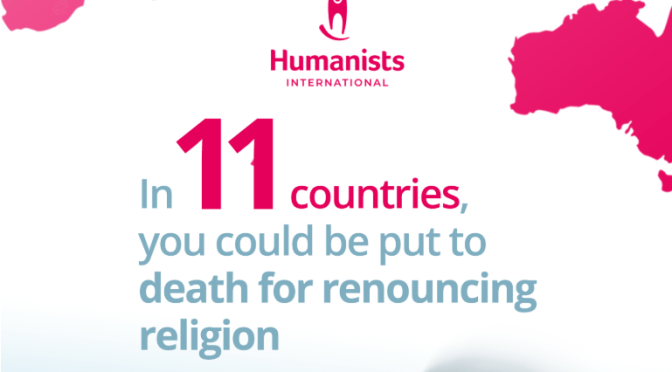
“Unfortunately, governments around the world continue to persecute people because of their religious beliefs or lack thereof. In recent years, USCIRF has been particularly troubled by the passage and enforcement of blasphemy laws, including a 2023 law in Denmark criminalizing ‘inappropriate treatment of a religious text’. Legal penalties around the world include fines, imprisonment as well as the death penalty on some occasions. Blasphemy laws affect people of all religious beliefs. However, members of atheist communities in many countries, especially vulnerable communities including women and LGBTQ+ communities, are at elevated risk given their fundamental disagreement with government-endorsed religious interpretations. […] For humanists, atheists and secular people in oppressive societies these [blasphemy] laws represent a severe restriction on their religious freedom.”

Introducing the Report, Humanists International’s Casework & Campaigns Manager, Emma Wadsworth-Jones, reminded guests that:

“We know from our work supporting humanists at risk across the globe that the fear of being accused of being ‘blasphemous’ or an ‘apostate’ – and the perils that are associated with it, be it ostracism, challenges securing employment, violence or legal prosecution – is one of the primary drivers of self-censorship among our community. For the non-religious, simply saying ‘I don’t believe in God’ can be taken as evidence of ‘blasphemy’. Their very belief system is ‘blasphemous’.”

Being concerned with humanism in Canada, we note that the Canadian entry in the FOTR was last updated in 2023.

Citations, References And Other Reading

  1. Featured Photo Courtesy of https://humanists.international/
  2. https://humanists.international/2025/02/american-humanist-association-hosts-international-launch-of-the-freedom-of-thought-report-2024/
  3. https://humanists.international/2020/06/growing-evidence-of-worsening-persecution-targeting-the-non-religious-around-the-world-new-report-reveals/
  4. https://humanistfreedoms.com/2020/12/18/humanist-internationals-2020-freedom-of-thought-report/
  5. https://www.msn.com/en-us/news/world/us-leaders-gather-to-discuss-rights-of-nonreligious-people-across-the-world/ar-AA156MlE

The views, opinions and analyses expressed in the articles on Humanist Freedoms are those of the contributor(s) and do not necessarily reflect the views or opinions of the publishers.

Black History Month and Humanism

According to the Government of Canada, February is Black History Month and “the 2025 theme for Black History Month is: Black Legacy and Leadership: Celebrating Canadian History and Uplifting Future Generations.” The federal government’s website provides further information regarding the motivation for the official designation as well as an invitation to, “learn more about Black Canadian communities, and how they continue to help shape Canada.” A number of resources and tools are provided to support this invitation -including a timeline of significant events in “Black history in Canada.”

For our part, we decided to investigate whether there may be evidence that “Black history in Canada” and “humanism” overlap in clear and meaningful ways.

Prior to the modern era, the history of Black communities in Canada is closely connected to the global history of slavery. An excellent place to begin learning about this history is Amherstburg Freedom Museum (AFM). The museum was founded in 1975 by residents of Amherstburg, Ontario. It preserves and presents artifacts and tells the story of African-Canadians’ journey and contributions.

According to the AFM , between they years 1800 and 1860, some 50,000 people fled slavery to Amherstburg, now well known for its place in the “Underground Railroad.” The AFM also explains that, “the ‘Underground Railroad’, as it became known, is commemorated at the Amherstburg Museum, so that we may all continue to seek solace and inspiration from what human beings can achieve when they offer an open hand of kindness to those driven by determination.” and, “We will vigorously champion the power of human beings to come together across the dividing lines of our societies. We will openly challenge those who limit the dreams of others through racial, economic, or social oppression. We will work tirelessly to scale and dismantle the barricades that prevent people from building new lives and new futures.” If there are more definitively humanist sentiments linking humanism to Black history in Canada, we look forward to reading them.

Ontario-based inquirers may also wish to use the DestinationOntario.com resource to identify information about (early) Black settlement in Ontario.

The history of humanism in the modern era is irrevocably linked to the advancement of human rights. To pinpoint what “the modern era” means, we look to the creation of the Universal Declaration of Human Rights in 1948. Perhaps more precisely, we look to that document as the beginning of the modern era for humanism and the human rights that humanist principles imply. In this way, we may have an expectation that humanists and the organizations which they create are positively aligned with the promotion of human rights for Black Canadians as individuals and as communities.

This is not quite evidence of what form such an alignment might take. We look forward to receiving and publishing details as they are discovered or are provided to us.

In the meantime, we found a 2020 blog post by Andrew Copson (of Humanists UK) which had some words that resonated with our inquiry and thought it would be worthwhile sharing them here, “Humanists, who care about the building of a more rational and fairer society, should always be ready to combat not just hate and prejudice but the injustice that arises from long standing inequalities. Humanists UK co-organised the first global congress against racism in the UK in 1911 and was a campaigner against colonialism, and its social and intellectual forebears have a good record on opposing slavery and injustice. What we don’t do as often is celebrate the black humanists who have shaped the humanist movement and are part of our modern tradition so here are seven of the best!

We also found a CBC’s Ideas episode titled, Négritude: The birth of Black humanism. Historian Merve Fejzula had presented a talk at the University of Toronto in November 2022 which led to the Ideas episode.

Throughout our publication history, Humanist Heritage Canada (formerly HumanistFreedoms), we have covered stories and issues connected to African and Black humanists, most recently and frequently concerning Mubarak Bala. In the sprit of Copson’s seven best, here are seven of our best posts:

Humanism, which I consider the ideological plank of humanity, reclines on the principles of reason and rationality. To attain a better society where love, humane value, and freedom reign, away from excessive religiosity (not religion), the human agency places the power for individual action in some other forces outside of the self and has brought so much human destruction since many centuries ago.” Toyin Falola 2021

Note: Humanist Heritage Canada will continue to expand this article as additional information is identified.

Up For Discussion

If you’re interested in analyzing and discussing this issue, there are actions you can take. First, here at Humanist Heritage Canada (Humanist Freedoms), we are open to receiving your well-written articles regarding “Black history month in Canada’ and any links to the history of humanism in Canada.

Second, we encourage you to visit the New Enlightenment Project’s (NEP) Facebook page and discussion group.

Citations, References And Other Reading

  1. Featured Photo Courtesy of :
  2. https://www.cbc.ca/radio/ideas/n%C3%A9gritude-movement-black-humanism-1.6771763
  3. https://www.canada.ca/en/canadian-heritage/campaigns/black-history-month.html
  4. https://andrewcopson.com/2020/07/black-humanists-who-have-shaped-the-humanist-movement/
  5. https://bcblackhistory.ca/

By continuing to access, link to, or use this website and/or podcast, you accept the HumanistFreedoms.com and HumanistHeritageCanada.ca Terms of Service in full. If you disagree with the terms of service in whole or in part, you must not use the website, podcast or other material.

The views, opinions and analyses expressed in the articles on Humanist Freedoms are those of the contributor(s) and do not necessarily reflect the views or opinions of the publishers.

February 2025 – Humanist Heritage Canada Update and Call for Submissions

During the latter half of 2023 and most of 2024, we had been less active in sharing humanist news and events than we were from 2020 to 2023 (as HumanistFreedoms.com). We weren’t quite fully hibernated, but we were very sleepy. Now, in 2025, we’ve refocused on our new branding, Humanist Heritage Canada, with plans to document and share the ongoing history of humanism in Canada.

We’ll still be sharing important humanist stories from around the world when they seem to have special insights on how humanism is unfolding in Canada.

We hope that frequent visitors to HumanistHeritageCanada.ca have noticed that we’re developing a timeline of Canada’s humanist heritage. For that endeavor to tell the story of goals, achievements and important events, we are looking for your participation!

Please send us your timeline suggestions, articles, stories, biographies or whatever comes to mind that will flesh-out our timeline of Canada’s humanist heritage.

Please follow our website, share articles with your friends and help us grow.

Up For Discussion

If you’re interested in analyzing and discussing issues from a contemporary humanist position, there are actions you can take. First, here at Humanist Heritage Canada (Humanist Freedoms), we are open to receiving your well-written articles regarding artificial intelligence.

Second, we encourage you to visit the New Enlightenment Project’s (NEP) Facebook page and discussion group.

Citations, References And Other Reading

  1. Featured Photo Courtesy of :

By continuing to access, link to, or use this website and/or podcast, you accept the HumanistFreedoms.com and HumanistHeritageCanada.ca Terms of Service in full. If you disagree with the terms of service in whole or in part, you must not use the website, podcast or other material.

The views, opinions and analyses expressed in the articles on Humanist Freedoms are those of the contributor(s) and do not necessarily reflect the views or opinions of the publishers.

Mubarak Bala 2025

According to Legit and The Cable Mubarak Bala has been freed, “Initially sentenced to 24 years in 2022, Bala’s term was reduced following an appellate court decision deeming it excessive“.

According to a BBC report on Tuesday, Bala is being housed in a secure location due to alleged threats of harm against him.

The freedom is here but also, there is an underlying threat that I will now have to face, probably all those years those threats are maybe out there while I was under the security system. The concern about my safety is always there,” Bala said.

When asked about his guilty plea in 2022, Bala said his motivation was to protect himself and others connected to the situation.

I believe that what I did then was saving not only my life but people in the state and especially those that were attached to my case, because they were also targets,” he said.


On August 9, 2020, HumanistFreedoms.com published our first article about Mubarak Bala. At that time, we featured Wole Soyinka’s all-too-prophetic condemnation of the Nigerian government’s treatment of Bala:

When I accepted the International Humanist Award at the World Humanist Congress in 2014, I spoke of the conflict between Humanists and Religionists; one of enlightenment versus the chains of enslavement. Your arbitrary incommunicado detention over the last 100 days is the cruel reality of this conflict. All too often these chains of enslavement lead directly to the gallows or a prison cell.

On April 5, 2022 – the Kano High State Court sentence Bala to 24 years imprisonment following a guilty plea to 18 charges blasphemy and public incitement. As the president of the Humanist Association of Nigeria, Mubarak Bala is a prisoner of religious tyranny.

BBC Africa has recently published a documentary titled “The Cost of Being an Atheist” which carries a terrible reminder of just how correct Wole Soyinka’s words were. Too often and far too readily, tyrants curtail free speech with arbitrary actions which lead to prison cells and worse.

Mubarak Bala is a chemical process engineer. A husband. A father. He and his family deserve better than this. They don’t just deserve better – they had a fundamental right to better.

And so does every living person, regardless of the country they live in or the beliefs or non-beliefs that they may have. That’s why the freedom of thought, freedom of expression and freedom of religion (including freedom from religion) are called Fundamental Freedoms.

Citations and References

  1. https://humanists.international/2020/08/wole-soyinka-sends-message-of-solidarity-to-mubarak-bala/
  2. https://www.theguardian.com/books/2020/aug/06/wole-soyinka-protests-imprisonment-of-nigerian-humanist-mubarak-bala
  3. https://freemubarakbala.org/
  4. https://en.wikipedia.org/wiki/Wole_Soyinka
  5. https://www.legit.ng/nigeria/1634435-muslim-man-turned-atheist-arrested-blasphemy-finally-regained-freedom-speaks/
  6. https://www.thecable.ng/my-life-is-still-at-risk-mubarak-bala-speaks-after-release-from-jail-for-blasphemy/

The views, opinions and analyses expressed in the articles on Humanist Freedoms are those of the contributor(s) and do not necessarily reflect the views or opinions of the publishers.

Featured Photo Courtesy of Humanists International