Tag Archives: science

A New Campaign to Oppose Ontario’s Public Funding of Religious School Systems

We have received notice that the Society of Freethinkers (SoFree)and it’s lobbying partner, Secular Connexion, based in the Hamilton/Burlington and Elmira areas (respectively), have launched a new campaign to oppose Ontario’s system of public funding of religious school systems.

Here’s what we’ve been told so far:

Secular Connexion Séculière is a national non-profit lobby group that seeks justice for non-believers. Please join The Society of Freethinkers and us in an e-mail campaign directed at Ontario MPPs to change funding for the RC separate school system by distributing the attached email and MPP contact list to your members and friends.

We want to demonstrate the overwhelming support that exists in Ontario for a change to the current funding of Catholic separate schools.  This e-mail sets out the facts about the current system and the savings that would be generated.

It is being sent to Secular Humanist organizations, religious groups, public school teachers’ organizations and others who have expressed support for this change. Our hope is that an inundation of e-mails from various sources, including from non-Catholic religious groups, will convince them that it is time for a change. Ontario is a multi-cultural, multi-ethnic, multi-religious province that differs markedly from the Ontario of 1867.

Please distribute the attached e-mail and and contact list  to members of your organizations and to others who may also support this endeavour.

There are many myths and misconceptions around the current funding of the Catholic school system. The email we are asking people to send presents these facts:

• the current full funding of the Catholic school system is not constitutionally guaranteed. The Constitution grants provinces the right to determine the amount of funding for denominational schools if they funded such school systems prior to joining Confederation. Ontario chose to fully fund Catholic elementary and high schools as did Québec. Quebec changed their school system, in 1997, to one based solely on language, not religion, by merely asking the Federal government to let them stop the funding. Newfoundland and Labrador also changed their school system to eliminate funding of Catholic schools.

• 74%1 of Ontarians are not Roman Catholic, but pay for a system that can legally refuse to hire them as teachers, and can exclude their children from its schools.

 • the municipal taxes of Catholics pay for, at most, 8% of the operating costs of the separate system: the balance is paid out of taxes paid by all Ontarians, be they Catholic, Protestant, Atheist, Jew, Muslim, Hindu, etc.

• Ontario could save over $1.5 billion a year by having one non-denominational public school system

 • parents who send their children to non-Catholic private schools pay tuition fees which are generally not tax deductible, and must also pay their municipal taxes, including the education portion


We need our children to learn what unites them, not what divides them.

Please contact either of us for additional information. Should you wish to see the source documents for the figures cited above, these can be provided.

Thank you for your consideration of our proposal.

Doug Thomas, President, Secular Connexion Séculière,
president@secularconnexion.ca
Isobel Taylor, Vice-President, SOFREE, vicepresident@sofree.ca

Up For Discussion

If you’re interested in analyzing and discussing this issue, there are actions you can take. First, here at Humanist Heritage Canada (Humanist Freedoms), we are open to receiving your well-written articles.

Second, we encourage you to visit the New Enlightenment Project’s (NEP) Facebook page and discussion group.

Citations, References And Other Reading

  1. Featured Photo Courtesy of :
  2. https://sofree.ca/
  3. https://www.secularconnexion.ca/2093-2/

By continuing to access, link to, or use this website and/or podcast, you accept the HumanistFreedoms.com and HumanistHeritageCanada.ca Terms of Service in full. If you disagree with the terms of service in whole or in part, you must not use the website, podcast or other material.

The views, opinions and analyses expressed in the articles on Humanist Freedoms are those of the contributor(s) and do not necessarily reflect the views or opinions of the publishers.


Manitoba’s Bill 40

As you may be aware, Humanist Heritage Canada emerged, primarily, from a concern with protecting the freedom of expression in Canada and in support of humanist initiatives to oppose public funding of religion – in schools and other places. It is with these core issues in mind that we note that the current Manitoba government has a bill which may be of tremendous value.

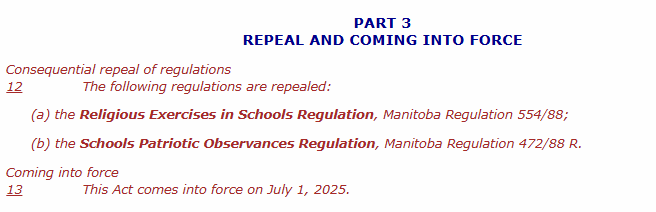
Bill 40 is titled, “AN ACT RESPECTING “O CANADA” AND OTHER OBSERVANCES AND LAND AND TREATY ACKNOWLEDGEMENTS IN SCHOOLS (EDUCATION ADMINISTRATION ACT AND PUBLIC SCHOOLS ACT AMENDED)”. On March 6, 2025, it was at First Reading.

The part that should interest Canadian secularists and humanists says:

Assuming the bill does pass and come into force, this will be a significant advancement for secularization in Canada. As we are not up-to-speed regarding any Manitoba-based humanists or secularists who may have been involved in advocating for the repeal of these regulations, we’ll content ourselves with referring further reading to the recent BC Humanist article, “In 2023, the BC Humanist Association released Religion in Public School Acts, which documented the provinces that still include provisions to permit prayers and Bible studies in schools.

We join BCHA in their encouragement to Manitoba citizens and residents to contact their Member of Legislative Assembly in support of this provision of Bill 40. The bill has other provisions which are not secularist in nature and deserve evaluation on their own merits.

We also encourage those who are interested in humanism and secularism in Manitoba to procure a copy of Elliot Hanowski’s Toward a Godless Dominion: Unbelief in Interwar Canada. We recently acquired and read a copy (a book review is forthcoming) and were greatly pleased with the thorough review of Manitoba’s significant history of humanism and atheism during that period. If you’re looking for insights into Canada’s humanist heritage, this is a treasure.

Up For Discussion

If you’re interested in analyzing and discussing this issue, there are actions you can take. First, here at Humanist Heritage Canada (Humanist Freedoms), we are open to receiving your well-written articles.

Second, we encourage you to visit the New Enlightenment Project’s (NEP) Facebook page and discussion group.

Citations, References And Other Reading

  1. Featured Photo Courtesy of : https://www.mhs.mb.ca/docs/sites/legislativebuilding.shtml
  2. https://www.bchumanist.ca/manitoba_plans_to_scrap_religion_in_public_schools_act
  3. https://www.bchumanist.ca/religion_in_public_school_acts
  4. https://www.canlii.org/en/mb/mbqb/doc/1992/1992canlii8482/1992canlii8482.html
  5. https://web2.gov.mb.ca/bills/43-2/b040e.php
  6. https://www.gov.mb.ca/legislature/business/billstatus.pdf
  7. https://web2.gov.mb.ca/laws/regs/current/554-88.php?lang=en

By continuing to access, link to, or use this website and/or podcast, you accept the HumanistFreedoms.com and HumanistHeritageCanada.ca Terms of Service in full. If you disagree with the terms of service in whole or in part, you must not use the website, podcast or other material.

The views, opinions and analyses expressed in the articles on Humanist Freedoms are those of the contributor(s) and do not necessarily reflect the views or opinions of the publishers.
Centre For Inquiry Canada’s Annual Report 2024

Each year, formally organized entities must make available an annual report of their prior year’s activity. In Canada, there are a relatively small number of organization that thar obligated to provide such a report.

Humanist Heritage Canada is not required to publish an annual report because we are not a public organization. However, we maintain an interest in documenting the activity of Canada’s humanist communities.

Centre For Inquiry Canada was founded in Toronto in 2009 and rapidly became one of Canada’s leading secular/humanist organizations. The organizations 2024 report was released via the CFIC website on March 9, 2025.

CFIC’s lead claim for the year appears to be that, “GLOBALLY AND ACROSS CANADA SECULARISM, SCIENCE AND HUMAN RIGHTS HAVE BEEN… UNDER ATTACK.” (all caps courtesy of CFIC). The report provide some description of how it has responded to the situation.

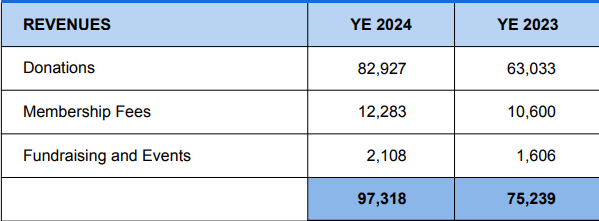
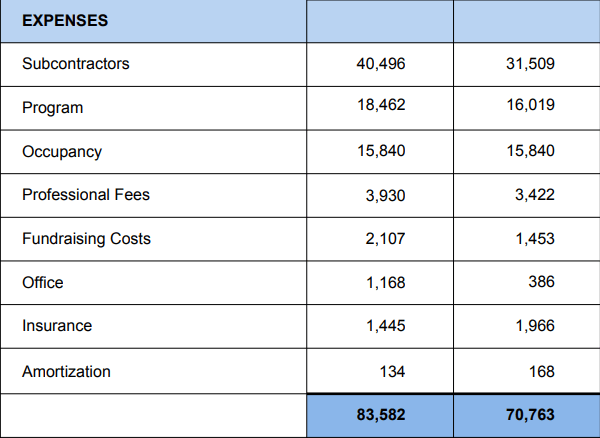
In addition to providing an annual report, CFIC makes available a statement of its financial position. This is a part of the organization’s responsibility as a registered charity. This information helps to reveal information about the organization’s scope and active membership.

Given that CFIC’s membership fees are $45 (individual) and $60 (family), we can determine that CFIC reported a membership of approximately 205-275 people for the year. The annual donation figures provide a much less precise measure of the organization’s scope as these revenues are typically skewed by a small number of large donors. In CFIC’s first years of operations, a single family foundation provided the primary sustenance of the organization.

Of some reasonable concern is the distribution of the organization’s expenses as some 41.7% of the organization’s revenues appears to have been sent to “subcontractors”. The annual report does not make clear what the subcontractors did for the organization. Given that this line is the single largest in value for the organizations’ report and that it is more than double the “program” expenses, some additional transparency may be appropriate to explain what the expenses represent.

In a 2008 article, Mark Blumberg posted an article regarding the use of funds by charities, “Some people use the 80/20 rule because the Canadian disbursement quota (DQ) requires charities in most cases to spend 80% of the amount receipted by the charity in the previous year on charitable activities in the following year.  The 80/20 rule is very misleading in terms of overhead as many charities receipt little of their donations and therefore can legally spend much less than 80% of their revenue in the previous year on the subsequent year’s activities and still be compliant with the disbursement quota.  In fact, many charities could take in a lot, and spend nothing, and still be compliant with their disbursement quota obligations.”

Blumberg goes on cite Canada Revenue Agency guidance to assessing the activity of charitable organizations:

“The CRA has come up with a grid for evaluating fundraising expenses based on the percentage of “fundraising costs” to “fundraising revenue”.  The evaluation grid provides:

Ratio of fundraising cost/fundraising revenue in fiscal period

  • Rarely acceptable: more than 70% (charity nets less than 30%)
  • Generally not acceptable: 50% to 70% (charity nets 30% to 50%)
  • Potentially not acceptable: 35.1% to 49.9% (charity nets 50.1% to 64.9%)
  • Generally acceptable: 20% to 35% (charity nets 65% to 80%)
  • Acceptable: less than 20% (charity nets more than 80%)”

Given CFIC’s activity expressing concern regarding the “cost of religion in Canada’ which includes an examination of financial indicators of faith-based charities in Canada, it seems appropriate that CFIC’s financial report receive at least some public, independent third-party scrutiny.

Up For Discussion

If you’re interested in analyzing and discussing this issue, there are actions you can take. First, here at Humanist Heritage Canada (Humanist Freedoms), we are open to receiving your well-written articles.

Second, we encourage you to visit the New Enlightenment Project’s (NEP) Facebook page and discussion group.

Citations, References And Other Reading

  1. Featured Photo Courtesy of :
  2. https://www.canada.ca/en/revenue-agency/services/charities-giving/charities/operating-a-registered-charity/annual-spending-requirement-disbursement-quota/disbursement-quota-calculation.html
  3. https://centreforinquiry.ca/become-a-member-of-cfic/
  4. https://www.canadiancharitylaw.ca/blog/how_much_should_canadian_charity_spend_on_overhead/
  5. https://centreforinquiry.ca/wp-content/uploads/2021/04/CoR-charitable-tax-receipting-revised-may-6.pdf

By continuing to access, link to, or use this website and/or podcast, you accept the HumanistFreedoms.com and HumanistHeritageCanada.ca Terms of Service in full. If you disagree with the terms of service in whole or in part, you must not use the website, podcast or other material.

The views, opinions and analyses expressed in the articles on Humanist Freedoms are those of the contributor(s) and do not necessarily reflect the views or opinions of the publishers.

Majority of Canadians Choose Evolution in a Researchco.ca Poll

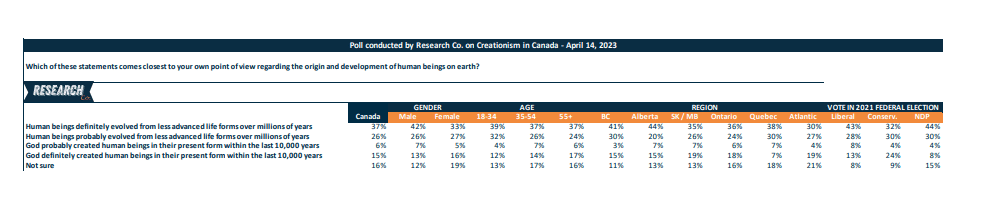
More than three-in-five  Canadians side with evolution when asked about the origin and development of human beings on earth, a new Research Co. poll has found.

In the online survey of a representative national sample, 63% of Canadians think human beings evolved from less advanced life forms over millions of years, down two points since a similar Research Co. poll conducted in March 2022.

Just over one-in-five Canadians (21%, +3) believe God created human beings in their present form within the last 10,000 years, while 16% (-2) are not sure.

Canadians aged 18-to-34 are more likely to endorse evolution (71%) than their counterparts aged 35-to-54 (63%) and aged 55 and over (61%).

More than a quarter of Canadians who voted for the Conservative Party in the 2021 federal election (28%) think God created human beings in their present form within the last 10,000 years. Fewer Canadians who cast a ballot for the Liberal Party (21%) or the New Democratic Party (NDP) (12%) feel the same way.

Consensus is not as clear when Canadians ponder whether creationism—the belief that the universe and life originated from specific acts of divine creation—should be part of the school curriculum in their province.

This year, 43% of Canadians (+5) believe there is a place for creationism in the classroom, while 38% (-4) disagree and 19% (-2) are undecided.

“Over the past three years, the numbers have fluctuated wildly on the question of discussing creationism at school,” says Mario Canseco, President of Research Co. “Support peaked at 44% in 2021, fell to 38% in 2022, and has now jumped to 43% in 2023.”

Just under half of Ontarians (47%, +3) and Atlantic Canadians (46%, +15) are in favor of teaching creationism in schools. The proportions are lower in Saskatchewan and Manitoba (41%, +4), Alberta (40%, +9) and British Columbia (39%, +11).

Methodology: Results are based on an online study conducted from April 7 to April 9, 2023, among 1,000 adults in Canada. The data has been statistically weighted according to Canadian census figures for age, gender and region. The margin of error, which measures sample variability, is +/- 3.1 percentage points, nineteen times out of twenty.

Find the data tables here.

Citations, References And Other Reading

  1. Featured Photo Courtesy of : https://chrishart.com/so-what-really-is-evolution/
  2. https://researchco.ca/2023/04/14/evolution-2023/

The views, opinions and analyses expressed in the articles on Humanist Freedoms are those of the contributor(s) and do not necessarily reflect the views or opinions of the publishers.
By continuing to access, link to, or use this website and/or podcast, you accept the HumanistFreedoms.com and HumanistHeritageCanada.ca Terms of Service in full. If you disagree with the terms of service in whole or in part, you must not use the website, podcast or other material.

Humanists UK’s New President

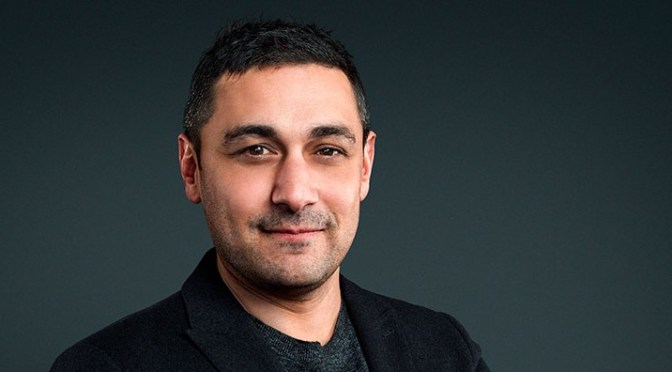
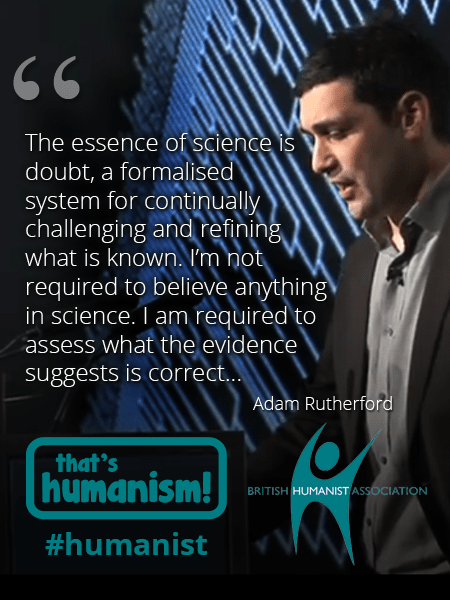
Humanists UK is delighted to announce that acclaimed geneticist, science writer, broadcaster, and humanist Adam Rutherford will be its next President. He will succeed current President Alice Roberts in June 2022 who, like her predecessors as President, will become a Vice President of Humanists UK.

Adam has been a high-profile ambassador and patron of Humanists UK for many years, especially as an advocate for robust science education and against religious discrimination in state faith schools. As President, Adam has pledged to spearhead both those campaigns, as well as Humanists UK’s campaign for assisted dying. He will also continue Humanists UK’s work of connecting the millions of non-religious people in the UK who strongly hold to values of rational thinking, kindness, and empathy – the humanist approach to life.

According to YouGov research, over 17 million people in the UK hold humanist beliefs and values, with 5 million primarily calling themselves ‘humanists’. Around 34 million people – half the population of the UK – identify as ‘non-religious’.

Adam continues to use his platform and his insights as a geneticist to challenge racism and to promote humanist values. He delivered Humanists UK’s 2019 Voltaire Lecture, How to argue with a racist, which became the basis for his 2020 bestselling book of the same name. The lecture, and indeed, much of Adam’s work, challenged false claims from religion, pseudoscience, and simple prejudice, emphasising instead our common humanity and our capacity to build a better society. This is also the subject of his latest book, Control: The Dark History and Troubling Present of Eugenics.

Accepting the appointment, Adam Rutherford said:

‘As a geneticist, I believe strongly in our shared humanity and how, through science and the humanist values of logic, reason, and evidence, we can overcome divisions and create a society where everyone is treated equally.

Surveys show that most people in the UK are non-religious, and about a quarter hold humanist beliefs and values. Humanists can be found in so many walks of life and, by working together, there is so much we can do to help promote a better, fairer society.

I am deeply honoured to become the next President of Humanists UK and to be part of this community of like-minded, thoughtful, and compassionate people striving for positive social change.’

Adam also paid tribute to his predecessor Alice Roberts, saying:

‘Alice has done an amazing job at advancing the causes of and promoting humanism to a wider audience. She’s a hard act to follow, but it’s an honour to do so.’

Welcoming the appointment, Humanists UK Chief Executive Andrew Copson said:

‘Throughout his career Adam has used his platform as a geneticist and science communicator to challenge falsehood and prejudice in the interests of building a better society.

At a time of increased uncertainty, and when our work in bringing non-religious people together is more important than ever, we are delighted to welcome such an experienced communicator with a passion for promoting humanist values.’

Outgoing President Professor Alice Roberts commented:

‘Since 2019, I’ve been honoured to serve as President of Humanists UK and help to bring attention to our amazing work – from our ceremonies for non-religious people and the support we offer to the vulnerable in hospitals and prisons, through to our important campaigns for freedom of thought, choice, and expression. Adam is a brilliant scientist and communicator who I know will do a fantastic job promoting the values of humanism.’

Citations, References And Other Reading

  1. Featured Photo Courtesy of
  2. https://humanists.uk/2022/03/05/adam-rutherford-named-next-president-of-humanists-uk/

The views, opinions and analyses expressed in the articles on Humanist Freedoms are those of the contributor(s) and do not necessarily reflect the views or opinions of the publishers.
On Consciousness: A Probe into the Boundaries of Science (ONLINE EVENT)

May 13, 2021 19:30 EDT

What is consciousness? Is this even a sensible question to ask? Join us for a fascinating evening of discovery into scientific inquiry, where neuroscience meets ethical philosophy.

Leonard Maler | Brain and Mind Research Institute ...

Leonard Maler, Neuroscientist and Distinguished Professor at Ottawa University’s Department of Cellular and Molecular Medicine will introduce us to interesting new concepts in consciousness that open a doorway into new issues, perspectives and approaches. Arising out of recent discoveries on the neural bases of consciousness and on extensive discussions with colleague, University of Ottawa Philosophy Professor, Vincent Bergeron, the limits of “access” consciousness encounter philosophical ideas on “phenomenal” consciousness and their ethical implications.

Humanist Ottawa is a volunteer-run association, serving the Ottawa community since its founding in 1968. Our vision is a world where reason and compassion guide public policy and social values to enable the fulfillment of human potential.

May 13, 2021 19:30 EDT

Register in advance for this meeting:
https://us02web.zoom.us/meeting/register/tZMtcO6vqD4sH9HTfM4UhXxrH4sZ6X3PYUjD

After registering, you will receive a confirmation email containing information about joining the meeting.


The views, opinions and analyses expressed in the articles on Humanist Freedoms are those of the contributor(s) and do not necessarily reflect the views or opinions of the publishers.