A fable is a story that imbues animals and imaginary creatures, along with any manner of natural or supernatural forces, with human-like traits to convey any part of its plot, meaning or narrative. It seems that fables have been a staple of human storytelling for as long as humans have had stories to tell. Even the oldest documented story currently know, The Epic of Gilgamesh, contains elements of fable carved into tablets.
Given this fundamental position of fable in human culture, it should be no surprise, that fable retains a key role in contemporary story-telling. Human connection, whether individual or collective, to the natural world is too vital for fable to ever be completely banished. Fable may be considered as humanism over-lain on the natural world.
We do tend to used fable where it seems to have proven highly effective: story-telling to convey a moralistic message. Often that means children’s stories, but fable is certainly not exclusively for children.
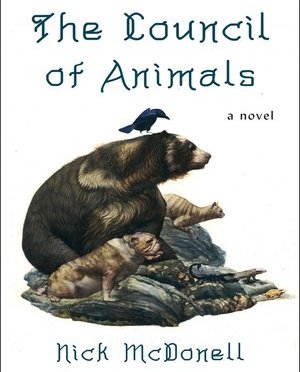
The Council of Animals, by Nick McDonell was published early in 2021 and is a contemporary fable. The storytelling is not particularly innovative nor is the story itself novel and compelling. At the beginning of the story, a council of animals is gathering to decide the fate of humanity – will the animals decide to exterminate the last of humanity or leave them to live out their lives in peace?
In reading the story, other fables readily come to mind and it seems only marginally necessary to state their titles. Pick the first five fables that come to mind and you’ve probably stitched together much of the plot and much of the narrative style. Mentioning McDonell’s willingness as an author to mug for the camera via animal-themed puns and set-pieces and that might be the end of it. It’s almost unworthy of a book review.
Except that the book feels as though its original intent, a story where Kingdom Animalia renders judgment on humanity, had been leant a new direction when the global pandemic came to town. Over the course of the story, it is revealed that some unspecified pandemic had struck down humanity’s population and provided animals (and some mythological creatures) the opportunity to finally gather their collective strength and dominance to be able to decide what to do with the stragglers that had survived.
The efficacy of fables is not their reality. The efficacy is in their ability to convey a moralistic meaning. McDonell’s novel expresses existential concern regarding humanity’s relationship to nature and existential panic in the face of pandemic. Whether that should be considered to be moralized fear-mongering, naive hand-wringing or something else entirely may be up to the reader.
Whether the book is viewed as any of these things should not preclude recognizing that the matter of the book’s panic (a human-created pandemic that threatens to end humanity) is the smaller consideration compared to the book’s concern ( humanity’s relationship to nature).
The book does not seem to be a book of humanism, however it is a book which offers a reminder that contemporary humanists, or perhaps more accurately, contemporary human societies whether they’re humanist or not, currently have the significant challenge to set aside human-centered existential crises in order to address the larger and more significant concern of this planet’s capacity to support life in any form at all. We need a new and vigorous Biophilic Humanism – a humanism, and a humanity, that places its interest in itself within the sustaining interests of the natural world we inhabit.
The moral of the story, when it comes to reading The Council of Animals, is that the time for fables, this over-laying of human priorities and characteristics onto nature, seems to be reaching its limits. Now is the time for laying of nature’s needs and priorities over human character.
The views, opinions and analyses expressed in the articles on Humanist Freedoms are those of the contributor(s) and do not necessarily reflect the views or opinions of the publishers.
2020 was HumanistFreedoms.com’s first full year of operation. We enjoyed publishing articles promoting and celebrating humanism and our common humanity. We thank our contributors, readers and visitors for making http://www.humanistfreedoms.com a unique online magazine.
Please follow our website, share articles with your friends and help us grow. At the end of February, we had reached half of the views we had for all of 2020! As the month of July comes to an end, we’ve surpassed our total views from last year!
Now for 2021 we are looking for even more essays, articles and stories to share! We are not able to pay for articles (yet) but we want to hear what you have to say. This month, themes that we want to explore include:
Contemporary Humanism’s Biggest Priorities and Challenges for 2021
Leadership Within The Humanist Movement
Humanism and Secularism
Humanism and Human Trafficking
Digital Humanism
Humanism and Global Population
A Humanist Perspective of Radical Politics
Humanist Photography: Photographer Review
Humanism in the Arts
Humanism Behind the Mask: Maintaining Respect and Compassion During the Pandemic
Humanism and the Environment
Humanism and Freedom of Expression: Lessons From 2020
Humanism and Freedom of/from Religion: Global Lessons
Humanism and Architecture
Book/Movie/Music/Arts Review: A Humanist Recommends….
Do you have an idea that isn’t on our list? Let us know. Inquire at humanistfreedoms@gmail.com
In 1995, Christopher Hitchens published The Missionary Position: Mother Theresa in Theory and Practice. Both then and now, Hitchens’ investigative journalism (and let’s be honest, polemics) earn him life-size portions of love and hate. But Hitchens was well aware that going after one of the twentieth century’s most iconic and celebrated figures of religious propagation would not result in anonymity.
Twenty-first century humanists owe much to Hitchens’ willingness – or perhaps more accurately, energetic eagerness! – not only to publish the results of his inquiries, his insights and his opinions but also to engage with the often passionate and outraged responses.
Consider the popular new podcast, The Turning: The Sisters Who Left which currently has ten episodes available via iHeartRadio and other podcast providers. It hardly seems at all likely that this podcast would be available and popularly received, if not for the earlier work of Hitchens.
The folks responsible for producing the podcast have indicated that it is “inspired by Mary Johnson’s memoir, An Unquenchable Thirst. Weaving poignant, sometimes startling stories with a gorgeous soundscape, host Erika Lantz of Rococo Punch interviews Mary and several other former Missionaries of Charity.”
Meanwhile, on Mary Johnson’s website, we learned that “Mary Johnson is the author of An Unquenchable Thirst, named one of 2011’s best nonfiction books by Kirkus Reviews and awarded the New Hampshire Literary Award for Outstanding Work of Nonfiction. After spending 20 years as a nun with the Sisters of Mother Teresa of Calcutta, she completed an MFA in Creative Writing at Goddard College and helped found A Room of Her Own Foundation. She married. Mary now considers herself a secular Humanist .As a Humanist Celebrant, Mary creates unique ceremonies for weddings, funerals, and other rites of passage, and has twice been voted New Hampshire’s top wedding officiant….Mary continues to find the world a marvelous place and tries her best to treat others well. She continues to invest in community, knowing that respectful, affectionate bonds formed among human beings are among life’s most precious gifts, whether in churches, mosques, gyms or bars, schools or shops, or synagogues. “
The Turning, An Unquenchable Thirst and The Missionary Position are each deserving of recognition for their own type of courage and their own humanist character, inevitably linked to their times and social conditions. In ten or twenty years, there will be humanists who will be able to say, Thank you Christopher Hitchens. Thank you Mary Johnson.”
The views, opinions and analyses expressed in the articles on Humanist Freedoms are those of the contributor(s) and do not necessarily reflect the views or opinions of the publishers.
It isn’t often that HumanistFreedoms.com expects to feature a job opening for a major architectural firm. We don’t even have a classifieds section! But we’ve come across something that we couldn’t overlook. According to Archinect, Selldorf Architects is searching for an Advanced Architectural Designer and a Project Architect. Not ready for “Wow!” yet? Keep reading.
What caught our eye was the job ad’s assertion that “Selldorf Architects is a 70-person architectural design practice founded by Annabelle Selldorf in New York City in 1988. The firm creates public and private spaces that manifest a clear and modern sensibility to enduring impact. Since its inception the firm’s guiding principles have been deeply rooted in humanism. At every scale and for every condition, Selldorf Architects designs for the individual experience. As a result, its work is brought to life–and made complete–by those who use it.” Sounds like a pretty good reason for any architect who happens to be a humanist to pay attention right?
How about Annabelle Selldorf’s 2018 essay Pressing for Evolution in the Field – (NewCities.org), when Selldorf advocated for greater equality in architecture, “For us to move forward as a society and within our architectural coterie we need to tackle the structures that seek to curtail women’s progress. This is both an issue of policy and individual responsibility. Ultimately, gender equality is an issue of humanism and respect. It is only until we eliminate the notion of “the other” that we will begin to truly achieve a fully evolved and equitable society. It is both an internal and personal endeavor to overcome our own biases as well as an external one to push for change within our field and broadly.“
And then there’s the amazing projects the firm has been involved in: The Frick Collection, Luma Arles, The Museum of Contemporary Art San Diego, Steinway HAll and one our favorites (see featured image) The Mwabwindow School in Southern Zambia, a project to increase education in rural Africa.
Firms like Selldorf Architects are helping to make humanism an exciting feature of contemporary society. Definitely a company that ought to make a humanist say, “Wow!” If you know an architect who happens to be a humanist – maybe the July 6 job postings we found are something they will want to hear about!
The views, opinions and analyses expressed in the articles on Humanist Freedoms are those of the contributor(s) and do not necessarily reflect the views or opinions of the publishers.
In our search for interesting, challenging and critical perspectives on contemporary humanism, we occasionally find articles published in other venues that we think humanistfreedoms.com readers may enjoy. The following article was published on:
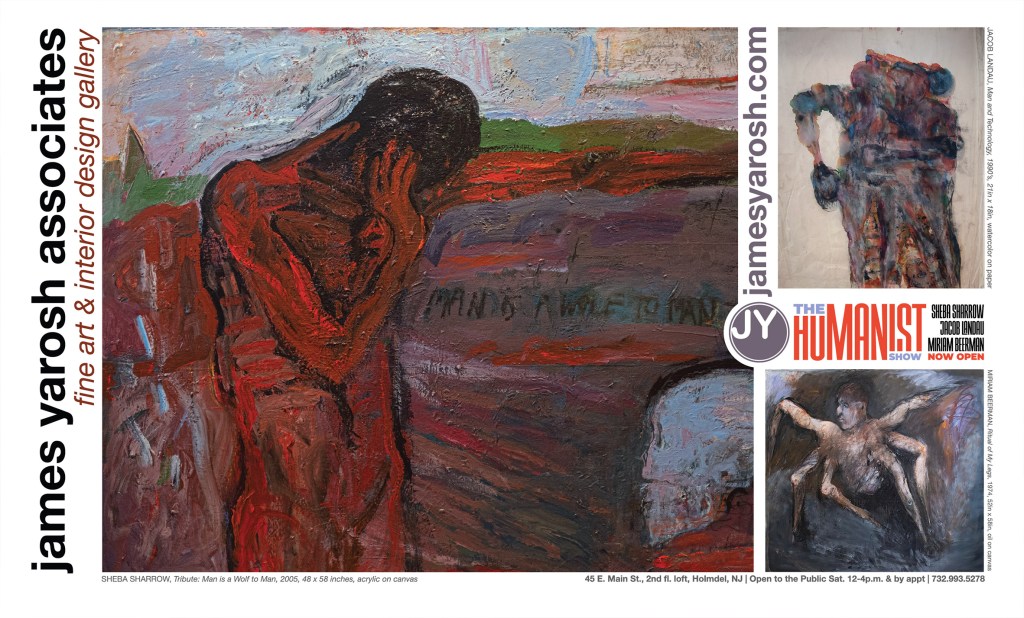
THREE ARTISTS ARE CURRENTLY ON VIEW AT JAMES YAROSH ASSOCIATES: Now though October 2, 2021
Established in 1996, James Yarosh Associates Fine Art Gallery is located in the second floor loft space of the former 1917 firehouse at
45 E. Main Street (Rt.520) in Historic Holmdel Village, NJ 07733
Entrance on the inside corner of building & additional parking lots in the rear.
Open Saturday 12-4pm. Weekday & evenings hours scheduled by appointment
The bodies of work of three museum-recognized artists are being revisited as part of a curated exhibit that explores the different artistic answers each creator has to similar humanist subjects—but mainly to highlight how we are very much the same.
The artists in The Humanist Show at James Yarosh Associates are all from a similar era and likeminded in their philosophy of using art as a form of activism. Now, their voices have the opportunity to be heard again in an exhibit that allows visitors to experience their interaction and to feel how great art can emote in ways words alone cannot.
The arts always have been an intellectual engagement first; the conversations of artists are the most revealing of that fact and tradition.
Since his eponymous gallery opened in 1996, Yarosh’s intentions have remained clear for the gallery’s art representation: to use an artist’s eye and the very human approach of showcasing works that resonate with viewers. Curation begins with valuing art for art’s sake. Beauty is deeper than the surfaces of great art. When we view art, we share journeys through the artists’ minds, connecting us through the feelings and responses we share in the experiences of life. How lucky for collectors who embrace works that define our culture and are able to participate in the continuum!
The common theme is: artists using their talents and great minds to illustrate empathy. They provide lessons and find answers to issues confronting human welfare and respond to human suffering. Artists rely on their acute sensitivity to create and thus can become compelled to employ art to “bear witness” to the injustices they see around them.
Cultural Conversations
Each artist in this exhibit was born nearly a century ago and yet the energy of their art still feels very forward, unafraid of moving viewers today to go outside of their initial comfort zones.
The exhibit also captures the lifetime of learning that goes into a work of art and the honing of an artist’s voice at each stage of their career. An artist faces a canvas bravely, taking on subjects and often creating from nothing, just trusting their voice.
The results can become very layered and require sophistication to recognize what each artist achieved. We need open minds to view ourselves in the subject matter, beyond the simplicity of “portrait, still life and landscape,” and an investment of time to discover the depths of the work. The rewards are ultimately greater for the soul once this is understood.
In the artist documentary Expressing the Chaos, Miriam Beerman, then 90, says, “You have to do some work. I think it’s clear by now I’m not interested in painting pretty pictures.” In a 1988 catalog, Beerman referred to Sheba Sharrow as “one of the finest women artists of our time.” Sharrow mentioned often that she did not see art as entertainment and although her drawing and painting skills are brilliantly seductive, her work tends to stir the conscience. Jacob Landau was unabashedly outspoken to use his art as a flag, warning of threats to mankind if we didn’t choose change. Presenting Landau as the only male artist in the exhibit, the show shifts the dynamic of this era when males dominated the art world.
Yarosh says of the three artists: “Landau’s drafting offers exacting lines that put images in order and organizes thoughts as if he were confronting technology head-on. His mapping of paths of a new world orchestrates, almost scientifically, an equation of what will become of mankind when our humanity becomes obsolete in the name of progress.”
“Sharrow’s expressionism is direct, using both force and tenderness. The lyrical line of her hand becomes a visual poetry. Her art has an elegance, embracing formal balances of good to overcome trauma and transmute it into art. Themes of mortality are explored and revisited throughout, knowing that beauty can only be seen by knowing the sadness of its polar opposite, allowing us to understand both highs and lows as forever tied into life’s journey. Her work speaks lovingly, even if with fearless candor, acknowledging that with awareness come burdens.”
“Beerman’s work and subject matter is near primal with color. Her hands in combat, she does not shy away from the bruises of pain as these come with the safety net of a momentary intoxication, compelling her to revisit subjects like moth-to-flame to further the act of creation. Beerman’s work exalts winning the battles in life. There is even humor — albeit sometimes akin to nervous laughter — in the face of demons. The result is an art, bursting and satisfying like ripe fruit, on a precipice edged along the past, present and future, embracing living in the current moment.”
“With all of these artists, however, their messages focus on the ever-present option of choosing beauty,” he continues. “This fact is evident with the beautiful handling of their mediums, with which they simultaneously create intoxicating subplots for our eyes and reward us for not looking away, for being present in the noble act of viewing art.”
Yarosh, an artist, interior designer and gallerist, notes his gallery always has favored the idea of being more of an artist’s home, open to the public to allow people to uncover the merits of the art that “we as artists know is great.” There is an unfortunate chasm between the works collected and exhibited at museums and what galleries offer, catering to a limited concept of what people hang in the home. Artists are more interesting as they color outside the lines of restriction; it is better to follow their lead of subject matter to uncover the truths they expose. It’s fascinating to see a body of work in hindsight. Reviewing an artist’s oeuvre as a lifetime body of work offers advantages in appreciation for both dealers as well as collectors. Seeing the art through the lens of the artist’s life story allows us to more clearly understand the path they took to greatness. It is important to view artists’ works in the context of their times and also see how it still holds up today with continued interest.
“I am excited to be able to offer works by Beerman, Landau and Sharrow to collectors on a gallery level,” Yarosh says. “Their art is much bigger than many realize and even as an art dealer, I’m still discovering more as I live with these great works. As time goes on, I realize how much more there is to learn in life. These artists are our teachers, and I have always put my faith in the arts. I feel very encouraged for the future of humanist artists when I see important exhibits like Alice Neel: People Come First currently at the Metropolitan Museum. These artists’ bodies of work live on and the conversations of humanity always will connect us as long as we continue to exist.”
The Humanist exhibit at James Yarosh Associates gallery offers a window into the artists’ world in an accessible setting that allows us to meet the artists’ works up close. Works on view include large-scale canvases, works on paper and artist books of mixed-media/collage. The gallery is open to the public Saturdays 12-4 p.m. and by appointment. Previews of the show can be seen on the What’s New page on the gallery’s website, http://www.jamesyarosh.com.
Miriam Beerman
Beerman (b.1923) is a contemporary maker of painterly power objects, imbuing the paint with profound psychology as well as beauty. Her subject has been the arena of the human condition, whether expressed overtly with imagery evoking genocide or abstractly through the call-and-response of process. These works are serious paintings offering a lifetime of contemplation and stimulating a depth of thought. Beerman has contributed to the contemporary involvement in art as a political tool to alter consciousness.
Miriam Beerman
In 2015, Beerman, one of the first women to have a solo show at the Brooklyn Museum, was the subject of the 50-minute artist documentary Expressing the Chaos, a film that is available to stream on Amazon Prime and YouTube outlets. Material on Beerman’s art currently is being compiled, detailing the over 60 U.S. and European museums which include her work in their collections. She will be the focus of an Artist in Spotlight exhibit at James Yarosh Associates Fine Art Gallery for the Fall 2021/Winter 2022 season.
Jacob Landau
Jacob Landau
Landau (1917–2001) was an American artist best known for his evocative works on the human condition. Typically, his works address the Great Depression, World War II and the impact of technology and politics on individuals and their surroundings. Landau’s works can be found in the permanent collections of the Metropolitan Museum of Art, the Library of Congress, the Museum of Modern Art and the National Gallery. The 2021 book The Prophetic Quest: The Stained Glass Windows of Jacob Landau brings his artistry to the fore, revealing the magnitude of a series of ten monumental abstract stained-glass windows, created by Landau for the Kenneth Israel synagogue just north of Philadelphia, depicting the lives and words of the biblical prophets.
Sheba Sharrow
Sharrow (1926–2006) was born during the Great Depression and came of age during World War II. Her art exemplifies an artist with eyes wide open. Her expressionist paintings of abstract humanity are masterful in execution, poetically engaging us with topics such as mortality, desire, vulnerability, power, warfare and spirituality.
Sheba Sharrow
In 2017, Monmouth University’s exhibit Sheba Sharrow: Balancing Act was co-curated by James Yarosh Associates Fine Art Gallery, and in 2020, Sharrow’s art was the subject of the solo exhibit History Repeats at James Yarosh Associates Gallery. Opening in September 2021, Sharrow’s multi-paneled painting “The Dateci Quartet,” in the collection of the Zimmerli Art Museum at Rutgers University, is the basis for its exhibition Dateci: Sheba Sharrow and Primo Levi and a subject of an online discussion led by Margaret Olin, Senior Research Scholar at the Yale Divinity School, entitled Social Justice as a Theme in Jewish Art. Sharrow’s work can also be seen in the Art on Paper NYC art fair in September 2021 with Exhibitor James Yarosh Associates.
The views, opinions and analyses expressed in the articles on Humanist Freedoms are those of the contributor(s) and do not necessarily reflect the views or opinions of the publishers.
In his 1914 poem Mending Wall, Robert Frost made significant use of the old proverb, good fences make good neighbors. In the poem, a narrator explains that “something there is that doesn’t love a wall” and this something tears down a sturdy stone wall that separates the narrator’s property from the neighbor’s. So each year, the narrator and the neighbor meet on an appointed day to “walk the line and set the line between us one again”, the neighbor often reciting the ancient wisdom. Good fences make good neighbors. Meanwhile, the narrator wants to suggest the mischievous force that is tearing down the wall is “elves” but would prefer for the neighbor to say so.
It’s a lovely poem which aptly reminds the reader how to keep one’s metaphorical apple’s from eating-up someone else’s metaphorical pine cones .
In Canada, there is a new Facebook chat group named Secular Wall with an interest to walk the line and mend the wall. The group states that it wishes to “connect all Canadians opposed to the discriminatory and wasteful public funding of religious schools (especially in Alberta, Saskatchewan and Ontario) plus healthcare institutions. Secular Wall members support every citizen’s undisputed RIGHT to worship however they please … with the corresponding RESPONSIBILITY to fully fund their own beliefs.“
The organizers of Secular Wall seem to have staked-out familiar, but necessary, territory. Just as there are many individuals who would prefer not to have all their pine cones eaten-up by the neighbor’s apples – there are also plenty of apple-growers who would like to keep their apples from tasting of pine. A bit of annual wall mending is indeed a good thing.
After all, the really does seem to be a great deal of elf-activity from year to year and the walls won’t mend themselves.
The group has a stated zero tolerance for hate speech or profanity, which suggests that dialogue may maintain a level of dignity and respect despite a topic likely to bring out deep-seated values, perspectives and opinions.
If you have an interest in the integrity of your own domain, you may want to join the conversation.
The views, opinions and analyses expressed in the articles on Humanist Freedoms are those of the contributor(s) and do not necessarily reflect the views or opinions of the publishers.
On January 29, 2021 German heavy metal band Accept released their sixteenth studio album, Too Mean to Die. Here at http://www.humanistfreedoms.com, we don’t always connect with the latest releases in the heavy metal music scene, so we hope to be forgiven by the band for overlooking the release.
One song on Too Mean to Die has caught our ear. “No One’s Master”. We’ve provided a link to a lyric video for other humanist fans of heavy metal to connect with. Unlike many of Accept’s songs, which have carried credit to “Deaffy” all the way back to the 1980’s (actually Gaby Hoffman, the band’s manager and also Accept guitarist Wolf Hoffman’s spouse), “No One’s Master” is credited to band members Martin Motnik, Wolf Hoffmann and Mark Tornillo.
Still, it is absolutely essential when considering Accept, to identify Deaffy, who wrote the lyrics for the band’s most famous song “Ball’s to the Wall” (circa 1983). Who could forget a song that begins with the line, “Too many slaves in this world die by torture and pain”, and gets raunchier, bloodier and more rebellious from there?
Back in 1983, Deaffy also wrote the lyrics for “Fight it Back”, excerpted here as backdrop to the Accept song we’re actually listening to today “Always been the prophets who make the world evolve. Always been the average breaking it down. Majority, the unknown giving us the rules. It’s more than luck to get the standard. You’ll never find me like you hope that I am. You’ll never treat me like you think you can. Be always independent, surrendering no way. I won’t deal with crimes of society. Find myself in crisis, get near to collapse. Am I forced to live that boring life? God, I hate the average. Go and nuke it out. Go, piss the accepted, screw them all! Now, if you hate it, you gonna fight it back. Just try to change it. Fight it. Fight it back.”
Agree with the sentiments or not, Gaby Hoffman’s lyrics set out some clear perspectives on the individual’s role within their society. Now, let’s push forward to more recent days.
It appears that Tornillo, the band’s vocalist has written the lyrics for “No One’s Master”. Some time ago (actually 2012) Tornillo said that he enjoyed the opportunity to write socio-political lyrics. With “No One’s Master” Tornillo seems to be refining sentiments that Deaffy/Accept had established almost forty years earlier.
The “No One’s Master” lyrics take aim at the influence of media on people collectively while setting a rebelliously individualistic and humanistic ethic that is firmly set in the present.
Here is a “lyric video” version of the song, which is rather catchy in a rock-anthem kind of way:
For those who may not be enthusiastic fans of the genre, presented here is an abridged version of the lyrics:
The media’s controlling the masses Stoking our anger and fear Further dividing the classes Serving the richest careers Their mantra is lies and deception When honesty’s all that I crave I decline and there’ll be no exceptions I am no one’s master No one’s slave Living in fear ain’t worth living Wasting your life is the crime The reaper will be unforgiving Wake up, while you’re still in your prime The guide of my life is my conscience My way is the path that I pave I treat, how I want to be treated I am no one’s master No one’s slave I won’t rule; I won’t bow I won’t sink my eyes to the ground I won’t steal; I won’t kneel I won’t bend my knee to the crowned I pledge an oath to myself and to life I’m not afraid of the sword or the knife The guide of my life is my conscience My way is the path that I pave Equality’s all that I’m after I am no one’s master No one’s slave No one’s master I am no one’s No one’s slave
The song and the genre are a terrific reminder that living a humanist ethic may occasionally require a bit of rebellion, a bit of anger and a lot of personal courage.
June 22, 2021 at 5pm – 6pm (Pacific Daylight Time)
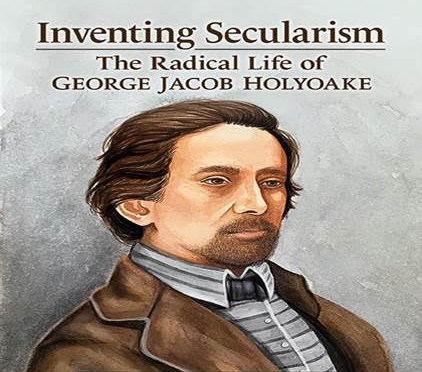
Secularism, the world’s most widely applied model for the separation of church and state, has freed peoples and their governments from control by religious authority. At a time when it is being challenged by evangelical Christianity and fundamentalist Islam, Inventing Secularism, the first modern biography of secularism’s founder, George Jacob Holyoake, is scheduled for the Spring 2021 list of McFarland & Co.
Ray Argyle, Canadian biographer of French president Charles de Gaulle and American ragtime composer Scott Joplin, writes that George Holyoake “changed the life experience of millions around the world by founding secularism on the idea that the duties of a life lived on earth should rank above preparation for an imagined life after death.”
Jailed for atheism and disowned by his family, Holyoake came out of an English prison at the age of 25 determined to bring an end to religion’s control over daily life. He became a radical editor and in 1851 invented the word secularism to represent a system of government free of religious domination. Inventing Secularism reveals details of Holyoake’s conflict-filled life in which he campaigned for public education, freedom of the press, women’s rights, universal suffrage, and the cooperative movement. He was hailed on his death in 1906 for having won “the freedoms we take for granted today.”
More than 160 secular and humanist organizations around the world today advocate principles set out by George Holyoake in his newspaper The Reasoner and in hundreds of lectures as well as books and pamphlets.
Argyle’s Inventing Secularism warns that a rise in religious extremism and populist authoritarianism has put secularism under siege in countries ranging from the United States to such once staunchly secular nations as Hungary, Poland, Turkey and India. He writes that Holyoake “looked beyond his own time, confident of a future of moral as well as material good, offering an infinite diversity of intellect with equality among humanity.”
McFarland & Company, Inc., Publishers, is located in Jefferson, North Carolina, and is one of the leading publishers of academic and scholarly nonfiction in the United States, offering about 6000 titles in print.
We are a registered charitable organization. Our mission is:
to promote the ideas and philosophy of secular humanism by all available means of education and communication;
to serve the educational needs of its members and others of humanistic, scientific and naturalistic outlook, in a democratic, non-dogmatic manner free from authoritarian doctrine;
to provide opportunities for fellowship, study and service at all levels of humanistic endeavour, and to advance the values and welfare of humanity in dedication to the continuing enhancement of human life through human effort and understanding;
to offer and provide meaningful ceremonies to members and non-members at significant times such as marriage and death; and
to elaborate and to express publicly Humanist positions on issues of concern to people, including values, morality and ethics.
The views, opinions and analyses expressed in the articles on Humanist Freedoms are those of the contributor(s) and do not necessarily reflect the views or opinions of the publishers.
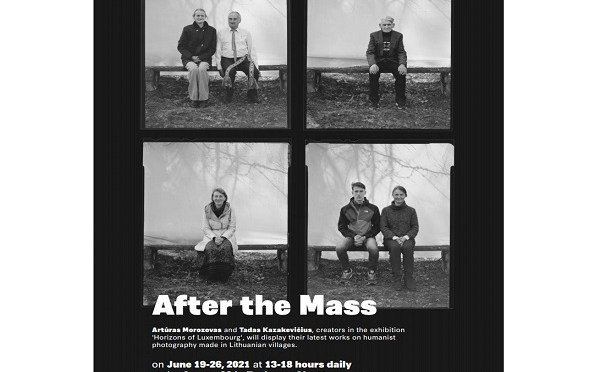
Lithuanian artists Artūras Morozovas and Tadas Kazakevičius will display their latest works on humanist photography next month at the Annexe22 in Esch-sur-Alzette.
The latest works by the photographers behind the “Horizons of Luxembourg” exhibition and competition include photographs taken in in Lithuanian villages. Organised by the Lithuanian Society in Luxembourg, this second exhibition, “After the Mass”, forms part of the Esch2022 – European Capital of Culture programme.
The exhibition will run from 19 to 26 June 2021, from 13:00 to 18:00 daily.
The artists will be giving free guided tours on humanist photography, in English, on 19 and 20 June 2021 at 13:00 and 15:00. Registration is obligatory via Eventbrite or email: litartlux@gmail.com; those wishing to attend should indicate the date, time and number of attendees when registering.
Photojournalist and war photographer Artūras Morozovas is the recipient of the 2016 Award of the Lithuanian Artists’ Association. He is one of the ambassadors of Kaunas 2022 – European Capital of Culture. Likewise, photographer Tadas Kazakevičius won third prize in the 2020 World Press Photo Competition in the Portraits and Stories categories.
Humanists UK has called upon all states to make sure the school curriculum is critical, objective, and pluralistic, particularly in its approach to religions and humanism. This is necessary to safeguard the right to freedom of thought. Humanists UK made this call in response to a consultation issued by Dr Ahmed Shaheed, the UN Special Rapporteur on Freedom of Religion or Belief.
International human rights law includes the right to ‘freedom of thought, conscience, religion, or belief’. But, freedom of thought has been little considered in its own right.
Humanists UK said freedom of thought encompasses much more than our private internal experiences. It is a skill set. The skill of being able to seek out, receive, comprehend, and evaluate information. Like any skill, it needs to be taught and developed.
States have a duty to create a culture in which freedom of thought and free enquiry can flourish. In practice, this means having laws that protect people from propaganda and misinformation. It also means schools must teach critical thinking skills. These skills include an understanding of the scientific method. It also means teaching in detail about different religions and humanism, but in a critical, objective, and pluralistic way. All citizens must have access to a wide variety of educational resources, whether that means through books, online, or by other means. And the media also has a strong role to play in informing and educating citizens – particularly public sector media. It must also make sure its content is pluralistic.
Humanists UK also called for the global repeal of blasphemy and apostasy laws. As freedom of thought is an absolute right, no one should be punished because they hold certain thoughts. Laws that criminalise apostatic or blasphemous thoughts are thus incompatible with this right.
Humanists UK’s Director of Public Affairs and Policy Richy Thompson commented,
‘Thought is not only a private experience. It is also a skill. Like any crucial skill, it needs to be taught and given the opportunity to develop. Thus, the state must ensure schools teach in a critical, objective, and pluralistic way. We are concerned that in the UK this is not being achieved. Religious education syllabuses still frequently exclude humanism. All state schools must conduct a daily act of compulsory worship – usually Christian in nature. And we are also aware of an increasing number of illegal religious schools. In these schools, the curriculum is extremely narrow, putting the children at risk of indoctrination. We need a society where all schools, the media, and public access to information is diverse and pluralistic.’
Notes:
For further comment or information, please contact Humanists UK Director of Public Affairs and Policy Richy Thompson at press@humanists.uk or phone 020 7324 3072 or 07534 248 596.
Humanists UK is the national charity working on behalf of non-religious people. Powered by 100,000 members and supporters, we advance free thinking and promote humanism to create a tolerant society where rational thinking and kindness prevail. We provide ceremonies, pastoral care, education, and support services benefitting over a million people every year and our campaigns advance humanist thinking on ethical issues, human rights, and equal treatment for all.
In 2021, Humanists UK is celebrating its 125th anniversary with a renewed focus on its history. The new website Humanist Heritage is a rich new web resource that uncovers the untold story of humanism in the UK – a story of people, groups, objects, places, movements, publications, and ideas.
The views, opinions and analyses expressed in the articles on Humanist Freedoms are those of the contributor(s) and do not necessarily reflect the views or opinions of the publishers.








 Humanist Heritage Canada