with celebrity naturalist Chris Packham, hosting a conversation after the screening with expert panelists including 8 Billion Angels Producer Terry Spahr.
The views, opinions and analyses expressed in the articles on Humanist Freedoms are those of the contributor(s) and do not necessarily reflect the views or opinions of the publishers.
** This is an ONLINE only event. Please register for an online ticket using the “Book Now” link **
* Conway Hall is a charity and we politely ask you to add a donation of at least £5 when registering. *
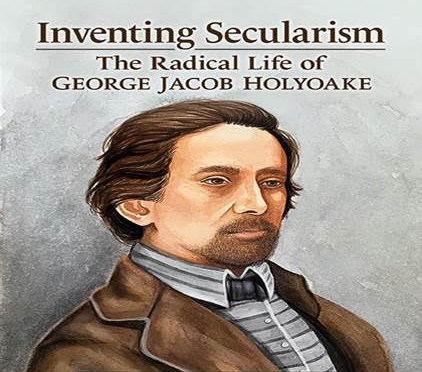
You may recall Ray Argyle from his articles here on humanistfreedoms.com (search for “Ray Argyle” using the search tool). If you’re as crazy for the history of humanism and secularism as we are, you’ve been anticipating the release of his biography of George Jacob Holyoake for months. Well the virtual book launch is upon us!
What follows is the press-release information shared with us when the book was in pre-launch phase. We’re still reading and expect to launch our review soon!
Secularism, the world’s most widely applied model for the separation of church and state, has freed peoples and their governments from control by religious authority. At a time when it is being challenged by evangelical Christianity and fundamentalist Islam, Inventing Secularism, the first modern biography of secularism’s founder, George Jacob Holyoake, is scheduled for the Spring 2021 list of McFarland & Co.
Ray Argyle, Canadian biographer of French president Charles de Gaulle and American ragtime composer Scott Joplin, writes that George Holyoake “changed the life experience of millions around the world by founding secularism on the idea that the duties of a life lived on earth should rank above preparation for an imagined life after death.”
Jailed for atheism and disowned by his family, Holyoake came out of an English prison at the age of 25 determined to bring an end to religion’s control over daily life. He became a radical editor and in 1851 invented the word secularism to represent a system of government free of religious domination. Inventing Secularism reveals details of Holyoake’s conflict-filled life in which he campaigned for public education, freedom of the press, women’s rights, universal suffrage, and the cooperative movement. He was hailed on his death in 1906 for having won “the freedoms we take for granted today.”
More than 160 secular and humanist organizations around the world today advocate principles set out by George Holyoake in his newspaper The Reasoner and in hundreds of lectures as well as books and pamphlets.
Argyle’s Inventing Secularism warns that a rise in religious extremism and populist authoritarianism has put secularism under siege in countries ranging from the United States to such once staunchly secular nations as Hungary, Poland, Turkey and India. He writes that Holyoake “looked beyond his own time, confident of a future of moral as well as material good, offering an infinite diversity of intellect with equality among humanity.”
McFarland & Company, Inc., Publishers, is located in Jefferson, North Carolina, and is one of the leading publishers of academic and scholarly nonfiction in the United States, offering about 6000 titles in print.
The views, opinions and analyses expressed in the articles on Humanist Freedoms are those of the contributor(s) and do not necessarily reflect the views or opinions of the publishers.
2020 was HumanistFreedoms.com’s first full year of operation. We enjoyed publishing articles promoting and celebrating humanism and our common humanity. We thank our contributors, readers and visitors for making http://www.humanistfreedoms.com a unique online magazine.
Please follow our website, share articles with your friends and help us grow. At the end of February, we’ve had almost half of the views we had for all of 2020! You can help!
Now for 2021 we are looking for even more essays, articles and stories to share! We are not able to pay for articles (yet) but we want to hear what you have to say. This month, themes that we want to explore include:
Contemporary Humanism’s Biggest Priorities and Challenges for 2021
Leadership Within The Humanist Movement
Humanism and Secularism
Humanism and Human Trafficking
Digital Humanism
Humanism and Global Population
A Humanist Perspective of Radical Politics
Humanist Photography: Photographer Review
Humanism in the Arts
Humanism Behind the Mask: Maintaining Respect and Compassion During the Pandemic
Humanism and the Environment
Humanism and Freedom of Expression: Lessons From 2020
Humanism and Freedom of/from Religion: Global Lessons
Humanism and Architecture
Book Review: A Humanist Recommends….
Do you have an idea that isn’t on our list? Let us know. Inquire at humanistfreedoms@gmail.com
Since HumanistFreedoms.com began publication early in 2020, we have witnessed more…and more frequent…signs that humanists around the world are seeking a next wave of humanism. Twentieth century humanism is dead – long live twenty-first century humanism!
What will the next wave of humanism look like?
Is Hardcore Humanism An Answer?
Do an internet search for “Hardcore Humanism” and you will find a website and blog for Dr. Michael Friedman, PhD – a clinical psychologist who promotes ” a life philosophy, therapeutic modality and life coaching program that brings together the compassionate holistic approach of humanistic psychology with the scientific rigor of behavioral therapy. Humanistic psychology promotes unconditional positive regard – a basic belief that all people are good and have value – as they strive to achieve their life’s purpose and best self. With Hardcore Humanism, the Humanistic approach is optimized to include the hardcore work ethic and science-based approach of behavioral therapy. In other words, Hardcore Humanism means not only understanding and accepting yourself but also working in a methodical way to achieve your purpose and find fulfillment.”
Whether Friedman’s clinical approach is particularly novel or not, fundamental to his branding is the marriage of humanism to a commitment so staunch, so unwavering and elemental that it is “hardcore”. Friedman’s podcast and website currently has a wide selection of articles which feature connections between heavy metal and punk subcultures and and music.
Is There Room For A Radical Humanism?
On July 1, 2020 Counterpunch published an article by Julian Vigo calling for a “radical humanism” in response to current social and political events and trends. Despite the bold title, “A Call for Radical Humanism: the Left needs to return to Class Analyses of Power“, Vigo did not directly define “radical humanism”. Nor did Vigo clearly state why or how a proposed return to class analysis of power by The Left would fulfill a radical humanism. Over the course of the article, Vigo jumped instead to a kind of applied radical humanism without providing the reader with the benefit of a defined radical humanism.
Vigo’s article suggests that there are contemporary humanists who crave the presence of a form of humanism that has been absent from contemporary public life and politics.
An exploration of the term radical humanism must begin with definitions of the two root words, humanism and radicalism.
Humanism has a rich, complicated and nuanced history that we’re going to set aside as too vast to explore in a short article. If you’re reading this article, you probably have a reasonably well-informed perspective anyway. For the purposes of this inquiry, the term humanism denotes ethical perspectives which focus exclusively on human (and not supernatural or theistic) actions, interests, values and dignity.
Radicalism on the other hand requires more exploration. Vigo’s article is not clear whether “radical humanism” is intended to suggest an extremist position or whether it is to indicate a form of humanist fundamentalism.
Whether Vigo intended a call for extremism or fundamentalism, or some combination of both, it seems that the call for radical humanism is a call for a stronger and more assertive wave of humanism that prioritizes a search for solutions to the root causes of the problems facing humanity over addressing their symptoms and a focus on substance rather than symbols addressing class.
In recent decades, it has been popular to characterize humanism as an ideology of “old white men”. This characterization has become so widely accepted that Roy Speckhardt, the most recent leader of American Humanist Associate recently resigned from the role stating that, “Being at the helm of such an organization as the AHA, whose mission is so critical to our times and whose influence far outstrips its size, was the greatest honor of my life, but I’ve decided it’s time for me to step down and make room for new leadership. It is my emphatic hope that my seat is filled with a Black or Brown humanist because our movement has gone too long without such diversity at the helm and this would open the door for the AHA to truly achieve its potential as a humanist and anti-racist institution.”
On March 13, 2021 we published “Humanists – Where Are You”by Jay Rene Shakur. The article is signed as “The New Humanist”. The question of who The New Humanist may be is vital to the future of humanism.
Shakur heads-up the website HipHopHumanism.Com. The website explores the connections between Hip Hop music and culture and humanism. There is an important similarity between Friedman’s linking of metal and punk subculture trends to humanism and Shakur’s work to do the same between Hip Hop and humanism. In either case, within the mirrored statements, “I am Hip Hop” and “I am Punk” or “I am Metal” there is also reflected a particular statement of who the New Humanist is and how they may be found. The New Humanist is part of wide-spread cultural identities as well as niche sub-cultures with values and aesthetics that are no longer exclusive to “the old white man” of the nineteenth and twentieth centuries.
Extreme Humanism
Another example of the contemporary urge toward an assertively-held contemporary humanism may be found in a new management book by Tom Peters titled “Excellence Now: Extreme Humanism“.
That the term humanism would be used as a primary component of a mainstream business-guru-genre book is evidence of just how widespread and essential humanism has become in mainstream culture. And the current appetite is not for yesterday’s average humanism. The appetite is for Extreme Humanism.
Where some parts of society have social sub-culture identities that form a vital connection to their humanism – others have professional sub-cultures. Business gurus and leaders like Peters are pursuing organizational excellence through humanism. The medical profession pursues better medicine through humanism by including humanism as a key-note speaking engagements or through patient relations initiatives. In January of 2021, PhD candidate Daniel Matthews-Ferrero published an article titled “Towards a Humanist Environmentalism” on Spiked where stating “if we are serious about overcoming the environmental challenges that are facing us, and coming up with social solutions to social problems, then humanism must be our starting point. Meanwhile, the technology industry has the Vienna Manifesto on Digital Humanism with an implicit focus on humanism.
Next Wave Humanism
Next Wave Humanism has already begun. It is an ideological building- block of a wide-variety of sub-cultures, professional perspectives, artistic approaches and adjacent ideological movements.
Earlier waves of humanism were pre-occupied with shifting ideological attention away-from supernaturalism and theology and toward humanity. Thanks to the successfully-waged ideological battles of yesterday, Next Wave Humanism is now far less-concerned with that fight. Contemporary humanists of the twenty-first century are concerned with applied humanism – the many ways that humanism is used for solving problems. The New Humanist says, “I am Extreme; I am Radical; I am Hardcore. I am Humanist.“
The views, opinions and analyses expressed in the articles on Humanist Freedoms are those of the contributor(s) and do not necessarily reflect the views or opinions of the publishers.
In a celebration of the humanities, Humanist Ottawa hosts this afternoon of conversation with Henry Beissel, poet, playwright, fiction writer, translator, editor and winner of the 2020 Ottawa Book Award in English Fiction for his book of poetry, “Footprints of Dark Energy“.
In awarding this prize, the jury said, ” Part idyll, part love song and mostly about man in nature, Henry Beissel’s Footprints of Dark Energy approaches the sublime in its epic treatment of its subjects. The meditative undertones of the shorter poems coalesce into the epigrammatic wit of the long title poem, and all are bolstered by the narration’s majestic sweep.”
The title poem of this collection takes us on an epic journey across past and present historical events and through spaces defined by the natural sciences, as it explores the challenges of being human in these troubled times. It is accompanied by a gathering of shorter poems that confront the dark forces in our world as they struggle for the light at the end of the tunnel. In stark imagery, these poems turn words into music to celebrate the anguish and the glory of being alive.
Henry Beissel is author/editor of 44 published books. Among his 22 collections of poetry are his epic “Seasons of Blood” and the lyrical “Stones to Harvest” as well as his celebration of Canada in “Cantos North” and the 364 haiku in “What if Zen Gardens …“. He lives in Ottawa with his wife Arlette Francière, the artist and literary translator.
Feel free to forward this invitation to any of your friends.
When: Saturday, March 27, 2021
Time: 1:30 pm Eastern Time
Medium: Zoom – Please register in advance for this free event at:
The views, opinions and analyses expressed in the articles on Humanist Freedoms are those of the contributor(s) and do not necessarily reflect the views or opinions of the publishers.
Thomas Jefferson, writing to worried Baptists in Danbury, Connecticut in 1802, pledged that his administration would adhere to the “supreme will of the nation” on behalf of the rights of conscience and the free exercise of religion. The First Amendment, he said, had built “a wall of separation between Church & State.” America would have an impenetrable barrier to religious involvement in affairs of state.
Thomas Jefferson
One hundred and eighty years later, on April 17, 1982, Queen Elizabeth II gave royal assent to a new Canadian Constitution at a rainy outdoor ceremony in Ottawa. It contained a much heralded Charter of Rights and Freedoms guaranteeing “freedom of conscience and religion” while asserting that Canada was founded on “principles that recognize the supremacy of God.”
Both countries had set out to build secular and humanist societies. The United States, to all appearances, rejected any role for religion in its founding documents. Canada, in contrast, subjected itself – at least titularly – to God’s will. It guaranteed public funding of Roman Catholic schools and accepted the Queen’s role as head of state and “defender of the faith,” as symbolized by the Anglican Church.
Move forward to 2021 and a world slowly emerging from a global pandemic. What do we find? In the United States, relentless Christian evangelical attacks on secularism; in Canada, almost universal public acceptance for secular social policies. Arrived at free of religious interference, Canada guarantees, among other secular rights, freedom of choice (abortion rights), the right to medically assisted dying, medical and recreational use of marijuana, and a long-standing ban on capital punishment.
Ironically, the most contentious secular issue in Canada is not the defence of secularism, but whether the Province of Quebec has adopted too rigid a form of secularism through its ban on the wearing of religious symbols (i.e., the hijab) by public service workers in positions of authority. Civil libertarians see Quebec’s “Act Respecting the Laicity of the State” as an unreasonable curtailment of individual rights.
Quebec’s National Assembly
Around the world, secularism is under siege from religious forces ranging from populist Christian movements in Europe to extremist Islamic elements engaged in terrorist acts. Hindu nationalism in India has fractured a century of secular tolerance of Muslims and Hindus and China – ignoring its own secular constitution – is brutally suppressing its Uighur Muslim minority.
I gained a fuller appreciation of the ferocity of these attacks while researching Inventing Secularism, my biography of secularism’s founder, George Jacob Holyoake. The dangers I saw impelled me to add an epilogue identifying the actors and their strategies behind the assault on secularism which are now mounting around the world.
Thomas Jefferson’s proscription of religious involvement in affairs of state lasted until the mid -20th century. Then, Congress ordered the phrase “In God We Trust” to appear on U.S. currency and inserted “Under God” into the Pledge of Allegiance. The third Thursday in May was designated as a National Day of Prayer. A secularist organization, Americans United for Separation of Church and State, sees this contrivance for what it is: “… a vehicle for spreading religious misinformation and fundamentalist Christian doctrine under the aegis of the government – precisely what the framers [of the Constitution] were seeking to prohibit.”
These largely symbolic acts, while contrary to the principle that religion should have no place in lawmaking, stand today as minor irritants compared to the systematic attack on secularism that has been unfolding in U.S. courts and legislative bodies, and in countries around the world. The flow of public funds to U.S churches and faith groups through executive orders and court decisions, including an undetermined billions of dollars in COVID-19 relief intended for states and communities, is unprecedented in American history.
Under the guise of strengthening individual freedom, recent decisions of the U.S. Supreme Court have enabled local governments to fund and maintain public religious displays, provide access to public funding for certain religious schools, and allow service providers to discriminate among those whose lifestyles or religious principles they find disagreeable. From a humanist perspective, these actions amount to a reinterpretation of the religion clauses of the First Amendment – one prohibiting the “establishment” of a state religion and the other guaranteeing the “free exercise of faiths.”
“A person’s doctor or boss should not be able to use personal religious beliefs to dictate the healthcare their families can or cannot receive,” – American Atheists
As an example of anti-secular legislation by various U.S. states, a new Arkansas law would allow doctors, insurance companies, and employers to deny patients necessary healthcare on the basis of religious beliefs. “A person’s doctor or boss should not be able to use personal religious beliefs to dictate the healthcare their families can or cannot receive,” the watchdog group American Atheists said in a statement.
An air of optimism surrounded the first inter-faith meeting held by Pope Francis when he spent five days with Russian Orthodox Patriarch Kirill in Havana in February, 2013. It was the first such meeting in the nearly thousand years since the Great Schism of 1054 split Christianity between Greek East and Roman West. The newly ordained Pontiff had brought a breath of liberalism to the Vatican and his ability to communicate church doctrine in simple, homespun ways was impressing Catholics and non-Catholics alike.
Any expectation that Francis, as head of the oldest and arguably most influential Christian church would lead his 1.2 billion adherents to a new reality of modern life was quickly dashed. A thirty-point declaration out of Havana confirmed traditional teachings of both the Russian Orthodox and Roman churches. Most notably, the statement marked the Pontiff’s endorsement of a fresh crusade against secularism.
“The transformation of some countries into secularized societies, estranged from all references to God and his truth, constitutes a grave threat to religious freedom,” the statement declared. It attacked the “very aggressive secularist ideology” that seeks to relegate religion “to the margins of public life.” It also declared that “Europe must remain faithful to its Christian roots.”
Aside from alarming humanists, the declaration troubled some Catholics. Jon O’Brien, president of the Washington-based Catholics for Choice, said it misrepresented the true meaning of secularism. “A secular society is not one in which one religion or religious belief is in any way opposed, but one in which all citizens can practice as they see fit. In a secular society, we can have freedom of religion and freedom from religion.”
Since Havana, Pope Francis has stepped up his assaults on secularism. In 2017 he traveled to Egypt to meet President al-Sisi and defend a “vision of healthy secularism” that he would like to see accepted by Muslim countries. The Pontiff’s remarks made it evident that the trade-off for acceptance of his version of a neutered secularism would allow religion to dictate public policies on issues the Church regards itself and the Bible as sole arbiters. He pressed his attack in celebrating World Mission Day in 2019. “Rampant secularism”, he said, “when it becomes an aggressive cultural rejection of God’s active fatherhood in our history, is an obstacle to authentic human fraternity.”
During Pope Francis’s reign, virulent attacks on secularism have emerged in the American Catholic press. The National Catholic Register, which describes itself as the most faithful Catholic news source in the United States, has blamed secularism for the crimes of Nazi Germany and Soviet Russia, declaring “Secularism in any of its guises is deadly.” Its article was headed ‘Beware the Stormtroopers of Secularism’ and was illustrated with a picture of Nazi troops in Poland taking a Catholic priest to his execution. Such hyperbole overlooks the fact that the Nazis defied secularist principles by persecuting a people based on their religious identity, while the Soviet campaign of atheism invaded the secularist right to freedom of religion.
This preoccupation with secularism is consistent with Pope Francis’s staunchly conservative theology, despite occasional flashes of liberality. Having cheerfully asserted that atheists should follow their conscience and can still go to heaven if they approach God “with a sincere and contrite heart,” Pope Francis also spoke tolerantly of same-sex relationships. “Who am I to judge?” he replied off-handedly in answer to a question about a gay priest. More recently, he has warned that priestly celibacy must be strictly adhered to and on other issues has reflected traditional Catholic views: opposition to abortion, birth control and gay marriage, denial of the right to assisted death, and restrictions on the role of women in the Church. Pope Francis has dealt with child sex abuse, a phenomenon endemic within the Catholic priesthood, by ending the edict imposing secrecy on anyone reporting sexual abuse, and has ordered church leaders to report sex abuse cases and sex abuse cover-ups.
Former President Donald Trump Holding Christian Bible
In the United States, the deep strain of religiosity running through American politics has encouraged militant Christian evangelists in their determination to apply religious tests to civil legislation, and to gain public funding through means that violate the First Amendment. A 2020 survey by the respected Pew Institute had half of Americans (49%) saying the Bible should have at least “some influence” on U.S. laws, with more than a quarter (28%) holding the view that the Bible should take priority over the will of the people. Well known examples include denial of LGBTQ rights, restrictions to abortion, withdrawal of funding to organizations like Planned Parenthood, and cancellation of foreign aid to countries permitting family planning (a policy reversed by President Biden).
In such an environment, politicians are generally reluctant to express a commitment to humanist values. There are exceptions. Nancy Pelosi, Speaker of the House of Representatives, declined to attend the 2020 National Prayer Breakfast and just over a dozen Democrats make up the Congressional Freethought Caucus. Its most recent recruit is Rep. Rashida Tlaib of Michigan, a Muslim. Its perhaps most notable member is Rep. Jared Huffman of California who has declared himself a “non-religious humanist.”
Between 2017 and 2021, President Donald Trump and members of his cabinet came down consistently in favor of evangelical political positions. According to Mat Staver, president of Liberty Counsel, a legal advisory organization, about ninety per cent of fundamentalist goals were achieved under the Trump administration. “He’s been the most pro-religious freedom and pro-life president in modern history,” Staver told the Associated Press.
“We will not let anyone push God from the public square,” President Trump declared. American states began to require schools to post the slogan In God We Trust on classroom walls. The State of Mississippi, in design of a new state flag, dictated it bear the same words.
These challenges to secularism were echoed in U.S. Attorney-General William Barr’s claim, made in a speech to the University of Notre Dame law school, that “militant secularists” were behind a “campaign to destroy the traditional moral order”.
Appointments to the Supreme Court by Republican presidents – in power for 24 years between 1981 and 2021 – have securely embedded conservative and pro-religious views on the nation’s highest judicial body. Trump appointees Neil Gorsuch, Brent Kavanagh and Amy Coney Barrett tilted the Court further to the right.
The United States faces anti-secularism on other fronts, including white Christian nationalist groups like the Proud Boys and the instigators of QAnon who participated in the January 6 putative insurrection in Washington, and neo-Nazi groups of the type that gathered in Charlottesville, Virginia, to defend a Civil War monument and chant “Blood and Soil”, a Nazi rallying cry.
Secularists have welcomed the election of Joe Biden, a practicing Catholic, as President. But they look with concern on his repeated invoking of God and prayer and his description of America as a nation “sustained by faith.” Such comments are seen as a contradiction to the separation of church and state and an expression of disrespect to the nearly one-third of Americans – atheists, agnostics and other non-religious – who hold dissenting views.
Blasphemy prosecutions abound across the Muslim world. They provide a convenient legal process that near-theocratic states employ to control dissent and repress humanist expression. The connection with secularism as known in the West may seem remote, but every charge of blasphemy is an offence to secularism and everything secularism stands for – democratic rule, human rights, religious freedom and freedom from religion, the exclusion of religion from public life, and government non-involvement in religious natters.
Rafida Bonya Ahmed and Avijit Roy
In Bangladesh, human rights advocate Rafida Bonya Ahmed and her husband were attacked by a machete-wielding gang enraged by his online anti-religious, secularist comments. Police stood by as he was murdered. Appearing before a U.S. House of Representatives Foreign Affairs subcommittee, she identified 83 countries with blasphemy laws carrying penalties of fines, torture, imprisonment, and death.
While blasphemy – showing contempt or lack of reverence for God – is considered a major crime in Muslim countries, apostasy – abandoning the faith – is considered an even greater offence. Ten countries impose the penalty of death for apostasy.
An Asian nation beset by the disintegration of secularism is India, where the Hindu nationalist government of Narendra Modi and his ruling Bharatiya Janata Party (BJP) has embarked on policies that repudiate the country’s long secularist tradition. The BJP’s policies are having the effect of turning religions that did not originate on Indian soil – notably Islam and Christianity – into alien essences. The most controversial is a Citizenship Act that provides for refugees who came to India from Pakistan, Bangladesh, and Nepal to be given expedited access to citizenship – providing they are not Muslims. A U.S. government commission on international religious freedom has called for punitive measures against India, citing a “drastic turn downward” in religious freedom.
Across Europe, secularism is under siege in many nations. In Poland, the ruling Law and Justice party has imposed a near-total ban on abortion, criminalized sex education in schools; and equated homosexuality with pedophilia. The German state of Bavaria mandated that government buildings display a crucifix to show the region’s “social and cultural identity.” In Hungary a populist government led by Viktor Orban has cracked down on the press and driven the Central European University, a research-focused institute founded by billionaire George Soros, out of the country.
Turkey, once the most secular of Muslim nations, has almost totally abandoned secularism under a government that has repudiated the policies of Mustafa Kemal “Ataturk”, who initiated modernization of the country in the 1920s. After jailing opponents and gaining control of most Turkish media, President Recep Erdogan has openly called for re-establishment of an Islamic state. In a dramatic move toward this goal, the historic Hagia Sophia, a secular museum since 1936, has been restored as a mosque. Within a month the mediaeval Church of the Holy Saviour, one of Istanbul’s most celebrated Byzantine buildings that has been a secular museum for more than 70 years, was also converted into a mosque.
England and France also have been affected by the strains of anti-secularism. The two countries have taken different historic paths to secularism but both have suffered terrorist attacks – notably the Charlie Hebdo and Bataclan Concert bombings in Paris and a London subway bombing and an attack on a Manchester concert venue in which 22 people were killed. These events traumatized people in both countries, although the victims were far fewer than the 3,000 who died in New York on September 11, 2001.
Secularists in the United Kingdom accept, reluctantly, the role of the Queen as head of its established church, but wage an unrelenting campaign to remove religious control from state-funded schools. They also oppose the appointment of the 26 Church of England bishops who sit in the House of Lords, pointing out that Iran is the only other state where the clergy are represented as of right.
Attacks on secularism, if not vigorously opposed, will lead inevitably to a world of less freedom and more oppression. A more positive alternative has been articulated by George Jacob Holyoake, the English social reformer who invented the term secularism in 1851. Writing in his groundbreaking Principles of Secularism, he saw it a duty to promote “the immediate and material welfare of humanity … amid whatever diversity of opinion may subsist in a Secular Society.” This is the challenge secularism still must meet, if it is to withstand the attacks of resurgent religious forces throughout the world.
Ray Argyle is author of Inventing Secularism: The Radical Life of George JacobHolyoake, published by McFarland & Co, USA.. He lives in Kingston, Ontario.
The views, opinions and analyses expressed in the articles on Humanist Freedoms are those of the contributor(s) and do not necessarily reflect the views or opinions of the publishers.
In our search for interesting, challenging and critical perspectives on contemporary humanism, we occasionally find articles published in other venues that we think humanistfreedoms.com readers may enjoy. The following article was published by The Arnold P. Gold Foundation.
The Canadian Conference on Medical Education (CCME) 2021 will take place from Saturday, April 17-Tuesday April 20, bringing 4 full days of CCME content! Each day will bring you one of our 4 plenary sessions, 4 major sessions, live workshops, asynchronous oral sessions, and constant access to our poster sessions.
The Conference program will feature interactive workshops, pre-recorded oral sessions followed by live Q&As and poster presentations that are grouped into themes. Each theme covers current and emerging issues in medical education, varying from diversity and equity, Covid-19, health & wellness, continuing professional development to faculty development, teaching & learning, curriculum, professionalism, postgraduate affairs and more. With CCME 2021 organized around many different tracks of educational content, attendees will find ample opportunities for learning, networking and collaboration.
Given the current global situation, CCME has chosen to move from an in-person conference to a virtual one. Join the conference from anywhere in the world, from the comfort of your home for an inspirational program and impactful networking opportunities. This year, the conference theme is Making Waves: Exploring the Waters of Medical Education. Register Here
Together with the Association of Faculties of Medicine of Canada (AFMC), the Gold Foundation for Humanistic Healthcare, Canada is pleased to announce the recipient of the 2021 AFMC-Gold Humanism Award and Lecture: Dr. Marie-Ève Goyer, a leader in caring for people with addiction and an exemplar of humanism in healthcare.
Dr. Goyer is a family physician at the new Notre-Dame Hospital in the Addiction and Urban Medicine Department. She is Assistant Medical Chief of Specific Services in Homelessness, Addiction and Mental Health at CIUSSS Centre-Sud-de-l’île-de-Montréal and Scientific Director of the Clinical and Organizational Support Team in Addiction and Homelessness at the Institut universitaire sur les dépendances.
“Dr. Goyer has been an exceptional leader of humanism during the opioid crisis, during an era of surprising difficulty, caring for her patients with both deep empathy and innovative, practical solutions. As a medical educator, she multiples her success by helping illuminate humanistic values for her students,” said Dr. Richard I. Levin, President and CEO of The Arnold P. Gold Foundation. “We are delighted to join with AFMC to honor her contributions.”
Both Dr. Goyer and Dr. Jillian Horton, the 2020 AFMC-Gold Award recipient, will be honored in April at theCanadian Conference on Medical Education award ceremony, and both will be presenting at sessions. (The 2020 CCME conference was cancelled due to the COVID-19 pandemic. Please see the 2020 announcement of Dr. Horton’s award.)
The AFMC Gold Humanism Award and Lecture was created in 2018 by both organizations to emphasize, reinforce and enhance the importance of humanistic qualities among medical school students and faculty. The nominations are open to physicians, nurses and other members of the health care team who practice in Canada or practitioners and researchers in health professions education.
“We are thrilled to honour Dr. Marie-Ève Goyer as this year’s AFMC-Gold Humanism Award winner,” said Dr. Geneviève Moineau, President and CEO of the AFMC. “Dr. Goyer inspires compassion and creates a humanistic learning environment, which motivates students and residents to get involved with underserved populations.”
Dr. Goyer participated in the implementation of the supervised injection services and the PROFAN naloxone program in Montreal and is responsible for the implementation of the first service for the treatment of opioid dependence via injectable medication. She is a clinical assistant professor at the University of Montreal as well as professor for the graduate microprogram in clinical addictology at the University of Sherbrooke. She is a medical advisor to the director of the Ministry of Health for the province of Quebec’s addiction and homelessness services.
She holds a Master’s degree in Community Health from the University of Montreal and the CFPC’s Certificate in Additional Competence in Addiction Medicine.
In his nomination of Dr. Goyer, Dr. Patrick Cossette, Dean, Faculty of Medicine, Université de Montréal, wrote: “As evidenced by her patients, Dr. Goyer inspires benevolence and compassion towards fragile populations. Fostering cooperation among many professionals, she knows how to create a humanistic learning environment and motivate current and future physicians to get involved with underserved communities. Community care, adapted access to opioid addiction treatment, and the experience of users facing low-threshold services are examples of her daily work, reflecting a humanistic practice environment.”
The views, opinions and analyses expressed in the articles on Humanist Freedoms are those of the contributor(s) and do not necessarily reflect the views or opinions of the publishers.
Humanist Canada, a national voice for humanism in Canada has announced the return of its (third annual) student essay contest for 2021. With thousands of dollars in prizes (for both English and French language essays) and a far more open field, this year’s contest design is far more inclusive and inviting!
You may want to spread the word!
The 2021 contest deadline has been set as May 21, 2021 and the organizers have provided a Frequently Asked Questions page for those who may have questions.
In 2020, Humanist Canada had a designated theme (Religion and Humanism in Education) that students were asked to write upon. On the current announcement there does not appears to be a theme. Instead, the organizers have provide the guidance that recommended topics include:
Humanism and society (e.g., religious schools, blasphemy laws, climate change, etc.)
This seems to be sufficiently broad to encourage any number of submissions – particularly in light of the uniquely-worded definition of humanism that appears on the contest FAQ page: “Humanism is a dynamic way of life that is guided by rational thought, inspired by music and art and motivated by ethics, compassion and fairness.“
One of Humanist Canada’s suggested themes for the 2021 Student Essay Contest
Another change in the competition since 2020 appears to be who the competition is open to. In 2020, Humanist Canada stated that “We welcome Canadian high school students to submit their strongest ideas, thoughts, and arguments to us.” For 2021, the competition seems to have been opened up with wider eligibility criteria:
Anyone enrolled in a Canadian educational institution/ Canadian citizen studying abroad
Junior Category: 17 years old and younger on May 21, 2021
Senior Category: 18-25 years old on May 21, 2021
In addition, the competition expects to award prizes in each of two streams – English and French. Wow! Talk about opening up the field.
There is a contest submission form on the Humanist Canada website. This is a sweet opportunity for some talented students to earn some much-needed tuition money or to launch themselves on a writing career!
About Humanist Canada
Humanist Canada (HC) promotes education and awareness of humanism. We are a resource for secular groups and causes across Canada. We support the advancement of scientific, academic, medical, and human rights efforts.
The views, opinions and analyses expressed in the articles on Humanist Freedoms are those of the contributor(s) and do not necessarily reflect the views or opinions of the publishers.
2020 was HumanistFreedoms.com’s first full year of operation. We enjoyed publishing articles promoting and celebrating humanism and our common humanity. We thank our contributors, readers and visitors for making http://www.humanistfreedoms.com a unique online magazine.
Please follow our website, share articles with your friends and help us grow. At the end of February, we’ve had almost half of the views we had for all of 2020! You can help!
Now for 2021 we are looking for even more essays, articles and stories to share! We are not able to pay for articles (yet) but we want to hear what you have to say. This month, themes that we want to explore include:
Contemporary Humanism’s Biggest Priorities and Challenges for 2021
Leadership Within The Humanist Movement
Humanism and Secularism
Humanism and Human Trafficking
Digital Humanism
Humanism and Global Population
A Humanist Perspective of Radical Politics
Humanist Photography: Photographer Review
Humanism in the Arts
Humanism Behind the Mask: Maintaining Respect and Compassion During the Pandemic
Humanism and the Environment
Humanism and Freedom of Expression: Lessons From 2020
Humanism and Freedom of/from Religion: Global Lessons
Humanism and Architecture
Book Review: A Humanist Recommends….
Do you have an idea that isn’t on our list? Let us know. Inquire at humanistfreedoms@gmail.com
In our January 2021 Call for Submissions, we asked for articles in consideration of “Contemporary Humanism’s Biggest Priorities and Challenges for 2021“. In Canada, two leading humanist organizations, Centre For Inquiry Canada (CFIC) and Humanist Canada announced their backing of Parliamentary e-Petition 3114.
The meat of this e-Petition, which was opened for signatures on January 25, 2021, is a call upon Canada’s Minister of Immigration, Refugees and Citizenshipto change the policy regarding Less Complex Claims to include atheists in the list of people eligible for the status, so that they will be treated equally with those people belonging to the religions currently listed in the Less Complex Claims policy.
While you will find the text of the e-Petition via the link to the e-Petition’s government website (above), we have provided the text at the bottom of this article.
Canada’s system of Parliamentary e-Petitions was introduced in December of 2015. The e-Petition system follows the same principles as paper petitions, but with particular procedural rules in place for the digital age. These rules include, but are not limited to:
the petitioners completes a petition form (250 word maximum) based on the classic model on the government website
the petitioners submit names and contact information of at least five individuals who support the process
the e-petition must be sponsored by a Member of Parliament
when an e-petition has cleared all preliminary screening, it is published and remains open for signature for 120 days
individuals who sign an e-petition must provide their contact information, confirm that they are a resident of Canada or a Canadian citizen living outside of Canada
e-petitions that have a minimum of 500 valid signatures are sent to the sponsoring Member of Parliament for presentation to the House of Commons
In an email we received from Centre For Inquiry Canada, we learned that CFIC’s involvement in the e-Petition is tied to their involvement in assisting atheist and humanist refugees. Currently, CFIC is “supporting Omer (a pseudonym) [a refugee from Pakistan] while he waits to come to Canada. In 2011, after a heated debate about religion with a friend, Omer was abducted and beaten by five men. Omer was sexually assaulted, his finger was cut off, and the abductors used a burning cigarette to write Tauba (“repent”) on his arm.” CFIC has been involved in assisting atheist refugees since 2015 when it led a successful campaign to support another atheist targeted for attack, Raihan Abir.
CFIC also appears to have been tracking Canada’ e-Petition system since the system was launched. In a 2016 article on the CFIC website, the organization states: “Some of these e-petitions will fail to garner the support they require to justify a response by Parliament; others will be ill-timed to existing legislation (e.g. the physician assisted death petitions above) and as identified by the limited responses by Parliament to date, a great many that do reach Parliament are likely to be dismissed, shuffled to the side or otherwise punted by the politicians. It is possibly, however, that some e-petitions may result in policy change. At minimum, these e-petitions offer an opportunity to communicate directly to Parliament on federal issues such as Canada’s blasphemous libel law or other federal policy. As leading secular citizens of Canada – it is a process which CFIC and its members should monitor and participate in.”
CFIC and Humanist Canada were leading organizers of e-Petition 382, opposing Canada’s blasphemous libel law in 2016. The two organizations were essential to garnering 7406 signatures on the e-Petition. The targeted section of the Criminal Code was repealed in 2018.
As of February 17, 2021, e-Petition 3114 has collected 1139 signatures and remains open for signature through to April 25, 2021.
The Member of Parliament whose name currently appears with e-Petition 3114 is Nathaniel Erskine-Smith from the Beaches—East York riding.
It will be interesting to observe whether CFIC and Humanist Canada release further education regarding the Parliamentary e-Petition process and the particular regulation that e-Petition 3114 targets. At this time, it is not clear whether either organization has developed a related position paper or policy brief on the matter. It is also not yet clear whether the national leaders of these organizations are actively engaged with their provincial and local counterpart organizations to raise awareness and action on the issues in Canada. Nor whether this may be a part of international partnerships regarding atheist, humanist and apostate refugees. We welcome an opportunity to publish any articles that may be made available.
Changing government policy or federal law is a significant challenge in any country. As may be the case with the Less Complex Claims policy, strategic targets for change may also be an important part of furthering and fostering humanism around the globe.
Petition to the House of Commons in Parliament assembled
Whereas:
Atheists are persecuted in several countries both by government and the public;
Atheist persecution can result in serious injury, imprisonment, or death at the hands of family members, street mobs, or governments;
Some countries, including Saudi Arabia, label all atheists as terrorists: this alone should not disqualify them for refugee status;
The Supreme Court of Canada has ruled several times that the Canadian Charter of Rights and Freedoms guarantees the right to freedom from religion as much as the right to freedom of religion, a standard which applies to refugees as well as citizens;
Atheists are denied access to the Less Complex Claims Policy of Canada because they are excluded from the list of those who qualify, all of whom are members of a religion; and
This is an urgent matter because the lives of several atheists are currently in danger while awaiting their refugee hearings, which would be avoided if atheists were included in the less complex claims process.
We, the undersigned, residents of Canada, call upon the Minister of Immigration, Refugees and Citizenship to change the policy regarding Less Complex Claims to include atheists in the list of people eligible for the status, so that they will be treated equally with those people belonging to the religions currently listed in the Less Complex Claims policy.
The views, opinions and analyses expressed in the articles on Humanist Freedoms are those of the contributor(s) and do not necessarily reflect the views or opinions of the publishers.












 Humanist Heritage Canada